RaeRae Reacts · One Piece Episode 312
The Going Merry’s Final Thank-You Makes Goodbye an Act of Love
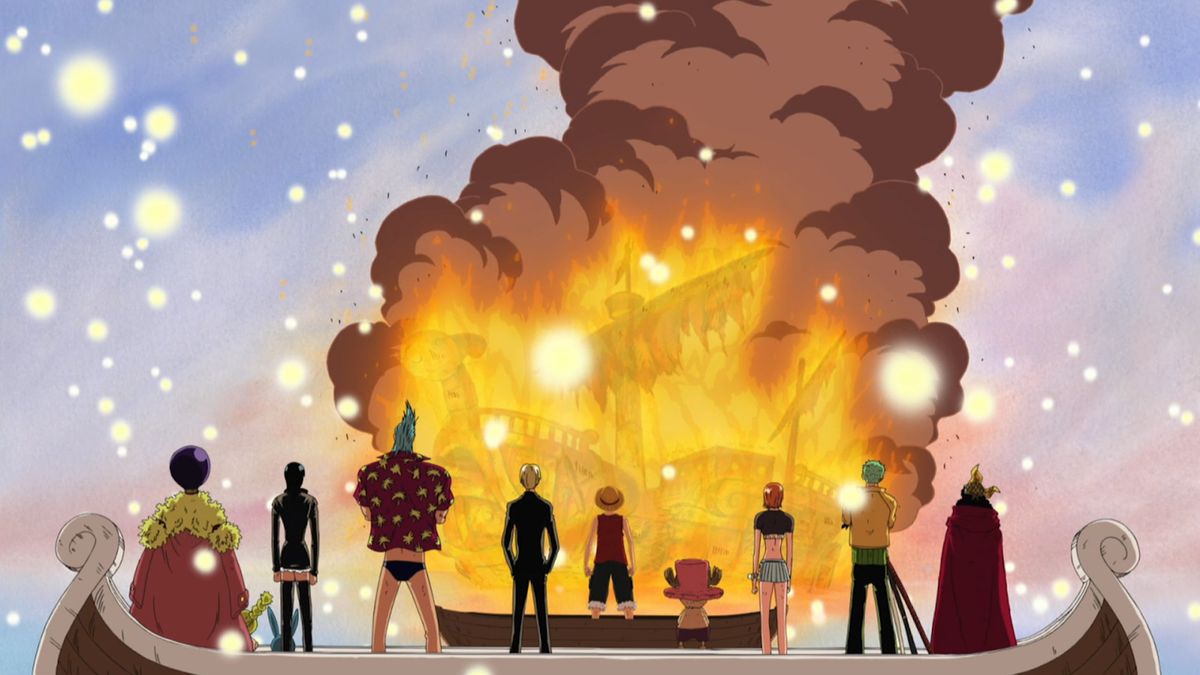
One Piece Episode 312 breaks Merry after one final rescue and gives the Straw Hats a snowy funeral for the first home that carried their dreams.
The short version
Episode 312 breaks the Going Merry in two after one final rescue and gives the Straw Hats time to say goodbye to their first home. The funeral burns because continuing to demand another voyage would turn love into refusal. Grief becomes the last care the crew can offer.
Galley-La’s arrival brings safety and truth
The rescue party reaches allies, but the relief lasts only moments. Shipwrights understand what Merry’s body has endured. Their knowledge gives language to the limit the crew can no longer postpone.
The broken keel reaches its final consequence
Water 7 did not invent a convenient argument. Merry had crossed a structural point no repair could reverse. The ship’s last journey was extraordinary, not evidence that the diagnosis was wrong.
Merry came because the crew called home
The ship traveled beyond expected capacity to reach people stranded inside impossible violence. That choice transforms the rescue from transportation into farewell action. Merry spends the final strength on family.
Luffy has to lead through letting go
Captaincy once required declaring that the crew needed another ship. Now Luffy must perform the funeral for the vessel he loved. Leadership means accepting the truth that protects everyone, even when the truth feels like betrayal.
The apology reverses who thought they failed
The crew apologizes for damage and inadequate care. Merry answers with gratitude for the adventures. The ship does not measure love by perfect maintenance. Shared life becomes the meaning of the voyage.
Snow and fire hold grief together
Flames consume the ship while white flakes soften the sea and sky. The visual refuses ugliness without denying destruction. Beauty becomes the form through which memory can remain present during loss.
RaeRae’s receipt
I do not call Merry “just a ship” because the story spent hundreds of episodes proving otherwise. Home carried them until home could not carry itself. The crew’s responsibility is to listen when that limit arrives.
Episode 312 devastates because nobody stopped loving. Love is exactly why goodbye becomes necessary.
Episode facts and receipts
Episode 312 aired June 3, 2007. ONE PIECE.com credits Ryo Suga for the script, Katsumi Tokoro for direction, Eisaku Inoue for animation direction, and Miho Shiraishi with Michiyo Kawasaki for art.
Classification: numbered manga-canon Enies Lobby television episode and RaeRae React. Anime, Anime Series, Japanese Anime, and Anime Reacts, not Anime Reviews.
The break happens after Merry completes the rescue
Merry holds together through the fleet, the whirlpool, and the final route toward Galley-La. Only after delivering the crew does the hull split. The timing makes the ship’s last journey feel intentional without erasing structural reality.
Merry spent the remaining capacity on return. The body reaches safety for everyone else and then can no longer carry itself.
That sequence is why gratitude and devastation arrive together.
Iceburg brings the authority of care and craft
He understands ships, knew Merry’s condition, and helped the vessel answer the call toward Enies Lobby. His presence during the aftermath connects emotional truth with professional knowledge.
Iceburg does not mock the crew for loving Merry or pretend another repair remains possible to soften their pain.
Compassion means telling the truth gently enough that people can act with dignity.
The keel was the boundary nobody could negotiate
Surface planks, sails, rails, and rooms can be repaired many times. A broken keel compromises the structural spine carrying every other part. Water 7 established that distinction before the crew knew how soon the final consequence would arrive.
Usopp’s patchwork showed devotion and ingenuity. The repairs could not restore the original structural future.
Love does not become false when maintenance reaches a limit.
Luffy’s funeral decision completes the captain’s Water 7 burden
He already made the painful choice to seek another ship because continuing would endanger everyone. Usopp heard abandonment where Luffy meant responsibility. Episode 312 forces Luffy to carry that responsibility through the final ritual.
Setting the ship alight looks like destruction, yet leaving Merry to collapse and sink without ceremony would deny the relationship they shared.
Leadership becomes the willingness to perform care that feels unbearable.
A Viking-style funeral gives the ship a sailor’s dignity
Fire separates Merry from ordinary wreckage. The crew does not sell usable parts, leave the hull drifting, or treat the vessel as waste after service ends. They acknowledge a companion whose body deserves an intentional goodbye.
The ceremony belongs to the sea and to the people who crossed that sea together.
Ritual creates a container for grief when no practical repair remains.
Every apology reveals a private memory
The crew remembers collisions, rough handling, inadequate maintenance, and moments when adventure demanded more than the ship should have carried. Their apologies sound specific because guilt searches for a point where loss might have been prevented.
Grieving people often inventory mistakes after the future closes.
The scene lets them speak those regrets without claiming regret caused the terminal damage.
Merry answers guilt with gratitude
The ship does not conduct an audit of broken rails or missed repairs. Merry remembers being happy. Adventures, laughter, belonging, and purpose define the shared voyage more strongly than imperfect care.
That response does not erase responsibility for maintenance. The response refuses the crew’s belief that imperfection cancelled love.
Forgiveness becomes the final gift after physical rescue.
Usopp’s grief contains the entire Water 7 argument
He recognized Merry’s personhood before most of the crew could name what they felt. Fear of losing the ship mixed with fear of becoming the next weak member left behind. The duel with Luffy turned those fears into harm.
Hearing Merry’s gratitude confirms that his love reached the ship, even though his proposed future could not work.
The farewell validates emotion without validating denial.
Luffy cries without surrendering leadership
The captain does not become stoic to prove the decision was correct. Tears reveal the cost of acting on truth. He can light the fire and still wish desperately for another answer.
That emotional openness makes his leadership stronger. The crew sees that necessity did not make Merry disposable in his heart.
Grief and responsibility occupy the same body.
The ship was the crew’s first shared home
Merry arrived through Kaya’s gratitude when the Straw Hats were still a small East Blue group. Bedrooms, kitchen, deck, mast, and figurehead held the transition from individual dreamers into a crew.
Every new member learned the group inside that space. The ship carried not only bodies but the practice of living together.
Losing Merry means losing the physical archive of their earliest family.
Memory turns ordinary voyages into farewell weight
The montage does not rely only on famous battles. Quiet travel, repairs, jokes, meals, and arguments matter because life aboard a home is built mostly from repetition.
Adventure landmarks gain emotional depth from all the unrecorded hours between them.
Episode 312 understands that grief attaches to routine as strongly as spectacle.
The snow-like ash softens without sanitizing loss
White flakes fall around orange flame, creating beauty where the crew experiences irreversible destruction. The image allows tenderness without pretending the funeral is clean or painless.
Snow often suggests silence and transition. Fire suggests transformation and finality. Their combination holds stillness around active loss.
The visual becomes iconic because opposing sensations remain unresolved.
Merry’s voice changes every earlier repair scene
Once viewers know the ship could feel gratitude and answer the crew, moments of care become conversations whose second speaker had not yet been audible. Usopp’s repairs, the Skypiea apparition, and the crew’s daily presence gain new significance.
The revelation does not require retroactively humanizing every object.
This particular ship became a crewmate through extraordinary shared attention and experience.
The farewell rejects ownership as the final relationship
If Merry were property alone, the owners could dispose of a broken asset and purchase a replacement. The funeral follows the ethics of relationship rather than inventory.
The crew acknowledges that receiving years of shelter created obligations toward the vessel at the end of service.
Gratitude changes disposal into mourning.
Letting go prevents love from becoming harm
Demanding another voyage would force Merry’s failing body to absorb the crew’s fear of change. The final act of care is accepting that the ship has already given beyond capacity.
This truth reaches beyond boats. Love cannot always keep a body functioning, and refusal to accept a limit can become cruelty dressed as devotion.
The funeral says the relationship matters enough to stop demanding proof through continued pain.
Katsumi Tokoro gives silence room to work
The direction slows after the chaos of the Buster Call. Pauses, faces, water, flame, and the ship’s voice receive space without frantic cutting. Eisaku Inoue’s animation direction keeps expressions vulnerable and the burning vessel physically present.
The episode trusts performance and accumulated history rather than forcing grief through constant explanation.
Silence becomes part of the crew’s answer.
A farewell can be a victory and a loss
Merry completed the rescue. Robin is free. Lucci is defeated. The crew escaped. Those achievements do not make the ship’s death happy, and the death does not erase what Merry accomplished.
Episode 312 refuses emotional bookkeeping where success cancels grief.
The crew survives precisely because somebody they love spent the final strength bringing them home.
The next ship will not replace this relationship
A new vessel can meet future seas, provide safer structure, and become another home. None of those possibilities turns the next ship into Merry with newer parts.
Healthy continuation allows a new bond without demanding duplication.
The Straw Hats carry memory forward rather than asking future companionship to erase the first companion.
RaeRae’s second look
Episode 312 destroys me because Merry apologizes for not carrying them farther when the crew believes they failed the ship. Everybody enters the farewell convinced love was insufficient. Merry answers that shared adventure was joy.
The ship’s body cannot continue. The relationship already changed every person standing in the snow-like ash.
Letting go is not abandonment here. Letting go is the final moment the crew listens to what Merry’s body has been saying since Water 7.
Merry’s gratitude releases the crew from impossible perfection
Every member can name a moment when the ship deserved gentler handling or better repair. Merry does not deny those mistakes. The final message places them inside a larger relationship filled with joy.
Love was imperfect and still real. That truth gives the crew permission to mourn without rewriting every adventure as damage.
The funeral creates a boundary between memory and continued demand
Keeping the broken hull nearby could look like devotion while asking the ship’s remains to perform home indefinitely. Fire marks the end clearly enough for grief to begin moving.
The boundary does not destroy memory. The boundary protects memory from becoming another demand placed on a body that has finished giving.
Usopp’s eventual return will carry Merry with him
The conflict over the ship separated him from Luffy, but the farewell gives both men a truth they can share. Merry mattered as a crewmate, and Merry could not continue sailing.
Accepting both facts creates room for an apology that does not require Usopp to betray his love or Luffy to deny responsibility.
The ship’s death completes one era without shrinking the adventure
East Blue innocence, first voyages, and the crew’s earliest form burn with Merry. The Grand Line will demand another vessel and another level of preparation.
Continuation does not make the farewell a temporary obstacle. The next era can grow because this one receives an honest ending.
RaeRae’s final receipt
Merry apologizes for reaching a limit after carrying the crew farther than anyone had a right to expect. The Straw Hats apologize for being imperfect caretakers after filling the ship with a life worth remembering. Everybody thinks they failed because everybody loved deeply.
The final answer is gratitude. Not repair. Not denial. Not replacement. Thank you for carrying us. Thank you for sailing with me. Episode 312 understands that sometimes love’s last responsible sentence is goodbye.
The final image carries Merry beyond the flames
The physical ship disappears, but every future voyage will contain habits, memories, and forms of care learned aboard that deck. Grief does not preserve the hull. Grief preserves relationship through changed people.
Merry’s journey ends. The crew’s gratitude keeps the journey from becoming disposable history.
The flames end one voyage. Gratitude carries the relationship beyond the shore.
Goodbye completes the care.