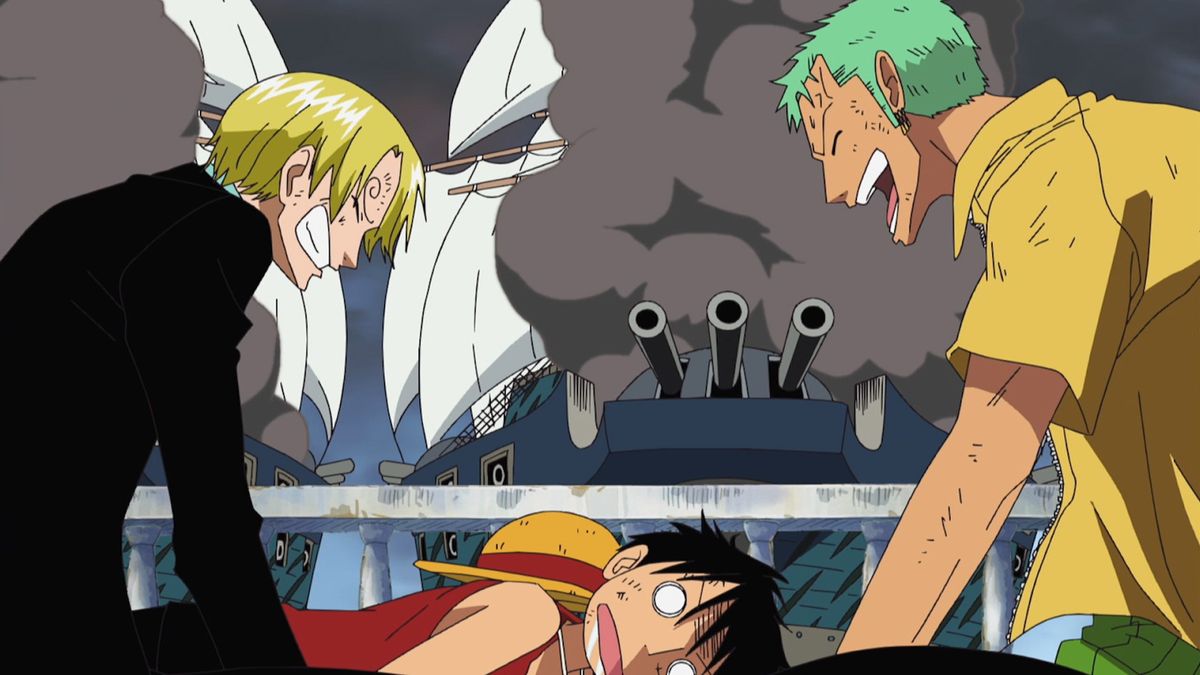
RaeRae Reacts · One Piece Episode 311
Sanji’s Gate Sabotage and Nami’s Navigation Defeat the Fleet
One Piece Episode 311 turns the closed Gates of Justice into a whirlpool and lets Nami guide Merry through a Buster Call fleet firing on itself.
The short version
Episode 311 turns Sanji’s quiet sabotage at the Gates of Justice and Nami’s navigation through the resulting whirlpool into Merry’s escape from the Buster Call fleet. The crew does not outrun overwhelming force through luck alone. Earlier planning and present expertise create the route.
Sanji’s secret move finally receives the receipt
While others fought visible battles, Sanji changed the gate mechanism. Closing the Gates of Justice alters currents and produces chaos among the warships. Support work becomes decisive after the person responsible has moved elsewhere.
The fleet’s size becomes a liability
Warships depend on formation, targeting, and navigable water. The whirlpool disrupts all three. Cannons lose clean lines and government vessels begin threatening one another.
Nami reads danger as a map
The current looks like certain death to people without her knowledge. Nami calculates the route through moving water and gives Merry a path between ships. Navigation becomes the skill that converts Sanji’s sabotage into escape.
Merry performs beyond a body already failing
The ship answers the helm and current despite damage that should have ended every voyage. The animation lets the small vessel look fragile among military giants without making fragility equal helplessness.
Teamwork operates across time
Sanji acted earlier. Nami interprets the result now. Merry carries everyone. Nobody owns the escape as a solo triumph. Decisions separated by place and time converge inside one route.
RaeRae’s receipt
Episode 311 is why I love logistical payoff. The crew escapes because somebody thought about a gate, somebody understands currents, and a beloved ship still has one impossible journey left.
Strength matters. So do timing, memory, navigation, and the work nobody applauded when performed.
Episode facts and receipts
Episode 311 aired May 27, 2007. ONE PIECE.com credits Naoki Koga for the script, Hiroyuki Sato for direction, Naoki Tate for animation direction, and Miyuki Sato with Hiromitsu Shiozaki for art.
Classification: numbered manga-canon Enies Lobby television episode and RaeRae React. Anime, Anime Series, Japanese Anime, and Anime Reacts, not Anime Reviews.
Closing the Gates of Justice changes the sea itself
The gates regulate massive currents around Enies Lobby. Sanji understands that moving them can disrupt the fleet’s stable firing geometry and create a whirlpool. He does not need to defeat every warship when the environment can make coordination collapse.
The move is strategic because Sanji acts on infrastructure rather than individual enemies. One mechanism influences every vessel depending on predictable water.
He finds the system’s pressure point and leaves the ocean to multiply the result.
Sanji’s best work happens without demanding applause
Nobody on the bridge fully understands why he disappeared when immediate combat still needed bodies. Sanji accepts that uncertainty because explaining the plan would waste time and expose the move.
The payoff arrives later, when the closed gates reshape the escape. By then, the action belongs to the whole crew’s survival rather than his personal reveal.
That willingness to solve an unseen problem is one of his strongest forms of care.
The strategy answers Sanji’s earlier advice to Usopp
Sanji told Sogeking to do what only he could do while Sanji handled the enemy better suited to his strength. Episode 311 extends the principle. Sanji performs the infrastructure task his mobility and perception allowed, then Nami performs the navigation task only she can complete.
Everybody does not need the same spotlight. The crew wins by matching people to problems.
Difference becomes coordination instead of hierarchy.
The whirlpool makes military formation unstable
Buster Call power depends on synchronized vessels maintaining distance, aim, and command. Turbulent currents rotate hulls and disrupt those relationships. Cannons that once surrounded the Straw Hats begin threatening other government ships.
The fleet’s enormous scale becomes difficult to control inside a narrow, violent flow.
Sanji does not create strength from nowhere. He converts the fleet’s density into vulnerability.
Nami sees a route where everyone else sees chaos
A whirlpool is not automatically an escape. Without reading speed, direction, vessel position, and changing current, Merry could be crushed or carried into artillery. Nami turns environmental disorder into a navigable map.
Her calculation supplies the difference between Sanji’s sabotage creating confusion and the crew actually surviving that confusion.
Strategy becomes useful only when somebody can move through the opening.
Navigation receives climax-level importance
Battle arcs often reward the person who lands the hardest hit. Episode 311 places the crew’s future inside Nami’s ability to understand water. The navigator becomes as decisive as any CP9 victor.
This is exactly what a sea adventure should remember. Punches can clear enemies, but nobody reaches the next island without someone who reads the ocean.
Nami’s expertise converts victory into continued story.
Merry trusts the navigator who learned aboard her
Nami’s relationship with the ship includes countless ordinary decisions about weather, sails, routes, and safety. Those days built knowledge of how Merry responds under pressure.
Guiding the damaged vessel through a whirlpool becomes collaboration between navigator and ship rather than a generic steering feat.
Their shared history helps Nami ask one final impossible performance from a body she understands.
The Buster Call begins firing on itself
Government violence was always indiscriminate in moral terms. The whirlpool makes that indiscrimination physically visible as targeting lines break and warships collide with their own attack pattern.
The fleet designed to erase an island cannot distinguish friend from enemy once control slips.
That reversal exposes how quickly overwhelming force becomes danger to the people operating the machinery.
Spandam’s order cannot restore authority
He demands unified bombardment as though louder command can repair a broken battlefield. The order ignores current, vessel position, and the human cost of firing through friendly lines.
Spandam’s leadership has always confused authority with competence. Episode 311 lets the sea answer.
A title can issue commands. A title cannot make reality obey bad judgment.
The small ship survives through precision
Merry cannot overpower a Buster Call vessel through size or armor. The ship survives by occupying spaces the larger fleet cannot control quickly. Nami uses agility, timing, and current rather than pretending the vessel has become a battleship.
The escape honors Merry’s actual design and limitations.
Fragility becomes compatible with agency when skill chooses the route.
Every earlier choice enters the escape
Luffy defeated Lucci. Usopp called him back up. Robin chose life. Franky freed her. Sanji changed the gates. Nami reads the current. Merry arrived. None of those actions alone would move the entire crew beyond the fleet.
Episode 311 gathers separate labor into one trajectory.
The ship racing through warships is the visual sum of an ensemble refusing isolation.
The crew cannot simply flee without looking back
Allies remain on or near the collapsing island, and Luffy has only just been recovered from his fight. Escape carries relief, concern, and incomplete knowledge about who survived.
The episode keeps those emotional debts present while the ship accelerates.
Freedom does not require forgetting everybody who made the route possible.
Merry’s performance is not proof of restored health
The ship answers the helm and survives the whirlpool, but the keel remains beyond repair. Extraordinary movement under final conditions should not be confused with recovery.
This distinction protects the next episode’s farewell from feeling arbitrary. Merry spends remaining strength on the people aboard.
The miracle has always carried a physical ending inside the miracle.
Hiroyuki Sato makes currents readable
The direction must communicate ship positions, whirlpool motion, gate consequences, and changing cannon aim while preserving emotional urgency. Hiroyuki Sato keeps cause and effect visible across a crowded sea.
Naoki Tate’s animation direction gives the water force without turning the escape into abstract effects.
Viewers can understand why the plan works, which makes cleverness more satisfying than unexplained luck.
The episode rewards thinking done before crisis peaks
Sanji cannot wait until the fleet closes every route and then search for a mechanism. He acted when opportunity appeared. Preparation creates an option the crew will need later.
That structure resembles good navigation: anticipate the weather before the wave arrives.
Episode 311 celebrates foresight alongside improvisation, showing that spontaneous courage works best when earlier thought has left a door open.
RaeRae’s second look
I love this escape because nobody punches an entire fleet into submission. Sanji changes one piece of infrastructure. Nami reads the ocean produced by that change. Merry carries the crew through the narrow answer.
The Buster Call brought scale, weapons, and official certainty. The Straw Hats brought observation, timing, trust, and a ship determined to finish one final job.
That is not luck. That is collective intelligence moving at sea.
The escape proves support actions need narrative memory
Sanji changed the gate before viewers knew exactly how the act would matter. A weaker story might forget the detail or explain success through coincidence. Episode 311 remembers.
Payoff teaches audiences to respect actions that do not produce immediate applause. Quiet planning remains part of the story’s causal structure.
Nami transforms current into shared confidence
The others do not need to understand every calculation. They need to trust the navigator’s reading and execute instructions without panic. Nami translates complex water into decisions the crew can follow.
Expertise becomes leadership when knowledge creates coordinated movement rather than private superiority.
Merry’s small size creates the possible line
The fleet’s larger hulls carry weapons and durability, but the same mass reduces responsiveness inside violent currents. Merry can enter spaces and angles the warships struggle to match.
Nami does not deny the ship’s fragility. She uses the vessel’s actual characteristics against an environment punishing bulk.
Sanji’s gate plan respects Nami’s expertise
Changing the current would be reckless without somebody capable of reading the result. Sanji acts because he trusts the crew has a navigator who can convert turbulence into a route.
The plan therefore contains collaboration before the collaborators speak. He leaves Nami a difficult ocean problem because he knows she can solve one.
The government loses control of its own symbols
The Gates of Justice were designed to direct prisoners and ships through official space. Closed at the right moment, those gates create the current disrupting the Buster Call.
Infrastructure meant to enforce government order becomes the mechanism of pirate escape. The reversal is practical and political at once.
The crew escapes through knowledge gathered across worlds
Nami’s weather sense, Water 7 shipbuilding knowledge, Sanji’s reconnaissance, and Merry’s accumulated voyages converge around the helm. No single island supplied every answer.
Adventure builds a portable archive. The crew survives new danger by carrying lessons and relationships from earlier destinations.
RaeRae’s final receipt
Episode 311 gives the fleet everything power usually trusts: numbers, cannons, command, and control of the official route. Then one closed gate, one brilliant navigator, and one dying little ship dismantle the certainty.
I love the escape because intelligence stays embodied. Sanji notices systems. Nami reads water. Merry responds. Their combined work turns an impossible sea into the road home.
The current forces the fleet to experience uncertainty
Government warships approached Enies Lobby as though scale guaranteed control. The whirlpool removes stable distance, predictable aim, and confidence in neighboring vessels. Sailors operating overwhelming weapons suddenly face an environment they cannot command.
Nami thrives inside that uncertainty because navigation never promised domination over the sea. Navigation requires attention, adjustment, and respect for forces larger than the ship.
Escape becomes the crew’s collective final attack
Jet Gatling finished Lucci, but movement through the fleet completes the rescue. Sanji’s sabotage, Nami’s calculation, Merry’s remaining strength, and everyone’s trust combine into an attack aimed at captivity itself.
The crew does not need to sink every warship. They need to deny the fleet possession of Robin and the future she chose.
The sea rewards humility rather than rank
Admirals can authorize force, captains can command formations, and cannons can destroy islands. None of those powers automatically reads a changing current better than Nami.
Episode 311 gives authority to knowledge earned through listening to weather and water. The navigator succeeds because she treats the sea as reality to understand, not property expected to obey.
The escape route is narrow because good strategy does not make danger imaginary. Nami must keep reading every shift while Merry’s structure strains and warships lose control. Success arrives through continuous attention, not one lucky turn of the helm. Navigation stays active until the fleet falls behind.
The navigator does not conquer the sea. Nami understands the moving danger well enough to lead everybody through.