RaeRae Reacts · One Piece Episode 301
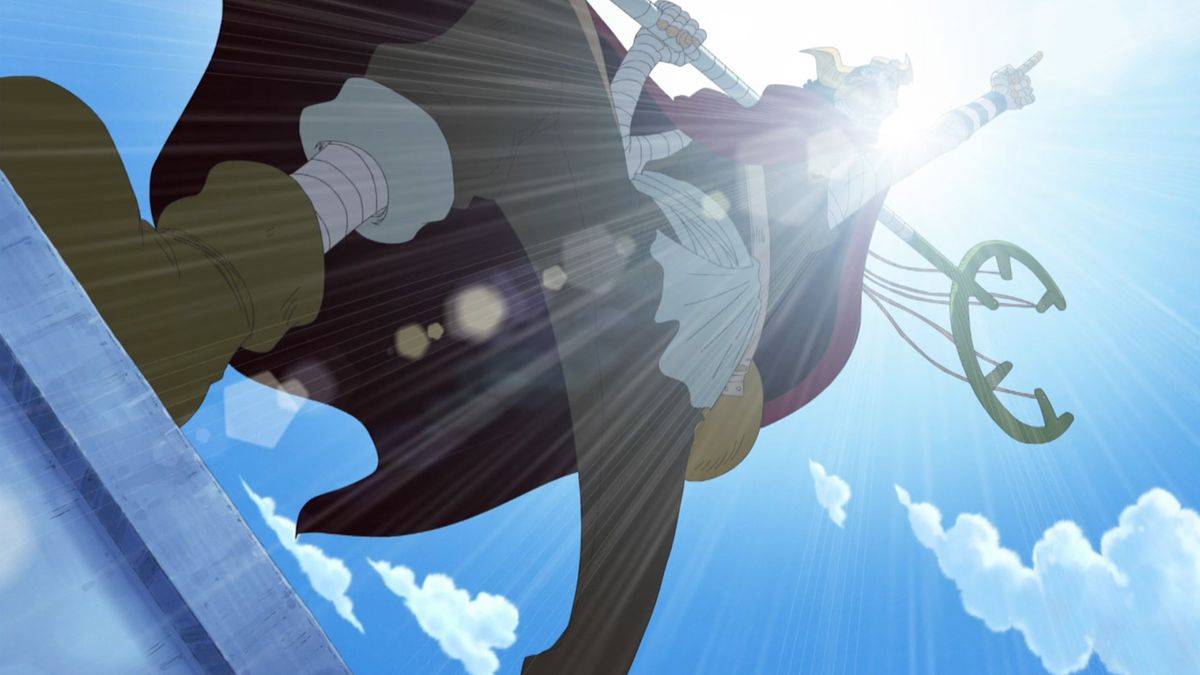
Sogeking Makes the Impossible Rescue Shot Robin Needs
One Piece Episode 301 gives Sogeking the one job no close-range powerhouse can do: stop Spandam across the impossible distance to Robin.
The short version
Episode 301 turns Sogeking into the hero Robin needs by making an impossible shot across Enies Lobby. Spandam drags Robin toward the Gates of Justice, but Usopp reaches farther than brute force can travel. The mask does not erase him. The shot reveals what Usopp has always brought to this crew.
Robin keeps resisting before rescue arrives
Robin is exhausted, injured, and physically restrained. None of that makes her passive. She fights Spandam with every scrap of movement still available because choosing life did not magically remove the system trying to take that life from her.
The episode respects the difference between wanting rescue and waiting helplessly. Robin participates in her survival even when the power balance is obscene.
Spandam mistakes possession for authority
He treats Robin’s body like proof that he has won. Every shove and insult exposes a coward borrowing institutional power. The World Government gave him a title, agents, and a route to the Gates. None of those things create courage or moral legitimacy.
Watching him panic when the shot lands is satisfying because distance had made him feel untouchable.
Sogeking solves the problem only a sniper can solve
Zoro and Sanji can defeat monsters at close range. Luffy can hold Lucci. None can cross the enormous gap quickly enough to stop Spandam. Usopp’s specialty becomes the missing answer.
That division of labor is why the Straw Hats work. Friendship does not flatten everybody into the same kind of fighter.
The Tower of Justice becomes a sniper’s stage
The visual distance matters. Enies Lobby has spent episodes making its architecture feel hostile and oversized. Usopp converts that intimidating scale into a demonstration of range, calculation, and nerve.
The shot travels across a space designed to separate prisoners from rescuers. Skill refuses the separation.
The mask creates permission without stealing the achievement
Sogeking lets Usopp act while pride and shame remain unresolved. That coping mechanism is funny, transparent, and emotionally useful. The crew mostly honors the fiction because the person beneath the mask needs a way back into relationship.
Episode 301 refuses the cheap claim that courage counts only when fear and embarrassment disappear first.
Usopp’s weapon finally receives epic framing
Kabuto does not imitate a sword or superhuman fist. The slingshot extends Usopp’s existing craft into a form capable of meeting the island’s scale. Growth comes through invention, practice, and understanding trajectory.
The result feels like evolution instead of genre-mandated replacement.
Robin recognizes the voice behind the name
The rescue does not depend on anybody believing Sogeking comes from Sniper Island. Emotional recognition travels beneath the performance. Robin hears a crewmate who came despite everything Water 7 broke open.
That knowledge makes the shot more than tactical assistance. Usopp is answering her declaration that she wants to live.
Heroism is usefulness under pressure
Usopp cannot win the arc’s largest duel. He can interrupt an execution route at the exact second everyone else is out of position. One Piece measures heroism through what a person chooses to do with the ability available.
Episode 301 gives the weakest Straw Hat a job no stronger crewmate can substitute.
RaeRae’s receipt
This is why I refuse power rankings that treat support as lesser action. Sogeking changes the rescue from impossible to possible with one accurate decision. The shot carries years of insecurity, craftsmanship, and love across the gap.
Usopp still owes the crew honesty after Water 7. Accountability remains real. So does this act of courage. Fandom can hold both truths without cheapening either.
Episode facts and receipts
Episode 301 aired March 18, 2007. ONE PIECE.com credits Ryo Suga for the script, Yoshihiro Ueda for direction, Masayuki Takagi for animation direction, and Miyuki Sato with Fumihiro Uchikawa for art.
Classification: numbered manga-canon Enies Lobby television episode and RaeRae React. Anime, Anime Series, Japanese Anime, and Anime Reacts, not Anime Reviews.
The shot answers the cruelty of distance
Spandam counts on distance as much as handcuffs. He believes the span between the Tower of Justice and Robin’s position has removed every person capable of interfering. The architecture serves his confidence. A bridge, a drop, armed guards, and the machinery of government all tell him that rescue has arrived too late.
Sogeking breaks that assumption without crossing the space. A sniper changes what distance means. The gap protecting Spandam becomes the exact condition that makes Usopp indispensable.
That reversal feels delicious because the least physically imposing Straw Hat defeats the safety calculation of the man abusing Robin.
Usopp reads wind, height, and timing under emotional pressure
The scene is not only about eyesight. Kabuto’s range demands judgment about trajectory, air, moving targets, and the instant before Spandam reaches the next threshold. Usopp has to solve all of those variables while watching a friend suffer.
Fear usually makes his thoughts loud and scattered. Here, fear sharpens attention. Courage does not silence panic; practiced skill gives panic somewhere useful to go.
The anime gives the preparation enough room for viewers to understand that accuracy is labor. The projectile lands because Usopp studied his craft, not because the plot briefly granted luck.
Kabuto carries the crew’s inventive tradition
Franky builds ships and weapons. Nami designs navigation tools. Usopp creates ammunition and mechanisms suited to enemies who outclass his body. The crew survives partly because several members solve impossible problems by making new objects.
Kabuto extends that tradition. The weapon preserves the homemade personality of a slingshot while providing the reach Enies Lobby demands. Usopp does not become brave by copying a gunman or swordsman. He becomes more fully himself.
That specificity is important. Growth should deepen a character’s identity rather than sanding everybody into the same battle template.
Spandam receives humiliation without becoming harmless
The impact throws him off balance and punctures his performance of control. I enjoy every second. Still, comedy cannot erase what he has already done to Robin or the authority he can continue directing against her.
One Piece often humiliates cruel men before defeating the systems supporting them. The laughter gives viewers release, but the episode keeps the escort route, Gates of Justice, and Buster Call active.
Spandam is pathetic and dangerous at the same time. That combination resembles plenty of institutional abusers whose personal weakness never prevents structural harm.
Robin’s survival exposes the lie in Spandam’s certainty
He has spent the arc speaking as though Robin already belongs to the government. Every act of resistance contradicts that claim. Her life cannot become his possession simply because a court, cipher agency, or inherited office declares otherwise.
Sogeking’s shot makes the contradiction public. The prisoner has allies. The route is contested. The official delivering her no longer controls the scene.
Robin’s earlier declaration keeps echoing here: wanting to live created an obligation the crew eagerly accepted. Episode 301 shows one practical form of honoring that obligation.
The rescue refuses a macho hierarchy
Sanji saved Sogeking from Jabra, and Sogeking immediately turns that survival into help for Robin. Protection circulates instead of proving which man ranks above another. Nobody’s contribution cancels the next person’s contribution.
That chain matters more than a scoreboard. Sanji’s kick, Usopp’s aim, Franky’s key run, and Luffy’s containment of Lucci all exist inside the same rescue architecture.
Healthy crew strength looks relational. People cover the gap another person cannot reach, then trust somebody else to cover theirs.
Sogeking’s song and persona change the emotional temperature
The mask, cape, and declarations are ridiculous by design. Usopp needs theatrical distance from the shame of leaving the crew. The performance lets him enter danger before he can speak plainly about returning.
Instead of mocking that coping strategy out of existence, the story lets the persona accomplish something real. Sogeking can be a joke and a bridge back toward Usopp’s truest values.
I appreciate that generosity. People sometimes need an awkward temporary identity while rebuilding a relationship they damaged.
The crew recognizes contribution before reconciliation
Water 7 raised serious questions about Usopp’s choices, insecurity, and refusal to accept Luffy’s decision about Merry. Those questions do not evaporate because the sniper performs heroically. The crew will still need an honest reckoning.
Yet withholding safety until every conflict is settled would be cruelty disguised as principle. Sanji protects him. Usopp protects Robin. Reconciliation remains unfinished while belonging continues to exert a claim.
The episode understands that accountability and care can coexist in the same hour.
Robin sees proof that nobody accepted her sacrifice
She left Water 7 believing surrender could keep the Straw Hats alive. Their presence at Enies Lobby already disproved the plan. Sogeking’s projectile adds another answer from a crewmate whose own status felt uncertain.
Even the person separated from the crew refuses to let Robin disappear. That fact makes the rescue larger than Luffy’s command. Every bond she formed has begun acting on its own.
The World Government calls her isolated. The shot maps a relationship across the sky.
Voice performance carries fear beneath the bravado
Sogeking’s heroic register never fully hides Usopp’s nerves, and that is the point. The performance gives courage shape without rewriting his emotional reality. Viewers hear the effort required to hold the pose.
Robin’s response carries a different strain. Relief has to pass through exhaustion, pain, and the disbelief of somebody trained to expect abandonment.
The vocal contrast lets a technically spectacular action remain intimate. One projectile connects two frightened people who both chose the crew again.
The production makes a slingshot feel worthy of the battlefield
Yoshihiro Ueda’s direction emphasizes scale before release. The camera establishes the distance, isolates Usopp’s position, and follows the line of action toward Spandam. Masayuki Takagi’s animation direction gives the shot clarity without burying the emotional target beneath effects.
The result does not imitate the visual language of Zoro’s Asura. Usopp receives a triumph built from stillness, aim, and sudden reach.
Different heroes deserve different rhythms. Episode 301 understands the weapon and the person using the weapon.
The episode title calls him a hero for a reason
Heroism here does not require fearlessness, public credit, or a clean personal record. Usopp stands on the Tower because leaving Robin to Spandam would violate the person he still wants to be.
The mask may receive the name, but the decision belongs to Usopp. He chooses to act while the crew conflict remains painful and while success looks statistically ridiculous.
That choice is not redemption completed. The choice is evidence that repair remains possible.
RaeRae’s second look
Episode 301 makes me emotional because Usopp’s greatest strength finally receives a problem sized exactly for him. The story does not ask him to become Luffy. The story asks him to see farther, calculate better, and care enough to release the shot.
I also love that Robin witnesses the answer. She spent decades believing association with her only brought death. Now a frightened sniper risks himself from an impossible distance because her life is worth protecting.
That is not fluff. That is character history becoming action.
Sniping becomes a form of testimony
Spandam has tried to control the story as aggressively as he controls Robin’s movement. He calls her existence criminal, her knowledge dangerous, and her surrender inevitable. Sogeking’s shot interrupts that official narrative in public. Somebody far away sees what is happening and refuses to let the abuse pass as procedure.
The projectile says Robin has witnesses. The government cannot isolate her suffering inside a corridor and call the result justice.
Range lets Usopp protect without becoming somebody else
Usopp often compares his body with monsters on his own crew and concludes that courage must look like surviving the same blows. Episode 301 gives him a better measure. His value grows from identifying the position only he can occupy.
A sniper protects through sight, preparation, and intervention before an enemy reaches close range. Usopp does not need Zoro’s endurance or Sanji’s kicks to be essential.
The victory becomes self-knowledge delivered under fire.
The next step still requires an apology
I will not use one heroic shot to erase the conflict over Merry. Usopp publicly challenged Luffy, left the crew, and allowed pride to block honest vulnerability. The eventual return must include accountability because the relationship deserves truth.
Episode 301 strengthens that future apology rather than replacing the apology. Usopp acts like a Straw Hat before he can admit how badly he wants to be one again. The deed proves love survived the rupture. Honest words will still have to meet the deed.