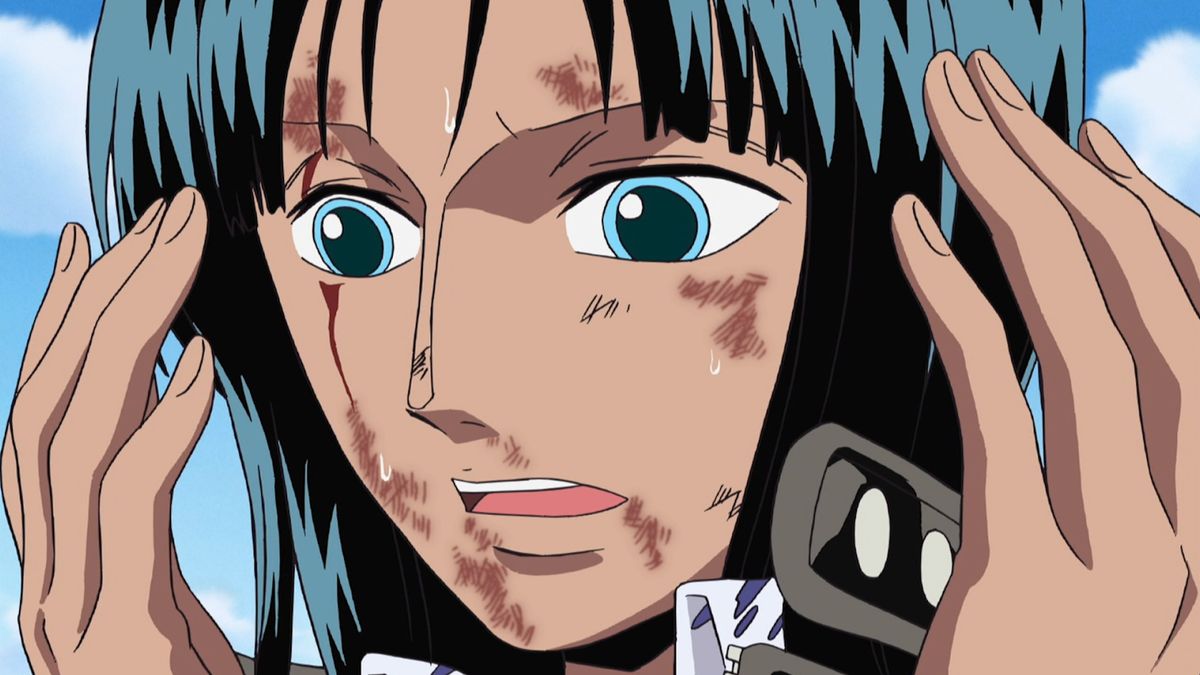
RaeRae Reacts · One Piece Episode 302
Robin’s Handcuffs Open While the Buster Call Closes In
One Piece Episode 302 lets Franky unlock Robin’s cuffs, then turns the collapsing island and Lucci fight into the crew’s next survival problem.
The short version
Episode 302 breaks Robin’s handcuffs, then refuses to pretend freedom means safety. Franky’s key works. The Buster Call tears through the judicial island. Luffy and Lucci remain locked in a fight that controls whether the crew can actually escape together.
The open cuffs change Robin’s body language
For much of Enies Lobby, chains translated government ownership into a visible object. Removing them returns physical agency to Robin. She can stand, move, and choose where her body goes without Spandam deciding every step.
The release matters because the story spent time showing the violence of restraint rather than using cuffs as decoration.
Freedom arrives through accumulated crew labor
No single Straw Hat freed Robin alone. Chopper bought time. Nami and Sanji secured keys. Zoro defeated Kaku. Sogeking stopped Spandam from reaching the Gates. Franky carried the right key to the lock.
The unlocking scene is a receipt for coordinated devotion. Every earlier fight changes the meaning of this small metal turn.
The Buster Call punishes the island indiscriminately
Government weapons do not protect the innocent architecture, employees, or soldiers gathered beneath their own flag. Once activated, the machinery values annihilation over discernment. Enies Lobby becomes evidence against the justice the institution advertised.
Robin knows this sound and scale from Ohara. Her freedom arrives inside the repetition of an old terror.
Trauma does not vanish when the lock opens
The bombardment can return Robin emotionally to childhood even while the present crew surrounds her. Survival stories become dishonest when rescue erases memory on contact. Episode 302 keeps the old wound active without denying present difference.
This time Robin is not alone, and that distinction changes what happens next.
Luffy holds the final human obstruction
Lucci represents the person most capable of chasing the crew down before escape. Luffy understands that releasing him would place everyone else back in immediate danger. The captain’s duel becomes containment as much as conquest.
Leadership looks like staying behind with the worst threat while trusting others to move Robin.
Sea water turns broken architecture into a trap
Lucci’s earlier slash opens a path for water to flood the underground route. The environment keeps changing around exhausted fighters. Escape cannot become a clean victory lap because the island itself is collapsing into the sea.
The flooding also reminds us that Devil Fruit power always carries a maritime vulnerability.
Franky’s success completes Tom’s inherited defiance
Franky opposed the government partly because Tom’s fate taught him how institutions manufacture guilt. Reaching Robin with the key lets him turn that inheritance toward somebody else condemned by the same system.
He is not merely helping Luffy. He is refusing another judicial lie.
Lucci treats obedience as identity
Unlike Spandam, Lucci possesses real courage and frightening skill. That competence makes his moral emptiness more dangerous. He uses the government’s license as permission to pursue violence while calling the result justice.
The episode draws a clean line between strength and worthiness.
RaeRae’s receipt
The handcuffs opening is one of those quiet mechanical sounds carrying an entire arc. Robin asked to live. Her crew crossed the impossible island. Now her hands are hers again.
I love the victory, but the warships will not let the audience relax. One Piece understands that liberation is an action and a continuing defense, not a single beautiful frame.
Episode facts and receipts
Episode 302 aired March 25, 2007. ONE PIECE.com credits Naoki Koga for the script, Akira Suzuki for direction, Yukari Kobayashi and Shinichi Suzuki for animation direction, and Miyuki Sato with Kunihiro Chida for art.
Classification: numbered manga-canon Enies Lobby television episode and RaeRae React. Anime, Anime Series, Japanese Anime, and Anime Reacts, not Anime Reviews.
The key is ordinary, and that makes the payoff better
Enies Lobby contains transformed assassins, superhuman techniques, warships, and impossible architecture. Robin’s freedom still depends on a small key fitting a mechanical lock. The object gathers meaning because so many people fought to move the right one into Franky’s hand.
One Piece refuses to let scale erase logistics. Rescue requires emotion, strength, information, and somebody physically reaching the cuffs.
The click feels enormous because the crew completed every link in that chain.
Franky returns choice to Robin instead of speaking for her
His job is not to decide where Robin goes after the cuffs open. He removes the restraint so she can move under her own authority. That distinction matters in an arc where Spandam constantly claims the right to define her future.
Healthy rescue restores agency. The crew wants Robin with them, but their love does not turn her into a different kind of possession.
Franky helps create the conditions for the choice Robin already voiced at the courthouse.
The Buster Call repeats Ohara’s soundscape
Artillery, collapsing stone, smoke, and official certainty return Robin to the weapon that destroyed her home. The present bombardment is not merely a larger obstacle course. Every explosion carries historical meaning for the person the crew came to save.
Trauma often enters through sensory repetition before rational thought can establish the differences. Robin can know she has allies and still feel the old terror in her body.
Episode 302 allows both realities to exist. The past is active, but the outcome is no longer predetermined.
Ohara and Enies Lobby expose the same definition of justice
Both operations destroy broadly in order to eliminate knowledge or people the government labels threatening. Civilian life, architecture, and even loyal personnel become acceptable losses once authority declares an emergency.
That pattern makes the Buster Call political rather than decorative. The weapon reveals what the institution protects when forced to choose between human life and control.
Robin survived the first answer alone. Her crew intends to force a different answer now.
Lucci weaponizes the escape route
His slash opens the underground passage to incoming seawater, creating danger beyond the direct duel. Lucci understands that defeating Luffy is not the only way to win. He can make the environment kill exhausted Devil Fruit users and trap people moving toward the bridge.
The tactic matches his worldview. Bodies are variables, and collateral suffering is useful if the mission concludes.
Luffy has to fight an opponent who thinks strategically about everyone outside the room.
Luffy’s decision to stay carries captain-level loneliness
The crew moves toward Robin while Luffy remains with Lucci. Trust makes that separation possible, but trust does not make the assignment painless. He cannot see every friend or personally confirm each escape route.
A weaker version of leadership would chase visible control. Luffy accepts incomplete information and focuses on the enemy only he can contain.
The episode turns separation into proof of connection. He stays because he believes the others will keep moving.
Robin’s freed hands do not end the rescue
Physical liberation is necessary, not sufficient. The group still needs to reach a ship, survive bombardment, cross hostile territory, and prevent Lucci from pursuing. Freedom has to be defended through the next series of choices.
That refusal of premature closure gives the unlocking scene credibility. The story celebrates without pretending one solved problem deletes the surrounding state violence.
Robin can move now. The government still wants to erase the person moving.
Sogeking, Zoro, and Sanji leap into the next danger
The fighters escaping the Tower of Justice cannot linger over their victories. Bombardment forces immediate movement toward the Bridge of Hesitation. Exhaustion becomes another obstacle the episode does not romanticize away.
Their earlier fights matter because those wins created this route, but survival requires converting victory into motion.
One Piece understands that a rescue team cannot confuse winning rooms with completing the mission.
Spandam loses control and reaches for larger violence
His personal weakness becomes more dangerous when paired with access to weapons he cannot responsibly command. Instead of acknowledging failure, he escalates. The institution gives an insecure man enough machinery to punish an entire island for his humiliation.
That is why laughing at Spandam never feels like the full answer. Removing one coward without challenging the authority protecting him would leave the weapon available to the next coward.
The Buster Call is his tantrum multiplied by bureaucracy.
The episode separates legal status from moral truth
Robin is the government’s prisoner on paper and the crew’s chosen family in practice. Enies Lobby calls the transfer lawful. Every image of abuse shows the law operating without justice.
Franky’s key does more than open metal. The action rejects the premise that official custody deserves obedience simply because officials created the rules.
The rescue becomes moral judgment delivered by people the courthouse labeled criminals.
Direction keeps simultaneous crises legible
Akira Suzuki’s direction moves between Robin’s release, the Tower escape, artillery destruction, flooding passages, and Luffy’s duel without losing the central objective. Yukari Kobayashi and Shinichi Suzuki guide animation that distinguishes intimate relief from large-scale disaster.
The episode has many moving parts, but each thread answers the same question: can the crew turn Robin’s declared will to live into actual survival?
Clarity matters because spectacle without spatial understanding would weaken the rescue.
Robin is no longer the only Ohara survivor carrying the truth
The government spent years treating her knowledge as an isolated threat. Enies Lobby creates witnesses to the institution’s cruelty and people personally invested in protecting her future. The crew cannot inherit her scholarship, but they can share the burden of keeping the scholar alive.
That social change challenges the government’s strategy. Isolation made Robin easier to hunt. Belonging creates resistance in every direction.
The cuffs open around one person, while the meaning spreads across the entire crew.
RaeRae’s second look
I refuse to reduce Episode 302 to a transition between flashier fights. Robin’s hands becoming free is the mission paying a first real dividend. The moment belongs beside the courthouse declaration because desire finally gains physical room.
The Buster Call crashing into that relief is cruel and dramatically honest. Liberation rarely arrives after danger has politely ended. People claim freedom while the system is still firing.
This time Robin hears cannons with friends beside her. That difference is the whole emotional battlefield.
The unlocking scene answers Robin’s childhood sentence
Robin spent years hearing that continued existence was a crime inherited from Ohara. Handcuffs turned that ideology into daily physical fact. When Franky opens them, the crew rejects both the metal restraint and the sentence beneath the metal.
She does not need to earn another right to live. The rescue recognizes a right the government never possessed authority to revoke.
Survivor guilt meets collective refusal
Robin surrendered because she believed the crew’s safety required her disappearance. That calculation grew from decades of watching association with her become dangerous. Enies Lobby answers with people who understand the danger and still refuse the bargain.
Their refusal does not mock her fear. Every explosion proves the fear was informed. Love becomes meaningful because the crew sees the price and chooses her anyway.
The crew turns separate victories into one route
Zoro’s key, Sanji’s key, Nami’s strategy, Chopper’s sacrifice, Sogeking’s range, and Franky’s movement converge at Robin’s wrists. No contribution functions as optional decoration. Each action removes a different layer of the government’s control.
This is ensemble storytelling with receipts. The narrative does not merely say the Straw Hats operate like family. The rescue maps how family labor moves across rooms, bodies, and specialties.
The sea becomes danger and possible escape
Floodwater threatens Devil Fruit users inside the passage, while the ocean beyond Enies Lobby remains the only road away from the government’s fortress. The same element can trap the crew or carry them toward freedom.
That tension fits the series. The sea never becomes a simple symbol. Pirates depend on water that can kill several of them, and survival requires trust in crewmates whose bodies answer the danger differently.
Relief should feel unfinished here
The cuffs opening deserves celebration, yet a clean emotional release would betray the scene around Robin. Cannons continue firing. Lucci remains active. The escape route is collapsing. Episode 302 lets viewers breathe for one second, then reminds us freedom needs a future tense.
The restraint is gone. Now the crew has to keep Robin alive long enough for choice to become a life rather than a final gesture.
Robin takes the next step with hands the government no longer controls. That movement is small, physical, and revolutionary inside a story built around denying her future.