RaeRae Reacts · One Piece Episode 300
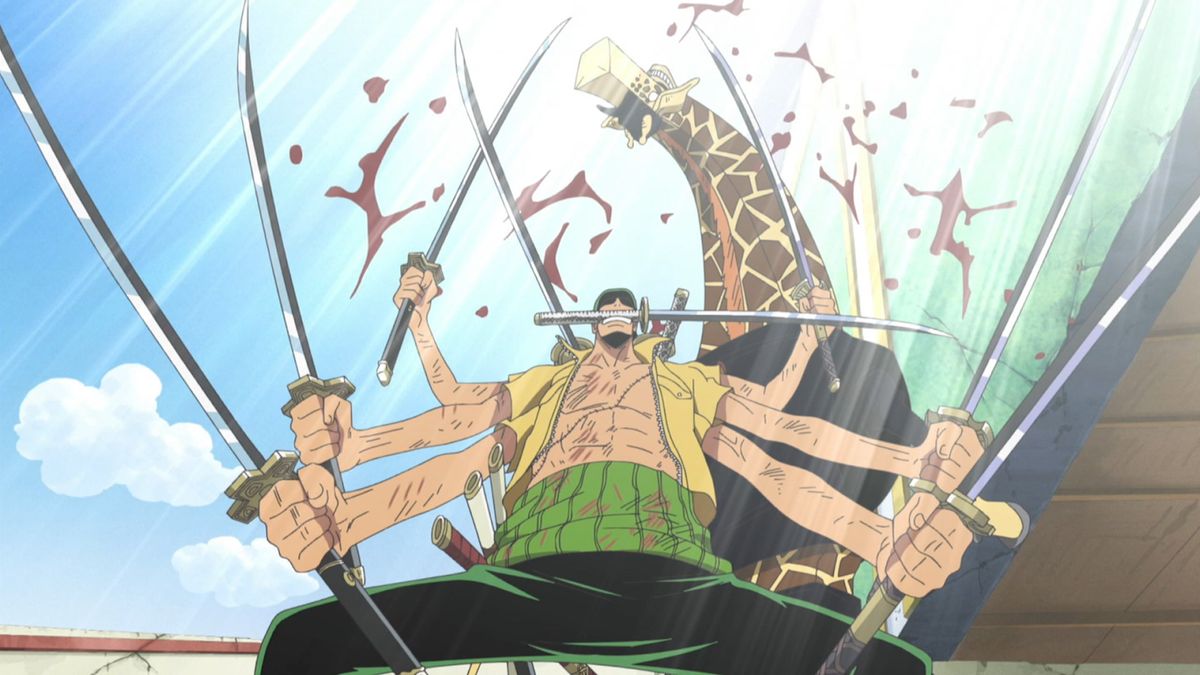
Zoro Makes Fighting Spirit Visible Through Nine-Sword Style Asura
One Piece Episode 300 turns Zoro’s presence into a three-faced, six-armed Asura image and answers Kaku’s many attack lines with nine swords.
The short version
Episode 300 gives Zoro’s fighting spirit a three-faced, six-armed image and turns the illusion into Nine-Sword Style Asura. Kaku overwhelms him with blades from hands, legs, and nose. Zoro answers by making presence feel like additional weapons.
Asura begins as perception
Zoro does not literally grow permanent limbs. Kaku perceives an overwhelming form produced by spirit and technique. The attack changes what the opponent believes is approaching.
Fighting spirit becomes visible pressure
One Piece often treats will as a force bodies can feel before systems fully explain the mechanism. Asura gives that pressure an icon.
Nine swords expand an existing identity
Zoro’s three-sword style remains the foundation. The new form multiplies rather than replaces his discipline. Growth emerges from the style he already built.
Kaku’s many attacks create the thematic answer
The giraffe body gives Kaku more striking surfaces. Zoro responds with the image of more blades. The finishing technique mirrors the problem.
Mythic imagery does not make the fight morally abstract
Zoro is not seeking transcendence for prestige. Robin needs a key, warships are coming, and the crew needs this room cleared.
Kaku’s adaptability deserves respect without absolution
He mastered unfamiliar geometry quickly. Skill remains real while serving CP9 violence. Competence and morality are separate judgments.
The hundredth-episode milestone inside the run matters
Episode 300 receives a technique designed to feel momentous. The production marks scale through imagery rather than pausing for recap celebration.
Adaptation and performance
Naoki Koga’s script and Yoko Ikeda’s direction build toward the apparition as a change in atmosphere. Takeo Ide’s animation direction gives the finishing exchange weight and clarity.
RaeRae’s final reaction
Asura works because the image expresses what Zoro has always done: make commitment feel physically larger than one body. The spectacle still owes its meaning to Robin’s rescue. Nine swords matter because one key needs to move.
Episode facts and receipts
Episode 300 aired March 11, 2007. ONE PIECE.com credits Naoki Koga, Yoko Ikeda, Takeo Ide, Miyuki Sato, and Michiyo Kawasaki.
Classification: numbered manga-canon Enies Lobby television episode and RaeRae React. Anime, Anime Series, Japanese Anime, and Anime Reacts, not Anime Reviews.
Kaku creates the need for a mythic answer
His attack volume exceeds the visual grammar of an ordinary three-sword exchange. Hands, legs, nose, neck, and transformed mass fill the room with cutting intention. Zoro needs more than another named slash.
Asura arrives as an image capable of matching the impossible scale Kaku created.
The apparition begins in the opponent’s perception
Kaku sees three faces and six arms because Zoro’s spirit changes the encounter before blades connect. The image exists through pressure, fear, technique, and interpretation.
That ambiguity is productive. One Piece allows will to have material consequence without turning every effect into a lecture.
Nine-Sword Style multiplies commitment
Zoro’s body still carries three physical blades. The Asura image makes his established discipline feel tripled. Growth does not require discarding the style that brought him here.
The technique says that practice can become presence larger than anatomy.
Demon imagery reclaims an accusation
Zoro has long been framed as frightening, cursed, or monstrous because of violence and ambition. Asura takes that fear and authors the image deliberately.
Like Robin’s demon label, meaning depends on who controls the story. Zoro uses terror against an agent enforcing captivity.
Spirit is not a substitute for technique
The apparition would mean little without years of sword discipline. Zoro still needs timing, angle, grip, and the ability to cut through Kaku’s finishing attack.
Will amplifies trained action. Will does not erase the labor that makes action possible.
Kaku’s many blades receive a mirrored response
The giraffe swordsman expanded attack lines beyond conventional anatomy. Zoro answers with the perception of additional arms and swords. The finish reflects the duel’s central problem.
Strong climaxes often solve conflict through thematic symmetry before raw output.
Asura is frightening because Zoro remains calm
He does not lose control like Monster Point Chopper. The demonic image emerges from concentration. Greater visual ferocity accompanies greater command.
The contrast distinguishes chosen intimidation from a body overtaken by emergency power.
The technique serves a key, not a throne
Zoro is not fighting Kaku to prove abstract superiority. Robin’s cuffs remain locked, the Buster Call approaches, and time is collapsing.
Nine swords become rescue labor. Spectacle gains moral direction through the person waiting beyond the room.
Kaku’s skill remains visible in defeat
He adapted to a new Devil Fruit faster than almost anyone could expect. The loss does not require pretending his creativity was fake.
Acknowledging skill sharpens judgment. Talent used to enforce state violence remains talent and remains accountable.
CP9 power ranking fails to measure conviction
Doriki can estimate physical combat ability. The number cannot calculate what Robin’s survival means to Zoro or how much pain he will absorb before abandoning the crew.
Commitment is not magic arithmetic. The fight demonstrates why institutional metrics miss decisive variables.
The Episode 300 milestone receives transformation without recap
Round-number broadcasts often invite celebration. Episode 300 marks importance through a new technique inside active story rather than stepping outside the rescue.
The choice preserves momentum. The milestone belongs to the arc instead of interrupting the arc.
Naoki Tate’s predecessor and Takeo Ide’s visual challenge
Animating Asura requires clarity across overlapping faces, arms, swords, and attack effects. The image must feel overwhelming without becoming unreadable.
Takeo Ide’s animation direction anchors the apparition in Zoro’s posture and the decisive line through Kaku’s attack.
Zoro’s voice performance keeps myth attached to character
Kazuya Nakai delivers the technique without turning Zoro into a different personality. The sound remains disciplined, severe, and focused on completion.
That continuity lets the supernatural-looking image feel like an extension of the swordsman viewers know.
The duel pays off the giraffe comedy honestly
Earlier episodes laughed at Kaku’s form. Episode 300 never apologizes for the joke and never uses the joke to invalidate danger. The final fight contains both histories.
One Piece earns absurdity by following absurd premises through serious consequences.
RaeRae’s second look
Asura works for me because Zoro does not become a generic demon power-up. His existing three-sword identity becomes so intense that Kaku perceives three times the body. The image is character before mythology.
The key remains the final receipt. If Nine-Sword Style does not help Robin, the apparition is only a poster. Enies Lobby makes the poster carry a rescue route.
Asura makes intimidation an authored image
Enemies have read Zoro as demonic since early in the journey. Episode 300 lets him control that reading. He produces the image at the moment fear can disrupt Kaku’s certainty.
Authorship distinguishes reclamation from accusation. Zoro chooses the demon form as language rather than accepting a label imposed to dehumanize him.
The illusion has material consequence because perception shapes action
Kaku must respond to what he believes he sees. A fighter’s timing, confidence, and chosen defense depend on interpretation. Changing interpretation changes the physical exchange.
The episode does not need to decide whether every arm is metaphysically present. The attack becomes real through consequence.
Nine swords answer Kaku’s abundance without copying Kaku
Kaku creates cutting force through transformed anatomy and Rokushiki. Zoro creates perceived multiplicity through spirit and sword discipline. Both increase attack lines through character-specific systems.
The symmetry preserves difference. Zoro does not need a Zoan body to answer Zoan geometry.
Asura remains controlled unlike Monster Point
Chopper’s giant form removed agency while increasing force. Zoro’s apparition intensifies agency. Focus becomes so concentrated that Kaku perceives more of him.
The comparison reminds viewers that visual monstrosity does not define whether a power is safe for the user.
Zoro’s ambition aligns with crew obligation
He wants to become the world’s greatest swordsman. Defeating Kaku develops that path. The immediate reason for fighting remains Robin’s freedom.
Personal ambition and collective care do not have to compete when skill is directed toward the crew’s survival.
The technique carries Mihawk’s lesson about resolve
Zoro’s earliest defeat taught him the distance between ambition and mastery. Every later innovation exists beneath the promise not to lose again. Asura is another answer to that humiliation.
The promise gained a crew context. Losing now would cost more than personal pride.
Kaku’s defeat tests whether professionalism excuses harm
He can be likable, funny, and sincerely interested in ships. None of those qualities frees him from responsibility for Robin’s captivity and Water 7’s betrayal.
Complex villains should not require moral fog. A person can contain appealing traits and still choose work that harms others.
The key is the final measure of the swords
Zoro’s finish becomes rescue progress only when Kaku can no longer withhold access. The key converts mythic imagery into a practical result.
Nine-Sword Style may dominate memory. A small metal object carries the mission forward.
Episode 300 looks backward and forward at once
The milestone celebrates how far Zoro’s technique has traveled from ordinary three-sword combat. The new form also opens questions the series will continue exploring about will, aura, and perception.
Good milestone storytelling rewards history without becoming trapped in summary.
The Asura name draws on a conflict-filled figure
Asura imagery evokes beings associated with battle, pride, and relentless struggle. The reference matches Zoro’s frightening commitment without requiring a literal religious identity.
Myth becomes shorthand for the emotional force Kaku experiences in front of him.
Animation gives multiplicity a central silhouette
Several faces, arms, swords, and attack effects could scatter attention. The sequence anchors the viewer in Zoro’s forward intent. Multiplicity radiates from a single decision.
That composition keeps the image readable enough to become iconic rather than merely busy.
The final attack is brief because preparation carried the weight
Episodes of pressure, handcuffs, improvised Sogeking swordplay, and Kaku’s experimentation built the conflict. The finishing exchange can move quickly because meaning already accumulated.
Length does not determine payoff. Context supplies mass.
RaeRae’s third look
Asura lands because Zoro looks impossible without becoming unrecognizable. The discipline, severity, ambition, and loyalty remain his. The image amplifies a person the story already built.
I keep returning to the key. Zoro’s spirit becomes nine swords, but the victory matters because Robin needs one lock opened. That practical destination keeps myth from floating away.
Asura is terrifying because discipline created the vision
The nine-sword image does not arrive as random supernatural decoration. Zoro’s concentration, pain tolerance, and murderous resolve become so intense that Kaku perceives more warrior than one body should contain. The scene makes inner force visible without separating that force from years of practice.
That balance preserves the character. Zoro looks mythic, yet the moment still belongs to the swordsman who trains, fails, bleeds, and tries again.
Episode 300 earns a milestone instead of announcing one
A round episode number can invite empty celebration. This chapter of the anime earns the marker by resolving a major Enies Lobby duel and revealing a technique viewers would remember for years. The milestone lives inside story consequence rather than pausing the story for ceremony.
Kaku falls, a key changes hands, and Robin’s rescue becomes more possible. Spectacle carries weight because the plot ledger moves with the animation.
Zoro’s promise still governs the impossible image
Long before Asura, Zoro promised that defeat would not casually separate him from the ambition he declared to Luffy. Nine-Sword Style feels like another expression of that vow. When ordinary capacity reaches a wall, commitment searches for a shape beyond ordinary capacity.
The anime does not need to explain every metaphysical detail for the emotional logic to read clearly. Loyalty and ambition are pressing through the frame together.
Kaku’s disbelief completes the visual idea
Asura needs a witness. Kaku’s shock tells us the technique has crossed from difficult swordsmanship into an experience his usual confidence cannot neatly classify. His perception becomes part of the attack’s meaning.
The reaction also pays off Kaku’s earlier playfulness. A fighter who kept treating transformation as a laboratory suddenly confronts an opponent whose will refuses to fit ordinary measurement.
The victory belongs to the rescue chain
Sanji defeated Jabra, Zoro defeats Kaku, Franky moves toward Robin, and Luffy contains Lucci. No single victory finishes Enies Lobby. Each person removes one obstruction so somebody else can reach the next door.
That chain is the Straw Hats at their best. Individual signature moves remain exciting, but cooperation gives those moves moral direction. Episode 300 closes a duel while strengthening the larger promise: Robin will not be abandoned to the World Government’s machinery.
Asura is the image everyone remembers. The shared rescue is the reason the image matters.