RaeRae Reacts · One Piece Episode 295
Nami Makes Rain, Multiplies Herself, and Breaks Kalifa’s Control
One Piece Episode 295 uses water and Mirage Tempo to reverse Kalifa’s soap trap and show why Nami’s environmental intelligence cannot be power-ranked away.
The short version
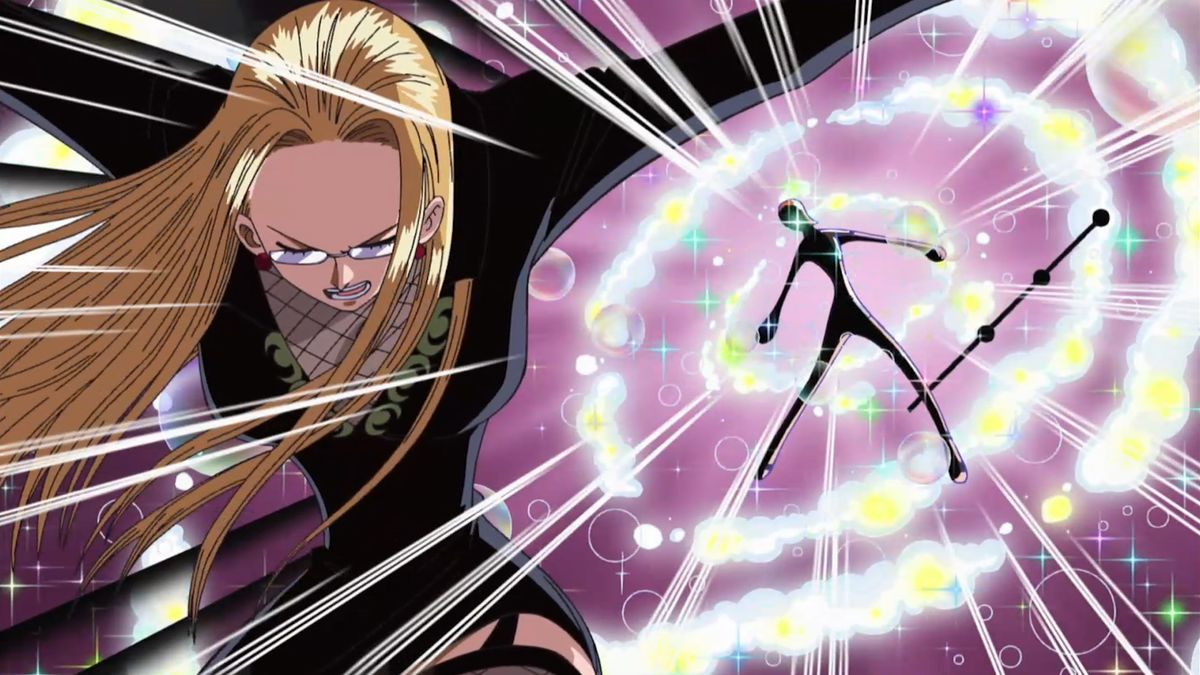
Episode 295 lets Nami solve Kalifa’s soap power with water, then turns mirage into a weapon against an agent who trusted polished surfaces. Monster Point exposes the bubbles’ weakness. Rain Tempo restores Nami’s body, and Mirage Tempo multiplies the target Kalifa must read.
Water returns function, not beauty
Nami does not counter the soap by becoming prettier. She removes the imposed condition and restores strength. Recovery means regaining agency.
Monster Chopper provides information without intention
His uncontrolled movement introduces water and reveals the weakness. Even without conscious strategy, his presence changes the fight. The help arrives with danger attached.
Nami turns weather knowledge into resistance
Rain Tempo is a technical answer built from observation. She recognizes the material rule, tests the counter, and changes the room’s conditions.
Five Namis punish visual certainty
Kalifa depends on sight and control. Mirage Tempo produces multiple plausible bodies. The agent must interpret atmosphere instead of trusting one polished image.
Illusion is not dishonesty when power rigged the room
Nami’s mirages protect a body Kalifa already altered without consent. Deception restores tactical choice against institutional violence.
The fight validates nontraditional combat intelligence
No Doriki score would capture meteorology, refraction, timing, and emotional composure. Nami’s value exists outside CP9’s ranking system.
Robin’s key remains the objective
Kalifa’s defeat matters because the crew needs the handcuff key. The finishing attack is part of a rescue route, not an isolated showcase.
Adaptation and performance
Ryo Suga’s script and Yoshihiro Ueda’s direction stage discovery before reversal. Noboru Koizumi’s animation direction gives the mirage doubles distinct placement while preserving the puzzle.
RaeRae’s final reaction
Episode 295 belongs to Nami because she refuses Kalifa’s definition of the battlefield. She makes rain inside a controlled room, restores her own body, and multiplies the image the agent thought she could manage.
Episode facts and receipts
One Piece Episode 295 aired in Japan on January 28, 2007. ONE PIECE.com credits Ryo Suga, Yoshihiro Ueda, Noboru Koizumi, Miyuki Sato, and Kunihiro Chida.
Classification: numbered manga-canon Enies Lobby television episode and RaeRae React. Anime, Anime Series, Japanese Anime, and Anime Reacts, not Anime Reviews.
Nami finds the weakness because she watches consequences
Monster Chopper’s uncontrolled movement brings water into contact with Kalifa’s bubbles. Nami notices the change. Discovery belongs to the person who interprets the event, not only the person whose body created the clue.
Observation converts accident into knowledge. Without Nami’s attention, water remains background chaos.
Rain Tempo restores a stolen body
Kalifa’s soap imposed smoothness and weakness. Rain removes the condition. Nami does not receive a new body or external rescue. She recovers familiar movement through environmental understanding.
That distinction makes the counter feel personal. Weather knowledge returns ownership over flesh another agent tried to manage.
Water undermines the fantasy of perfect cleansing
Soap requires water to spread, rinse, and disappear. Kalifa treats bubbles as a permanent mark of control, then ordinary water exposes the power’s dependence. The cleansing agent can itself be washed away.
Power often presents temporary conditions as natural order. Nami changes one variable and reveals contingency.
Mirage Tempo weaponizes the room’s atmosphere
Nami creates doubles through temperature and refraction rather than mystical cloning. The technique depends on understanding how light travels through altered air. A scientific principle becomes tactical misdirection.
Kalifa controlled surfaces. Nami controls perception between surfaces. The battlefield expands into the space eyes take for granted.
Five images do not divide Nami’s agency
The mirages create multiple targets without producing multiple people. Nami remains the author of every false position. Multiplication protects a single vulnerable body.
The image also refuses Kalifa’s attempt to define what Nami should look like. Nami floods the room with versions Kalifa cannot classify fast enough.
Deception answers an unequal fight
CP9 already used disguise, infiltration, secret law, and hidden information to capture Robin. Complaining about Nami’s mirages would require pretending the contest began under fair rules.
Tactical deception can restore balance when authority monopolizes force. The ethical question concerns purpose and target, not abstract purity.
Kalifa’s confidence becomes a sensory weakness
She believes the room, fruit, and Rokushiki training guarantee control. Confidence narrows attention. Once water removes the expected effect, she must process a battlefield her assumptions cannot explain.
Nami’s counterattack works because strategy attacks interpretation before the body.
Weather knowledge cannot be reduced to support
Navigation is often treated as useful only aboard the ship. Episode 295 shows the same expertise operating indoors. Humidity, temperature, electricity, and light remain weather materials inside stone walls.
Nami brings her profession into combat. The technique is not a departure from navigation but an extension of environmental reading.
Usopp’s invention becomes Nami’s language
The Clima-Tact began as another improbable Usopp device. Nami studies the tool until performance reflects her own precision. Collaborative technology does not erase authorship at either end.
The weapon carries crew connection into a room where she fights alone. Usopp’s construction and Nami’s knowledge meet inside every mirage.
Monster Chopper links separate battles
The tower’s walls cannot keep consequences contained. Chopper’s loss of control changes Nami’s fight by revealing water. Nami’s eventual victory will produce a key another room needs.
The crew operates as a network even without deliberate coordination. Harm and help circulate together.
Kalifa’s defeat must include the key
A finishing strike without retrieval would satisfy spectacle and fail the rescue. Nami keeps the objective visible. Robin’s freedom depends on what the defeated agent carries.
The episode measures victory through access. Power matters because power opens a route.
Thunder Lance concentrates the storm
Nami’s lightning no longer functions as an uncontrolled area effect. Knowledge focuses charge toward a selected target. Precision makes the attack more than greater voltage.
The move answers a story that repeatedly underestimates her direct combat role. Intelligence produces force without imitating the crew’s strongest bodies.
The animation gives uncertainty a readable shape
Mirage sequences require viewers to share Kalifa’s uncertainty without losing the logic completely. Distinct placement and reaction timing allow the audience to study possibilities alongside the agent.
Noboru Koizumi’s animation direction treats visual clarity as part of Nami’s tactical victory.
RaeRae’s second look
Episode 295 gives Nami a problem built from beauty, coercion, and lost bodily control. She answers with rain and refraction. That choice feels exactly right for a navigator who survived by learning systems better than the people using those systems against her.
I do not need a brute-force transformation for Nami. I need the room to discover that weather was already inside the walls.
Nami’s method begins with refusing repetition
Thunderbolt Tempo failed against the bubble barrier. Repeating the same attack with greater desperation would reward Kalifa’s control. Nami changes the question from “How much lightning?” to “What condition makes the bubbles fail?”
That shift is the heart of strategy. Strength pushes harder inside existing rules. Intelligence looks for the rule that can be changed.
Rain Tempo is both cure and experiment
Nami uses water to wash away the imposed smoothness and tests whether the same counter affects Kalifa’s wider field. Treatment and research happen at once because the rescue offers no protected interval.
The decision carries risk. If the theory fails, Nami exposes another technique and loses more time. Confidence rests on observation rather than certainty.
The Clima-Tact transforms invisible systems into visible action
Temperature gradients, moisture, electrical charge, and refraction usually remain unseen. Nami makes those relationships legible through clouds, rain, mirages, and lightning. The weapon translates professional knowledge into spectacle.
That translation helps audiences value navigation beyond steering. Weather expertise becomes a complete combat language without ceasing to be weather expertise.
Mirage Tempo challenges Kalifa’s surveillance training
CP9 agents rely on observation, infiltration, and rapid identification of threats. Five apparent Namis overload that confidence. The skill designed to read a room becomes vulnerable when the room produces contradictory evidence.
Nami wins time by making certainty expensive. Kalifa must test possibilities while the navigator already knows which body carries intent.
The doubles reclaim visual objectification
Kalifa’s soap reduced Nami to a changed surface. Mirage Tempo floods the scene with surfaces Nami controls. The target of visual domination becomes the author of vision.
The reversal does not remove the episode’s fan-service framing. Nami still turns that framing into tactical authorship, which deserves recognition alongside critique.
Water makes Kalifa’s power relational
No Devil Fruit ability exists as absolute force. Environment, material, user experience, and opponent knowledge shape effectiveness. Water does not make Kalifa weak in every context. Water changes the specific relationship between bubbles and target.
That nuance keeps the counter from feeling like arbitrary immunity. Nami discovers a physical interaction and builds a sequence around the interaction.
Nami’s history with coercive contracts informs the fight
Arlong promised village freedom under terms he never intended to honor. Kalifa served a government where procedure similarly disguises predetermined outcomes. Nami knows rules can be technically stated and morally fraudulent.
Her combat style refuses passive obedience to the system presented. She reads the fine print written in air and water.
Monster Chopper’s accidental help carries no clean gratitude
The uncontrolled form reveals water and creates an opening, but Chopper is suffering. Nami cannot celebrate the clue as though a teammate volunteered stable assistance. Help and emergency arrive in the same body.
That emotional complexity prepares Episode 296. The victory over Kalifa immediately creates responsibility toward Chopper.
Kalifa underestimated adaptation, not femininity
The loss should not be reduced to vanity between women. Kalifa trusted a new power, elite training, and environmental control. Nami changed faster after discovering the rule.
The meaningful contest concerns learning under pressure. Nami’s advantage is a lifetime of reading systems capable of killing a crew when misunderstood.
The finishing move pays off layered preparation
Thunder Lance Tempo works because water restored Nami, mirages disrupted Kalifa, and observation produced a clear opening. The lightning is the final line of a longer proof.
Focusing only on the impact would erase the labor making impact possible. Nami’s fight is cumulative reasoning.
Key Number Two transforms private victory into crew progress
The key leaves Kalifa’s possession and enters the network searching for Robin’s freedom. Nami’s individual battle changes what everyone else can do.
Ensemble storytelling works when victories circulate. A navigator on one floor can alter a swordsman’s handcuff problem and an archaeologist’s future elsewhere.
RaeRae’s receipt on five Namis
I love Mirage Tempo because the technique does not ask Nami to become a different kind of fighter. She wins by becoming more precisely herself: navigator, observer, survivor, inventor’s collaborator, and woman who refuses another polished cage.
Five images appear because one Nami understands the room better than Kalifa. Multiplication is theater. Knowledge is the weapon.
Nami defeats the expectation that specialists stay in one lane
A navigator is expected to guide ships, a fighter to defeat agents, and a strategist to interpret information. Nami performs all three functions because real expertise travels. Weather knowledge does not stop being relevant when she leaves the deck.
The crew survives because members refuse narrow job descriptions during emergencies. Nami can preserve professional identity while applying that identity to an unfamiliar room.
Mirage Tempo makes uncertainty protective
CP9 used uncertainty to scatter five keys and force the crew into every fight. Nami returns uncertainty to the institution through five images. Kalifa must spend attention determining which body is real.
The symmetry matters. Information control stops belonging exclusively to the captor. Nami manufactures enough ambiguity to recover action.
RaeRae’s final weather note
Rain does not arrive as atmosphere around the fight. Rain is the argument. Water removes Kalifa’s imposed condition, proves the glossy body was never permanent, and gives Nami enough freedom to build the mirage sequence.
The navigator does not overpower the room. She changes the forecast.
Kalifa loses control of the image
At the fight’s opening, Kalifa decided how Nami’s body would appear and function. By the end, Kalifa cannot determine which visible Nami is real. Control of the image has changed hands.
The reversal is satisfying because strategy answers the original harm. Nami does not merely hit harder. She makes imposed appearance unreliable as a tool of domination.
The navigator retrieves more than a key
Nami recovers bodily function, tactical authorship, and a material route toward Robin. Those victories are connected. A person denied control of her own body could not continue freeing someone else’s.
Episode 295 understands liberation as layered work. Rain, mirage, lightning, and the key each remove a different constraint.