RaeRae Reacts · One Piece Episode 294
Spandam’s Mistake Gives Institutional Incompetence an Island-Killing Button
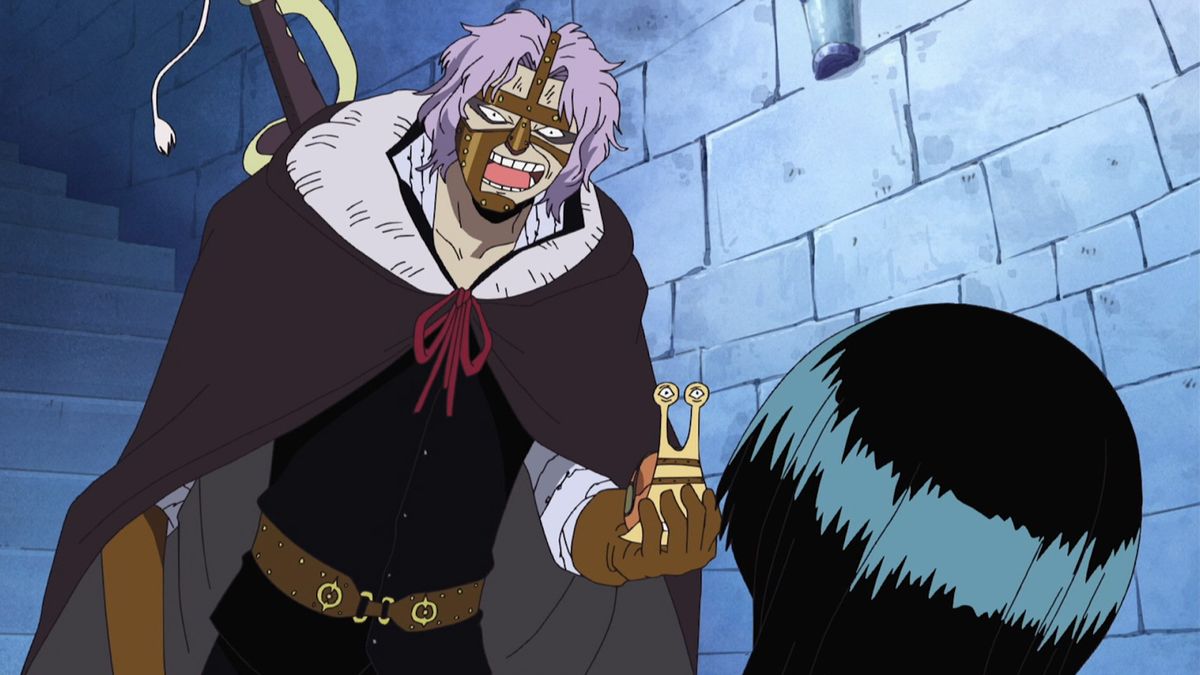
One Piece Episode 294 lets Spandam accidentally activate the Buster Call while Luffy’s voice finally reaches Robin through the underground passage.
The short version
Episode 294 lets Spandam trigger a Buster Call by mistake, proving catastrophic authority can sit in incompetent hands. Luffy’s voice reaches Robin through the underground passage. Spandam panics, presses the Golden Den Den Mushi instead of contacting CP9, and summons the same annihilation force that destroyed Ohara.
The mistake does not reduce responsibility
Spandam did not intend to press the button at that second. He accepted custody of a device capable of erasing an island. Negligence beside catastrophic power remains culpable.
Institutional design made one coward dangerous
The Buster Call depends on fleets, orders, weapons, and officers willing to execute the signal. Spandam’s thumb starts the process, but a whole structure converts error into mass violence.
Ohara enters Robin’s present again
The sound does not announce an abstract attack. Robin knows the ships, fire, screams, and disappearing home attached to the signal. Trauma becomes a forecast.
Luffy’s voice contests isolation
Spandam tries to make Robin believe resistance is over. Luffy reaches her through architecture designed to separate them. Sound carries relationship where bodies have not yet arrived.
A golden device launders horror through prestige
The trigger looks ceremonial and rare. Gold turns destructive access into a mark of status. The object makes atrocity resemble official privilege.
CP9 receives an order nobody voted to survive
Agents stationed on Enies Lobby now face the consequences of leadership failure. Serving the institution never guaranteed protection from the institution.
The episode widens the rescue
Saving Robin now requires escaping a fleet and protecting everyone still on the island. One mistaken press expands individual captivity into collective catastrophe.
Adaptation and performance
Naoki Koga’s script and Hiroyuki Kakudo’s direction let the trigger land through recognition. Masayuki Takagi’s animation direction gives panic physical clarity while the alarm expands beyond the room.
RaeRae’s final reaction
Episode 294 is why “just one bad official” never satisfies me. Spandam is uniquely pathetic. The system gave his panic an island-killing button and prepared thousands of people to obey the result.
Episode facts and receipts
One Piece Episode 294 aired in Japan on January 21, 2007. ONE PIECE.com credits Naoki Koga, Hiroyuki Kakudo, Masayuki Takagi, Miyuki Sato, and Michiyo Kawasaki.
Classification: numbered manga-canon Enies Lobby television episode and RaeRae React. Anime, Anime Series, Japanese Anime, and Anime Reacts, not Anime Reviews.
Spandam is not an exception the institution failed to anticipate
He gained authority through family connection, political maneuvering, and willingness to direct cruelty while stronger people carried out orders. The government did not accidentally discover his incompetence after granting access. His history was available.
Promoting him communicates institutional priorities. Loyalty upward, aggression downward, and usefulness in manufacturing charges mattered more than judgment. The Buster Call mistake is a predictable result of the selection system.
The Golden Den Den Mushi concentrates irreversible power
A single press sends an authorization signal to Marine Headquarters. The device offers no meaningful deliberation, victim hearing, local consent, or visible safeguard in the moment. Catastrophe is easier to initiate than to stop.
Design carries politics. An interface that makes mass force immediate assumes the authorized caller deserves extraordinary trust. Spandam proves the assumption false, but fleets are already moving by the time proof arrives.
Accident and accountability can coexist
Spandam did not wake that morning planning to destroy Enies Lobby. He knowingly carried the trigger, displayed the privilege, and handled the device during panic. Intent affects the charge. Intent does not resurrect anyone a fleet may kill.
Power requires a duty proportionate to possible harm. The greater the consequence, the less acceptable casual handling becomes. Calling the activation an accident cannot close the moral ledger.
The Buster Call is collective action disguised as one button
Warships require crews, ammunition, navigators, communication officers, commanding vice admirals, supply chains, and doctrine. Thousands of individual actions transform the signal into bombardment. The button hides that labor.
Systems prefer a simple origin story because responsibility becomes easier to isolate. Blaming Spandam alone would allow every obedient participant to disappear from analysis.
Following orders does not erase agency
Marines receiving the signal operate inside a hierarchy with punishment for refusal. That pressure matters. The people firing cannons still participate in consequences. Institutional coercion complicates responsibility without making bodies on the island less dead.
One Piece repeatedly asks whether justice exists when obedience replaces judgment. The Buster Call answers through scale: standardized compliance can commit violence no single coward could perform alone.
Robin hears history preparing to repeat
Ohara taught her what the signal means before most people on Enies Lobby understand. She remembers scholars, homes, books, fire, Saul, and the government narrative that followed. The present alarm reopens an event that never became past.
Trauma includes recognition without control. Robin knows the pattern and cannot stop the machinery while cuffed. Knowledge becomes another burden until allies respond.
Luffy’s voice gives Robin a competing forecast
Spandam’s signal predicts annihilation. Luffy’s call predicts arrival. Robin hears two futures at once: the institution repeating Ohara and the crew refusing to let repetition finish.
Sound matters because Luffy has not reached her body. Voice crosses the remaining architecture first. Relationship becomes evidence before rescue becomes physical.
Spandam panics because personal authority feels threatened
Luffy’s approach destroys the illusion that Robin is securely processed. Spandam reaches for communication because he depends on agents to defend authority he cannot defend himself. Panic exposes borrowed power.
The wrong press magnifies that dependence. A weak leader controls stronger subordinates and a stronger weapon. None of the power reflects personal capacity, which makes emotional instability more dangerous.
Enies Lobby becomes expendable to its own government
The island presents itself as a permanent monument to justice. The Buster Call reveals that buildings, workers, agents, prisoners, and symbolic authority can all be sacrificed when central command accepts the signal.
Institutions often promise protection to insiders while reserving the right to classify them as acceptable losses. CP9 served the government for years. That service does not place the agents outside the bombardment zone.
Oimo, Kashii, Galley-La, and the Franky Family inherit the threat
The rescue coalition includes people with different reasons for entering Enies Lobby. Spandam’s mistake collapses those differences into shared exposure. A fleet will not sort moral histories before firing.
Collective punishment treats presence as guilt. The Buster Call makes government categories meaningless at the moment their violence becomes largest.
A warning system can become a weapon against the warned
Alarms supposedly communicate danger so people can respond. This signal does not primarily warn residents. The call authorizes forces elsewhere to create danger. Communication flows toward weapons rather than potential victims.
That structure keeps local people powerless. They learn what happened after remote command has already received permission to act.
The episode changes every victory condition
Defeating CP9 and unlocking Robin are no longer enough. The crew needs an exit route capable of surviving warships, blocked gates, injured allies, and collapsing infrastructure. Time shrinks while the number of people needing evacuation grows.
Good escalation changes strategy rather than only adding a larger enemy. Episode 294 turns a tower rescue into an island evacuation without erasing the key hunt.
Comedy around Spandam must not soften the consequence
His mistake is absurd because the most dangerous man in the room is physically pathetic and administratively foolish. The comedy attacks his claim to authority. Laughter should travel upward toward power.
The danger arrives when comedy lets viewers treat the Buster Call as a gag. Robin’s reaction restores the cost. For her, the button has always been fire.
The production uses repetition as horror
Visual and sonic references to Ohara allow the audience to recognize the threat through Robin’s memory. The story does not need warships to begin firing before dread arrives. A familiar signal carries twenty years of consequence.
Hiroyuki Kakudo’s direction lets alarm, voice, and reaction connect separate spaces. The tower, underground passage, Marine Headquarters, and Robin’s past become one causal chain.
RaeRae’s second look
I cannot reduce Episode 294 to “Spandam pressed the wrong button.” A government put an island-killing device in his hand, built a fleet ready to obey, and created a doctrine that treats annihilation as legitimate procedure. The thumb is one receipt in a much larger transaction.
Luffy’s voice matters because somebody must interrupt inevitability. Robin knows exactly what state power can erase. The crew answers with the one thing Ohara could not receive in time: people already inside the machine, shouting that she is not alone.
The Buster Call turns paperwork into artillery
Before the signal, Robin’s destruction is processed through charges, custody, and transfer. After the signal, the same institutional judgment becomes cannon fire. Bureaucracy and violence are not separate phases. One authorizes the other.
Paperwork creates distance between decision and consequence. The Golden Den Den Mushi collapses that distance into one press while preserving the language of official procedure.
Catastrophic systems require friction
Responsible design would require verification, authentication, confirmation, and a clear path to cancel an accidental signal. Episode 294 presents almost none of that friction. Speed receives priority over safety.
The design assumes hesitation is more dangerous than wrongful destruction. That assumption reveals whose lives the government considers expendable.
Spandam’s privilege includes freedom from competence
People below him must master Rokushiki, infiltration, intelligence, and lethal discipline. Spandam can mishandle an apocalyptic device and still expect subordinates to repair the outcome. Hierarchy protects failure at the top.
CP9’s merit language therefore operates downward only. Strong agents compete for rank while inherited connection determines who holds the button.
Robin’s memory supplies the human count hidden by doctrine
“Buster Call” sounds technical and clean. Robin remembers individual scholars, Saul’s laughter, her mother’s face, burning books, and the boat that did not save everyone. Memory returns names to an institutional phrase designed to remove them.
Her terror is evidence. The government calls Ohara a completed operation. Robin’s body records an unfinished crime.
Luffy does not answer trauma with an argument
He cannot persuade Robin that the fleet is harmless. He answers by continuing toward her. Action offers a new outcome without denying the old one.
That response respects the reality of fear more than empty reassurance. Robin has every reason to believe the pattern. Luffy creates another reason while walls still separate them.
The government will call its own destruction necessary
If Enies Lobby burns, official narratives can blame pirates, emergency conditions, or the unavoidable cost of justice. Institutions capable of violence often control the first archive explaining the violence.
Robin’s survival threatens that control because she carries memory the government failed to erase. Saving her preserves a witness as well as a friend.
The signal makes evacuation a political act
Leaving the island rejects the state’s authority to classify everyone present as acceptable loss. Giants, shipwrights, criminals, agents, and civilians share the right to survive regardless of government categories.
Rescue expands beyond affiliation. A bombardment cannot become just because some targets broke laws written by the people firing.
RaeRae’s receipt on accidental atrocity
I refuse the comforting story that one foolish man caused everything. Spandam pressed the trigger. The World Government manufactured the trigger, selected the holder, trained the fleet, normalized the doctrine, and prepared officers to act without seeing the island’s people.
Episode 294 is frightening because the system works exactly as designed after the error. Reliability becomes horrifying when the reliable outcome is annihilation.
The Buster Call exposes the lie of controlled force
The government describes overwhelming violence as a tool reserved for exceptional threats. Spandam demonstrates that exceptional authorization can be attached to ordinary panic. A doctrine advertised as precise becomes indiscriminate as soon as one unqualified holder makes one mistake.
Control was always partly theater. The fleet can coordinate fire with military precision while possessing no precise moral knowledge about the people below. Technical accuracy does not create justice.
Robin remains the expert witness
Everyone hears an alarm. Robin hears Ohara. Her response should guide the emotional scale because she understands what the euphemism contains.
The final institutional receipt
Spandam created the immediate error. The government created every condition that allowed the error to become policy at fleet scale. Responsibility expands rather than transfers.
The alarm makes that responsibility impossible to hide.