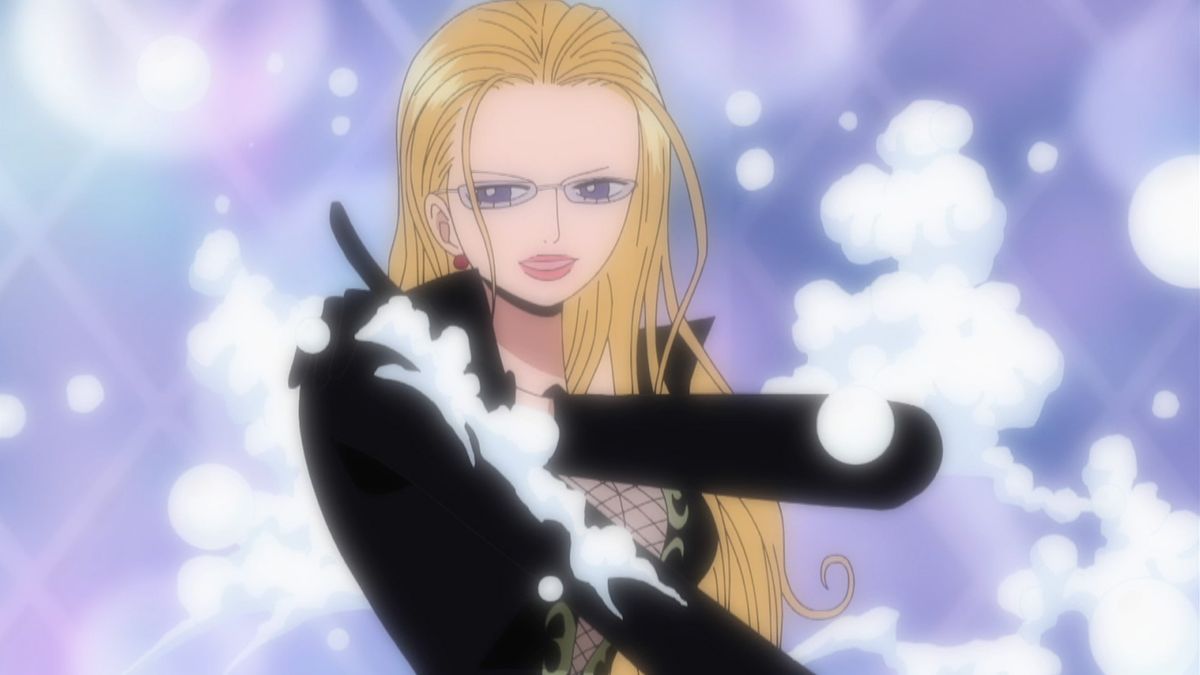
RaeRae Reacts · One Piece Episode 293
Kalifa Turns Cleanliness Into a Weapon Against Nami
One Piece Episode 293 reveals Kalifa’s soap power and forces Nami to study a trap that polishes bodies while stripping away strength.
The short version
Episode 293 gives Kalifa a soap power built around cleansing language and bodily theft. Her bubbles polish surfaces while draining Nami’s strength, turning “clean” into a weapon that makes the target less capable. Nami must study the rule while fighting inside a room Kalifa controls.
Cleanliness becomes institutional violence
Enies Lobby calls Robin dangerous, criminal, and disposable. Kalifa’s power repeats that politics physically. Soap removes what the user defines as unwanted. The target receives no voice in the definition.
Nami enters with the consequence of Sanji’s rule
This matchup was transferred to her after Sanji refused effective resistance. Nami begins with less time and an active agent holding a possible key. Her fight carries somebody else’s moral choice.
Kalifa is accountable for how she uses power
Gender does not soften her participation in CP9. She infiltrated Water 7, attacked Iceburg, helped abduct Robin, and now uses a new Devil Fruit to protect the operation. Treating her as untouchable erases agency.
Nami fights through observation
The Clima-Tact rewards environmental reading. Nami cannot overpower Kalifa directly, so she tracks bubbles, surfaces, range, and changes to her body. Information becomes the first counterattack.
Soap creates a beauty trap
Kalifa’s power leaves skin smooth and glossy while taking strength. The visual improvement masks material harm. Beauty becomes coercive when appearance is valued above function and consent.
The key keeps the fight attached to Robin
Nami is not battling for rank. Kalifa may hold the handcuff key. Every experiment and injury occurs beneath Robin’s deadline at the Gates of Justice.
Adaptation and performance
Ryo Suga’s script and Hiroaki Miyamoto’s direction introduce the Bubble-Bubble Fruit through clear cause and effect. Kenji Yokoyama’s animation direction keeps the glossy transformations readable without losing Nami’s tactical attention.
RaeRae’s final reaction
Episode 293 turns a silly power into an argument about purity. Kalifa can make a body look polished while stripping away capacity. Nami’s answer has to begin by rejecting the appearance and reading the system underneath.
Episode facts and receipts
One Piece Episode 293 aired in Japan on January 14, 2007. ONE PIECE.com credits Ryo Suga, Hiroaki Miyamoto, Kenji Yokoyama, Miho Shiraishi, and Fumihiro Uchikawa.
Classification: numbered manga-canon Enies Lobby television episode and RaeRae React. Anime, Anime Series, Japanese Anime, and Anime Reacts, not Anime Reviews.
Kalifa turns a domestic symbol into state force
Soap is associated with kitchens, bathrooms, laundry, hospitals, and the repeated labor required to keep shared spaces usable. Kalifa removes that ordinary care context and converts cleansing into domination. Her bubbles do not help Nami inhabit her body more safely. They decide what the body should become and remove strength along the way.
The reversal matters because domestic labor is often treated as naturally feminine and politically unimportant. Episode 293 gives a woman a power built from that language, then places the power inside a secret police operation. Cleanliness becomes neither gentle nor neutral.
The World Government has always used purity language
Ohara was described as a threat that needed erasure. Robin was called a demon child. Pirates become contamination in official narratives even when government agents commit greater violence. Purity language allows authority to present removal as maintenance.
Kalifa’s soap makes that logic visible on skin. The target becomes smooth, weak, and easier to control. Order improves the surface while destroying capacity underneath.
Nami’s body becomes contested territory
Kalifa changes the shape and function of Nami’s body without consent. The effect is played through visual comedy, but the tactical reality concerns bodily autonomy. Nami cannot move with familiar strength because another person imposed a condition.
Her counterstrategy must therefore accomplish more than landing damage. She needs to understand what was taken, identify the rule, and restore ownership over movement. The fight is about recovering the ability to act.
Beauty standards become part of the trap
The smooth, polished result resembles exaggerated beauty advertising. A body appears improved according to surface conventions while becoming materially less capable. The image satirizes a system that praises women most when they take up less force.
Nami has spent the series using beauty strategically without confusing appearance with value. Kalifa’s power weaponizes the confusion. The episode becomes sharper when viewers refuse to read gloss as harmless.
Kalifa’s new Devil Fruit does not erase professional skill
Kalifa already possesses Rokushiki training, infiltration experience, and years of intelligence work. The Bubble-Bubble Fruit expands her options rather than creating competence from nothing. She tests the power quickly because CP9 trained her to convert information into control.
That adaptability makes her dangerous. The ridiculous premise cannot be dismissed as novelty. A skilled agent receives a flexible environmental weapon inside a room arranged to favor her.
The office history follows both women into the fight
Kalifa spent years performing secretarial labor for Iceburg while helping CP9 map Water 7’s defenses and search for Pluton. She used workplace intimacy as surveillance. Nami enters knowing that apparent professionalism concealed an assassination plan.
The fight therefore contains two forms of administrative intelligence. Kalifa knows how institutions hide power behind routine. Nami knows how exploitative systems hide danger behind contracts, maps, prices, and polite language.
Sanji’s defeat shapes the opening conditions
Nami does not arrive fresh. She had to find Sanji, understand his refusal, accept the reassigned opponent, and continue while Robin moved closer to the gate. Emotional processing and tactical transition consumed time.
That history belongs in the fight even after Sanji leaves the room. A transferred burden does not disappear when a more capable person accepts responsibility. The starting line was already moved.
Nami refuses the idea that another woman is an easier opponent
Gender-matched fights can imply that women belong in a lesser combat lane. Episode 293 undermines that reading when Kalifa immediately overwhelms Nami through unfamiliar power and elite training. The matchup is necessary because Sanji failed, not easy because both fighters are women.
Nami’s path depends on analysis rather than an assumed physical equality. She must construct an advantage the room does not give her.
The Clima-Tact is collaborative technology
Usopp built Nami’s weapon around her weather knowledge, then upgrades and improvisation turned the tool into a genuine combat system. Every technique carries crew labor. Nami’s intelligence determines how the system performs.
That history contrasts with CP9’s standardized Rokushiki. One technology emerged from friendship, eccentric invention, and a navigator’s specialized knowledge. The other emerged from institutional training designed to produce obedient agents.
Kalifa’s bubble barrier controls the terms of contact
Thunderbolt Tempo fails because the bubbles interrupt the attack. Nami learns that direct output cannot solve every problem. The barrier changes what reaches Kalifa and how contact affects the attacker.
Control of a boundary can matter more than strength behind the boundary. Kalifa decides which bodies and attacks enter her effective space. Nami must change environmental conditions rather than repeat force.
Information arrives through injury
Nami has no safe laboratory for testing the fruit. Every observation costs exposure. She learns what bubbles do by watching her own body lose function. Battlefield knowledge is embodied and expensive.
That cost separates analysis from detached cleverness. Nami’s intelligence does not float above pain. She thinks while the system she is studying actively damages her.
CP9 turns new power into immediate labor
Kalifa ate the Devil Fruit shortly before the battle and receives no protected period to learn. The organization expects instant weaponization. Her body, like every CP9 body, is a resource assigned to the mission.
She accepts that role more willingly than Robin, yet consent inside a coercive institution remains complicated. Agents compete, obey, and prove value under leadership that will soon endanger them with the Buster Call.
The fight challenges visual spectatorship
Soap effects and body changes invite the camera toward comedy and fan service. Editorial attention has to ask whose experience becomes a joke. Nami is losing strength during a rescue deadline. Kalifa uses sexualized confidence as another layer of control.
Enjoying visual invention does not require abandoning critique. Fandom can laugh at an absurd power and still name the gendered framing around bodies being altered.
Robin’s key gives every bubble political weight
Kalifa may carry the key to Sea-Prism Stone cuffs. Her ability to delay Nami preserves Robin’s captivity. The bubbles are part of the same government mechanism as chains and gates.
That connection prevents the fight from becoming a detached showcase. Nami’s body is attacked because she is trying to restore another woman’s bodily freedom.
What Nami needs from the next move
She needs a solvent, an environmental counter, or a method that prevents bubbles from defining contact. Weather knowledge makes water the obvious question, but observation must confirm the interaction.
The coming answer will matter because Nami earns the counter through reading. A weakness discovered in context belongs to intelligence, even when another character accidentally provides the clue.
RaeRae’s second look
The Bubble-Bubble Fruit sounded like comic relief until I watched what the power does: impose smoothness, reduce strength, and make resistance look prettier while becoming harder. That is not a small metaphor on a site interested in how women are packaged.
Nami refuses packaging as destiny. She has survived men who turned money, maps, and villages into ownership. Kalifa offers another polished system. The navigator is already looking for weather inside the room.
Kalifa’s power makes compliance look comfortable
The soap does not cover Nami in obvious wounds. The body becomes glossy and soft while losing strength. That presentation resembles systems that advertise compliance as comfort. Resistance becomes harder at the exact moment the surface appears more acceptable.
Violence does not need visible blood to remain violence. Removing capacity, changing a body without permission, and preserving captivity are material harms even when the image looks polished.
Nami has survived another imposed definition of usefulness
Arlong valued her maps and treated the person drawing them as property. CP9 values Robin’s knowledge and treats the archaeologist the same way. Kalifa’s power now attempts to reduce Nami’s body to a manageable object.
Nami recognizes the structure even when the method changes. People in power praise what they can extract and punish the rest. Her resistance protects Robin because both women know extraction disguised as order.
Femininity is not one shared political position
Nami and Kalifa are women, stylish, intelligent, and comfortable using appearance strategically. Those similarities do not create solidarity automatically. Kalifa chose an institution hunting another woman. Nami chose the rescue.
Representation without attention to power can flatten the difference. The fight is not meaningful merely because two women receive screen time. The choices governing that screen time matter.
Kalifa’s office competence served an assassination plot
For years she performed the labor expected from Iceburg’s secretary while passing information to CP9. Professional excellence became cover for institutional betrayal. The performance depended on colleagues assuming routine meant safety.
Soap extends the same method. A familiar tool associated with care conceals extraction. Kalifa weaponizes trust in appearances twice.
The room becomes a laboratory Nami never consented to enter
Kalifa experiments with a newly acquired fruit during live combat. Nami becomes the test subject. Every successful effect teaches the agent more about power while costing the target movement.
That imbalance gives research an ethical dimension. Knowledge gathered through coercion belongs to the violence, not outside the violence.
Nami’s fear remains part of her intelligence
She does not analyze because danger fails to affect her. Fear sharpens the need to understand. The body is changing, Robin is moving, and the opponent controls the room. Panic and thought coexist.
Characters become more human when competence does not require emotional numbness. Nami’s strategy matters because she constructs strategy under pressure.
RaeRae’s receipt on the matchup
Sanji’s refusal is still in the room because Nami has to learn a new Devil Fruit while already carrying the rescue clock. Kalifa’s agency is also in the room because she uses every advantage willingly. Nobody benefits from pretending gender erased either choice.
Episode 293 gives me two women with intelligence and responsibility on opposite sides of power. The editorial work begins after “girl fight” stops being an adequate description.
The final line
Nami has not found the answer yet, but she has identified the real problem: a polished surface can hide stolen strength.