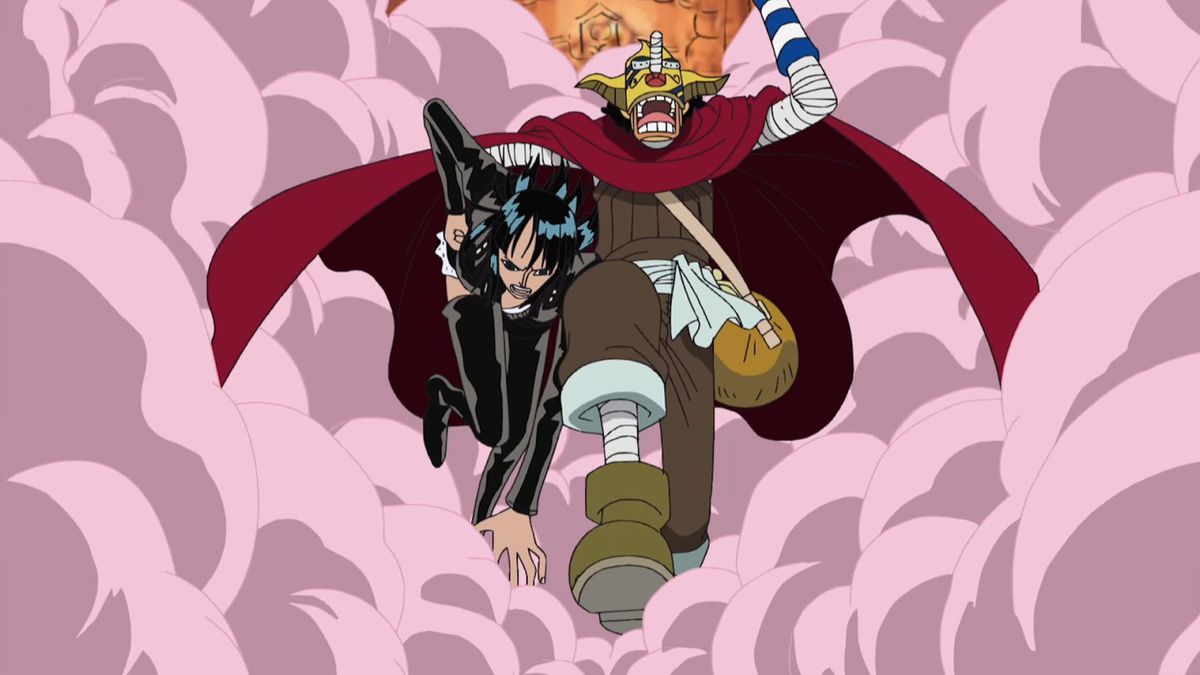
RaeRae Reacts · One Piece Episode 262
Sogeking Creates the Opening Robin Cannot Create Alone
One Piece Episode 262 lets Sogeking turn distance, observation, and disguise into a rescue tactic that interrupts CP9 without treating Robin as cargo.
Bottom line: Sogeking’s plan matters because Robin is not cargo, even when both sides are fighting over where her body goes
One Piece Episode 262 turns Robin’s rescue into a literal struggle over position inside a moving train. CP9 wants her delivered to Enies Lobby. Sanji, Franky, and Sogeking want to break that transfer before the judicial island closes around her. The action can look like a tug-of-war, but Robin is not a prize attached to the rope.
Sogeking’s value comes from changing distance, mechanisms, and timing so Robin gains an opening the government tried to remove. The best rescue does not replace CP9’s control with Straw Hat control. The best rescue makes room for Robin to choose life without the crew’s safety held hostage.
The official episode record
ONE PIECE.com lists Episode 262, “Robin’s Struggle! Sogeking’s Clever Scheme,” with a Japanese broadcast date of April 16, 2006. Hirohiko Kamisaka wrote the screenplay, Yukihiko Nakao directed, Kenji Yokoyama served as animation director, and Miyuki Sato and Fumihiro Uchikawa handled the credited art work.
The official title gives Sogeking the tactical spotlight while keeping Robin at the center of the struggle. His scheme matters because the scheme addresses the conditions around her captivity.
Robin’s body has been turned into the location of a political conflict
The World Government wants her ability to read ancient text. CP9 treats movement toward Enies Lobby as proof that the institution owns the next stage of her life.
The Straw Hats reject that claim because Robin surrendered under threat. Every attempt to change her position therefore carries moral weight beyond winning a train fight.
Coercion complicates what consent looks like in the carriage
Robin may tell rescuers to stop because CP9 promised to spare them if she cooperated. The words are real, but the conditions shaping the words are violent.
Her friends cannot ignore what she says. They also cannot pretend a hostage bargain expresses the full range of what she wants.
Sogeking works from distance because distance is his professional advantage
Sanji can clear close guards. Franky can alter machinery and absorb force. Sogeking can affect a target across the carriage without placing another body directly beside Robin.
Range becomes a rescue tool when approaching would trigger faster restraint or give CP9 another person to capture.
The clever scheme begins with reading structure
Train cars contain doors, couplings, windows, ropes, equipment, sightlines, and narrow passages. Government guards depend on those structures to control movement.
Usopp’s mind looks for the one part that can be changed from farther away. The slingshot becomes valuable because the environment contains more targets than enemy faces.
Sogeking does not need to overpower CP9 to disrupt custody
A direct strength contest would favor trained assassins. A marksman can interrupt hands, locks, signals, footing, or the path between a prisoner and the next car.
The plan succeeds by changing what stronger people are able to do, not by pretending Usopp suddenly became physically stronger than everyone present.
Usopp’s lies become tactical when they manipulate expectation
Guards who believe one threat is coming may expose themselves to another. Noise, invented identities, and dramatic claims pull attention away from a quieter mechanism.
Deception serves rescue when the deceived party is maintaining coerced custody. The moral context matters.
The mask lets Usopp take responsibility without demanding recognition
Sogeking can perform a crucial action even if Robin never thanks Usopp by name and Luffy never sees the shot. The contribution does not require public repair of his pride.
That anonymity challenges the part of Usopp that wants bravery witnessed before bravery feels real.
Sanji trusts the plan because he knows Usopp’s aim
He does not need Sogeking’s biography to judge the shot. Years beside Usopp provide evidence about range, timing, and improvisation under fear.
The obvious disguise cannot erase technical trust built through shared battles.
Franky understands that changing one connection can change the whole train
As a shipwright and cyborg, he reads the transport as linked systems. Separating cars, redirecting force, or damaging one mechanism can isolate guards and prisoners.
Sogeking’s precision and Franky’s structural understanding make a natural partnership even though their personalities look ridiculous in different directions.
Robin has spent twenty years expecting rescue attempts to become regret
Organizations sheltered her until danger or reward changed the calculation. The more risk Sanji, Franky, and Sogeking accept, the more she fears becoming responsible for their injuries.
A successful tactic must therefore do more than move her. The tactic must survive her expectation that everyone will wish they stayed away.
The crew’s answer needs repetition because trauma has repetition
One brave entrance cannot outweigh two decades of betrayal. Robin needs repeated evidence: Sanji boarded, Usopp returned, Franky resisted, Rocketman is coming, and Luffy chose pursuit after hearing the truth.
Consistency makes the rescue believable to someone trained not to trust isolated kindness.
The government treats her resistance as a problem of handling
Agents focus on restraints, escort formation, locked cars, and arrival. Those tools reduce a person’s disagreement to a logistical obstacle.
That reduction helps officials avoid hearing why Robin would reject the institution claiming legal authority over her.
Sogeking’s scheme restores uncertainty to a process designed to feel inevitable
Enies Lobby depends on the prisoner believing every door leads only forward. A shot from an impossible angle reminds Robin and the guards that the route can still change.
Hope begins as a mechanical interruption before hope becomes an emotional declaration.
The train’s motion keeps every partial victory temporary
Opening one door or freeing one restraint does not stop Puffing Tom. The island continues growing closer while the advance team fights.
Tactics must connect. Sogeking creates an opening, Sanji protects the opening, Franky changes the structure, and Rocketman has to arrive.
Robin’s rescue cannot be completed by men talking over her
Sanji, Usopp, Franky, Luffy, and CP9 all have strong positions about what should happen. Robin still needs space to state what she wants when the threat against the crew no longer controls the answer.
The coming confrontation must include her voice rather than treating survival as a decision others can settle around her.
Saving someone from coercion sometimes requires resisting the coerced instruction
If a hostage says to leave because a captor threatened family, immediate obedience can complete the captor’s plan. Refusal may protect the deeper preference the threat prevented them from expressing.
The ethical line depends on evidence, proportional action, and continued attention to the person once the coercive condition changes.
Sogeking’s plan earns trust because the plan has a narrow purpose
He is not claiming permanent authority over Robin’s future. He is trying to interrupt transfer long enough for her family to reach her and for the bargain to lose enforcement.
Limited intervention respects agency better than replacing one total plan with another.
CP9 agents benefit from treating rescue as childish emotion
Professional language makes custody sound rational while loyalty sounds reckless. That framing hides the assassination plot, threat, secret infiltration, and historical violence beneath the transfer.
Sogeking looks unserious, but his scheme responds to the actual facts more honestly than the uniforms do.
The comedy protects the episode from becoming procedural misery
The mask, poses, panic, and strange plan create laughter inside an otherwise brutal transfer. Humor comes from Usopp’s character and method rather than from mocking Robin’s fear.
The emotional stakes remain intact because the funny person performs useful work.
Usopp is proving that weakness can create a different form of precision
He cannot bulldoze through every carriage. That limit taught him to notice distance, leverage, distraction, and tools stronger fighters may ignore.
The weakness he feared would get him discarded becomes part of the rescue’s tactical intelligence.
Franky sees why this crew kept chasing Robin
Sogeking is technically outside the crew after Usopp’s departure, yet he risks the train anyway. Sanji follows without waiting for Luffy. Rocketman carries more allies from behind.
The Straw Hat bond survives conflict in ways Robin and Franky have not fully trusted in their own families.
The struggle over Robin previews Enies Lobby’s larger argument
The government claims custody through law, force, and historical accusation. The crew claims relationship through shared life and informed willingness to risk themselves.
Enies Lobby will force those claims into public conflict where Robin can finally answer both.
The scheme turns Sogeking from coping mechanism into crew function
Episode 258 showed why Usopp needed the identity. Episode 262 shows what the identity contributes. A mask becomes meaningful through choices that affect other people.
Usopp will still owe Luffy honesty later. Robin needs his precision now.
RaeRae verdict: Sogeking’s trick works because Usopp sees the opening stronger people cannot reach
Episode 262 gives the masked hero more than a funny introduction. He reads the train, uses distance, coordinates with Sanji and Franky, and interrupts a custody process designed to make Robin’s disappearance feel automatic.
I refuse to describe Robin as a prize in a tug-of-war. She is a person trapped inside a bargain built from threats. Sogeking’s best contribution is not pulling harder than CP9. His contribution is creating enough uncertainty for Robin’s real choice to matter again.
Robin’s silence cannot be separated from the threat hanging over the Straw Hats
Robin does not suddenly stop caring about the crew when she boards the Sea Train. CP9 has taught her that staying close to people places a target on their backs, and her childhood gave that threat enough proof to feel permanent. Every destroyed refuge tells her that affection creates casualties. When she agrees to go with CP9, she is choosing under a knife held against everybody else.
That history is why a simple rescue speech would not solve the problem. Robin already knows the Straw Hats care. She doubts their ability to survive the institution chasing her, and she has spent years accepting her own disappearance as the price of keeping other people alive. Sogeking’s plan must change the physical situation before Robin can believe another choice exists.
Sanji and Sogeking contribute different kinds of care
Sanji handles the immediate bodies in front of him. He fights through the train, watches the route, and keeps the rescue moving with the practical urgency Robin’s situation demands. Sogeking works from distance because distance is where Usopp can turn observation into leverage. Neither role makes the other smaller.
The episode understands teamwork as a collection of limits and specialties. Sanji cannot stand back when someone needs protection. Usopp cannot win by pretending his body works like Sanji’s. Their plan improves when both men stop measuring usefulness by the same standard and start building around what each person can actually do.
Spandam’s authority depends on making violence look administrative
Robin’s transfer comes wrapped in procedure. Agents have titles, orders, uniforms, destinations, and a chain of command. That paperwork-shaped language tries to hide the basic truth: a frightened woman has been threatened, restrained, and transported toward punishment for surviving a government massacre.
Spandam benefits whenever people treat the process as settled because a form or official order exists. Sogeking creates disorder, and disorder exposes how much government authority on this train depends on everyone obeying the performance. Once the route can be interrupted, the supposedly inevitable transfer starts looking like a group of armed people forcing one person toward a gate.
The rescue still owes Robin a conversation after the train stops
Saving Robin from CP9 does not give the Straw Hats permission to ignore everything she said. Her fear, guilt, and expectation of abandonment remain real even when her bargain was coerced. The crew will need to hear the part of her that wants to live instead of treating rescue as proof that they already understand every wound.
Episode 262 holds that conversation back because the immediate danger has not passed. I can accept the delay because the story keeps showing the difference between creating room for consent and claiming consent on Robin’s behalf. The rescue buys time. Robin’s own voice must decide what that time becomes.
Usopp’s disguise lets him return through responsibility before apology
Usopp has not repaired the argument with Luffy, and the mask does not erase the damage around the Going Merry. He still chooses to help Robin while carrying his embarrassment, grief, and pride. That decision feels human because people rarely solve every personal conflict before an emergency asks something useful from them.
Sogeking gives Usopp enough emotional distance to act without pretending the earlier fight never happened. The disguise is ridiculous, but the responsibility underneath the disguise is serious. He shows the crew who he remains when nobody has promised him an easy route back.