RaeRae Reacts · One Piece Episode 261
T-Bone Can Be Decent and Still Carry an Unjust Order
One Piece Episode 261 gives Zoro a principled Marine opponent while Robin’s coerced transport proves personal decency cannot make an unjust mission fair.
Bottom line: T-Bone is a decent man serving the wrong transport, and Zoro cannot let decency complete an unjust mission
One Piece Episode 261 gives Zoro an opponent who would be easier to hate if he were cruel. T-Bone cares for injured subordinates, tears clothing to make bandages, and takes responsibility for people under his command. He also guards the route carrying Robin and Franky toward Enies Lobby. Personal kindness does not change the function of that route.
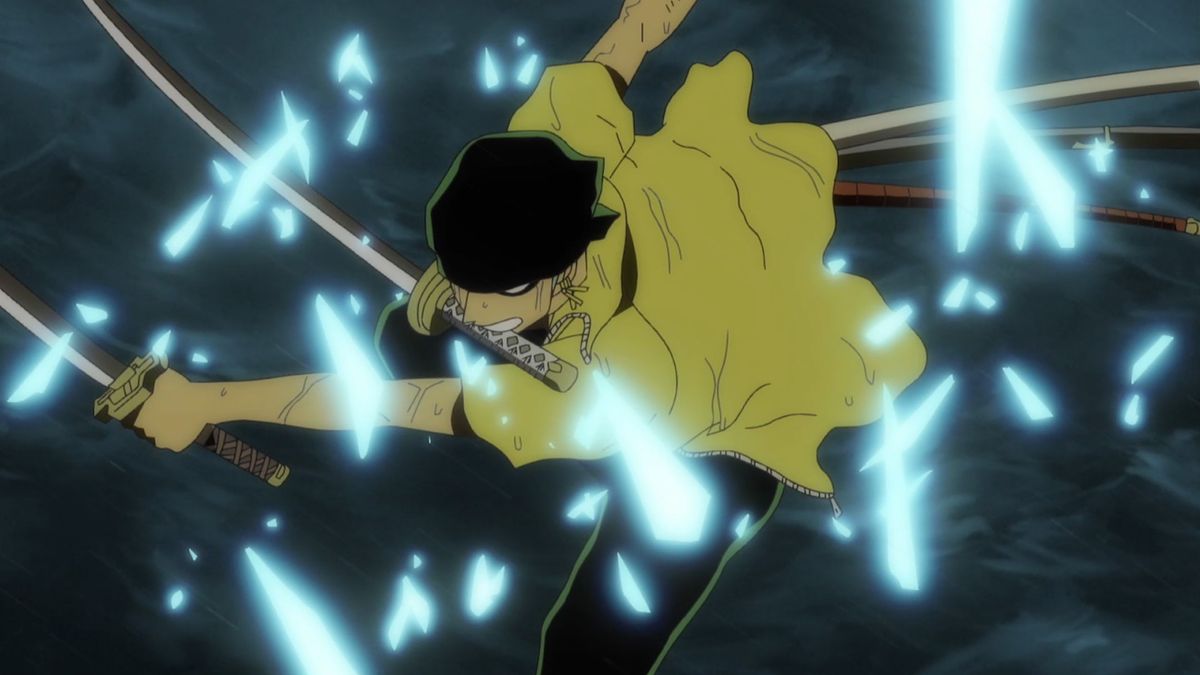
Zoro respects the swordsman enough to meet him directly and defeats him quickly enough to keep the rescue moving. The episode refuses the comfortable idea that every person inside a harmful institution must be secretly heartless.
The official episode record
ONE PIECE.com lists Episode 261, “Clash! Demon-Slasher Zoro vs. Ship-Cutter T-Bone,” with a Japanese broadcast date of April 2, 2006. Hirohiko Kamisaka wrote the screenplay, Morio Kano directed, Kazuya Hisada served as animation director, and Miyuki Sato and Kunihiro Chida handled the credited art work.
The title pairs two swordsmen through fearsome reputations. The episode then complicates the labels by showing T-Bone’s care for his men before placing him in Zoro’s path.
T-Bone looks like a horror story and behaves like a responsible officer
His gaunt face and severe posture invite immediate suspicion. The visual joke expects viewers to read danger before he speaks.
His actions reverse that expectation. He notices injuries, sacrifices his own comfort, and treats subordinates as people rather than replaceable pieces.
The reversal works because appearance is weak evidence of character
Water 7 has already shown polished shipwrights who were assassins and loud criminals who formed loyal families. T-Bone continues the pattern.
A face cannot settle the moral account. Choices, roles, and consequences provide stronger evidence.
T-Bone’s compassion is real without becoming proof that the mission is good
He may believe the prisoners are dangerous and the transport protects ordinary people. He can act sincerely from information shaped by government authority.
Robin still did not receive a free choice, fair hearing, or protection from the institution that destroyed Ohara. A kind guard remains part of coercive custody.
Good treatment inside a bad process can make the process harder to recognize
When an officer shares food or bandages a wound, subordinates gain evidence that the organization contains honorable people. That evidence can become a reason to stop asking what the organization is doing.
T-Bone’s care deserves credit. The care cannot wash the destination off the train.
Zoro does not need T-Bone to become a monster before fighting him
The swordsman stands between Rocketman and Robin. That position creates the conflict even if T-Bone loves his crew and follows a personal code.
Zoro can respect an opponent’s conduct while refusing the outcome the opponent protects.
The broken train connection isolates T-Bone physically and morally
Separated cars leave him on the ocean route while the main transport continues. He keeps moving because duty does not disappear when machinery fails.
The image shows commitment and the danger of commitment detached from fresh information. T-Bone follows the mission farther than the train can carry him.
Running the rail turns duty into bodily labor
He cannot rely on rank, orders, or a carriage once separated. Legs, breath, balance, and endurance carry the uniform forward through storm conditions.
The labor makes him admirable and tragic. He spends genuine effort to restore a transport serving institutional harm.
T-Bone’s ship-cutting reputation makes him a serious obstacle
A swordsman capable of slicing ships can damage Rocketman, sever rails, or end the pursuit with one well-placed attack. His threat is structural as well as personal.
Zoro has to protect the vehicle and defeat the fighter before another separation leaves the coalition stranded.
The ocean rail gives neither swordsman a forgiving arena
Water surrounds a narrow path. Rocketman approaches with passengers behind Zoro, and T-Bone has little space to evade without falling.
Precision matters because a wide attack can destroy the route everyone still needs.
Zoro reads T-Bone through stance rather than moral biography
He does not have time to interview the officer about justice, Ohara, or CP9. Blade position, footing, intent, and timing reveal what the immediate fight requires.
The encounter remains short because Zoro prioritizes the rescue over proving superiority through a long duel.
A fast victory can show respect more clearly than theatrical hesitation
Zoro takes the threat seriously and answers with sufficient force. Pretending T-Bone is harmless because he seems honorable would insult the officer’s skill and endanger the train.
Respect means recognizing capability and refusing to waste the opponent’s commitment on performance.
The sword styles reveal different relationships to service
T-Bone’s blade belongs to a Marine identity organized around duty, protection, and command. Zoro’s swords belong to promises carried from Kuina through the crew’s journey.
Both men serve something beyond private survival. The episode asks whether the chosen object of service deserves that loyalty.
Zoro’s loyalty remains personal without becoming small
He fights for Robin because she is his crewmate and because her surrender was coerced. He does not need a universal theory of government before acting.
The personal bond places him against an institution whose conduct has become clear through specific harm.
T-Bone may believe he protects civilians from pirates
The World Government describes Robin as a catastrophic threat and pirates as criminals. An officer working from that record can interpret pursuit as public safety.
The lie succeeds because the institution controls archives, bounties, courts, and official explanations of Ohara.
Information inequality shapes the morality of the duel
Zoro knows Robin, heard the terms CP9 imposed, and witnessed the agents’ infiltration. T-Bone likely knows the wanted poster and transport orders.
Both men act decisively, but only one has direct evidence from the person being carried away.
Following orders does not erase responsibility
T-Bone’s limited information can explain his belief without making every action neutral. Officers still choose how much force to use, which questions to ask, and when evidence conflicts with orders.
Institutional deception distributes guilt. The distribution never reduces guilt to zero everywhere.
The episode avoids making kindness useless
T-Bone’s care for subordinates still improves real lives. A bandage matters to the person bleeding, even if the officer supports a harmful mission elsewhere.
Moral complexity should not become an excuse to mock small acts of care. The stronger conclusion holds care and complicity together.
The defeat exposes how institutions spend decent people
T-Bone risks his body on a broken route to restore the mission. Government leadership does not stand beside him in the rain or explain the hidden political objective.
His honor supplies labor and credibility to a system that can replace him if he falls.
Zoro cannot rescue T-Bone from institutional loyalty during one clash
A speech on the rail would not undo years of belief or provide proof T-Bone is ready to hear. The train is moving, and Robin’s deadline remains.
Zoro solves the obstruction available now. Larger political understanding belongs to consequences beyond the duel.
The fight strengthens Zoro’s role as the crew member who cuts through delay
Luffy drives the rescue’s direction. Nami and Kokoro manage the route. Zoro removes a structural threat before the threat can stop everyone.
His contribution is brief because effectiveness, not screen time, defines the job.
T-Bone and Zoro share discipline without sharing allegiance
Both men train, accept pain, and hold themselves to standards larger than comfort. Similar virtues can support opposing outcomes.
Virtue requires an object. Discipline serving injustice does not become justice merely because discipline is impressive.
The scene asks fandom to stop using “good person” as the end of analysis
T-Bone is a good person in several visible relationships. That observation should begin the conversation about his role, not end the conversation.
Fans can like his compassion and still examine the prisoners, institutions, and violence his duty protects.
The short duel preserves urgency better than a tournament structure would
Robin is approaching Enies Lobby. Sanji, Sogeking, and Franky are fighting inside Puffing Tom. Rocketman carries a crowded coalition through a storm.
A five-episode exchange of named attacks would betray the rescue’s clock. Zoro ends the obstacle and moves.
T-Bone’s care reveals a welfare gap the institution expects individuals to fill
An officer tearing personal clothing into bandages suggests immediate compassion and inadequate preparation around him. Injured subordinates need supplies, rest, trained medical attention, and systems that do not depend on a commander sacrificing his coat during transport.
T-Bone steps into that gap because he notices people. The World Government benefits twice. His labor keeps personnel functioning, and his visible kindness gives the organization a human face without requiring leadership to change the conditions producing need.
The point is not to criticize him for helping. The point is to notice why the help had to become personal improvisation. Institutions often celebrate exceptional caretakers while quietly relying on those caretakers to cover structural neglect.
Lawful custody and legitimate custody are not the same claim
Enies Lobby represents government law, official judgment, and authorized force. Robin’s route may satisfy procedures written by the same authority that declared Ohara’s research criminal and killed civilians to control historical knowledge.
T-Bone can therefore protect a lawful transport while Zoro challenges the transport’s legitimacy. Law gains moral credibility from fair evidence, accountable power, meaningful defense, and protection of basic human rights and personal dignity. A government cannot create justice merely by naming every stage official.
Robin expects no neutral hearing at the destination. CP9 already used assassination, threats, hidden identities, and collective punishment to get her aboard. The process announced its answer before the train left Water 7.
The visual direction lets the storm strip both men down to choices
Uniforms, bounties, titles, and reputations matter less on a narrow rail surrounded by black water. T-Bone keeps running because he chooses duty. Zoro stands in front of Rocketman because he chooses Robin and the crew.
The setting removes offices and crowds that might reinforce either identity. Rain hits both fighters. A missed step threatens both bodies. Their blades become the clearest expression of competing commitments.
That simplicity gives the encounter dignity without pretending the sides carry equal moral stakes. The men receive equal physical danger. Robin remains the person whose freedom neither guard nor court allowed her to choose.
Zoro’s force is calibrated to clear the route rather than punish T-Bone’s entire identity
Zoro does not need to prove that every Marine deserves death. He needs T-Bone unable to cut Rocketman or restore the prisoner transport. The distinction keeps the duel attached to rescue rather than revenge.
Calibrated force matters because Zoro carries weapons capable of lethal injury. Respect for an opponent includes responsibility for what happens after a blade lands. A swordsman cannot hide behind intensity and call every consequence accidental.
The quick defeat therefore tells us something about control. Zoro recognizes T-Bone’s commitment, answers the attack, and continues toward Robin without turning the officer into a trophy. The crew gains a path, the story preserves T-Bone’s humanity, and the disagreement remains larger than which man looks cooler after the clash.
That restraint also fits the coalition behind Zoro. Rocketman carries people who were enemies hours ago. If every conflict required total destruction, none of those passengers could share the train now.
Zoro’s decision leaves room for T-Bone to confront the mission later, with the experience of meeting people official records taught him to see only as criminals unworthy of any honest hearing or human context at all.
RaeRae verdict: T-Bone deserves respect, and Robin still deserves rescue more than his orders deserve completion
Episode 261 gives One Piece a better conflict than another cruel Marine laughing at prisoners. T-Bone cares for his people, works hard, and meets Zoro with genuine skill. Those qualities make the institution’s use of him more troubling.
I can respect the man and cheer when Zoro removes him from the route. Robin did not consent to the transport, Franky is being targeted for inherited knowledge, and Enies Lobby is not waiting to become fair. Decency cannot be allowed to deliver injustice efficiently.