RaeRae Reacts · One Piece Episode 224
Luffy Loses Everything and Still Wants a Ride
One Piece Episode 224 turns love and fear into a memory trap before Luffy’s surviving curiosity breaks the seahorse’s false Sennenryu transformation.
Bottom line: the thief steals every memory and still cannot make Luffy cautious
One Piece Episode 224 gives the seahorse every memory the Straw Hats possess, swells the creature into a ridiculous imitation of a Sennenryu, and still loses because Luffy sees a flying animal and wants to ride the thing. That solution is silly, character-specific, and more satisfying than a hidden immunity would have been. Luffy does not defeat complete memory loss through destiny. His curiosity survives long enough to put his rubber body around the thief and force the first memories back.
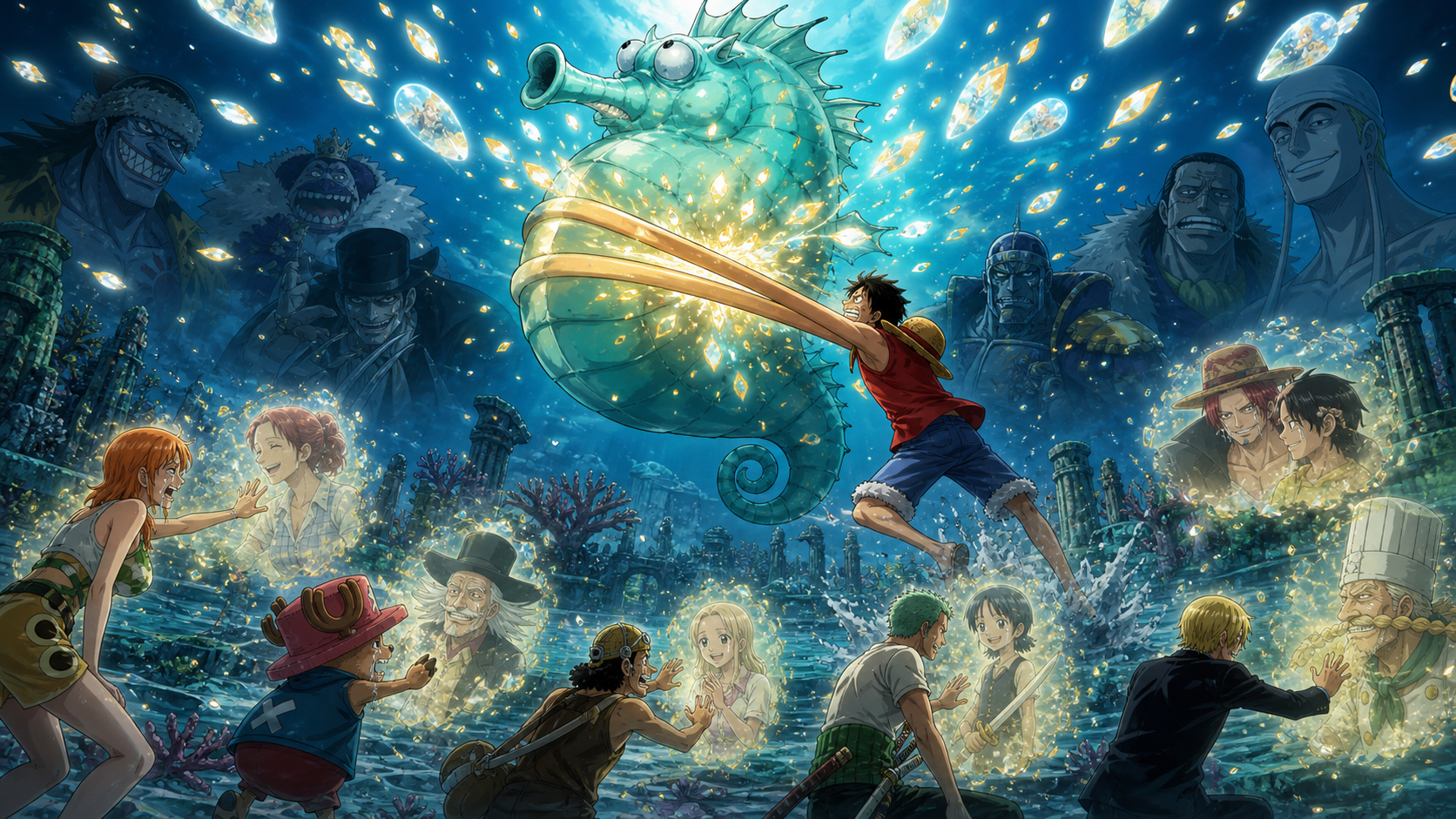
The finale also understands how memory can be weaponized. The seahorse shows each crew member somebody beloved, then replaces comfort with the enemy attached to an old wound. Bell-mere leads toward Arlong. Hiriluk leads toward Wapol. Kaya leads toward Kuro. Kuina leads toward Zoro’s grief. Zeff leads toward Krieg. Shanks and Ace lead toward dangers Luffy cannot solve through ordinary closeness. The creature does not invent new fear. The creature rearranges love into an opening.
Episode facts and the end of Ocean’s Dream
Episode 224 aired in Japan on March 6, 2005. Hirohiko Kamisaka wrote the screenplay with assistance from Hito Koyama. Takahiro Imamura directed the episode, Kazuya Hisada served as animation director, and Miyuki Sato and Kumiko Fukuzawa handled the art direction. The official title announces the memory thief’s last counterattack and exposed nature.
This episode closes the five-part anime-original Ocean’s Dream story, Episodes 220 through 224. The arc draws from the PlayStation game and does not advance the manga storyline. The ending returns the crew to their established continuity before the brief Foxy’s Return detour. That production function is obvious. The final episode still has a useful character argument: identity lives across memory, habit, body, desire, relationship, and choice, so stealing one layer does not produce a controllable blank person.
Zoro remembers and still looks ready to fight
Zoro approaches the group with the same severe expression that made Sanji assume the hypnosis remained active. Sanji prepares to fight him. Luffy arrives by launching himself into both men, turning a dangerous misunderstanding into a pile of irritated crewmates.
Zoro explains that his memories returned when the seahorse released them. His face did not change because Zoro naturally looks like somebody considering whether a sword could improve the conversation. Sanji’s suspicion is funny because their rivalry has returned in full. Memory restoration does not make them polite. The familiar conflict is proof that the relationship is back.
Luffy was late because a boulder won the first round
The episode eventually explains why Zoro reached the palace before Luffy. Zoro’s Oni Giri left Luffy trapped beneath a boulder. No secret technique, moral crisis, or dramatic sacrifice delayed him. A large rock did the job.
That detail keeps the filler arc from pretending the duel settled a permanent power ranking. Zoro struck an emotionally constrained Luffy under hypnosis and moved ahead. Luffy survived, escaped, and returned at the least dignified useful moment. Their relationship can absorb the embarrassment.
Zoro chases the seahorse because anger has its memory back
Once Zoro understands that the creature manipulated him, he dives into the lake after the thief. His anger is personal. The seahorse stole his judgment, redirected his swords toward Luffy, and used Kuina’s promise as material.
The chase shows why returning memory creates accountability. Zoro can now name what was violated. He does not merely want the creature stopped for public safety. He wants an answer for what happened through his body while consent was missing. That distinction gives the pursuit more bite than a standard escaped-monster chase.
The last resort begins with people they want to see
Cornered, the seahorse releases gas and fills the ruins with familiar faces. The first images are not enemies. They are people the Straw Hats miss, love, admire, or owe. Bell-mere appears to Nami. Hiriluk appears to Chopper. Kaya appears to Usopp. Kuina appears to Zoro. Zeff appears to Sanji. Shanks and Ace appear within Luffy’s memory.
The choice is cruel because affection lowers defense faster than fear. Nobody wants to strike the face carrying a foundational bond. The crew pauses because memory produces recognition before reason can test whether the person is physically present. The thief uses emotional truth to support a visual lie.
Bell-mere is not bait because Nami is weak
Bell-mere represents the mother who chose Nami and Nojiko under impossible conditions, named them family, and died rather than deny either child. Nami’s reaction does not make her gullible. Love and grief have trained her body to respond before an investigation can begin.
The seahorse exploits the gap between recognizing Bell-mere and knowing Bell-mere cannot stand at the palace. That gap exists because memory is faster than analysis. Nami’s pain gives the illusion power, but the pain also proves how completely Arlong failed to erase Bell-mere from her life.
Hiriluk reaches Chopper through the doctor he became
Hiriluk carries Chopper’s first experience of human acceptance and the impossible dream that medicine can serve hope. Seeing him again would overwhelm any careful distinction between wish and evidence. Chopper has spent the whole arc rebuilding trust from those surviving foundations.
The illusion turns gratitude into paralysis. The seahorse does not care what Hiriluk meant. The creature sees a rich memory capable of holding Chopper still. Consumption strips meaning from the relationship while depending on the relationship’s emotional weight.
Kaya reminds Usopp that stories once protected somebody
Kaya is tied to Usopp’s lies, but those lies were never only vanity. He used stories to bring laughter and movement into the life of a lonely, grieving girl. The Going Merry itself came from that bond.
An illusion of Kaya reaches the part of Usopp that wants to be brave enough for his own stories. The seahorse treats that aspiration as food. Usopp’s fear becomes easy to mock until the episode shows how often fear sits beside care.
Kuina remains the promise Zoro cannot put down
Kuina shaped Zoro’s dream before any pirate flag entered his life. Her image stops him because the Wado Ichimonji, his ambition, and his grief all point back to their promise. The memory thief already used that history once when directing him toward Luffy.
The second use exposes the predator’s method. The seahorse does not understand Kuina as a person. The creature understands that her image controls attention. A life becomes a lever. Zoro’s fury makes even more sense once that reduction becomes visible.
Zeff is Sanji’s hunger, debt, and home in one body
Zeff gave Sanji food, discipline, a profession, and the freedom to pursue All Blue. Their relationship contains gratitude, resentment, comedy, and a sacrifice neither man likes discussing plainly.
Sanji can kick a stranger threatening Nami without hesitation. Zeff’s face interrupts that certainty because the bond helped create the ethics behind every kick. The seahorse turns origin into obstruction. Sanji’s love becomes a temporary cage.
Shanks and Ace reveal the distance inside Luffy’s freedom
Shanks gave Luffy the hat, the model of chosen piracy, and a promise tied to reunion. Ace represents brotherhood, competition, and a person Luffy loves without needing constant proximity. Both figures carry a future meeting.
The hallucinations exploit Luffy’s willingness to run toward people he loves. His freedom has never meant emotional detachment. He can sail forward because relationships give the journey shape. The thief mistakes those bonds for exploitable storage and misses the stubborn traits that remain after storage is emptied.
The enemies arrive through the doors opened by love
After the beloved figures hold the crew’s attention, old enemies replace them. Arlong, Wapol, Kuro, Don Krieg, Crocodile, and Enel appear as concentrated threats from each journey. The sequence moves from longing to alarm before the victims can reset.
The pairings show how memory networks work. Bell-mere and Arlong share Nami’s history. Hiriluk and Wapol share Chopper’s. Kaya and Kuro share Usopp’s. Zeff and Krieg share Sanji’s. Crocodile and Enel belong to collective victories that made the crew trust one another. The seahorse follows emotional connections like routes on Nami’s chart.
Complete theft makes the creature larger and the victims smaller
The seahorse absorbs the crew’s full memories and inflates until the creature can float. The thief claims to have become a Sennenryu, a grand transformation built from lives consumed as fuel. The swollen body is funny, but the appetite underneath is ugly.
Growth without understanding produces imitation. The creature possesses experiences of courage, grief, navigation, medicine, cooking, archaeology, promises, and friendship. None of that knowledge makes the seahorse wise. Hoarding memory cannot replace living inside relationships or accepting their responsibilities.
Luffy loses his life story and keeps wanting the impossible animal
With every memory gone, Luffy sees the floating seahorse and wants to ride the strange creature. That impulse becomes the arc’s answer to identity. He no longer knows his crew, voyage, title, or past. Curiosity remains. Physical confidence remains. The desire to meet the impossible by moving closer remains.
I would not use this episode to claim personality exists untouched by memory. The previous chapters showed how drastically everyone changed when shared history disappeared. Luffy’s surviving impulse proves something narrower and more believable inside the fantasy: memory is one layer of self, not the only layer.
Rubber becomes the accidental cure
Luffy launches himself upward and wraps around the bloated seahorse. The creature’s pain forces Luffy’s memories back first. Once he remembers the theft and the people below, curiosity turns into focused anger.
The solution uses his body and personality together. Another fighter might attack from a distance and miss the pressure point. Luffy embraces the ridiculous target because grabbing strange things is normal behavior for him. The accident restores the captain capable of finishing the job.
Luffy beats the rest of the crew back into the world
After recovering his own history, Luffy attacks until the seahorse releases everybody else’s memories. The fragments return to the crew and island residents. The inflated false dragon loses the lives that made the transformation possible.
The victory belongs partly to chance, but chance has always needed somebody reckless enough to exploit the opening. Luffy’s body creates the opportunity. Memory tells him why the opportunity matters. The crew returns because one person recovers the relationship and acts before the thief can regroup.
The villagers remember everything except who deserves credit
With memory restored, the villagers mistake the Straw Hats for the thieves. The crew asks for a reward and receives an angry chase instead. After saving the island, they flee empty-handed on the Waver.
The ending is funny and appropriately unfair. Restored memory does not guarantee accurate judgment. People can remember their lives and still accept the wrong public story about a crisis. The boy points toward danger in the forest, panic fills the gaps, and pirates make convenient suspects. Information without careful attribution can reproduce another injustice immediately.
The Waver escape leaves the Going Merry question offscreen
The crew escapes the crowd using Nami’s Waver and returns to the sea. The practical staging rushes past some logistics because the arc wants a comic exit and dinner aboard the ship.
That haste is one of the finale’s weaknesses. A community suffered mass memory theft, received memories back, and attacked the rescuers within minutes. The episode uses the town as a punch line instead of exploring recovery. Five episodes leave little room, but one grounded scene of neighbors checking on one another would have made the restored social world feel real.
Sanji’s dinner is the real sign that the crew survived
Back aboard the ship, Sanji prepares food and the crew returns to familiar arguments. The meal closes the crisis better than the defeated seahorse. Everybody knows where to sit, who cooks, who steals portions, who complains, and who belongs.
Episode 220 began with the same bodies unable to understand why they shared a deck. Episode 224 ends with ordinary routine carrying the answer. Home is not only recovered adventure footage. Home is the repeated labor people expect from one another and the freedom to resume being annoying without fear that the relationship will vanish.
What changed when I replayed the finale
On the first watch, the giant seahorse and Luffy’s accidental recovery dominated everything. On replay, the order of the hallucinations mattered more. The creature begins with love because love creates attention, then introduces fear through the same memory pathways. That sequence is much smarter than a random parade of familiar faces.
I also appreciated the villagers’ mistake as more than a final joke. The entire arc treats memory as evidence, but Episode 224 reminds us that evidence needs interpretation. Remembering an attack does not automatically identify the attacker. The island regains information before regaining shared judgment.
The production chooses emotional inventory over subtle horror
The finale fills the screen with recognizable faces, turquoise light, and the inflated thief. The visual abundance gives every crew member a personal stake and lets longtime viewers read relationships quickly. The approach is direct rather than eerie.
A quieter version could have made the hallucinations more disturbing by letting each beloved figure behave almost correctly before revealing the trap. The episode chooses speed because the arc has to resolve the creature, restore the town, deliver a chase, and return the crew to sea. The emotional inventory still works because the underlying relationships were established across the series, not invented for this battle.
RaeRae’s verdict
Episode 224 gives Ocean’s Dream a messy, funny, character-faithful ending. The Sennenryu claim is ridiculous. Luffy’s solution is even more ridiculous. Those pieces fit One Piece because the emotional argument remains sincere beneath the comedy. The seahorse can steal stories, names, promises, and faces. The creature cannot turn Luffy into a cautious person who leaves a flying mystery alone.
The five-part arc never becomes essential canon, and the finale rushes the recovery that should matter most. I still prefer this detour to filler built only from generic fights. Ocean’s Dream examines what each Straw Hat carried before the crew, what the voyage added, and why shared memory helps power become loyalty instead of danger. The final meal says the family survived. The next journey can begin because everybody knows why they are on the ship again.
Official source and next route
The official ONE PIECE episode guide confirms the March 6, 2005 broadcast date, production credits, restored villagers, Zoro pursuing the seahorse, the memory-image paralysis, and the crew losing their memories again. The bounded Ocean’s Dream directory now closes with Episode 224 before the viewing route continues into Foxy’s Return.