RaeRae Reacts · One Piece Episode 225
Foxy Finds Pride After Losing His Crew
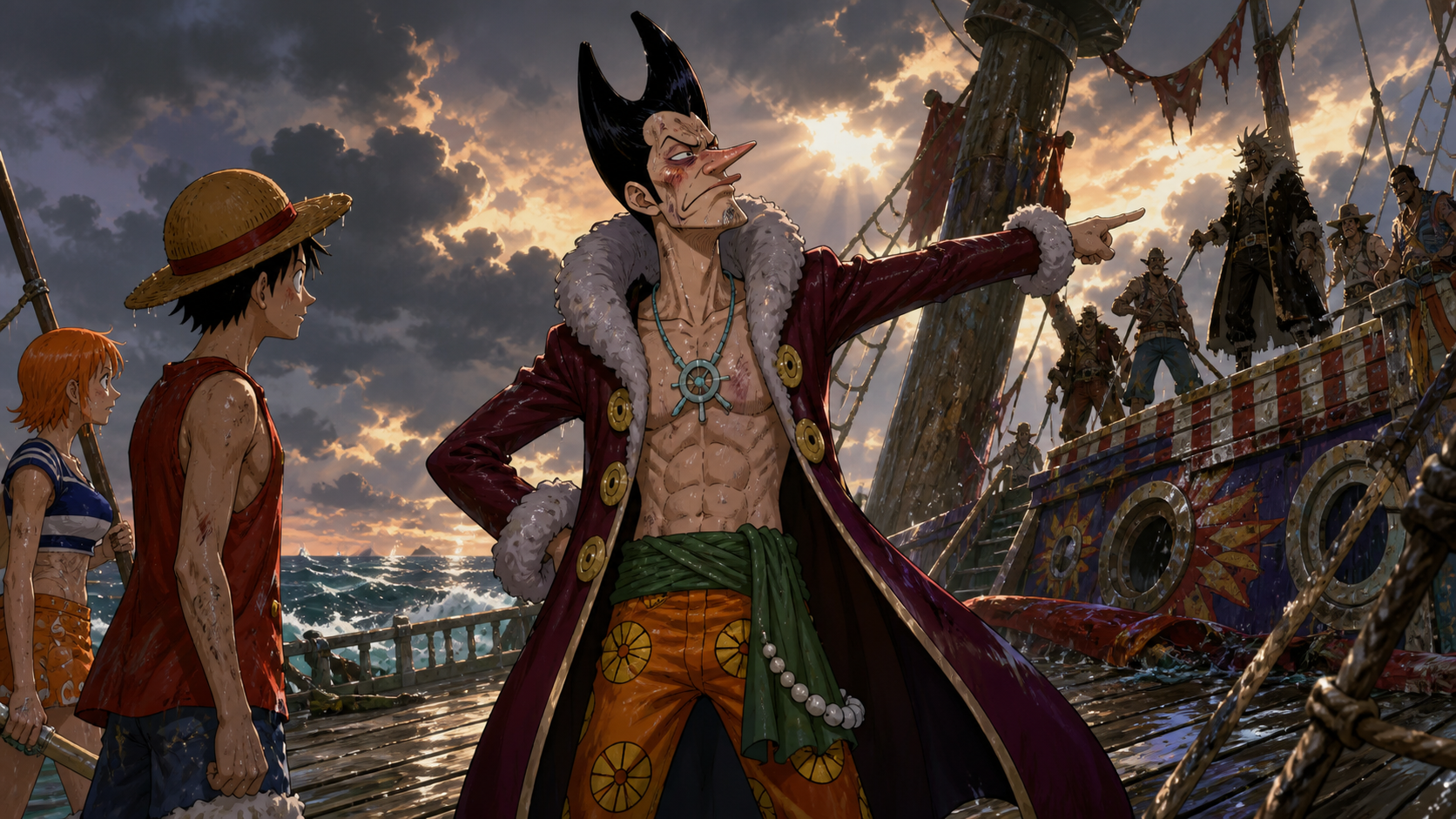
One Piece Episode 225 strips Foxy of his ship, followers, and stage, then finds the stubborn piece of leadership buried under his cheating performance.
Bottom line: Foxy finally earns respect when nobody owes him any
One Piece Episode 225 drags Foxy back onto the screen wet, humiliated, abandoned, and somehow more serious than he looked during the entire Davy Back Fight. The same captain who cheated through games cannot tolerate strangers stealing his ship and treating his crew as property. That contradiction should make him impossible to respect. Instead, the episode finds the small piece of pride underneath all the peacocking and lets Foxy defend something beyond his own applause.
I still would not trust this man to supervise a raffle. Foxy lies, rigs contests, collects people, and folds whenever somebody hurts his feelings. None of those facts disappear because a mutiny bruises his heart. The surprise comes from watching him stand up after the cheering stops. Foxy wants his people back even when they have already followed another captain, and Luffy recognizes that stubborn attachment before anybody can turn the rescue into another joke.
Episode facts: an anime-original return attached to a canon doorway
Episode 225 aired in Japan on March 13, 2005 under the official Japanese title “The Proud Man! Silver Fox Foxy.” Yoshiyuki Suga wrote the screenplay, Yoko Ikeda directed, Naoki Tate served as animation director, and Miyuki Sato with Tadami Shimokawa handled the art direction. The official synopsis begins with Luffy rescuing Foxy’s group during a storm, then follows Foxy back to the Sexy Foxy after the ship has been seized by the Fanged Toad Pirates.
This chapter belongs to the anime-expanded Davy Back Fight run. The official One Piece episode guide places Episodes 207 through 228 under that story umbrella even though the Foxy return material expands beyond the manga contest. That placement matters because Episode 225 looks backward at the games while Episode 226 begins pointing toward Aokiji. The anime uses Foxy as a comic decompression chamber before opening a door that Robin already knows should terrify everyone.
A storm removes the stage Foxy normally needs
Foxy usually performs with banners, rules, referees, traps, and an audience trained to repeat his name. The storm strips all of that away. Porche, Hamburg, and their captain are simply bodies in dangerous water until Luffy pulls them aboard. No tournament gives Foxy control over the terms. No beam can slow a wave. Rescue depends on the rival he tried to rob.
The humiliation works because Luffy does not use the rescue to settle a score. He saves people because people are drowning. Foxy cannot turn that behavior into a transaction without exposing how different the two captains are. One man needs public victory to feel secure. The other moves first and decides whether to complain later. That gap between them remains funnier than another insult about Foxy’s hair.
Porche and Hamburg stay because loyalty can survive bad leadership
Porche and Hamburg could abandon Foxy after Long Ring Long Land. Both have seen him cheat, collapse, and make reckless decisions. They stay close during the storm and keep responding to him as captain. Their loyalty does not prove Foxy deserves every person under his flag. Their choice proves that the Foxy Pirates contain relationships deeper than a collection of stolen bodies.
That distinction repairs some of the ugliness buried inside the Davy Back premise. A crew won through games cannot automatically equal a family. Porche and Hamburg matter because they choose Foxy after defeat. The episode should have spent more time on why. Even so, their presence gives Foxy something specific to protect rather than a crowd that exists only to chant.
The Sexy Foxy becomes evidence that command is never the same as ownership
When Foxy finds his ship, relief lasts only long enough for the new occupants to reveal themselves. The Fanged Toad Pirates have taken the vessel and absorbed former Foxy Pirates into their force. Foxy talks as if the ship and crew were possessions stolen from a shelf. His anger sounds hypocritical because he built his reputation by winning people from other captains.
The episode does not erase that hypocrisy, but the mutiny forces Foxy to feel the rule from the losing side. A flag, a hull, and a roster cannot guarantee allegiance. Leadership must survive contact with disappointment. Foxy discovers that theatrical authority becomes useless when somebody else controls the deck and his own people no longer echo the performance.
The Fanged Toad captain recognizes the weakness under the costume
The usurper does not need a complicated political argument. He sees a captain who lost publicly and treats the loss as permission to take everything. Pirate culture in One Piece often rewards strength before law, and Foxy has advertised strength as spectacle. Once the spectacle breaks, a predator arrives to collect the props.
That threat exposes the cost of building loyalty around winning. A crew trained to worship results may look elsewhere when the results become embarrassing. Foxy wants devotion through charisma, fear, and celebration, but none of those tools teach people what the flag means during failure. The mutiny turns his leadership model back on him.
Luffy refuses the idea that losing makes a captain disposable
Luffy has every reason to enjoy Foxy’s humiliation. Foxy tried to take Chopper, attacked his crew, manipulated the rules, and turned friendship into a prize pool. Luffy still does not accept another pirate stealing the defeated captain’s place. His response separates rivalry from contempt.
That line is central to Luffy’s ethics. He can punch a captain, reject the captain’s values, and refuse to deny the relationship between that captain and the people who chose him. Luffy does not need Foxy to become admirable before defending the principle. The principle already belongs to Luffy: nobody gets to erase a bond simply because the bonded people look ridiculous.
Nami sees the scam before the men finish naming the challenge
Nami understands faster than Luffy that Foxy’s crisis can become another trap. Her suspicion is not cruelty. She remembers every rigged event and knows that Foxy treats rules as decorations around an ambush. Rescuing him from the sea does not obligate the Straw Hats to enter another contest.
The episode benefits whenever Nami supplies that practical resistance. Luffy’s instinct protects the moral center, but somebody still has to notice the invoice, the hidden rope, and the captain smiling too early. Her skepticism prevents kindness from becoming gullibility. Foxy deserves help as a person in danger; Foxy does not deserve unlimited control over the form that help takes.
Foxy’s pride becomes useful only after pride stops being a demand for praise
Most Foxy comedy begins with him demanding recognition and collapsing when the recognition turns negative. Episode 225 gives him a better reason to stand upright. His ship has been taken. His remaining companions expect him to respond. His former followers are watching. Pride shifts from “tell me I am magnificent” toward “I cannot let somebody else decide what my flag means.”
The shift is not a redemption. Foxy remains selfish and theatrical. A single brave afternoon cannot repair the way he treated Chopper or every crewmate acquired through coercive games. The episode offers a more modest gain: a bad captain can reach for a real responsibility. That smaller claim feels honest enough to matter.
The comedy works best when Foxy keeps ruining his own dramatic entrance
Foxy wants the return to feel legendary. His body, timing, and wounded ego keep undercutting the speech. The humor comes from the distance between the captain he imagines and the captain standing on wet boards in front of people who have already replaced him. One Piece does not need to pause and explain the joke. Foxy supplies the evidence with every pose.
Naoki Tate’s animation direction helps the elastic embarrassment. Foxy’s face can jump from wounded dignity to panic without losing the emotional thread. The visual exaggeration does not mean his hurt is fake. The series often uses a ridiculous face to expose a feeling more plainly than a restrained performance would.
The episode asks whether a crew can choose badly and still own the choice
Some former Foxy Pirates appear willing to follow the usurpers. The story does not slow down long enough to interview them, which leaves a useful question underdeveloped. Were they frightened, opportunistic, resentful, or simply accustomed to serving whoever won? Different answers would change how much “rescue” they actually wanted.
A better version would have allowed at least one crewmate to reject Foxy openly and another to choose him after seeing him return. Agency cannot exist only when the choice flatters the captain. The episode gestures toward voluntary loyalty through Porche and Hamburg, then rushes the larger crew back into a unified reaction. That shortcut keeps the plot moving but weakens the leadership argument.
Davy Back rules return as a language Foxy understands too well
Foxy falls back on a contest because contests are how he organizes power. A straight conversation about betrayal would require him to hear grievances. A game lets him convert pain into rules, opponents, and a prize. The habit is funny and revealing. He knows how to fight for people without knowing how to ask why they left.
Luffy accepts action more easily than committee work, so the setup catches both captains in familiar behavior. They solve emotional disorder through competition. The difference lies in what they want from the result. Foxy wants his status restored. Luffy wants the stealing to stop and dinner to remain a realistic possibility.
The Straw Hats help without pretending Foxy has joined the family
The crew’s participation never becomes a warm adoption scene. Sanji, Zoro, Usopp, Chopper, Robin, and Nami have their own levels of irritation and caution. Helping Foxy does not require them to rewrite Long Ring Long Land as harmless fun. That boundary keeps the episode from becoming sentimental nonsense.
Chosen family is not an instruction to love everybody. The Straw Hats protect one another through earned trust, while Foxy receives temporary assistance under specific circumstances. Luffy can recognize another captain’s bond without granting that captain access to his own crew. Compassion and boundaries sit on the same deck.
Robin remains quiet because the real danger has not reached the island yet
Robin’s relative calm fits the Foxy problem. She has lived through organizations where loyalty changed with power, money, and fear. A comic mutiny does not surprise her. She watches more than she reacts, letting the younger crew members argue about whether Foxy deserves help.
That restraint gains weight because the next danger is Aokiji. Foxy represents authority as costume and cheating. A Marine admiral represents institutional power capable of reaching Robin through history, law, and state violence. Episode 225 still plays in the shallow end. Robin’s body will tell the crew when the water becomes deep.
Foxy and Luffy are opposite answers to the same captain question
Both men attract strange people, reject ordinary respectability, and build crews around personality. Foxy manages belonging through acquisition and performance. Luffy manages belonging through invitations, trust, and an almost frightening refusal to surrender a person once accepted. Both can be reckless. Only one treats a crewmate’s freedom as part of the bond.
Episode 225 becomes stronger when viewed as a leadership comparison rather than a detour. Foxy’s crisis reveals what his model cannot withstand. Luffy helps because his own model is secure enough to recognize another crew without coveting the people inside that crew. He has no need to become Foxy’s new boss after proving stronger.
The weakest choice is pretending the mutiny can be solved without a real aftermath
The episode wants a brisk adventure, so betrayal becomes another obstacle instead of a fracture requiring repair. Once the conflict turns, Foxy can reclaim the performance and the crew can return to familiar positions. Nobody conducts an honest accounting of why the takeover worked.
I wanted one ugly conversation. Let a crewmate say that constant cheating made the flag feel empty. Let Foxy hear that public humiliation was not the only cause. A scene like that would not require a new moral or a polished apology. Foxy could reject half the criticism, misunderstand the rest, and still leave with a splinter of truth under the costume.
What changed when I watched Foxy without the tournament
During the games, Foxy’s insecurity feels exhausting because every hurt feeling becomes permission to cheat harder. Remove the tournament and the same insecurity looks lonelier. His crew supplies the audience that keeps his identity standing. Losing them means losing the mirror that tells him he is a captain.
That realization does not make me like him. The realization makes his desperation legible. Foxy’s courage arrives when the mirror stops flattering him. For a few minutes, he acts before applause can guarantee the reward. That is the first version of Foxy I can respect without lying to myself about the rest.
The episode prepares the audience for a much colder definition of power
Foxy’s power depends on tricks, timing, and spectacle. His enemies can resist him, mock him, or take his ship. The coming admiral does not need a cheering section. Aokiji carries authority that follows him across the sea, and his Devil Fruit can alter the environment rather than merely slow one target.
Placing Foxy immediately before Aokiji creates tonal whiplash with purpose. Episode 225 asks whether a silly captain can recover dignity. Episodes 227 and 228 ask whether Luffy can protect Robin from a power tied to the World Government and her destroyed home. One threat bruises pride. The other reaches for the crew’s future.
RaeRae verdict: ridiculous pride is still better than borrowed authority
Episode 225 gives Foxy his best material because the chapter stops rewarding the cheat and tests the captain. He remains vain, manipulative, and too willing to treat people like winnings. He also returns to a stolen ship when hiding would be easier. The contradiction belongs to him, and the episode lets both sides remain visible.
The Fanged Toad Pirates can seize a deck, but possession does not create the relationship they want to command. Foxy cannot demand loyalty into existence either. Porche and Hamburg stay. Other followers drift. Luffy intervenes without claiming anybody. Under the comedy, the episode lands on a fandom truth One Piece keeps revisiting: a flag matters only because people decide what they are willing to carry beneath that flag.
Receipts and the route forward
The official One Piece episode guide supplies the March 13, 2005 broadcast date, Japanese title, synopsis, and production credits for Episode 225. The guide places the chapter inside the Davy Back Fight television range, Episodes 207 through 228. That official grouping explains why the anime keeps Foxy in view while beginning the transition toward Water 7.
Episode 226 completes the fight for the Sexy Foxy and introduces the “most dangerous man” waiting beyond the joke. Continue through the Episodes 225–228 directory for the exact static-card route. The shift toward Aokiji is not another tournament escalation. Robin recognizes the difference before the rest of the crew understands what has arrived.