RaeRae Reacts · One Piece Episode 401
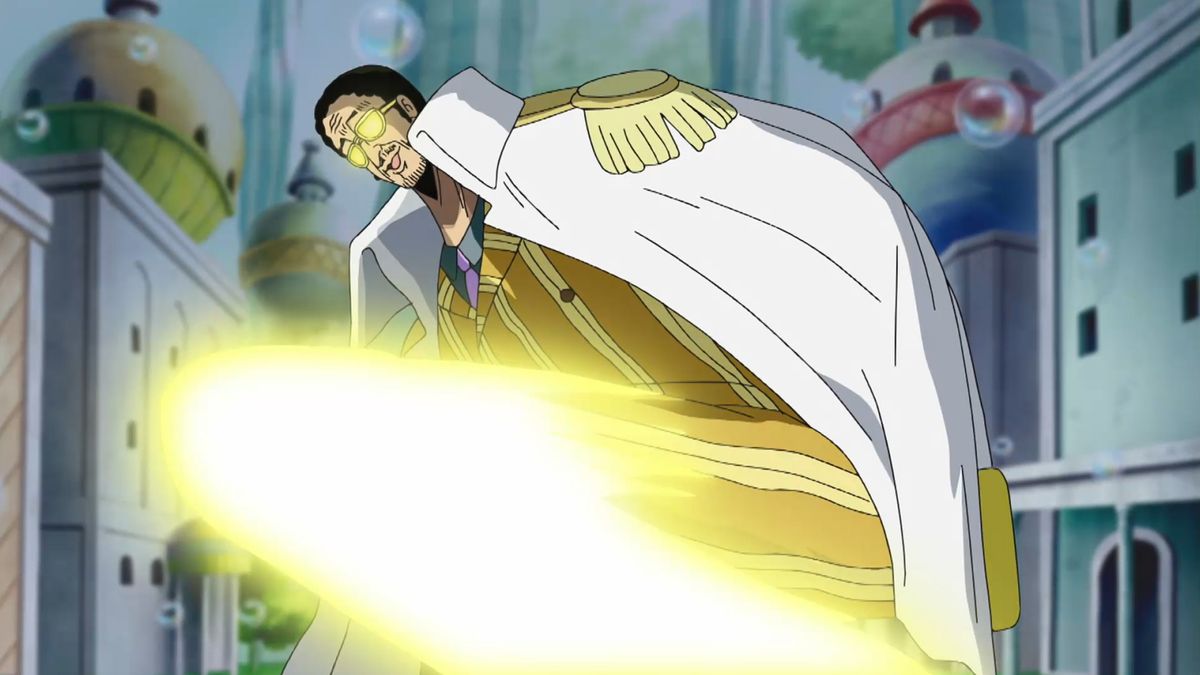
Kizaru’s Light-Speed Kick Resets the Supernovas’ Entire Power Scale
One Piece Episode 401 React follows Kizaru overwhelming Hawkins and other rookies while a Kuma-shaped weapon blocks the Straw Hats’ escape.
One Piece Episode 401 React: Kizaru demonstrates light-speed force across Sabaody, Supernovas discover that bounty does not equal readiness, and the Straw Hats meet a Kuma-shaped weapon while Rayleigh’s three-day coating clock has barely started.
What happened in Episode 401
Rayleigh begins preparing the Sunny for underwater travel while the Straw Hats separate and hide from Marine patrols. Admiral Kizaru moves through Sabaody with relaxed confusion and devastating force, searching for Sentomaru while confronting high-bounty rookies. His light-speed kick overwhelms Basil Hawkins and his attacks expose the gap between an admiral and the celebrated newcomers. Elsewhere, Luffy’s group encounters what appears to be Bartholomew Kuma blocking their escape.
RaeRae’s opening receipt
Episode 401 takes every ounce of confidence built during the three-captain breakout and places Kizaru beside the measurement. The result is humiliating by design.
The Supernovas are extraordinary. An admiral can still make extraordinary rookies look stationary.
Three days sounds short until the island becomes a hunting ground
Rayleigh needs time to coat the Sunny. The crew must survive nearby without drawing the search toward their ship.
Logistics converts every hour into exposure.
The Straw Hats cannot solve waiting through speed
Sailing away would destroy the Fish-Man Island route. Remaining together would create one obvious target.
Survival requires separation, patience, and trust.
Rayleigh works while younger pirates absorb the consequence
His task is quiet and essential. The rookies encounter the government’s visible answer elsewhere.
Craft and combat proceed on parallel clocks.
Kizaru arrives like somebody mildly inconvenienced
His voice, posture, and questions suggest no urgency. The gap between manner and destructive capacity makes every movement unnerving.
Calm becomes menace when nobody nearby can force seriousness.
He searches for Sentomaru instead of respecting the panic
Kizaru appears almost distracted by communication problems. The island experiences an emergency while he behaves like a visitor asking directions.
Eccentricity denies opponents the emotional script they expect.
Light changes movement into inevitability
A kick begins and contact arrives before ordinary defense can organize. Speed removes the dramatic warning that fighters usually read.
Power feels unfair because perception cannot keep pace.
Basil Hawkins trusts probability under impossible pressure
His cards tell him death is not scheduled for that day. The prediction supports composure without promising comfort.
Survival and victory remain completely different outcomes.
Kizaru’s kick turns a famous rookie into a demonstration
Hawkins carries an enormous bounty and supernatural preparation. One light-speed strike still sends him through destruction.
The admiral teaches the island through a body everybody recognizes.
Bounty numbers stop functioning as a complete scale
Posters quantify threat to government interests. They do not guarantee parity with the government’s strongest officers.
Sabaody exposes every assumption built from ranking alone.
Hawkins survives through transferred damage
His straw dolls absorb fatal consequences that would otherwise end the encounter. Each escape consumes another prepared life.
The ability makes survival visible as a dwindling resource.
Kizaru observes strange powers without anxiety
He notes Hawkins’s resilience and continues applying force. Curiosity never becomes caution.
Dominance appears through the luxury of experimentation.
Urouge’s strength cannot close the speed gap
Raw power and increasing size matter only when attacks can reach their target. Kizaru controls distance through movement opponents cannot follow.
A specialty becomes irrelevant against the wrong measurement.
Drake understands more than he wants to say
His Marine history gives him context for Pacifistas, admirals, and government weapons. Recognition arrives with dread.
Knowledge can deepen fear when no useful countermeasure follows.
Apoo watches spectacle until attention reaches him
Distance feels safe while somebody else receives the attack. On Sabaody, sound, light, and military reach complicate every boundary.
Spectatorship can become participation without consent.
The Supernovas share danger without becoming a team
Several captains occupy the same crisis, but survival remains crew-centered and improvised.
A generation label cannot manufacture trust under fire.
Kizaru embodies the response Charlos expected
The admiral’s overwhelming force proves the noble’s confidence was not empty. State violence exists to restore the taboo Luffy broke.
Every light-speed strike carries the auction’s political aftermath.
The episode refuses to call that response justice
No comparable deployment came for enslaved people. Kizaru attacks pirates because noble authority must look untouchable again.
Power can be lawful and morally grotesque at the same time.
The island’s beauty becomes camouflage
Bubbles, mangroves, amusement spaces, and bright avenues surround militarized pursuit.
Sabaody keeps proving that attractive surfaces can host organized cruelty.
The Straw Hats meet Kuma’s silhouette too soon
Bartholomew Kuma nearly destroyed them at Thriller Bark. Seeing the same body during escape triggers memory before analysis.
Familiar terror becomes the Pacifista’s first weapon.
One Kuma was already beyond the crew’s comfort
Thriller Bark required sacrifice, luck, and Kuma’s private decision. A return on Sabaody suggests unfinished danger.
The crew has grown without gaining evidence that this opponent became manageable.
The copy creates a mystery through small differences
Behavior, speech, and presence do not perfectly match the man they met. Confusion costs precious time.
Replication weaponizes uncertainty about identity.
Government science enters the power hierarchy
The Kuma-shaped figure suggests that institutions can manufacture force instead of relying only on exceptional officers.
Mass production changes one feared opponent into a category.
Kizaru and the Pacifista represent two enforcement models
An admiral carries singular personality and nearly unmatched ability. A human weapon carries repeatability.
The government invests in both irreplaceable talent and scalable violence.
Luffy’s crew does not know which model stands ahead
They read the face through lived experience. Viewers sense that the answer will not make escape easier.
Incomplete information becomes part of combat.
The episode widens the bill for Charlos’s punch
What began in one auction hall now reaches separate groves, rival crews, Marine units, and experimental weapons.
Protected privilege turns personal retaliation into island-wide punishment.
The rookies needed this loss of scale
Paradise allowed victories to accumulate into confidence. Sabaody shows a ceiling without asking permission.
Growth requires an honest measurement before the New World.
Overwhelming force does not make the rookies fraudulent
Hawkins, Drake, Urouge, and Apoo remain exceptional pirates. Kizaru’s dominance reveals context rather than erasing achievement.
Two truths can coexist without flattening either side.
Fear returns after the captains enjoyed swagger
Episode 399 celebrated powers and ambition. Episode 401 makes escape the mature objective.
Changing goals under new evidence is survival, not cowardice.
The coating job becomes the invisible hope
While light tears through groves, Rayleigh’s work offers the only route forward. The Sunny must become capable of entering another world.
Preparation remains a quieter kind of resistance.
This remains an episode React
This page responds to Kizaru’s light-speed attack, Hawkins’s survival, the Supernovas’ scale shock, and the Kuma-shaped figure before Luffy. Full Sabaody evaluation belongs elsewhere.
React classification keeps the episodic record correctly routed away from Anime Reviews.
The official local still remains canonical
The Episode 401 official still serves as featured image, hero, directory card, and social preview through one local attachment.
Complete metadata and unique use preserve source clarity, accessibility, and route parity.
RaeRae’s final receipt
Kizaru does not need to rage because the entire island is already arranged around his power. He asks questions, loses contact with Sentomaru, and kicks a celebrated rookie with the ease of somebody testing light against furniture. Hawkins survives, which is not remotely the same as competing.
That distinction saves the Supernovas from becoming jokes. Their bounties remain real. Their abilities remain dangerous. The admiral simply occupies a scale the rookies have not reached, and government science has started reproducing another scale through Kuma’s face.
The Straw Hats need three days. They barely receive three minutes before a familiar silhouette blocks the road. Episode 401 takes a crew that punched false divinity and reminds viewers that divinity has weapons, budgets, laboratories, and admirals. Freedom still matters. The price has finally stepped into frame.
Kizaru’s body behaves like a weaponized law of nature
Opponents can hate a soldier and still struggle to fight light itself. His Fruit makes institutional force feel elemental.
The government benefits from presenting enforcement as inevitable.
Hawkins turns prediction into emotional armor
Knowing death will not arrive allows him to remain composed while his body takes catastrophic punishment.
Certainty about survival cannot remove pain.
Each straw doll gives damage another address
Hawkins’s technique redirects consequence rather than deleting consequence.
His defense carries an ethical shadow beneath tactical brilliance.
Drake’s recognition foreshadows classified machinery
A former Marine sees design where other pirates see Kuma.
Insider knowledge reveals the state has been building more than ships.
The Pacifista borrows a human face
Technology could wear any shape. Choosing Kuma turns reputation into part of the weapon.
Identity becomes government property under mass production.
The crew’s fear carries memory
Thriller Bark taught them what Kuma could do. Sabaody offers no reason to assume mercy will repeat.
Past survival sharpens present alarm.
Escape becomes the intelligent response
No speech about courage changes the power gap. Crews need distance, information, and regrouping.
Wisdom begins when pride stops controlling the objective.
RaeRae’s extra receipt
Sabaody has spent several episodes introducing famous young pirates like the future arrived early. Kizaru walks into that excitement and resets every clock.
The reset is brutal, funny, and politically ugly. An admiral protects the world that sold Camie. A manufactured Kuma blocks the people who freed her. The rookies are not ready, but readiness has never been the only measure of whose cause deserves survival.
Light erases the pause between choice and impact
Most fighters can read a shoulder, blade, or breath before contact. Kizaru compresses warning until reaction becomes nearly impossible.
The body loses access to the information combat normally provides.
Hawkins measures death while Kizaru measures inconvenience
One man consults fate because survival is uncertain. The other wonders why communication failed.
The emotional imbalance announces the power imbalance.
Surviving the first kick spends someone else’s protection
Hawkins’s doll breaks so his body can continue. Defense has a visible inventory.
Every additional strike turns probability into attrition.
Kizaru learns through attacking
He tests how Hawkins absorbs damage rather than retreating from an unfamiliar power. Superior speed gives him time to study during domination.
Curiosity becomes another privilege of strength.
The Supernovas cannot borrow one another’s solutions
Hawkins has dolls, Urouge has strength, Drake has transformation and knowledge, Apoo has sound. None supplies a shared answer to light.
Diversity of power does not automatically create collective strategy.
Drake’s Marine past complicates his freedom
Leaving the institution did not remove knowledge of its weapons. His history follows through recognition.
Escape from a system can leave permanent fluency in its threats.
The Pacifista turns Kuma into a uniform
A singular face appears attached to repeatable military hardware. Government science converts personhood into branding.
Fear becomes standardized.
Luffy’s group has no time for forensic certainty
They must respond before learning whether the figure is Kuma, a copy, or something between. Delay and haste both carry danger.
Weaponized ambiguity narrows every good choice.
The three-day plan survives only through scattered trust
No crew member can watch Rayleigh work and every threat at once. They must believe the ship, coating, and separated friends will remain available.
Trust holds the plan together across groves.
Sabaody reveals the government’s industrial imagination
Nobles rely on inherited rank, admirals embody elite force, and Pacifistas promise production. Oppression invests in multiple futures.
Resistance must understand every layer rather than winning one dramatic room.
Kizaru makes distance feel dishonest
A grove appears large enough for escape until light crosses the interval. Geography stops protecting people who cannot match his speed.
The island’s open spaces become another kind of enclosure.
The Kuma-shaped roadblock makes memory tactical
The Straw Hats know what those paws, proportions, and Bible once meant. Previous terror informs their first response before new evidence can arrive.
Survival uses memory even when the present has copied the face.
Episode 401 closes every comfortable exit at once. The ship cannot sail, the crew cannot gather openly, an admiral crosses distance like light, and government science places a familiar nightmare ahead. The only honest plan is to survive the next contact and keep the three-day promise alive.
The power gap makes future growth concrete
Kizaru’s dominance does not offer a vague promise that stronger enemies exist somewhere ahead. Speed, impact, and the rookies’ failed responses place the missing capability directly on screen.
Training will later matter because viewers can remember this measurement. The crew needs more than bravery and accumulated victories. They need bodies, techniques, and judgment capable of surviving opponents who remove reaction time itself.
Survival becomes the only honest victory available
No rookie needs to defeat Kizaru to prove the voyage mattered. Escaping with crew members alive would already challenge the punishment sent to restore noble fear. The episode narrows success without narrowing the value of resistance.