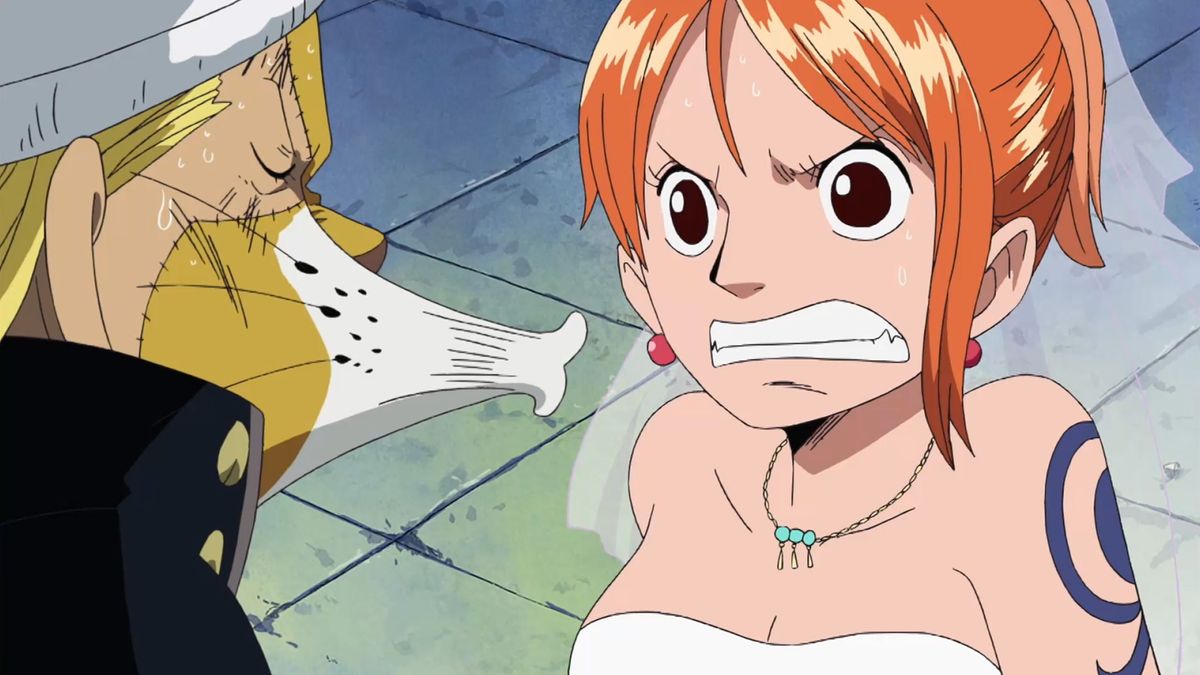
RaeRae Reacts · One Piece Episode 366
Nami Wakes Before Absalom’s Forced Kiss and Brings Friendship’s Lightning Into the Fight
One Piece Episode 366 React returns Nami’s voice before Absalom can complete the coerced ceremony and lets friendship, not possession, direct her counterattack.
One Piece Episode 366 React: Oars leaves battered Straw Hats behind to search for missing targets while Nami wakes moments before Absalom can force the ceremony’s kiss.
What happened in Episode 366
Nami regains awareness inside a future Absalom scripted without her. Her counterattack belongs to friendship and self-determination, not a transfer of possession between men.
RaeRae’s opening receipt
Nami waking changes the moral grammar of the scene. The navigator can finally name the route, refuse the role, and direct her own lightning.
Nami wakes before Absalom can force the ceremony’s kiss
The timing returns consciousness at the edge of another irreversible violation. Absalom arranged the dress, witnesses, vows, and physical proximity while Nami could not answer. Waking restores the voice his plan required absent.
The ceremony changes instantly because the person assigned the bridal role can finally reject the assignment.
Her first authority is the authority to say no
Nami does not need a competing romantic claim or a stronger man’s permission to refuse Absalom. Her own will settles whether the ceremony may continue.
Consent is not one opinion among several people in the room. The decision belongs to the person whose body and future are being claimed.
Consciousness restores information as well as movement
While unconscious, Nami could not know how she was dressed, where she had been taken, or what Absalom intended next. Waking lets her observe the conditions and make choices from that knowledge.
Agency depends partly on access to reality. Absalom’s advantage relied on keeping reality from her.
The bridal image loses authority when Nami speaks
Costume and setting told a story before she could interrupt. Once Nami’s judgment enters, the visual narrative can no longer pretend to represent mutual commitment.
Her voice reveals the dress as evidence of captivity rather than evidence of consent.
Nami is not returned to the fight as a passive survivor
She assesses danger, recognizes relationships, and directs her own weapon. The navigator resumes the skill that defines her place in the crew: reading conditions and choosing a route through them.
Recovery becomes participation rather than removal from the scene.
Friendship gives the lightning a destination
The episode’s title connects Nami’s counterattack to a bond rather than romantic possession. Her anger does not exist only because Absalom targeted her. She also recognizes harm done to somebody whose feelings and vulnerability mattered.
Solidarity turns private survival into action on behalf of another person.
Lola complicates the category of enemy
Thriller Bark places zombie bodies under Moria’s command, but individual attachments and choices still disturb that obedience. Nami’s relationship with Lola cannot be reduced to the military role assigned to the zombie.
Friendship notices personhood where the system sees only a servant.
Nami’s strategic language creates connection under danger
She survives through quick reading, persuasion, misdirection, and attention to what another person wants. Those tools can be comedic, but they also create openings force alone would miss.
Her intelligence never becomes lesser because the strategy involves emotion and conversation.
Absalom treats relationships as ownership contests
He interprets desire as a claim and rivals as threats to that claim. Nami and Lola expose another model: bonds can generate care without granting possession.
Friendship asks what the other person needs. Ownership asks how the other person can be secured.
Nami’s lightning belongs to her decision
Sanji may have reached the ceremony and fought Absalom, but the decisive moral authority remains Nami’s. She chooses when and why to strike after regaining consciousness.
The scene should not be narrated as a man’s rescue simply because a man arrived earlier.
Rescue succeeds when the rescued person regains authorship
Removing Nami from the chapel would stop immediate access. Full restoration means she can interpret what happened, name the harm, and determine her next action.
Protection that continues speaking over her would preserve part of the structure Absalom created.
Absalom’s intended kiss makes coercion unmistakable
A kiss inside a mutual ceremony can express affection. A kiss imposed on an unconscious person extends assault. Context determines meaning.
The episode places Nami’s waking at that boundary so viewers cannot mistake ceremony for permission.
A public ritual can still conceal private violence
Witnesses and formal language make the event look socially recognized. None of them changes the conditions under which Nami was brought there.
Legitimacy cannot be manufactured by surrounding coercion with an audience.
Nami’s refusal corrects the entire room
Absalom wrote himself as groom and Nami as bride. Everyone else was expected to perform inside his story. Her waking introduces the fact the performance omitted: the supposed bride never chose the role.
One truthful refusal can expose a large coordinated fiction.
The crew’s defeat by Oars raises the cost of self-rescue
Sanji, Usopp, Zoro, and the others have been battered by a giant carrying Luffy’s shadow. The network usually available to protect Nami is under extraordinary pressure.
Her ability to act matters because chosen family supports agency rather than replacing agency.
Oars’s target list cannot identify every identity
Wanted posters help him locate crew members, but he fails to understand Sogeking and Usopp as the same person and continues searching for targets not present. Administrative records contain gaps.
The crew survives partly in the space between lived identity and institutional representation.
Being absent from the list does not mean being safe
Nami is away from Oars and still endangered by Absalom. A system’s official targets never account for every form of violence happening nearby.
The episode keeps several threats visible so scale does not erase intimate coercion.
Oars leaves damage behind while pursuing categories
He strikes the people he can identify and moves onward toward the remaining poster faces. The injured bodies become collateral inside a mission defined by completion of a list.
Administrative purpose can make suffering disappear once the checkbox has changed.
Nami’s fight refuses the hierarchy of spectacular threats
A giant attacking the crew may appear more important than one man attempting a forced kiss. Both involve another person’s will being overridden through power.
Ethical attention should not depend only on physical scale.
Friendship crosses the line Moria drew between human and zombie
Moria’s organization defines zombies as owned bodies carrying stolen shadows. Nami responds to Lola as somebody capable of feeling, attachment, and choice.
That recognition destabilizes the system because solidarity depends on personhood the hierarchy denies.
Lola’s feelings do not create ownership either
Friendship does not require agreeing that any admirer deserves the person they desire. Nami can care about Lola while still preserving the distinction between affection and entitlement.
Solidarity becomes stronger when nobody’s romantic longing overrides another person’s consent.
Nami uses weather as authored force
Her lightning is not supernatural power acquired through theft. The attack comes from knowledge, tools, timing, and years of learning how atmosphere behaves.
Against a man who relies on invisibility and altered bodies, Nami answers with practiced intelligence she owns.
The navigator turns a trapped room into a route
Absalom designed the chapel to end with one outcome. Nami’s awareness reveals alternatives, allies, vulnerabilities, and exits.
Navigation applies beyond oceans. She reads power, emotion, and environment until a forced destination becomes escapable.
Anger after waking deserves space
Survivors are often expected to feel grateful the worst possible moment was interrupted. Nami does not owe calm, politeness, or immediate emotional neatness.
Her rage is information about boundaries crossed while she could not defend them.
Sanji’s contribution does not need to disappear
He interrupted the ceremony and fought Absalom because Nami was endangered. Recognizing Nami’s agency does not erase that work.
A complete account can honor assistance without allowing assistance to become ownership of the ending.
The episode returns consequence to the invisible aggressor
Absalom used unseen access to avoid resistance and accountability. Nami’s lightning reaches the person behind the concealment.
Weather becomes an answer to secrecy because the strike does not require accepting his preferred visibility.
Episode 366 remains an episode React
This page responds to Nami waking before Absalom’s forced kiss, reclaiming agency, and directing friendship’s lightning while Oars leaves the battered crew to hunt remaining targets. A complete Thriller Bark Review belongs after the arc resolves those systems.
React classification preserves broadcast-level close reading and keeps whole-work Reviews distinct.
The official local still remains canonical
The Episode 366 still serves as featured image, hero, bounded-directory card, and social preview. One local attachment provides consistent recognition across every discovery route.
Complete source and accessibility metadata remain attached, and no other record reuses the image.
RaeRae’s final receipt
Episode 366 gives Nami back to herself at the exact moment Absalom expects her silence to complete his fantasy. He chose the dress, room, witnesses, vows, and intended kiss because unconsciousness removed the answer he knew he could not earn. Then Nami opens her eyes, and every decoration becomes what the ceremony always was: evidence of captivity.
Her counterattack matters because Nami is not a prize Sanji retrieved from another man. She is the navigator who reads the room, recognizes friendship, refuses the assigned future, and decides where lightning lands. Lola matters because Nami can see a person inside the zombie category Moria imposed. Oars is crushing the crew somewhere else, but size does not make Absalom’s coercion a smaller violation. Nami’s waking restores information, movement, anger, and authorship. The forced bride disappears the moment the woman speaks.
Survivor authorship begins before the danger is completely over
Nami does not receive a quiet recovery room where every threat has already been removed. She wakes within the coercive setting and has to make decisions while Absalom remains present. Agency returns under pressure rather than after a neat rescue ending.
That timing gives her actions special weight. She does not need perfect safety before her interpretation counts. Her refusal and anger become authoritative the moment consciousness returns.
The forced ceremony tried to make Nami’s body speak without her
The dress, position, audience, and intended kiss were arranged to communicate bridal agreement while Nami could not communicate anything. Absalom used her appearance as false testimony supporting his desire.
Waking allows Nami to contradict the image with the person. The body never consented merely because somebody else posed the body inside familiar symbolism.
Friendship notices choice inside a category designed to erase choice
Moria calls Lola a zombie, a label meant to settle ownership and purpose. Nami responds to her attachments, pain, jealousy, generosity, and capacity to act. The relationship recognizes more than the role assigned by the master.
That recognition matters because liberation often begins when somebody refuses the category authority claims is complete.
Nami’s strategy does not make her friendship insincere
She can read Lola’s emotions tactically and still care about what happens to her. One Piece lets survival intelligence and genuine attachment grow beside each other. Human motives rarely arrive in isolated boxes.
The important boundary is whether Nami treats Lola’s feelings as disposable after gaining safety. Friendship becomes real through continued recognition rather than initial purity.
Lightning answers concealment with environmental reach
Absalom’s invisibility helps him choose when others may perceive him. Nami’s weather knowledge changes the surrounding conditions instead of waiting for him to present a convenient target. The attack belongs to expertise developed through observation and practice.
Her weapon does not reproduce his violation. She uses authored skill to end unwanted access, while he uses supernatural concealment to create unwanted access.
Sanji’s rescue and Nami’s counterattack can both matter
Recognizing her agency does not require pretending nobody helped. Sanji interrupted the ceremony and absorbed danger while trying to reach her. Nami then wakes, evaluates the situation, and supplies her own decision.
Chosen family is strongest when assistance creates more room for a person’s autonomy. The helper does not need ownership of the ending for the help to remain meaningful.
The absent crew still shapes Nami’s choices
Oars has scattered and injured the Straw Hats, but their relationships travel into the chapel through Nami’s confidence that rescue, resistance, and reunion remain possible. She acts as one member of a network rather than an isolated captive.
Moria can divide bodies across rooms. He cannot make the obligations among them disappear.
Waking is not the same as being untouched by what happened
Nami’s ability to fight does not erase the kidnapping, unconscious handling, forced clothing, or intended kiss. Competence after violation should never be used to claim the violation caused no harm.
Strength describes what she can do next. Strength does not revise what Absalom chose to do before she could answer.