RaeRae Reacts · One Piece Episode 316
Shanks and Whitebeard Split the Sky Over Ace’s Dangerous Pursuit
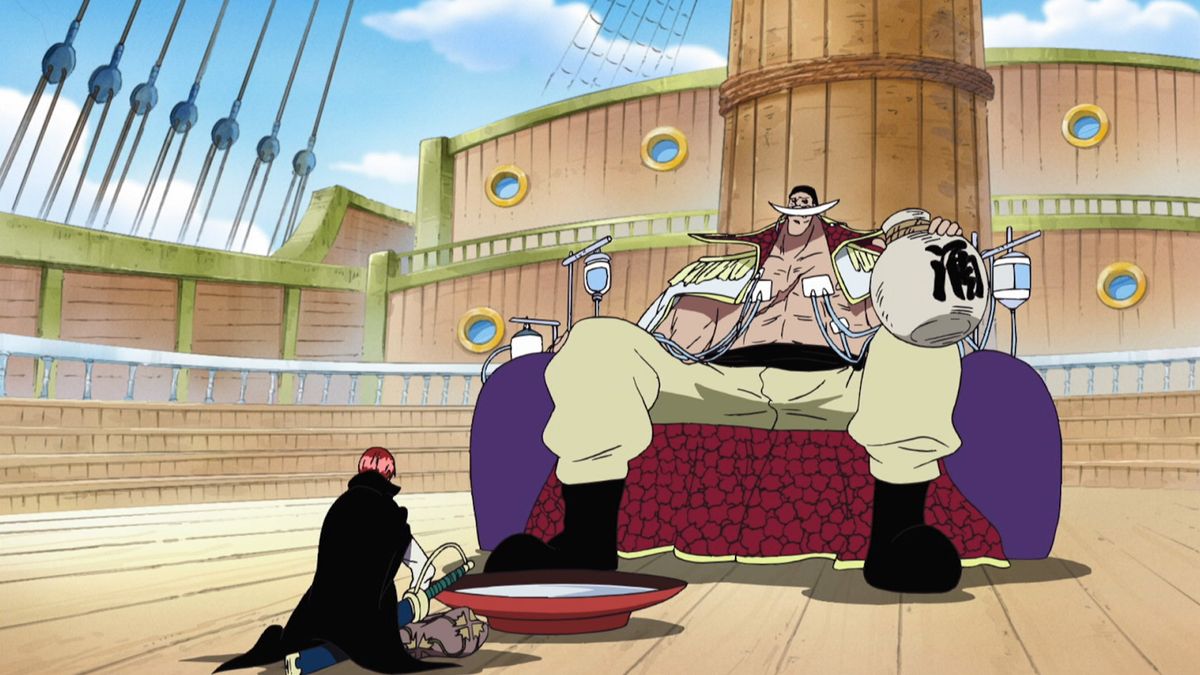
One Piece Episode 316 explains the Three Great Powers before Shanks warns Whitebeard about Blackbeard and their clash divides the sky.
The short version
Episode 316 explains the Three Great Powers, then lets Shanks board Whitebeard’s ship and split the sky during a clash between Emperors. The world outside Water 7 is already moving toward crisis, and Ace’s pursuit of Blackbeard sits directly inside that danger.
The Three Great Powers describe balance, not justice
Marine Headquarters, the Seven Warlords, and the Four Emperors restrain one another through threat. Stability exists because no side can move freely without consequences.
Shanks crosses military opposition to deliver a warning
Government ships cannot prevent the meeting. His presence demonstrates Emperor influence before the conversation even begins.
Whitebeard’s crew treats reputation as lived reality
The enormous ship, divisions, and confident family structure show power organized around a captain whose age has not erased authority.
Ace and Blackbeard make the meeting urgent
Shanks does not arrive for ceremony. He wants Whitebeard to recall Ace because Teach represents danger the younger commander does not fully understand.
The sky split makes will visible at world scale
When their weapons meet, the clouds divide. The image tells viewers that the strongest pirates alter atmosphere before the story fully explains every mechanism.
RaeRae’s receipt
I love the sky split, but the real tension is Shanks asking another powerful man to protect Ace from pride and incomplete information. Whitebeard hears interference where Shanks sees disaster approaching. The world will pay for that disagreement.
Episode facts and receipts
Episode 316 aired July 1, 2007. ONE PIECE.com credits Hirohiko Uesaka, Takahiro Imamura, Masayuki Takagi, Miyuki Sato, and Kumiko Fukuzawa.
Classification: numbered manga-canon post-Enies Lobby television episode and RaeRae React. Anime, Anime Series, Japanese Anime, and Anime Reacts, not Anime Reviews.
Shanks walks onto Whitebeard’s ship carrying diplomacy and danger
The meeting begins with courtesy under pressure. Shanks arrives as an Emperor, but he also arrives as a man asking another captain to stop a son from pursuing a fatal course. Every gesture carries two meanings: respect between legendary pirates and the possibility that respect will fail. The surrounding crews understand that a conversation between these men can alter seas far beyond the deck.
Shanks does not need a fleet demonstration to establish weight. His presence changes the physical behavior of weaker bodies nearby. Authority becomes atmosphere before either captain raises a weapon.
Conqueror’s Haki turns presence into visible consequence
Crew members collapse as Shanks advances, and the damage around him tells us that willpower can become force. The display expands the combat language without pausing for a textbook. Viewers learn through reaction: ordinary endurance cannot remain upright beneath this pressure, while Whitebeard’s strongest people continue watching.
The power suits Shanks because his defining influence has always exceeded direct screen time. He changed Luffy’s life through conviction, sacrifice, and a promise. Episode 316 gives that invisible force a physical vocabulary.
The warning about Blackbeard comes from a scar, not speculation
Shanks points toward the marks across his face as evidence. Blackbeard did not catch him careless, and the wound did not come from a childish accident. That testimony matters because Shanks possesses enough strength and experience to understand real danger. His concern for Ace grows from knowledge purchased through his own body.
The scar prevents Whitebeard from dismissing the warning as political maneuvering alone. Shanks is not asking for fear based on rumor. He is offering proof that Teach conceals more ability and patience than his former station suggested.
Blackbeard becomes terrifying through what powerful men do not know
Teach has spent years beneath attention, allowing louder names to define the hierarchy around him. Shanks recognizes concealment as part of the threat. A man who can wound an Emperor and then remain underestimated understands timing, performance, and ambition. Physical strength is only one weapon inside that patience.
The danger therefore exceeds a simple matchup with Ace. Blackbeard’s movement could disturb the balance supporting the entire era. Episode 316 lets absence create menace; Teach dominates the conversation without standing on the deck.
Ace’s pursuit turns loyalty into a possible trap
Ace hunts Teach because a crewmate was murdered and the offender violated Whitebeard’s family code. The pursuit grows from values worth defending. That moral clarity cannot guarantee a safe outcome. Loyalty can become vulnerable when an enemy predicts exactly which principle will force action.
Shanks asks Whitebeard to interrupt the pursuit, not because Ace lacks courage, but because courage cannot solve every imbalance. The request recognizes a painful truth: protecting somebody may require stopping a righteous decision before consequences become irreversible.
Whitebeard hears intervention as an attack on family authority
Calling Ace back would mean admitting another captain read danger more accurately inside Whitebeard’s own household. Pride and parental identity tighten around the decision. Whitebeard has built a family where sons act beneath his symbol, so Shanks’s request crosses both strategic and emotional territory.
His refusal is not empty stupidity. Whitebeard believes the family code must mean something when a son is killed. Yet the episode shows how an honorable system can become rigid when leadership cannot separate accountability from the specific method chosen.
The word son changes the meaning of pirate hierarchy
Whitebeard does not organize his crew only through rank. He calls them sons and receives filial devotion in return. That language offers belonging to people the world may have discarded. The warmth explains why Ace’s pursuit matters so deeply and why Whitebeard resists outside instruction.
Family language also creates responsibility. A father must protect, guide, and sometimes confront a child whose conviction outruns safety. Episode 316 quietly asks whether Whitebeard’s pride is serving Ace or serving the image of a father who never retreats.
Shanks acts from care without claiming ownership over Ace
Ace is not his subordinate, and Whitebeard owes him no obedience. Shanks still crosses hostile water to speak because the danger reaches Luffy’s brother and the larger world. Concern becomes action even when action risks insult.
That choice reflects the man Luffy remembers. Shanks can laugh away attacks against himself, but threats involving people he values change his response. The warning extends his protective instinct beyond his own flag.
The Three Great Powers make peace feel engineered rather than natural
Emperors, Marines, and the Seven Warlords hold the sea in a tense arrangement. Balance does not mean justice or friendship. Balance means enough competing force exists to discourage uncontrolled collision. Every ambitious move tests whether the structure can absorb another shock.
Shanks understands that Ace and Blackbeard are not isolated pirates settling a private grievance. Their confrontation can pull famous crews, government interests, and old rivalries into motion. Strategy begins by seeing the relationships surrounding a fight.
Whitebeard embodies an era that refuses to bend
His enormous body, medical support, legendary weapon, and absolute voice turn age into monument rather than weakness. He has survived long enough to watch generations rise beneath him. That endurance gives his judgment authority while also making change harder to accept.
Shanks represents a younger Emperor reading a new threat. Their disagreement becomes generational without reducing either man to age alone. One protects the code that built his family; the other warns that a patient outsider has learned how to exploit established expectations.
The sake cannot complete the ritual of mutual respect
Sharing drink traditionally creates room for conversation, recognition, and temporary peace. The meeting honors enough ritual to show neither captain arrived carelessly. Yet ceremony cannot resolve the underlying disagreement. Courtesy creates a bridge, but pride and conviction prevent either man from crossing fully.
That failure makes the eventual clash more tragic than a random contest. They understand each other’s stature. They simply cannot translate respect into agreement when Ace’s future and Whitebeard’s authority are at stake.
When the weapons meet, the sky reveals the scale
Shanks and Whitebeard do not need a prolonged duel. One collision splits the clouds overhead. The image tells us their disagreement has escaped ordinary measurement. Nature seems forced to acknowledge two wills that refuse compromise.
The spectacle also protects mystery. We receive enough power to understand why Emperors anchor the world’s balance, but not enough explanation to domesticate them. Awe remains part of the information.
The split sky is political imagery as much as combat imagery
Two captains divide the heavens because their choices may divide the era. Shanks sees a coming rupture. Whitebeard refuses the proposed prevention. The visual externalizes a world already separating around hidden ambitions, wounded pride, and a brother sailing toward danger.
No ordinary citizen witnesses the private argument, yet ordinary lives will eventually feel the consequences. Great-power decisions often begin in rooms far removed from the people who pay their price.
Luffy’s family expands through bonds that do not share blood
Dragon and Garp defined biological lineage in the preceding episodes. Ace and Shanks complicate that map. Ace is Luffy’s brother by promise, Whitebeard’s son by chosen belonging, and a person Shanks worries about partly through love for Luffy. The emotional network ignores tidy genealogy.
One Piece repeatedly treats chosen bonds as fully real rather than secondary substitutes. Episode 316 makes those bonds capable of moving Emperors toward confrontation.
Ace remains absent while everybody else measures his risk
The structure creates painful dramatic distance. Viewers hear the warning, understand Shanks’s scar, and watch Whitebeard refuse, while Ace continues toward Teach beyond the reach of this conversation. Knowledge arrives where action may no longer travel fast enough.
Absence keeps Ace from defending the choice or softening the concern. He becomes the point where love, pride, vengeance, and strategy collide. Every man claims some understanding of what must happen, but Ace is already authoring the next move.
The episode refuses to confuse confidence with safety
Ace is powerful. Whitebeard is powerful. Their crew’s reputation commands oceans. None of those facts makes Shanks’s concern irrational. Strength can increase exposure when strength encourages somebody to accept a fight designed around hidden advantages.
The warning feels credible precisely because Shanks respects Ace rather than belittling him. He fears the opponent and the circumstances, not a lack of bravery. That distinction keeps concern from becoming condescension.
Teach’s patience challenges the old world’s assumptions
Established powers rely on visible reputation. Bounties, titles, crews, and territories make danger legible. Teach spent years letting those systems undervalue him. His strategy turns the hierarchy’s confidence into camouflage.
Shanks recognizes the pattern because the scar records a moment when appearances failed. Whitebeard trusts the family order he built. The coming conflict grows from the space between hidden ambition and inherited certainty.
Episode 316 makes exposition feel like a storm warning
We learn about Emperors, balance, Haki, Blackbeard, Ace’s pursuit, and Whitebeard’s code, but the information never sits still. Every fact increases pressure on the next decision. Lore becomes suspense because understanding the world means understanding how much can break.
The episode demonstrates why long-form setup deserves emotional craft. A list of powerful names would feel distant. A scar, a father’s refusal, and a divided sky make the same structure personal.
RaeRae’s final receipt
Shanks came to prevent a disaster, and Whitebeard heard a challenge to his family. That mismatch hurts because both men care about Ace in different ways. One sees the predator hiding behind patience. The other sees a son enforcing the only code that makes their found family safe. Pride enters through the exact values that made each captain worth following.
Then the sky splits, because One Piece refuses to let this conversation feel small. Ace is sailing toward Blackbeard. Shanks carries a scar nobody should dismiss. Whitebeard will not call his son back. The episode ends without resolution, yet the warning has already become a receipt the future will collect. Every cloud above them knows the era just moved.
The warning preserves Shanks as a captain who thinks beyond victory
He could have treated Whitebeard as a rival whose mistake created opportunity. Instead, Shanks tries to prevent a chain reaction that might strengthen his own position through another crew’s loss. The choice reveals leadership concerned with the sea beyond immediate advantage.
That wider vision separates foresight from fear. Shanks is willing to look cautious in front of a legend because avoiding a catastrophic collision matters more than performing invulnerability.
That responsibility makes his failed warning more haunting with every coming consequence.
Always.
The warning remains.