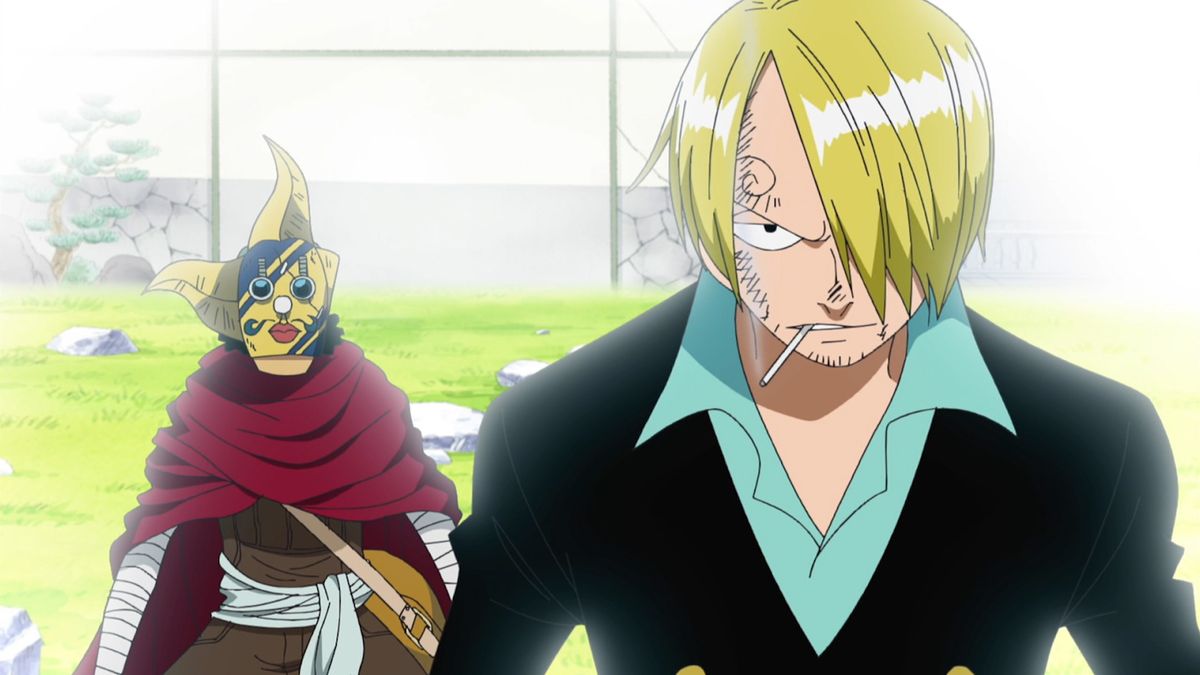
RaeRae Reacts · One Piece Episode 297
Sanji Saves Sogeking From Jabra’s Weaponized Lie
One Piece Episode 297 lets Jabra fake surrender, wound Sogeking, and discover that Sanji has arrived to put rescue ahead of the wolf’s deception.
The short version
Episode 297 gives Sanji the matchup where his protective instinct finally serves the rescue instead of obstructing the rescue. Jabra lies about surrendering the key, wounds Sogeking, and prepares a killing blow. Sanji arrives with a kick that answers deception through action.
Jabra understands compassion as an opening
He claims that he no longer wants to kill and tosses the key where Sogeking can reach. The lie works because the crew wants a route that avoids another costly fight. Jabra turns mercy into bait.
Sogeking is brave enough to hope
Usopp’s reach for the key is not pure stupidity. Robin’s deadline rewards risk. A peaceful surrender would save time and free another fighter. The possibility deserves testing even when the source is untrustworthy.
The wolf punishes vulnerability
Jabra’s claws strike the moment Sogeking moves into the open. CP9 training treats vulnerability as proof that violence is justified. The deception confirms that institutional ruthlessness survives beneath personal theatrics.
Sanji arrives after someone else paid for his earlier limit
Nami completed the Kalifa fight and Chopper became an emergency. Sanji’s return cannot erase that receipt. Heroic timing belongs beside accountability for the work transferred.
The hunter title reframes his role
Sanji is not entering to protect an abstract woman category. He protects a specific crewmate from a specific attacker while Robin needs a key. The action finally aligns care with material consequence.
Jabra’s lies attack crew trust
He manipulates information because Sogeking’s identity and place in the crew remain wounded. A lie reaches deepest when the relationship already contains doubt.
Kicking Jabra does not solve Sanji’s gender rule
The matchup lets him use full force because the opponent is male. Success demonstrates combat value without answering why Kalifa’s agency received different treatment.
Adaptation and performance
Ryo Suga’s script and Katsumi Tokoro’s direction build tension around the tossed key before Sanji’s entrance. Kazuya Hisada’s animation direction gives the rescue kick speed and consequence.
RaeRae’s final reaction
I love Sanji saving Sogeking. I also keep Nami’s labor on the page. Redemption cannot mean the audience forgets who carried the cost before the hero found a matchup compatible with his code.
Episode facts and receipts
Episode 297 aired February 11, 2007. ONE PIECE.com credits Ryo Suga, Katsumi Tokoro, Kazuya Hisada, Miyuki Sato, and Michiyo Kawasaki.
Classification: numbered manga-canon Enies Lobby television episode and RaeRae React. Anime, Anime Series, Japanese Anime, and Anime Reacts, not Anime Reviews.
Jabra’s surrender story is designed around time pressure
He does not need Sogeking to trust him forever. He needs one movement toward the key. Robin’s deadline makes a quick resolution desirable enough that even a suspicious offer deserves attention.
The lie exploits urgency rather than ignorance. A person can recognize danger and still test a narrow chance when delay carries its own cost.
False mercy is another CP9 technique
Rokushiki gives Jabra named physical attacks. The tossed key turns language and gesture into an attack before claws move. He performs reluctance to kill because mercy lowers the target’s defense.
The technique reflects an institution that uses justice language to disguise predetermined violence. Jabra’s small deception mirrors Enies Lobby’s larger one.
Sogeking’s reach keeps Robin at the center
Usopp risks exposure because the key may open Robin’s cuffs or free him and Zoro. He is not chasing treasure or trying to prove bravery. The object has immediate rescue value.
That purpose distinguishes courageous risk from vanity. Fear remains rational. Movement happens because another person’s life matters more than a safe hiding place.
The wound lands on a body already carrying Water 7
Usopp entered Enies Lobby after losing to the Franky Family, fighting Luffy, leaving the crew, and hiding behind Sogeking. Jabra’s claws strike a person whose confidence was already physically and emotionally damaged.
The injury therefore does more than threaten a sniper. The attack tests whether fragile return can survive another humiliation.
Sanji’s entrance protects a man, not an idealized category
He sees Jabra preparing to kill Sogeking and intervenes with effective force. The response centers the endangered person rather than Sanji’s image of himself as protector.
That difference matters after Kalifa. Care functions best when the protected person’s actual danger determines the action.
The hunter understands the wolf’s method
Jabra relies on predatory patience, false signals, and sudden movement. Sanji arrives after the trap has been revealed. He can read the agent as a hunter rather than a person negotiating in good faith.
The title’s hunter language positions Sanji as somebody capable of tracking intention beneath performance. Observation becomes part of the kick.
Protection becomes meaningful through specificity
Broad declarations about protecting women allowed Sanji to ignore Kalifa’s choices and transfer danger to Nami. Protecting Sogeking requires no abstract rule. A friend is on the floor and an attacker is moving.
Specific care responds to evidence. The clarity gives Sanji’s strength moral direction.
The episode offers repair through action, not absolution
Sanji saves Sogeking and reenters the key hunt. That action adds a positive receipt. The action does not delete his previous failure or complete an apology the story has not yet staged.
Character growth becomes believable when new choices accumulate without rewriting old harm. Fandom can celebrate the rescue and remember Nami.
Usopp needs saving without becoming useless
Receiving rescue does not cancel his contribution. Usopp entered the tower, helped Zoro survive the handcuff problem, identified CP9 rivalry, and moved toward a key while terrified.
Interdependence means strong people also become vulnerable. Worth cannot depend on never needing another crewmate.
Jabra’s contempt reveals a narrow strength ideology
He treats Sogeking’s vulnerability as proof that killing him carries no moral complication. CP9 ranks bodies and mistakes rank for value.
Sanji’s entrance rejects that equation. A physically weaker sniper can matter enough that a stronger fighter reorganizes the battle around his survival.
The key remains bait and objective at once
Jabra weaponizes the key because the crew genuinely needs the object. A tool can remain valuable after somebody uses value to build a trap.
The crew cannot simply stop wanting access. They must defeat the person controlling access and recover the material route toward Robin.
The fight redistributes roles again
Sanji takes Jabra. Sogeking survives and can return to range. Zoro needs freedom to face Kaku. Nami and Franky manage Chopper. Each corrected matchup changes the network.
Enies Lobby succeeds as ensemble action because switching one opponent alters several responsibilities at once.
Masculinity looks better when care has a name
Sanji’s theatrical chivalry often turns women into symbols. His defense of Sogeking is less glamorous and more grounded. He protects a frightened man wearing a ridiculous mask.
That care expands masculinity beyond rivalry. Strength becomes the ability to arrive for somebody who cannot offer prestige in return.
The animation sells interruption as power
Jabra controls the rhythm until the kick enters from outside his expectation. The entrance works because timing breaks the finishing motion rather than waiting for a formal matchup announcement.
Kazuya Hisada’s animation direction gives the impact enough clarity that viewers understand rescue before spectacle.
RaeRae’s second look
I want Sanji at his best, which means I refuse to call every choice his best. Episode 297 gives me a version of his protection I can support without qualification. He sees Sogeking in danger and changes the outcome.
The kick does not erase Kalifa. The kick proves Sanji can place care inside effective action. That proof makes the earlier failure more visible, not less.
Jabra’s performance depends on controlling the story first
He introduces himself as a reluctant killer before Sogeking can define the encounter. The claim asks the target to interpret claws through the language of restraint. Once the key leaves his hand, he appears to have surrendered control.
The physical attack reveals that narrative control was the first weapon. Jabra wants Sogeking moving according to a story Jabra authored.
Usopp’s relationship with lies makes the trap personal
Usopp lies to entertain, survive, inspire, stall, and construct courage. Jabra lies to create vulnerability for a killing blow. The episode places two uses of falsehood in the same space.
Ethics depends on purpose, power, and consequence. Calling both men liars does not make their actions equivalent.
Sogeking’s mask cannot protect the body
The persona gives Usopp enough emotional distance to return. Jabra’s claws bypass the story and reach flesh. Performance can help someone act without making action painless.
The wound preserves the cost of courage. Sogeking may sound legendary. Usopp still bleeds underneath.
Sanji recognizes Usopp through the disguise
Whether the crew openly names the secret matters less than how they respond. Sanji protects the person wearing the mask without demanding confession first.
Belonging does not wait for Usopp to resolve every word spoken in Water 7. The body in danger receives care now.
A rescue entrance can become emotional evidence
Usopp left because he believed weakness and disagreement might make him disposable. Sanji’s kick tells him that the crew will not allow Jabra to finish the job.
The action cannot repair the Going Merry conflict alone. The action creates evidence that repair remains possible.
Sanji’s mobility changes the room
Jabra controls Sogeking through close-range threat. Sanji’s speed interrupts the predator-prey arrangement before the finishing strike lands.
Arrival is tactical. The kick removes Jabra from Usopp’s immediate space and creates time for the wounded sniper to survive.
The matchup correction protects more than one fighter
Sanji taking Jabra allows Sogeking to leave direct combat, preserves his ranged contribution, and keeps a key-holder occupied. The change also supports Zoro’s separate battle by reducing interference.
One corrected pairing reorganizes the tower’s labor map.
Jabra’s cruelty is ordinary inside CP9
He treats deception and execution as professional craft. No dramatic personal grudge is required. Institutional culture made such choices routine.
That ordinariness matters. Robin’s captivity depends on agents who experience cruelty as a shift assignment.
Sanji’s anger does not need romantic ownership
He can be furious because a crewmate was attacked and another crewmate is being dehumanized. Care does not require imagining either person as property under his protection.
Episode 297 works best when anger grows from solidarity rather than masculine claim.
Sogeking’s survival preserves future action
The sniper still has roles no kick fighter can fill. Distance, communication, deception, and precision will matter once Robin reaches the bridge.
Saving him is not sentimental delay. The rescue protects capacity the crew will need.
The key trap reveals scarcity manufactured by CP9
Jabra can weaponize a small object because the government made access scarce and opaque. Five keys force the crew to treat every offer as potentially decisive.
Manufactured scarcity turns hope into leverage. The captor creates the problem, then punishes rescuers for responding urgently.
RaeRae’s third look
I refuse to make Sanji’s story a simple fall-and-redemption chart. Human choices are messier. He failed the mission against Kalifa, then made the right choice when Jabra attacked Sogeking. Both facts belong to him.
The crew does not need perfect people. The crew needs people capable of showing up, being held accountable, and making a better next decision. Episode 297 supplies one of those decisions.
The episode makes rescue an answer to shame
Usopp’s mask exists partly because returning openly felt impossible after Water 7. Jabra tries to turn that vulnerable return into death. Sanji’s arrival says shame does not cancel the crew’s obligation to keep him alive.
Protection comes before the argument is finished. That order matters. People need safety before they can complete accountability and repair.
Sanji’s best masculinity is relational
He does not win status by humiliating Sogeking or demanding gratitude. He places his body between a friend and a finishing blow. Strength becomes useful because relationship gives direction.
The moment expands Sanji beyond romantic performance. Men can protect one another without rivalry becoming the emotional center.
RaeRae’s closing receipt
Episode 297 does not need a speech naming every earlier failure. The new action still matters. Sanji sees the wolf weaponize mercy, sees Sogeking bleeding, and responds with the force the situation requires.
I celebrate that choice while keeping the ledger open. Loving a character should make accurate praise more important, not less.
The rescue lands before pride can interfere
Sanji does not pause to ask whether Sogeking deserves help, whether the mask is ridiculous, or whether their unfinished argument makes the danger less urgent. A friend is falling, so Sanji moves. That immediate answer gives the episode one of Enies Lobby’s clearest definitions of belonging.
Arguments can wait. Survival cannot.