RaeRae Reacts · One Piece Episode 280
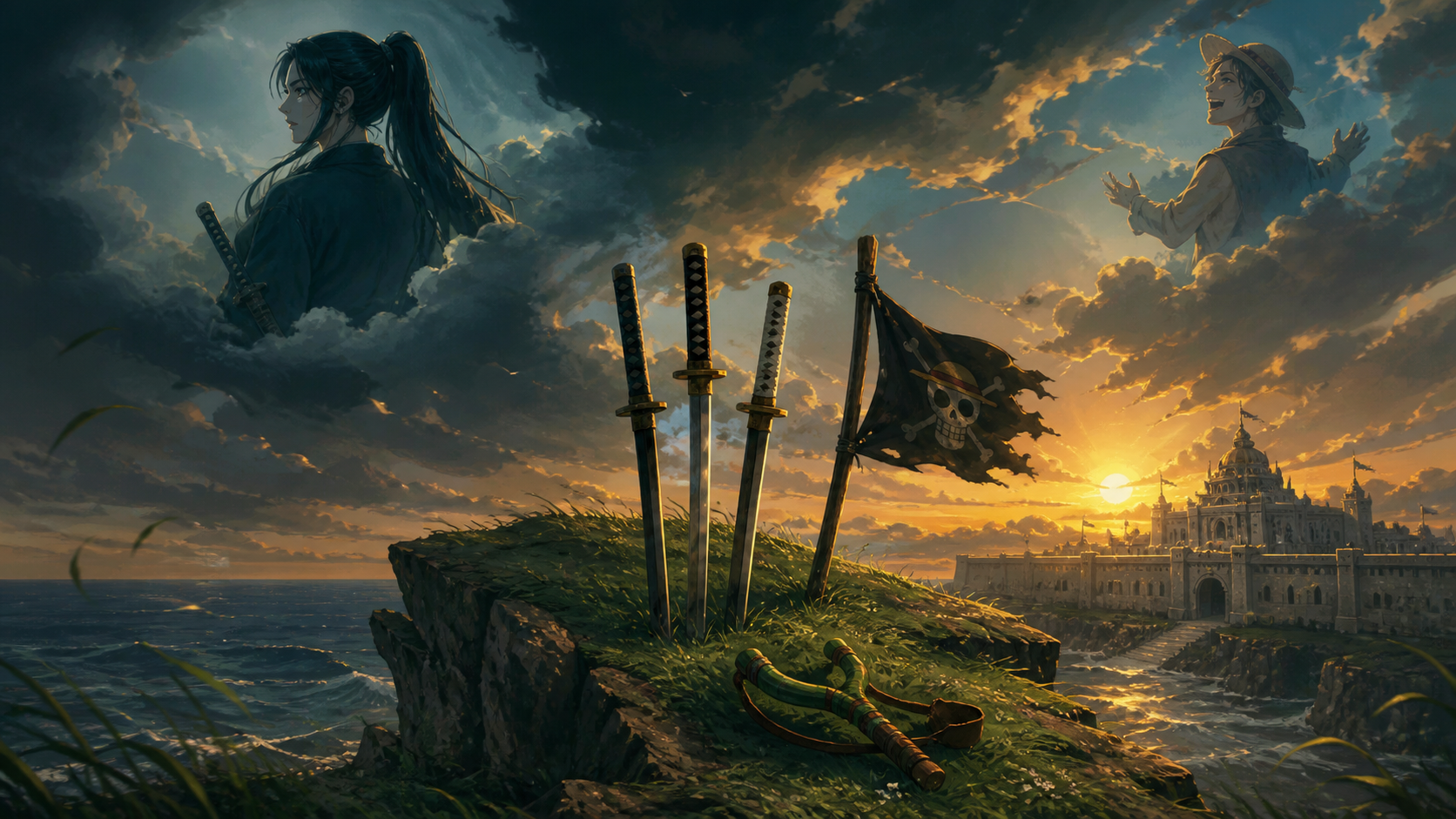
Zoro and Usopp Prove Courage Has More Than One Voice
One Piece Episode 280 pairs Zoro’s discipline with Usopp’s frightened bravery while Enies Lobby tests whether both forms of courage belong on the same crew.
The short version
Episode 280 pairs Zoro and Usopp because courage is not one personality type, and the crew needs both the man who looks fearless and the man who is brave while visibly terrified.
The anime remains parked in recap country, so let us not pretend the pacing problem disappeared. Zoro and Usopp get the second memory file while Robin is still waiting inside a government fortress. The pairing initially looks like “two male Straw Hats whose flashbacks fit in one broadcast.” Look closer and that becomes a useful argument about promises, shame, usefulness, and the different performances people build around fear.
What this recap is actually doing
Zoro’s history turns discipline into grief with a sword strapped over that. Usopp’s history turns invention and loud claims into a survival method. One promises to become the greatest swordsman because Kuina cannot continue. The other becomes a storyteller because absence hurts and a frightened village boy needs some control over what tomorrow might bring. Neither dream is decorative.
Zoro makes pain look quiet. Usopp makes pain noisy. Fandom often rewards the first presentation and treats the second as weakness, which misses what the crew actually uses. Zoro holds lines nobody else can hold. Usopp sees angles, invents tools, lies enemies into mistakes, and acts despite knowing exactly how badly a fight can go. Enies Lobby needs both forms of courage.
The choice that matters now
Usopp is not even standing there under his own name. Sogeking is the mask that lets him return after Water 7 without resolving every wound. That is messy, proud, loving, and painfully human. Zoro’s insistence on accountability still matters, but so does the fact that the crew makes room for Usopp’s indirect return because Robin’s life is bigger than the argument they have not finished.
Institutions love one narrow picture of strength: obedient, useful, quiet, replaceable. The Straw Hats keep failing that test. Zoro’s loyalty is chosen, not commanded. Usopp’s usefulness comes from imagination the government would dismiss until that burns their flag. The recap accidentally makes the case that freedom needs more than physical power; that needs people willing to imagine an outcome authority calls impossible.
Adaptation, pacing, and the awkward truth
Replaying two origins gives the episode a clearer internal contrast than a single-character clip reel, but that is still recycled footage placed at a cliffhanger. The strongest transitions connect Zoro and Usopp’s old vows to the bridge at Enies Lobby. The weakest passages behave like the audience forgot entire arcs and needs a compressed wiki page with music.
The bonus comedy keeps experimenting with the cast as archetypes instead of advancing canon. That makes that disposable, but not worthless. Seeing the actors and character designs pushed into nonsense reminds us how elastic this crew has become after hundreds of episodes.
RaeRae’s final reaction
Episode 280 is not required plot viewing. that is useful character viewing if you meet that on its actual terms. Zoro and Usopp do not teach the same lesson. They prove the same crew can hold radically different relationships with fear and still arrive at the same decision: Robin does not face the government alone.
Episode facts and receipts
One Piece Episode 280 aired in Japan on October 8, 2006. The official ONE PIECE.com episode record classifies that inside the Enies Lobby story and identifies that as a recap installment. That distinction matters: this React judges how the anime reframes established material at this exact rescue-story pressure point rather than pretending the flashbacks are new plot.
Classification: numbered television episode, recap-heavy anime-original presentation, RaeRae React. that belongs in Anime and Japanese Anime, and that does not belong in Anime Reviews.
Two dreams built from absence
Zoro and Usopp appear to occupy opposite ends of the bravery chart. Zoro walks toward danger with a sword in his mouth and a complaint about directions. Usopp sees every possible disaster, describes several additional disasters nobody considered, and then somehow stays. Episode 280 gains purpose by refusing to treat only one of those men as brave. Both dreams begin with absence. Kuina dies before Zoro can settle their rivalry. Yasopp leaves Syrup Village, and Usopp fills the silence with stories about pirates returning.
Zoro responds by hardening routine into discipline. Usopp responds by turning imagination into identity. One body trains until pain looks ordinary. One voice grows louder whenever fear threatens to define the room. Those methods are not equal in combat power, but Enies Lobby is not solved by combat power alone. The crew needs somebody willing to cut impossible material and somebody willing to burn a symbol from a distance.
Sogeking is a workaround, not a joke with no consequences
Water 7 leaves Usopp wounded by more than fists. The Going Merry dispute strikes money, usefulness, class, grief, and the fear that a crew will discard members who cannot keep pace. Luffy handles the conflict badly before handling the captain’s decision clearly. Usopp handles grief badly before identifying a real danger: people can turn practical replacement into emotional replacement without admitting the difference.
Sogeking lets Usopp return without yet crossing the pride barrier around his own name. The mask is funny because everyone can see through the performance except the people committed to the bit. The mask is also functional. Usopp borrows courage from a persona and uses that borrowed courage to help Robin. Psychology does not become fake because somebody needs costume, ritual, or performance to access a difficult action.
Zoro’s later insistence that Usopp apologize remains necessary. A crew cannot survive if any member can challenge leadership, leave, and return without naming what happened. Yet accountability does not require withholding help during an emergency. Episode 280 sits in that temporary space: unresolved family conflict pauses because another family member faces state execution.
Kuina’s promise and the danger of simple masculinity
Zoro’s flashback carries a gender argument beneath the sword rivalry. Kuina believes puberty and physical difference will close the path to becoming the world’s greatest swordsman. Zoro rejects that future and demands that their competition be decided through skill rather than surrender to a social prediction. Her death freezes the promise before either can discover how adulthood would complicate that conversation.
The series sometimes handles women and strength with care, then wanders into visual jokes or sidelining that undercuts the care. RaeRae does not need to pretend consistency where none exists. Episode 280 can honor Kuina’s importance to Zoro while asking why her primary narrative function becomes the fuel for a man’s dream. Keeping affection and criticism together produces a stronger reading than treating any question as disrespect.
Usopp’s lies can reveal the truth
Usopp lies about pirates, danger, armies, heroism, and his own confidence. Those lies frequently name the future he wants before he can reach that future. Luffy also announces impossible outcomes, but fandom calls Luffy determined and Usopp dishonest because their bodies perform certainty differently. Episode 280 exposes the bias. Both men speak desired futures into hostile reality. Usopp simply lets the fear show.
At Enies Lobby, the government’s lies carry institutional force. Oimo and Kashii were manipulated through a false story about Dorry and Brogy. Robin was branded through propaganda. Ohara was erased through official narrative control. Usopp’s theatrical lies are not morally equivalent to state deception. His stories build courage and connection; government stories isolate targets and justify violence. Context decides the ethical job.
Sword work, marksmanship, and crew labor
Zoro’s techniques look spectacular, but the recap benefits when the audience remembers how much labor sits beneath spectacle. Every named attack arrives after training, injury, failure, and adjustment. Usopp’s shots also depend on material knowledge, preparation, wind, distance, and invention. Neither contribution appears from pure feeling.
This matters because One Piece sometimes lets Luffy’s final punch swallow public memory of collective work. Enies Lobby cannot reach that punch without Nami reading routes, Sanji infiltrating, Chopper treating bodies, Franky understanding structures, Usopp hitting distant targets, and Zoro removing physical barriers. The rescue belongs to a system of chosen cooperation. The government has hierarchy. The crew has interdependence.
Does the recap earn the broadcast slot?
Not completely. Reusing beloved history at the climax remains a production compromise that viewers can feel. Episode 280 improves on a generic summary by building contrast between Zoro and Usopp, yet long stretches still depend on the original episodes to supply emotion. A new arrangement should create new emphasis. Otherwise the audience receives memory without discovery.
The Japanese performances help. Kazuya Nakai gives Zoro controlled weight without flattening him into permanent seriousness. Kappei Yamaguchi makes Usopp’s fear audible while keeping the character quick, inventive, and capable of sudden moral clarity. Hearing those voices side by side reinforces the argument that courage has multiple sounds.
RaeRae’s placement verdict
Episode 280 belongs in the complete episode route, clearly labeled as recap-heavy. Nobody should open the card expecting the next CP9 fight. Nobody should find the installment dumped into a Review directory because the React contains opinions. Accurate filing respects the reader and the form.
The episode’s lasting value comes from the pairing. Zoro and Usopp do not need to resemble one another to choose Robin. One turns grief into discipline. One turns fear into performance. Both carry unfinished promises onto the same government island. The crew becomes believable precisely because solidarity does not erase those differences.
Accountability is part of belonging
The Water 7 fight between Luffy and Usopp prevents the found-family idea from becoming soft-focus branding. Families can wound one another, misread grief, protect hierarchy, and demand repair. Zoro understands that a captain whose decisions carry no weight cannot keep a dangerous crew alive. Usopp understands that practical decisions can sound like confirmation that a less powerful member will be abandoned next. Both truths exist before the apology resolves the rupture.
Episode 280 gains urgency from that unresolved state. Usopp helps save Robin while still hiding behind Sogeking. Nobody pauses the emergency to stage a perfect reconciliation. The sequence recognizes triage: protect the person facing immediate state violence, then return to the internal harm that still requires words. That order does not erase accountability. That order keeps accountability from becoming an excuse for abandonment.
Why the pairing belongs in the archive
A complete One Piece episode route should preserve strange programming choices without pretending every choice is equally successful. Zoro and Usopp’s shared recap documents how the anime filled a scheduling block, but the pairing also gives viewers a useful contrast. Strength can look controlled or visibly frightened. Loyalty can involve enforcing a boundary or crossing a battlefield in disguise. The crew needs both men, and Robin’s rescue provides the proof.
Watch notes for Episode 280
Episode 280 should never be sold as the next step in the CP9 battle. The directory card and opening must identify the Zoro and Usopp recap focus immediately. That honesty lets the episode succeed on a smaller scale. Watch the contrast in how both characters carry grief, how voice performance separates confidence from courage, and how Sogeking turns unresolved shame into temporary action. The recap does not settle the Going Merry argument or Usopp’s departure. The recap shows why unfinished conflict does not prevent him from answering Robin’s emergency. Zoro’s discipline and Usopp’s improvisation share no surface resemblance, yet both become essential crew labor. That is the useful argument beneath a frustrating interruption.
One last crew note
Zoro and Usopp also challenge the lazy habit of measuring every crew member by duel results. Zoro’s combat strength is obvious. Usopp’s contribution often appears through timing, distance, invention, morale, or a refusal to abandon somebody while terrified. A rescue team that values only raw power would lose the person capable of solving problems outside sword range. Enies Lobby makes that truth literal when Sogeking can strike a government symbol nobody else is positioned to reach. Episode 280 repeats history, but the repeated history prepares viewers to recognize that shot as character payoff rather than comic luck.
One last crew note
Zoro and Usopp also challenge the lazy habit of measuring every crew member by duel results. Zoro’s combat strength is obvious. Usopp’s contribution often appears through timing, distance, invention, morale, or a refusal to abandon somebody while terrified. A rescue team that values only raw power would lose the person capable of solving problems outside sword range. Enies Lobby makes that truth literal when Sogeking can strike a government symbol nobody else is positioned to reach. Episode 280 repeats history, but the repeated history prepares viewers to recognize that shot as character payoff rather than comic luck. The contrast gives the coming declaration more weight.