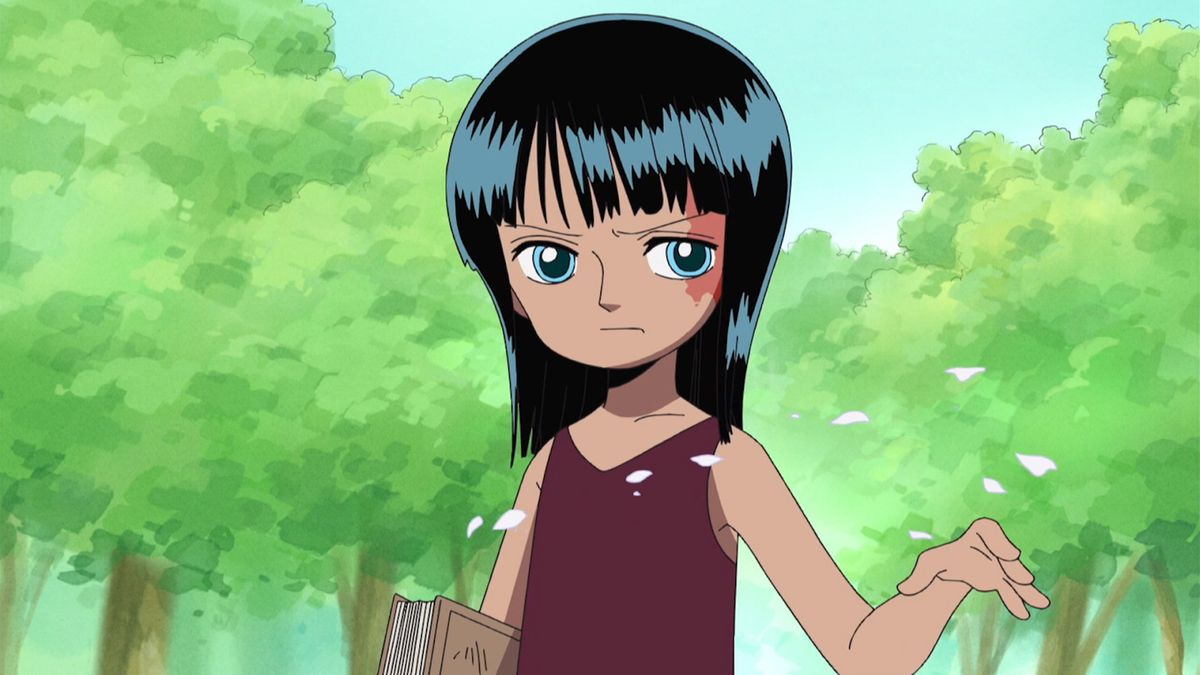
RaeRae Reacts · One Piece Episode 275
The Government Manufactured the Demon Child It Claimed to Find
One Piece Episode 275 shows how childhood exclusion, forbidden scholarship, and government propaganda turned eight-year-old Robin into a political target.
Bottom line: the government did not discover a demon child; adults manufactured one
One Piece Episode 275 begins Robin’s childhood by showing how many adults helped build the lie later printed on her wanted poster. Children mock her body and Devil Fruit ability. Caregivers treat food and shelter like debts she must repay through labor. Scholars value her mind but hide the work that could make her feel fully included. Then the World Government takes all that isolation and gives the lonely child a political label.
Robin was never born dangerous to ordinary people. She became dangerous to a state that needed history buried. Calling her a demon moves attention away from the government’s fear and onto the child’s existence. That propaganda works because Ohara had already taught Robin to expect blame whenever other people felt uncomfortable around her.
Episode facts and production credits
Episode 275 aired in Japan on August 13, 2006. Hirohiko Kamisaka wrote the screenplay, Hiroaki Miyamoto directed, Noboru Koizumi served as animation director, and Miyuki Sato and Kunihiro Chida handled the art direction. The episode moves from the Enies Lobby standoff into Robin’s life on Ohara twenty years earlier.
The transition explains why one military phrase can stop an adult Robin from accepting rescue. The Buster Call is not an abstract escalation. The name carries the island, people, knowledge, and childhood she lost. Episode 275 begins rebuilding that memory from ordinary cruelty upward.
Spandam threatens mass destruction while pretending Robin caused the danger
Spandam uses the Buster Call to frighten Robin and impress the Straw Hats. His language makes the weapon sound like a natural consequence attached to her presence. That framing is dishonest. Officials choose the target, authorize the ships, fire the cannons, and erase the records.
Blaming Robin for those choices lets the institution perform innocence. If destruction follows her, then people may decide abandoning her is self-defense. Spandam needs that conclusion more than he needs affection or loyalty from anyone involved.
Robin’s fear makes sense because she has already seen the government keep this promise
The crew hears a threat. Robin hears a memory. She knows the World Government will destroy civilians, buildings, archives, and its own convenient stories to prevent forbidden knowledge from surviving. No optimistic speech can make that history imaginary.
The crew’s job is not to prove Robin foolish for fearing the Buster Call. They must prove that fear does not give the government permanent ownership of her future. Courage begins with an accurate understanding of danger, not denial.
Ohara looks peaceful before the episode reveals who gets excluded from peace
The island’s great library and scholarly reputation suggest a community organized around learning. Young Robin still lives at the edge of that community. A place can celebrate knowledge while failing a child standing directly in front of the institution.
That contradiction matters. Ohara’s scholars later show tremendous courage, but courage in one struggle does not erase blind spots elsewhere. The episode allows the island to be worth mourning without pretending every part of Robin’s childhood was kind.
Children learn which difference adults permit them to punish
The local children call Robin a monster and react to her extra limbs as proof that she does not belong. Their cruelty is childish, but not innocent. Children repeat a social lesson: visible difference can be turned into entertainment when the target lacks protection.
Robin’s Hana Hana no Mi ability should inspire curiosity. Instead, the children treat her body as a public argument against her humanity. That pattern teaches Robin to hide power, emotion, and need before government agents ever arrive.
The adults responsible for Robin make care feel conditional
Robin lives with relatives while Olvia remains away on an archaeological mission. Her household provides necessities but does not provide belonging. Work, criticism, and comparison keep reminding her that the arrangement is an obligation rather than a home.
A child can recognize the difference between being housed and being wanted. Robin learns to minimize her presence, complete tasks, and avoid creating reasons for rejection. Those skills later help her survive pirate crews, but survival skills born from neglect still carry a cost.
Olvia’s absence has a political cause and a personal consequence
Olvia did not leave because Robin lacked value. She joined a dangerous expedition tied to the Void Century and the Poneglyphs. The research serves a larger human need to recover suppressed history. Robin still experiences the absence as a child whose mother is somewhere else.
Both truths belong on the page. Political commitment can be brave while the child left behind feels lonely. Turning Olvia into either a selfish mother or a flawless martyr would flatten the relationship before mother and daughter receive a chance to speak.
Robin studies because knowledge offers a place human beings have denied her
Books do not recoil from Robin’s hands. Archaeology gives her rules, questions, evidence, and a path toward the absent mother she wants to understand. Studying becomes intellectual joy and emotional shelter at the same time.
That combination explains her extraordinary progress without making loneliness sound beneficial. Neglect did not gift Robin brilliance. Robin used brilliance to build a livable interior world when adults failed to provide enough safety outside.
Becoming an archaeologist at eight proves ability, not readiness for adult danger
Robin passes the scholars’ examination and earns recognition as an archaeologist. The achievement is remarkable. The achievement does not make her an adult capable of consenting to political risk on the same terms as Clover and the research team.
Talented children often receive adult expectations as a reward for competence. Adults begin treating intelligence as emotional armor. Robin can read difficult material and still need protection, reassurance, play, food, sleep, and someone willing to answer a frightened question.
Clover welcomes Robin’s mind while drawing a boundary around the forbidden work
Professor Clover and the scholars value Robin. Their library gives her community and purpose. When Robin reveals her interest in the Poneglyphs, Clover refuses to let her join the research. His refusal comes from a desire to protect her.
The problem is that secrecy cannot fully protect a child already reading the room. Robin knows the adults she trusts share a purpose tied to her mother. Exclusion leaves her alone with clues, fear, and a stronger desire to prove she belongs.
The scholars face an impossible protection problem created by criminalized knowledge
If Clover tells Robin everything, he exposes a child to lethal government attention. If he tells her nothing, he repeats the isolation governing the rest of her life. No private communication choice can solve a structure that makes historical inquiry punishable by death.
That distinction matters because blaming the scholars alone would miss the source of the trap. The World Government creates the conditions under which mentorship, family, and research become dangerous to share.
The Void Century ban reveals a government afraid of evidence, not chaos
Officials describe forbidden research as a threat to world order. The scholars approach the subject through language, artifacts, comparative evidence, and preservation. Their methods do not resemble a military attack.
The government’s response exposes the imbalance. A stable institution should be able to answer scholarship with records and argument. An institution that answers archives with warships tells on itself. Suppression protects a version of history that cannot survive open examination.
Robin’s Devil Fruit becomes convenient propaganda
The government can combine Robin’s unusual body, archaeological knowledge, and association with Ohara into one frightening image. “Demon” turns several facts into a moral verdict without explaining any of them. Propaganda works fastest when a label feels simpler than the history being hidden.
Her power also helps officials sell a child as physically threatening. Readers and viewers can see the absurdity. Robin’s greatest danger to the government is not extra hands. Her danger is the possibility that she may read what powerful adults ordered everyone else to forget.
Jaguar D. Saul enters Robin’s life without demanding usefulness
Robin finds Saul after he washes ashore, and their relationship begins outside Ohara’s established social order. Saul does not approach her as a scholar, weapon, criminal, servant, or substitute adult. He talks, laughs, listens, and reacts to the child in front of him.
That ordinary attention matters because Robin has learned to earn space through competence. Saul gives her a different experience: companionship can begin before she proves value. His strange laugh makes the interaction less polished and more human, which Robin desperately needs.
Saul’s size makes him look frightening while his behavior exposes the label
A giant washed onto shore could fit every scary story local children project onto difference. Saul behaves with more tenderness than many ordinary-sized adults in Robin’s life. The contrast asks viewers to judge conduct rather than appearance.
Robin and Saul recognize forms of social othering in each other. Neither needs a lecture about tolerance. Their friendship grows through practical contact, curiosity, jokes, food, and the relief of not being treated as a spectacle.
Saul carries knowledge about the threat before Robin understands the connection
Saul escaped the Marines after questioning the operation tied to Ohara. His presence brings the outside machinery of state violence onto the same shore as Robin’s private loneliness. The two stories were always connected, but the episode lets the connection arrive through a person.
That choice keeps the history from becoming a dry information dump. Robin learns the danger through someone who has seen the institution from inside and decided obedience would make him complicit.
Leaving the Marines does not erase Saul’s earlier participation
Saul’s refusal matters because he held rank and benefited from the system before breaking with the mission. Moral courage does not require a spotless past. Courage often begins when someone finally recognizes what continued obedience will do.
The episode does not need to excuse every earlier order Saul followed. His present responsibility is to warn people, protect Robin, and refuse the extermination logic moving toward Ohara. Action gives his dissent weight.
The Buster Call turns procedure into distance from guilt
A formal authorization spreads responsibility across officers, ships, crews, and commands. Every participant can tell themselves that someone higher made the real choice. The island still burns because a chain of people agrees to perform one part.
Spandam loves that structure. Procedure lets a coward access violence far beyond his personal ability. He can threaten Robin with annihilation while treating the weapon like an office resource attached to his title.
The episode connects childhood bullying to political persecution without equating them
The children on Ohara do not possess warships, prisons, or a global propaganda network. Their cruelty is not the same as a Buster Call. The earlier exclusion still prepares Robin to believe the later accusation.
When a community repeatedly tells a child that difference makes her unwanted, a government label may feel like confirmation rather than invention. Social cruelty gives political cruelty an easier landing place.
Robin’s composure grows from practice nobody should envy
Adult Robin can read hostile rooms, conceal intention, and leave before betrayal closes around her. Episode 275 shows the childhood rehearsal behind those skills. She learned to watch adults for signs that care had expired.
Fans often admire her calm because calm looks powerful. I admire the intelligence while hating the price. A child should not need that level of emotional surveillance to get through breakfast, school, friendship, or grief.
The art direction makes knowledge feel physical enough to destroy
The Tree of Knowledge, shelves, books, stone, and old research spaces give history a body. Knowledge is not a vague glowing idea. People copied pages, preserved artifacts, learned languages, organized evidence, and built rooms where another generation could continue.
That materiality raises the stakes of the coming attack. Burning a library destroys labor and routes of access, not truth itself. The government can make recovery harder, kill the people holding context, and force survivors to rebuild from fragments.
The Japanese performances protect young Robin from becoming a symbol only
Anzu Nagai voices young Robin with intelligence, restraint, and unmistakable need. The performance never turns her into a tiny adult delivering lore. Robin remains a child trying to manage feelings with skills developed far too early.
Yuriko Yamaguchi’s adult Robin carries the memory in the present-day framing, while Kazuki Yao gives Saul warmth through size and roughness. The voices keep the political history attached to specific people rather than letting the episode become a lecture.
RaeRae verdict: Episode 275 shows how a lie becomes a child’s identity
Episode 275 hurts because the government’s propaganda does not begin from nothing. The state takes Robin’s isolation, her unusual power, her absent mother, and her forbidden education, then arranges those facts into a story where the child deserves whatever happens next.
Robin survives by becoming useful, quiet, observant, and ready to leave. Those traits later make her a brilliant archaeologist and crew member, but nobody gets to thank persecution for her strength. The crime belongs to the adults who made a lonely eight-year-old carry their fear of history and then called her demonic for refusing to disappear.