RaeRae Reacts · One Piece Episode 274
The Crew Reaches Robin Before Robin Can Reach Hope
One Piece Episode 274 puts the complete crew across the waterfall while Robin struggles to accept rescue after twenty years of coerced isolation.
Bottom line: Robin sees the rescue and still cannot believe she is allowed to accept
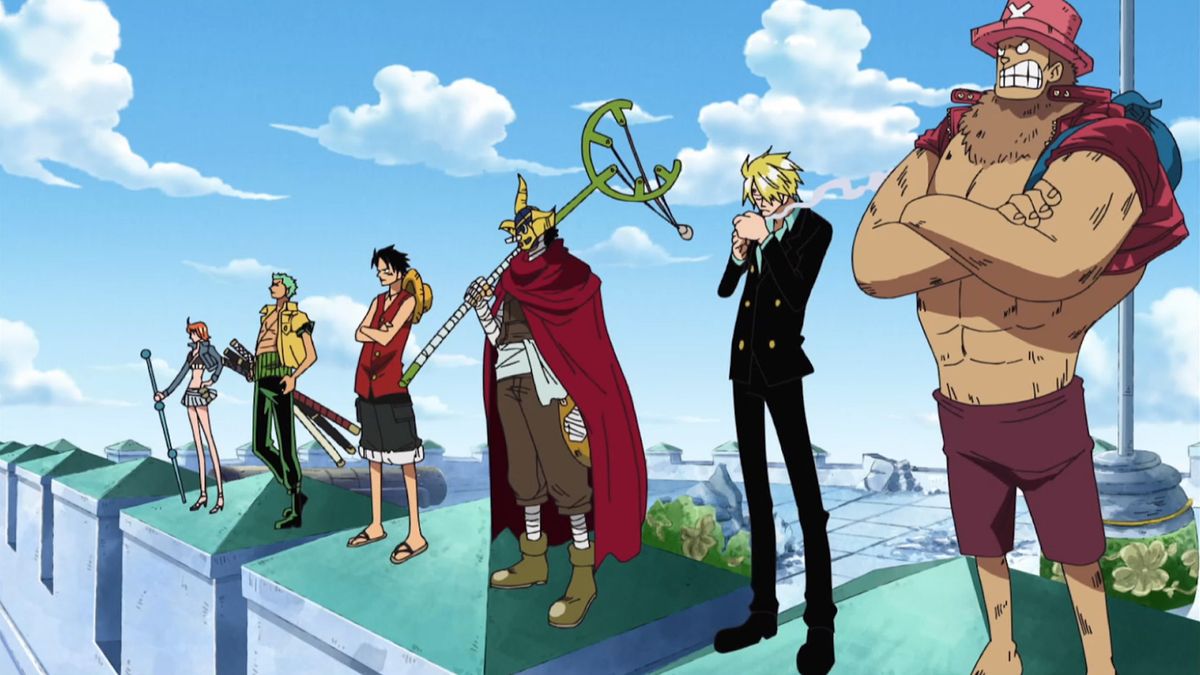
One Piece Episode 274 puts six people on the courthouse roof and asks why their presence does not immediately solve Robin’s fear. The answer hurts because the crew has already done everything a rescue story usually requires. They crossed a storm, invaded a government island, fought thousands of guards, and shouted her name where the whole institution could hear. Robin sees them. She understands why they came. She loves them enough to want them gone.
That last contradiction carries the episode. Robin does not reject rescue because she doubts the crew’s affection. She rejects rescue because twenty years of pursuit taught her that affection creates targets. Spandam uses that lesson like a chain. Luffy cannot break the chain by promising victory. He has to make Robin say what the government trained her to bury.
Episode facts and production credits
Episode 274 aired in Japan on August 6, 2006. Hirohiko Kamisaka wrote the screenplay, Yoko Ikeda directed, Kazuya Hisada served as animation director, and Miho Shiraishi and Kumiko Fukuzawa handled the art direction. The episode adapts the Enies Lobby confrontation around the Straw Hats’ arrival opposite Robin and CP9.
The production team slows the rescue at exactly the right moment. A faster episode could have rushed from crew arrival to declaration of war. Episode 274 holds both sides across the waterfall and lets distance become emotional evidence. Everybody can see everybody. Nobody can pretend the choice remains private.
Franky brings Robin into view because secrecy protects Spandam
Franky escapes onto the balcony with Robin and places her where the courthouse roof can see her. The move changes the conflict. Spandam has managed Robin through closed rooms, handcuffs, threats, and carefully limited information. Visibility gives the crew a chance to answer the story he has been feeding her.
Franky does not need to deliver a tender speech. His useful contribution is physical and political. He refuses to let the government move Robin through another hidden corridor while telling everyone else that her transfer was voluntary. Bringing her outside turns a prisoner-processing operation into a public confrontation.
Luffy reaches the roof first, but the crew makes the argument complete
Luffy standing alone would still matter. Robin already knows he will charge toward impossible trouble. The rest of the crew arriving changes the meaning from one captain’s recklessness to a shared decision. Nami, Chopper, Zoro, Sanji, and Sogeking have different fears, skills, and limits. Every one of them chooses the same roof.
That image answers Robin’s belief that she alone should calculate the danger. The crew has calculated enough. Some members understand the government better than others, but nobody arrived by accident. They have consented to the risk she keeps trying to remove from their lives.
Robin’s protection has become control, and the episode is honest about that
Robin wants to save the crew by making the decision for them. Her motive comes from love, not arrogance, but the result still denies their agency. She decides that their lives matter more than their stated loyalty and assumes she alone understands the price.
I cannot blame her for that reflex. Every group that sheltered Robin eventually faced pressure, betrayal, or destruction. Survival required leaving before attachment became evidence. Still, the Straw Hats are allowed to decide which danger belongs to them. Love cannot stay healthy when protection means refusing to hear another person’s answer.
Spandam treats trauma as proof that his institution is right
Spandam sees Robin’s fear and calls the fear common sense. That is one of his ugliest tricks. The World Government created the conditions that made trust feel suicidal, then points to Robin’s terror as evidence that resistance is foolish. Abuse manufactures the reaction later used to justify more abuse.
He does not need Robin to admire the government. He only needs her to believe resistance will kill anyone who stands near her. Once that belief settles in, she will police her own relationships. The institution saves labor because the hunted person begins performing the isolation herself.
The Buster Call is not only a weapon; Spandam uses the memory as discipline
Spandam invokes the Buster Call before the episode fully explains Ohara. Robin’s body already supplies the explanation. Her panic tells the audience that the name carries more than military danger. The threat returns her to a catastrophe that defined every year afterward.
State violence does not end when the ships stop firing. Survivors carry the event into future choices, relationships, sleep, work, and ordinary safety. Spandam knows enough about Robin’s history to reactivate that fear on command. He turns memory into part of the government’s current arsenal.
Robin is not choosing between capture and freedom
From the outside, the choice appears simple: go with CP9 or return to the crew. Robin sees a different set of options. In her mind, surrender may preserve six lives, while rescue may repeat Ohara on a larger stage. Freedom has been paired with collective punishment for so long that accepting help feels morally dangerous.
That is why cheering harder cannot finish the job. The crew must understand the choice she thinks she is making. Luffy’s anger becomes useful only when he aims beyond the handcuffs and attacks the lie governing Robin’s imagination.
Nami arrives with the experience of someone who once lied for the same reason
Nami knows what Robin’s refusal sounds like because Arlong forced her into a similar arrangement. Nami pushed people away, worked for the enemy, and tried to buy safety through solitary sacrifice. The details differ, but the emotional machinery is familiar.
Her presence on the roof quietly argues that coerced loyalty does not become real consent. Nami survived because Luffy refused the surface meaning of her actions and waited for the request beneath them. Robin deserves the same patience without reducing her story to a copy of Nami’s.
Chopper refuses the idea that vulnerable people become burdens
Chopper’s entire life challenges Robin’s fear that difference makes a person disposable. Humans called him a monster. Reindeer rejected him. Hiruluk and Kureha taught him that care can exist without demanding normality first. Robin’s government label cannot scare him into abandoning her.
His arrival also matters because Chopper has been treating the coalition’s injuries while moving forward. Rescue does create work, risk, and responsibility. The answer is not pretending otherwise. The answer is sharing the work instead of declaring the endangered person unworthy of the effort.
Zoro makes danger a crew decision, not Robin’s private debt
Zoro does not need emotional language to show commitment. Reaching the roof after fighting through Enies Lobby is his statement. He chose the captain, and the captain chose Robin. Zoro’s loyalty makes that relationship operational.
He also understands consequence better than most people present. Zoro never treats the government as harmless. His willingness to stay therefore carries weight. Robin cannot dismiss the crew as children who wandered into a conflict without understanding that swords, imprisonment, and death are possible.
Sanji’s rescue work respects Robin’s intelligence without accepting her conclusion
Sanji spent Water 7 following Robin’s movements and recognizing that her behavior did not match a willing departure. He treats contradiction as a clue rather than proof of betrayal. That is basic investigative care, and plenty of supposed allies fail to offer even that much.
Robin is intelligent. Trauma does not erase that intelligence. Sanji can respect her reasoning while rejecting the false premises Spandam forced into the calculation. A smart person can make a coherent decision inside a cage built from incomplete choices.
Sogeking gives Usopp enough distance to stand where Robin needs him
Usopp remains separated from the crew by pride, hurt, and the fight over the Going Merry. Sogeking lets him act before he has solved every personal conflict. The mask is funny, obvious, and emotionally practical. Robin does not need a perfectly repaired crew. She needs the person behind that mask to show up.
His place on the roof also proves that belonging can survive a rupture. Robin assumes danger ends relationships. Usopp’s presence shows a relationship can become messy, painful, and unresolved without becoming meaningless.
The waterfall creates a courtroom the government cannot fully control
Enies Lobby calls itself judicial, but Robin has no meaningful hearing, defense, or chance to contest the charges shaping her life. The opposing rooftops create a rougher and more honest courtroom. Spandam states the government’s claim. The crew answers with relationship, evidence, and refusal.
The space is theatrical because power relies on theater. Flags, uniforms, gates, titles, and impossible architecture tell prisoners that judgment has already happened. Luffy uses the same visibility to show Robin that another verdict exists.
Robin’s silence is not emptiness
Her hesitation carries twenty years of people calling her dangerous, useful, cursed, and temporary. Silence gives all those voices room to crowd around the crew’s invitation. Asking Robin to answer means asking her to speak through a history designed to make her distrust her own desire.
I like that the episode does not punish the pause. Nobody on the roof decides her delay proves she wants captivity. They remain present. Staying available while someone fights toward an answer can be a form of action.
Luffy finally asks the question beneath the rescue
Luffy does not want a strategic explanation. Robin has already supplied enough reasons for surrender. He wants the desire those reasons keep covering. The crew can fight CP9, cross the bridge, and break the handcuffs, but they cannot manufacture Robin’s wish to remain alive.
His demand may sound harsh outside their relationship. Here, bluntness cuts through Spandam’s carefully managed logic. Luffy refuses to debate whether the government is unbeatable before Robin identifies what she wants if fear does not get the final vote.
The episode understands that consent requires a real alternative
Spandam calls Robin’s surrender a choice while holding the crew’s lives over her. That is coercion wearing administrative language. A decision made under a threat against loved ones cannot prove genuine willingness.
The Straw Hats create an alternative by accepting the threatened consequences themselves. They cannot erase the danger, but they can stop Spandam from speaking for them. Once they say the risk belongs to all seven, Robin’s answer can begin moving closer to consent.
Why the crew must declare war before Robin can answer
Robin fears the government as an endless structure rather than a single enemy. Defeating one agent will not answer that scale. The crew has to show that they understand whom they are challenging. Their coming attack on the flag matters because symbolism is part of the prison.
A flag cannot bleed, but institutions use symbols to organize obedience. Destroying the symbol will tell Robin that the crew did not confuse her rescue with a small misunderstanding involving one bad official.
The Japanese performances keep the confrontation personal
Yuriko Yamaguchi gives Robin restraint that feels crowded rather than blank. The fear sits behind controlled speech, then breaks through whenever Ohara or the Buster Call enters the conversation. Mayumi Tanaka gives Luffy’s demand a directness that refuses decorative heroism.
Kazuki Yao’s Franky and Masaya Takatsuka’s Spandam work from opposite kinds of volume. Franky’s noise creates space for people. Spandam’s noise attempts to occupy every interpretation before Robin can speak.
The direction lets faces and distance carry more than movement
Yoko Ikeda’s direction treats arrival as a sequence of confirmations. Each crew member adds another body to the argument until the roof becomes a complete visual sentence. The episode spends its energy on orientation, reaction, and emotional geography rather than inventing extra action.
Kazuya Hisada’s character work keeps Robin recognizable through conflicting emotions. Relief, fear, love, shame, and disbelief do not arrive in a neat line. They overlap because real traumatic decisions rarely wait for one feeling to finish.
Robin’s life has value before she can explain why
The government demands usefulness from Robin as a scholar while condemning the knowledge that makes her useful. Pirate crews used her skills and discarded her when pressure rose. Everybody asks what her life can provide.
The Straw Hats come because Robin is Robin. Her abilities matter, but rescue is not payment for services. That distinction gives her a foundation from which desire may eventually grow. A person should not need a profitable reason to survive.
RaeRae verdict: the crew reaches Robin before Robin can reach hope
Episode 274 does not deliver the famous answer yet, and that restraint makes the answer stronger. The crew reaches the correct roof, but Robin still has to cross twenty years of government conditioning inside herself. Physical rescue arrives first. Emotional permission takes longer.
What gets me is how completely the crew refuses her isolation without pretending fear is silly. They show up, accept the danger, and wait for the truth beneath her surrender. Robin cannot believe in a future on command. She can begin because six ridiculous people stand across a waterfall and prove that wanting her alive is already their decision.