RaeRae Reacts · One Piece Episode 236
Usopp Cannot Beat Luffy, So He Makes Luffy Feel Every Reason the Duel Exists
One Piece Episode 236 turns shared history into Usopp's battle plan and makes Luffy win the duel without escaping the cost of losing a crewmate.
Bottom line: Usopp cannot beat Luffy, so he makes Luffy feel every reason the duel exists
One Piece Episode 236 gives Usopp no realistic path to overpower Luffy and lets him build a fight from knowledge instead. He predicts movement, uses Dials, fills the battlefield with gas, attacks from range, and turns every shared adventure into tactical information. Luffy wins because the gap remains real. Usopp refuses to make the loss easy.
The duel is not proof that Usopp secretly belongs in Luffy’s combat tier. The duel proves that observation, preparation, courage, and intimate knowledge can force a stronger opponent to take him seriously. That dignity matters because Usopp entered the fight believing weakness made him disposable.
Episode facts: the ten o’clock duel decides the Merry
Episode 236 aired in Japan on June 19, 2005 under the official title “Luffy vs. Usopp! The Spirit of the Clashing Men.” Hirohiko Kamisaka wrote the screenplay, Munehisa Sakai directed, Takeo Ide served as animation director, and Miyuki Sato with Michiyo Kawasaki handled the art direction.
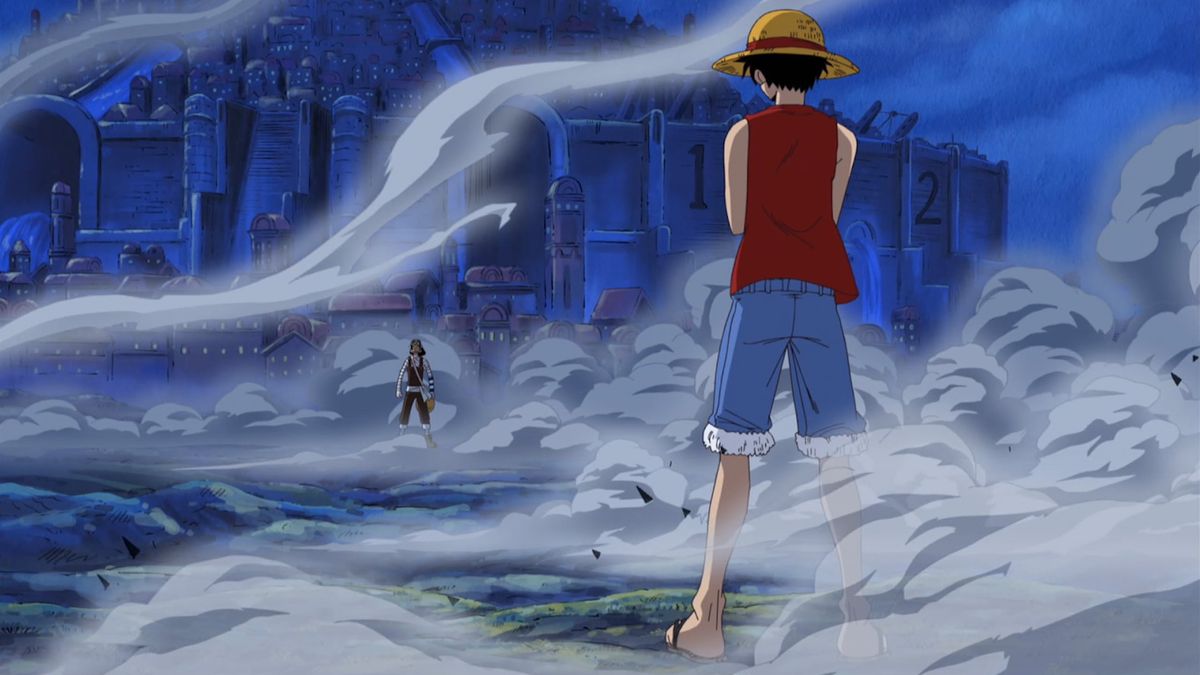
The official synopsis begins at ten o’clock when the promised duel starts. Usopp attacks Luffy seriously and secretly fills the area with gas through a Breath Dial before igniting the cloud with Firebird Star. The explosion shakes the ground and water. A wave strikes the Merry, and a line resembling a tear runs from the ship.
Ten o’clock turns family grief into a scheduled public contract
Setting a time gives both men a boundary around the confrontation. Usopp can prepare. Luffy can arrive knowing the stakes. The schedule makes the duel feel formal even though no neutral institution enforces the terms.
Formality protects dignity and hides pain. Rules let them behave as opponents because speaking as friends has failed. The clock supplies structure where the relationship no longer can.
Usopp’s preparation is a biography of paying attention
He knows Luffy’s appetite, recklessness, attack range, durability, habits, and willingness to charge through danger. Every trap comes from time spent traveling beside him. Friendship becomes battle intelligence.
That conversion hurts because knowledge once used for support now guides harm. The duel does not reveal that their bond was fake. The effectiveness reveals how real the bond became before pride redirected the knowledge.
Range gives Usopp temporary control over the pace
Usopp cannot trade punches with Luffy. He uses projectiles, distance, terrain, and staged effects to decide when Luffy can approach. The strategy respects his body instead of pretending courage will create durability.
Good fighting style begins with an honest inventory. Usopp’s strength is not accepting the opponent’s preferred distance. Water 7 turns skills sometimes treated as comic support into the core of a serious duel.
The Breath Dial rewards lessons carried down from Skypiea
Usopp collected and studied Dials because new tools fascinate him. The technology becomes useful beyond the sky island rather than remaining a souvenir. His curiosity expands the crew’s tactical vocabulary.
The Breath Dial also demonstrates unequal access to information. Luffy knows Usopp owns strange devices but does not know how the battlefield has been prepared. Usopp cannot hide physical weakness, so he hides the condition that will produce the explosion.
Firebird Star turns a tiny projectile into environmental danger
The ignition works because Usopp prepares the gas before revealing the attack. Damage comes from sequence rather than the projectile alone. He creates a system and waits for Luffy to occupy the system.
That planning distinguishes invention from random trickery. Each component performs a limited job. Combined at the correct time, ordinary limits become a threat even Luffy must respect.
Luffy allows the attacks to land because winning feels terrible
Luffy knows he must finish the duel, but his body language carries reluctance. He does not approach Usopp with the hunger he shows toward an enemy threatening the crew. Every counterattack confirms a separation he never wanted.
Hesitation cannot become surrender. The duel’s terms and captaincy require a conclusion. Luffy must take Usopp seriously enough to fight back, which makes violence a form of respect and a source of grief at once.
Usopp uses psychological pressure because physical pressure has a ceiling
He knows how Luffy reacts to fear, surprise, food, and threats. A weaker fighter can create openings by targeting attention and expectation. The tactics are not dishonorable merely because they avoid direct strength.
Calling every strategy a trick would privilege the body Luffy happened to receive and train. Usopp’s mind, preparation, and willingness to perform under fear belong to his strength.
The fight proves Usopp was never dead weight
A disposable crewmate could not study Luffy this closely, gather tools across islands, assemble a layered plan, and force the captain through genuine danger. The duel itself contradicts the insecurity that produced the duel.
Tragedy enters because Usopp cannot absorb that evidence. Losing confirms the power gap louder than the strategy confirms his value. Shame chooses the result that supports shame.
Luffy’s victory does not settle the Merry’s personhood
Winning gives Luffy possession under the agreed terms and confirms captain authority. The fight does not prove his emotional interpretation of the ship was better than Usopp’s. Both men already agreed the Merry mattered.
The unresolved question is how to honor a beloved vessel that cannot continue. Combat can settle control. Combat cannot create a farewell ritual, process grief, or determine what the ship would want if that desire could be known.
The tear on the Merry should remain an image before becoming a claim
A wave strikes the ship, and water runs from a place that resembles a crying eye. The visual invites viewers to read grief, response, or the Klabautermann’s presence. The episode does not require a technical declaration in that instant.
Symbolism works because material cause and emotional meaning can coexist. Water creates the line. The framing makes the line feel like a tear. We can name the interpretation without pretending the camera issued a scientific report.
The Merry witnesses people fighting over love for her
Both men hurt each other because neither can accept what losing the ship means. If the Merry possesses awareness through the Klabautermann, the duel becomes especially cruel: the cared-for vessel watches caretakers divide over how to care.
Even without confirmed consciousness in the moment, the image reflects the audience’s position. We know the history carried in the hull and understand why the fight is not really about ownership.
Zoro refuses to interrupt because the duel carries crew authority
Zoro could help end the battle, but intervention would invalidate Usopp’s challenge and Luffy’s acceptance. The crew must allow the terms to stand once both men formalize the separation.
That restraint is painful and politically necessary inside the crew. Captaincy cannot survive if every order or duel is privately revised by whoever feels strongest enough to interfere.
Nami sees tactics succeed and still wants the battle stopped
Nami knows Usopp’s ingenuity and recognizes the real danger created by his traps. Pride in his skill cannot cancel horror at seeing that skill aimed at Luffy.
Her position reflects the audience’s divided response. We want Usopp taken seriously and do not want the proof to require destroying his home. The duel gives him a stage after conversation denied him one.
Chopper is denied the doctor’s instinct to intervene
Chopper watches two patients injure each other under rules they consider necessary. Treating wounds afterward cannot prevent the emotional injury occurring in front of him.
The helplessness is especially sharp for a healer. Medicine offers procedures for bodies. No equivalent technique can close a crew fracture while both people insist the fracture must reach a conclusion.
Sanji knows the sentence he stopped has become a fight anyway
Sanji prevented Luffy from explicitly telling Usopp to leave in anger. The departure still happens through Usopp’s choice and the duel. Stopping one terrible sentence could not solve the beliefs feeding the conflict.
His earlier intervention still mattered. Luffy did not formally expel Usopp. That distinction preserves the truth that Usopp left and leaves a route for return if dignity and authority can later be reconciled.
Robin’s quiet absence gains another reason to look like sacrifice
The crew has now lost Usopp and the Merry as a future vessel while government pressure surrounds Robin. She can interpret her departure as removing one more source of danger from an already wounded group.
That logic mistakes isolation for protection, but Water 7 keeps providing evidence trauma can arrange into the wrong conclusion. A divided family looks easier to save by leaving.
Luffy leaves the Merry because victory does not feel like possession
After defeating Usopp, Luffy honors the agreed result and does not celebrate. The ship remains with the person who fought to keep her. The crew walks away carrying the decision and none of the relief a victory usually promises.
That exit respects Usopp’s agency and turns the dock into a site of mourning. The Straw Hats do not seize the prize because the prize is home, grief, and a friend lying beside both.
The empty place aboard the crew changes every role around the absence
Usopp’s departure removes more than a sniper from a roster. Nobody else fills his exact combination of invention, repair, lookout work, storytelling, panic, jokes, and stubborn hope. A crew can redistribute tasks without reproducing a person.
That distinction answers his fear of replacement. The Straw Hats may recruit a professional shipwright because the ship needs skills Usopp never claimed to master. Adding a specialist does not make his own role redundant. Family roles overlap without becoming interchangeable.
The duel gives Usopp evidence he can carry into a healthier return
He plans under pressure, controls the battlefield, injures an opponent far stronger than himself, and remains standing emotionally long enough to finish the agreed contest. Those facts can support growth once shame stops controlling the interpretation.
Return will require accountability as well as confidence. Usopp cannot come back by pretending the challenge and departure never happened. The duel preserves dignity, but dignity must eventually coexist with apology and respect for the captain’s responsibility.
What changed when I watched Usopp as a tactician instead of an underdog mascot
The fight is often praised because the weak member performs above expectation. That framing can patronize him. Usopp does not accidentally become clever for one night. He uses skills the story has built across the voyage.
The important surprise belongs to characters who underestimated the full application of those skills, not to viewers pretending he never had them. Preparation, deception, range, and technology are legitimate combat disciplines.
The episode’s craft refuses triumphant music in the emotional memory
The duel has explosions and named attacks, but the lasting rhythm is sorrow. Victory does not restore order. Defeat does not grant catharsis. The Merry’s apparent tear absorbs the spectacle into mourning.
That tonal control prevents the episode from becoming a tournament match between popular characters. Every impressive move costs the relationship more.
The episode’s weakness is tying dignity too closely to masculine combat
Usopp receives the serious recognition he wants through a duel. The structure suggests that fighting Luffy is the route to proving conviction. A conversation, refusal, or caretaking claim receives less narrative authority.
The duel works for these characters and the pirate code they accept. The story should still leave room to question why pain becomes credible only after bodies make pain visible.
RaeRae verdict: Usopp loses without becoming small
Luffy wins because his strength, durability, and battle experience exceed Usopp’s. The episode does not fake equality. Usopp makes the gap expensive through planning, technology, courage, and intimate knowledge.
His defeat cannot prove he was disposable because the fight demonstrates the opposite. The tragedy is that neither man can use that truth yet. One walks away as captain. One remains with the ship. Both lose a version of home.
Receipts and the route beyond the broken crew
The official One Piece Episode 236 page supplies the June 19, 2005 broadcast date, Japanese title, synopsis, and production credits. The synopsis confirms the ten o’clock start, Usopp’s serious attack, the Breath Dial gas, Firebird Star ignition, the explosion, the wave, and the tear-like line on the Merry.
Episode 236 closes this bounded Water 7 arrival and crew-fracture shelf. Episode 237 shifts toward the attempted assassination of Iceburg and the accusation against the Straw Hats. The next directory should follow the CP9 exposure and Robin crisis without turning the episode route into one endless list.