RaeRae Reacts · One Piece Episode 234
Destroying Franky House Cannot Repair What Shame Broke
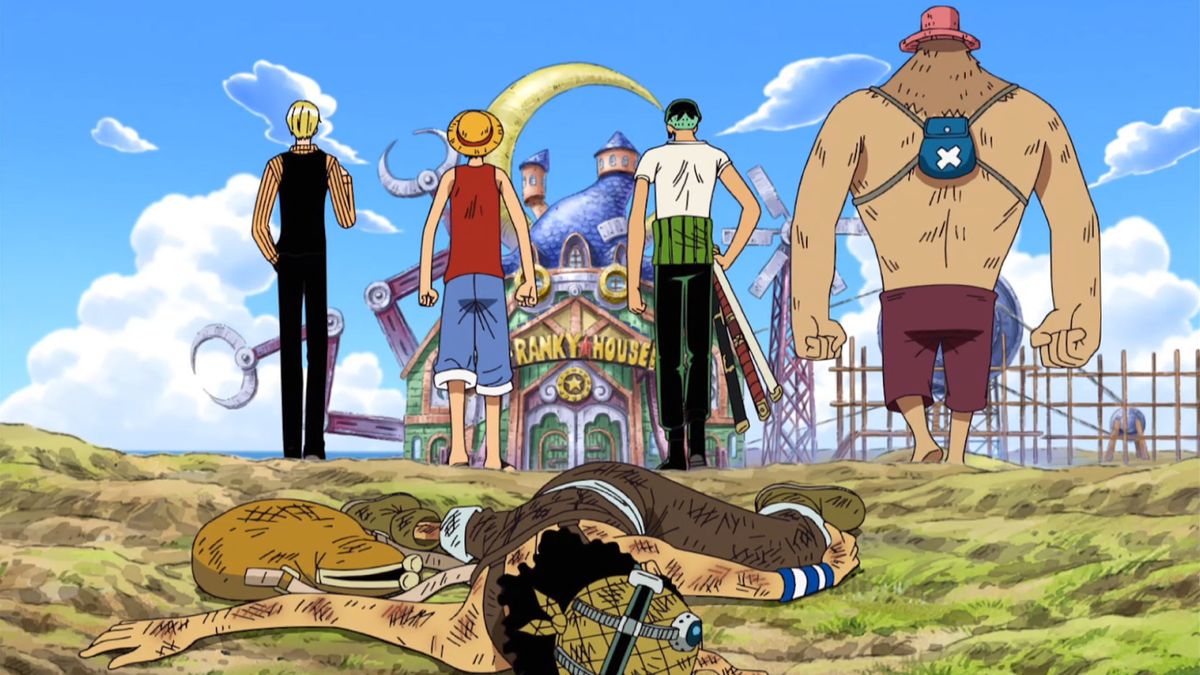
One Piece Episode 234 lets the Franky Family beat Usopp twice and gives Luffy, Zoro, Sanji, and Chopper a furious retaliation that cannot heal his shame.
Bottom line: destroying Franky House proves Usopp matters, but anger cannot repair what shame broke
One Piece Episode 234 sends Usopp back alone to recover the money meant for the Going Merry, lets the Franky Family beat him again, and answers with Luffy, Zoro, Sanji, and Chopper tearing Franky House apart. The retaliation is satisfying because the attackers deserve consequences. The retaliation is also incomplete.
Usopp needs to know the robbery does not make him useless, the Merry’s failed keel is not his fault, and the crew does not measure membership through raw strength. Blowing up a criminal headquarters says “you belong to us.” Nobody has yet said the rest clearly enough for him to believe.
Episode facts: the crew attacks Franky House
Episode 234 aired in Japan on June 5, 2005 under the official title “Rescuing Our Friend! A Raid on the Franky House.” Hirohiko Kamisaka wrote the screenplay, Hidehiko Kadota directed, Kenji Yokoyama served as animation director, and Miyuki Sato with Kunihiro Chida handled the art direction.
The official synopsis identifies the stolen money as the fund needed to repair the Merry. Usopp tries to recover the cash alone and is defeated again. Seeing him collapsed ignites the crew’s anger, and they move to destroy the Franky Family’s headquarters.
Usopp returns alone because shame makes support feel like evidence against him
After the first attack, the safest choice would be to tell the crew, recover physically, and plan together. Usopp instead goes back alone. He wants to reverse the failure before anybody must rescue him from the consequences.
Shame turns help into humiliation. If Luffy recovers the money, Usopp may hear proof that the captain must fix everything he cannot. A solo attempt offers the fantasy of restoring the fund and his worth in one action.
The second beating is not courage failing a test
Usopp knows the Franky Family can overpower him and returns anyway. That choice is courageous and self-destructive. Courage describes willingness to face fear. Courage does not guarantee that the chosen action is wise or likely to succeed.
The attackers remain responsible for the violence. Usopp’s risky decision does not transfer blame. The scene becomes painful because a real strength, his refusal to abandon the goal, is being directed by a false belief that he must earn his place through solitary recovery.
The money represents a future Kaku has already declared impossible
Usopp believes recovering the two hundred million berries can save the Merry. Kaku’s verdict means the keel cannot be repaired regardless of the fund. The cases now hold a future that no longer exists.
That fact does not make the money irrelevant. The crew needs resources for another vessel and continued travel. The emotional emergency comes from Usopp fighting for one promised use while everybody else has begun confronting another.
Luffy’s anger arrives before his language catches up
Luffy sees Usopp’s injuries and understands the essential fact: somebody hurt his crewmate. Action becomes immediate. He does not need a complete account before deciding the Franky Family must answer.
That instinct makes him a powerful protector. The same instinct can become a limitation when the injury is internal and the opponent is grief. Luffy can destroy a building faster than he can explain why replacing the Merry does not mean replacing Usopp.
Zoro treats the attack as crew business, not Usopp’s private failure
Zoro joins without asking whether Usopp should have been stronger. The robbery and beating concern the whole crew because membership distributes consequences. An attack on the person carrying the fund becomes an attack on the group.
That collective response contradicts Usopp’s self-accusation. He thinks he stood alone and failed. Zoro behaves as if “alone” was never the true condition. The crew’s delayed arrival does not make the bond optional.
Sanji’s rage gives care a target he understands
Sanji responds to harmed crewmates with physical certainty. The Franky Family offers a clean object for that certainty. They chose the attack, took the money, and beat Usopp when he returned.
Kicking them cannot repair the Merry or Usopp’s shame, but consequences still matter. Emotional complexity should not become an excuse for passivity toward obvious abuse. The crew can confront the criminals and still owe Usopp a deeper conversation afterward.
Chopper joins as a doctor who has seen the injuries
Chopper’s anger carries medical knowledge. He knows what the beating did to Usopp’s body and how easily another attack could have killed him. The injuries are not symbolic bruises placed for motivation.
His participation also shows how care can move from treatment to protection. A doctor does not need to become neutral toward the person who caused preventable harm. Chopper’s fury grows from the obligation to keep his patient alive.
Nami’s role remains tied to the money without reducing her concern to money
Nami understands the stolen amount and the practical damage to the crew’s options. She also understands Usopp’s emotional relationship with the fund. Anger over two hundred million berries and fear for a friend can exist together.
The series often exaggerates her financial obsession for comedy. Water 7 shows why money matters: repairs, transport, food, safety, and independence require resources. Protecting the fund is part of protecting the crew’s future.
Franky House turns criminal identity into architecture
The headquarters is loud, fortified, performative, and built around a family name. Destroying the building attacks more than walls. The crew tears through the public symbol that allowed the thieves to convert intimidation into local status.
Architecture can make an organization look permanent. Franky House tells victims that the group has territory, numbers, and confidence. Luffy’s assault strips away that message. A headquarters can fall when the people inside misjudge whom they targeted.
The Franky Family treats group numbers as permission to target isolated people
Usopp looks manageable when separated from Luffy, Zoro, and Sanji. The thieves use the imbalance because organized violence often depends on choosing a target who cannot call equal force quickly enough.
The retaliation reverses that calculation. The victim was isolated during the attack but connected in consequence. Predators who count bodies in the room may miss the relationships extending beyond the room.
The demolition is emotionally satisfying because impunity finally breaks
Viewers watch Usopp suffer, blame himself, and return to danger. The crew’s arrival releases accumulated anger. Each destroyed wall answers the Franky Family’s confidence that the beating would remain a private problem.
Satisfaction should not be confused with resolution. Punishment addresses the attackers. Recovery requires safety, treatment, restored trust, honest information, and time. The episode gives us the first and leaves the rest dangerously unfinished.
Usopp can read the rescue as love and humiliation at the same time
The crew’s rage proves he matters. Their overwhelming strength also highlights the gap he already fears. They can accomplish in minutes what he could not accomplish after risking his life twice.
Both readings are emotionally available. Telling him to focus only on love would ignore the shame shaping his perception. Somebody must name the comparison directly: difference in combat power does not establish difference in belonging.
The Merry’s verdict makes the recovered-money fantasy even crueler
Usopp returns for money attached to a repair that cannot happen. Luffy knows enough to begin considering a new ship. Their actions now point toward different futures before either man has explained the difference.
That split turns the Franky House victory into a temporary alliance of purpose. They can agree that the thieves must fall. They cannot yet agree on what the money means after the thieves fall.
Captaincy requires Luffy to stop using action as a substitute for explanation
Luffy’s attack is justified, but leadership does not end when the enemy loses. He must tell Usopp about the keel, the risk to the crew, and the decision to replace the ship. He must do so without treating grief as disobedience.
Luffy is young and emotionally direct. The task exceeds his practiced skills. Water 7 becomes a captaincy arc because fighting ability cannot solve the most important conflict aboard the crew.
Usopp’s class insecurity sits underneath the combat insecurity
Usopp joined with no Devil Fruit, no elite sword training, no superhuman kicks, and no inherited professional status. He contributes through tools, stories, repairs, and improvisation. Water 7 surrounds him with master shipwrights who can name the limits of his work.
The contrast can feel like social judgment. Professionals possess credentials and public respect. Usopp possesses patched boards and desperate experience. Their expertise does not erase his labor, but shame interprets hierarchy as proof that he never belonged near the task.
The crew’s destructive strength creates a responsibility after the spectacle
Luffy’s group can erase Franky House because their combat power overwhelms the family members present. That ability feels righteous after Usopp’s beating. Power still creates obligations even when anger has a good reason. They must distinguish the people directly responsible, the property supporting the criminal operation, and anybody nearby who did not choose the attack.
The episode keeps the target morally simple enough that demolition reads as justice. A fuller civic response would ask who investigates the stolen money, who protects future victims, and who prevents another headquarters from replacing the first. Breaking the symbol matters. Changing the conditions that supported the group requires more than one furious afternoon.
Retaliation also tells Water 7 that the Straw Hats have arrived
The raid cannot remain private. A famous criminal headquarters exploding draws witnesses, rumors, workers, officials, and other groups measuring power in the city. The crew recovers dignity for Usopp while increasing its own public visibility.
That visibility becomes dangerous with Robin under government pressure and Iceburg approaching a political crisis. A protective action can produce new exposure. Water 7 keeps making the crew pay for solving one problem inside a network of other problems.
Robin’s disappearance pressure remains hidden behind the louder crisis
While the crew attacks Franky House, the World Government’s interest in Robin continues. Her instinct to protect the crew by removing herself can grow stronger when she sees them fractured over the ship and Usopp.
Multiple crises compete for attention, and the quietest person can disappear while everyone responds to visible blood. Water 7 understands that danger does not wait for emotional scheduling.
What changed when I stopped calling the raid a simple friendship win
The attack absolutely communicates loyalty. The crew will not let Usopp’s beating stand. On a repeat watch, the scene also looks like the last easy moment before the family argument becomes unavoidable.
Everybody can agree on an external enemy. Agreement becomes harder when Luffy must make a decision Usopp experiences as betrayal. Franky House gives them a common target for one afternoon. The Merry gives them a shared love with incompatible conclusions.
The episode’s weakness is giving the Franky Family little interiority
The attackers function mainly as cruel bodies awaiting retaliation. That design keeps sympathy with Usopp and speeds the demolition. A fuller criminal ecosystem could show why members follow Franky, how stolen money circulates, and which local powers tolerate the group.
Later Franky material adds context around the family. Episode 234 needs them monstrous enough for catharsis, so nuance remains outside the headquarters while the walls come down.
RaeRae verdict: rage can defend a bond without healing the person inside the bond
Luffy, Zoro, Sanji, and Chopper make the correct immediate choice. Usopp was assaulted, and the organized group responsible expects no meaningful consequence. Franky House falls because the Straw Hats refuse that expectation.
The crew still owes Usopp more than revenge. They owe him the truth about the Merry, room to grieve, and a direct rejection of the belief that weakness makes him replaceable. The episode delivers the loud answer first. Water 7 is about to punish them for assuming the loud answer is enough.
Receipts and the route into the crew’s argument
The official One Piece Episode 234 page supplies the June 5, 2005 broadcast date, Japanese title, synopsis, and production credits. The synopsis confirms Usopp’s solo recovery attempt, his defeat, the crew’s anger, and the assault on Franky House.
Episode 235 moves the conflict aboard the crew. Luffy decides to replace the Merry, Usopp hears abandonment, and captaincy collides with grief under the moon. Continue through the planned Water 7 Arrival Episodes 229–236 shelf once unique canonical media production resumes.