RaeRae Reacts · One Piece Episode 232
Dock One Introduces Competence So Loudly Nobody Notices the Masks
One Piece Episode 232 introduces Iceburg, Paulie, Lucci, and Galley-La through a working shipyard whose public trust makes the coming deception possible.
Bottom line: Dock One introduces competence so loudly that nobody notices the masks
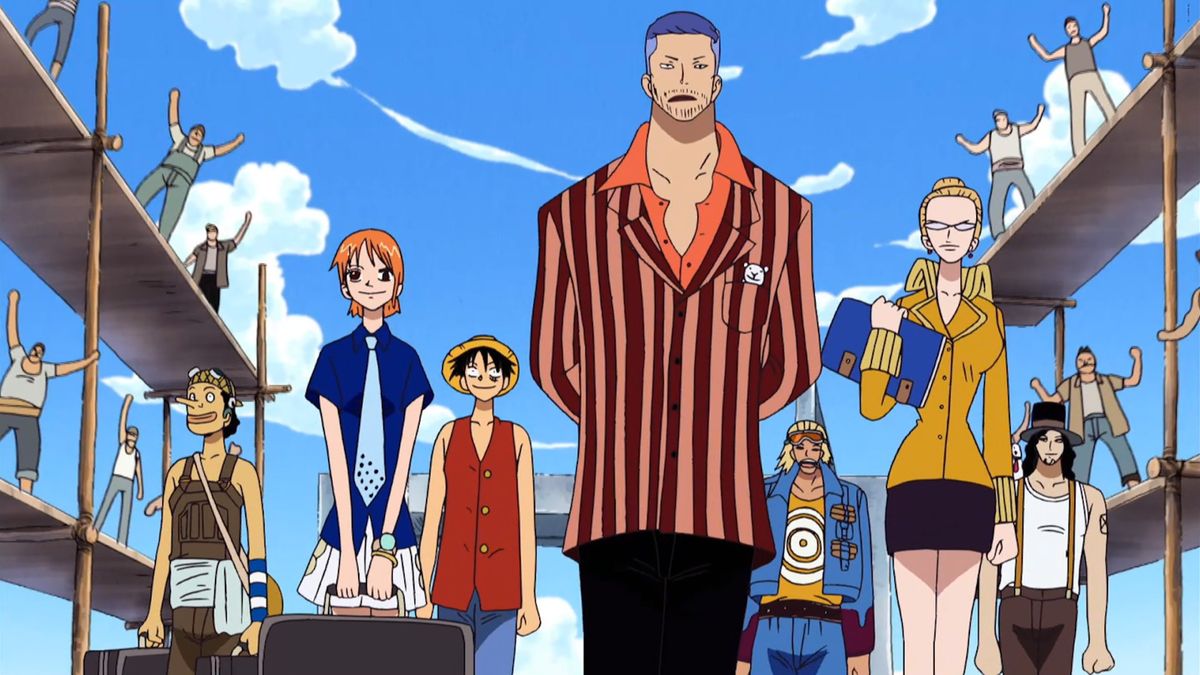
One Piece Episode 232 brings the Straw Hats into Galley-La’s working center, lets Paulie stop Franky Family thieves with ropes, introduces Rob Lucci through a talking pigeon routine, and surrounds Iceburg with shipwrights who look too distinctive to be ordinary employees. The chapter wants us impressed. We should be.
That admiration becomes camouflage. Water 7 respects skill, and skilled people receive access, trust, and public authority. CP9 has hidden inside that respect. The episode does not reveal the deception yet, but every entertaining introduction demonstrates why the disguise works. Competence is the credential nobody wants to question.
Episode facts: Galley-La’s Dock One opens its gates
Episode 232 aired in Japan on May 15, 2005 under the official title “Galley-La Company! A Grand Sight: Dock One.” Hirohiko Kamisaka wrote the screenplay, Konosuke Uda directed, Kazuya Hisada served as animation director, and Miyuki Sato with Kumiko Fukuzawa handled the art direction.
The official synopsis begins after the Franky Family takes two hundred million berries. Paulie, foreman of rigging and mast work, uses ropes to stop the thieves but appears ready to run with the money himself. Lucci, foreman of sawing and wooden pegs, brings Paulie back, and the pigeon on Lucci’s shoulder begins to speak.
Two hundred million missing turns the repair plan into an emergency
The theft removes most of the three hundred million berry fund before the Merry receives a professional verdict. The timing is cruel because Usopp attached the money to the ship’s survival. A criminal act now feels like damage to the vessel itself.
The crew still possesses resources, strength, and access to shipwrights. Shame does not calculate that balance. Usopp sees what disappeared while he was responsible. The number becomes evidence in the private case he is building against himself.
Paulie’s rope action makes a trade skill look like combat language
Paulie works with rigging and masts, so ropes belong to his profession before they become weapons. He redirects the same knowledge toward restraint, movement, and control. The fight grows from labor rather than a random power assigned for spectacle.
That connection gives Water 7’s shipwrights a distinct identity. Their bodies understand tension, weight, balance, knots, wood, sails, and height. Combat extends what work has trained them to notice. Craft produces power.
Paulie’s gambling debt complicates the heroic worker introduction
Paulie can protect company property and confront thieves while owing money through gambling. Competence in one area does not produce responsible behavior everywhere. The contradiction keeps him from becoming a clean civic mascot.
Debt also affects how others read his actions. When he touches stolen money, suspicion appears plausible. A reputation built through personal vice can weaken trust even when the immediate work is legitimate. Paulie creates some of his own vulnerability.
The crew meets a worker who could help and looks like another threat
From the Straw Hats’ position, Paulie is a stranger holding money thieves just stole from them. His manner is aggressive. His debt is known. His claim to company authority cannot instantly settle the question of where the cash will go.
Water 7 repeatedly forces judgments under incomplete information. The crew must decide who deserves trust while grief, urgency, and public rumors distort every interaction. That pressure prepares the larger Robin and CP9 crisis.
Lucci enters through silence and lets Hattori perform the personality
Rob Lucci appears severe and quiet while his pigeon Hattori speaks for him through an apparent ventriloquist act. The routine lowers the social threat. A silent, intimidating worker becomes memorable comedy because a dressed pigeon supplies the voice.
The performance is also camouflage built from audience participation. Everybody accepts the joke and stops asking why Lucci withholds his own voice. Humor gives the observer a satisfying explanation. Once people feel they understand the oddity, further investigation looks unnecessary.
Hattori proves a ridiculous detail can make a disguise stronger
A generic quiet man might invite suspicion. A master shipwright with a talking pigeon becomes a local character. The strange detail makes him easier to remember and harder to imagine as something else.
Good disguises do not always disappear. Sometimes they become so specific that the public confuses recognition with knowledge. Water 7 knows “the pigeon guy.” That label keeps people from asking what remains outside the label.
Dock One’s foremen distribute authority across visible specialties
Galley-La does not present one genius doing every job. Foremen represent rigging, masts, carpentry, joinery, and other disciplines. The company’s strength appears collective because large ships require coordinated expertise.
That distribution earns trust and creates hiding places. A specialist can become indispensable within a narrow role while concealing another identity. Institutions often know what somebody produces without knowing what else the person serves.
Iceburg’s company looks stable because workers can challenge one another
Lucci bringing Paulie back reads as internal correction. Paulie can act independently, but another foreman can prevent him from turning a confrontation into personal chaos. The company appears to contain its difficult personalities through peer authority.
That visible correction reassures clients. Galley-La does not need every worker to behave politely if the system can keep work and money moving. The appearance of accountability builds confidence around the organization.
The Franky Family enters the yard as a criminal labor force
The thieves are not random pickpockets. They act in numbers, recognize targets, transport stolen value, and operate under a family identity tied to Franky. Their work is organized even when their purpose is predatory.
Water 7’s economy creates both Galley-La and the Franky Family. One builds ships through respected trades. The other dismantles, steals, and sells through coercion. Both depend on the circulation of vessels, parts, money, and vulnerable outsiders.
Paulie stopping the thieves does not erase the city’s failure to stop the attack
A heroic interception can make a system look protective. Usopp has already been targeted and the money has already moved through violence. Catching one group inside Dock One does not explain how visitors should protect themselves or how often similar attacks occur.
The city benefits from pirate customers and repair funds. That economy creates some responsibility toward the people carrying those funds. Water 7’s celebrated public order coexists with a criminal network confident enough to operate near its premier yard.
Usopp’s absence from the impressive introductions is the emotional warning
While Luffy and others meet famous shipwrights, Usopp is connected to the stolen money and the consequences outside the center of professional attention. The crew’s route divides wonder from injury.
That separation matters because people can celebrate access to experts while missing the person whose shame is becoming a crisis. The best shipwrights in the world cannot help a crewmate nobody realizes is collapsing.
The Merry’s coming inspection gives every shipwright gesture extra weight
Kaku and the Dock One foremen are not merely colorful new allies. They represent the authority that will judge whether the Merry can continue. Every display of skill makes their future conclusion harder to dismiss.
The arc wisely earns professional credibility before delivering bad news. If an incompetent stranger condemned the ship, the crew could reject the verdict. Galley-La’s competence removes that escape.
Public admiration can hide how little citizens know about powerful workers
Residents recognize the foremen by appearance, trade, and reputation. Those facts are real. The public does not know Lucci’s government role or the operation hidden inside Galley-La. Familiarity becomes mistaken for transparency.
The deception reflects a broader political problem. Institutions grant access based on useful performance, references, and time. A patient infiltrator can convert reliable work into trust, then use that trust for goals nobody authorized.
Robin’s danger and CP9’s disguise share the same information imbalance
The government has told the world a false and incomplete story about Robin while hiding its own agents inside respected civic labor. She appears suspicious because her survival is visible. They appear trustworthy because their violence is concealed.
That imbalance is not accidental. Power controls which histories become public. Robin carries a bounty poster. Lucci carries a foreman’s reputation. The visible records point suspicion toward the target and away from the operative.
What changed when I watched Hattori after knowing Lucci’s identity
The pigeon routine remains funny, but the humor becomes a demonstration of control. Lucci can create a harmless social persona without speaking normally. He decides how people hear him, what they remember, and which oddity receives attention.
Hattori does not become responsible for the deception. The animal is part of the presentation. Lucci’s discipline makes the act work because he never breaks character merely to satisfy another person’s curiosity.
The episode’s craft succeeds by making introductions carry plot mechanics
Paulie’s ropes establish his trade and fighting method. Lucci’s ventriloquism establishes Hattori and concealment. Foreman titles establish Galley-La’s hierarchy. The stolen money connects the crew’s private crisis to the public yard.
Very little introduction exists only as biography. Each detail can become action, conflict, or misdirection later. Water 7 feels dense because character design, occupation, and plot function reinforce one another.
The episode’s weakness is using Paulie’s debt mainly as a suspicion switch
Gambling debt gives Paulie texture, but the story often treats the problem as a quick reason to imagine he might steal. Debt could reveal wages, vice, stress, lending, or how Water 7’s economy treats workers with public status and private instability.
The simpler joke works for pace. A deeper treatment would make his financial behavior more than a character quirk attached to an honorable craftsman. Water 7 already cares about money enough to support that analysis.
RaeRae verdict: Galley-La earns trust before the story shows the cost
Episode 232 makes Dock One impressive through motion, specialization, peer correction, and workers who can stop armed thieves without pausing production for long. The yard feels capable of evaluating the Merry because the episode demonstrates capability rather than asking viewers to accept a title.
That earned trust becomes the arc’s sharpest weapon. The crew needs Galley-La’s judgment. Iceburg needs his employees. Water 7 needs the company. CP9 hides where competence has already made doubt feel unreasonable.
Rigging knowledge lets Paulie control distance without destroying the yard
Paulie’s ropes can restrain bodies, redirect movement, and recover objects without turning Dock One into rubble. That precision suits a worker trained around valuable ships and coworkers operating at height. A careless brawler would create another repair job while stopping the thieves.
The scene therefore makes restraint part of strength. Paulie does not need the biggest explosion to dominate the exchange. He understands where tension will hold, how weight will shift, and which line can stop a person before momentum carries the fight through active construction.
Workplace safety becomes an invisible reason Kaku guarded the gate
Dock One contains suspended materials, tools, open structures, ropes under load, and workers moving through specialized tasks. An excited outsider running into that environment could injure himself and somebody earning a living nearby. Kaku’s earlier refusal gains practical meaning once the yard becomes visible.
Boundaries around skilled work are often misread as arrogance by people who do not see the hazards. Galley-La’s foremen know which spaces can tolerate visitors and which cannot. Respecting that knowledge is part of respecting the labor, not an obstacle placed before the customer. The gate protects the visitor, the worker, the ship, and the deadline at once. Luffy’s impatience cannot make those responsibilities disappear for the crew inside.
Receipts and the route toward the Merry’s verdict
The official One Piece Episode 232 page supplies the May 15, 2005 broadcast date, Japanese title, synopsis, and production credits. The synopsis confirms the two hundred million berry theft, Paulie’s rope intervention, his apparent attempt to leave with the money, Lucci bringing him back, and Hattori beginning to speak.
Episode 233 turns the split crew’s vulnerabilities into open crisis: Usopp’s attack, the stolen repair money, and the professional judgment hanging over the Merry. Continue through the planned Water 7 Arrival Episodes 229–236 shelf once unique local media production becomes available again.