RaeRae Reacts · One Piece Episode 430
Jinbe Names Whitebeard’s Debt as a Noodle-Speaking Sphinx Breaks Level Two
One Piece Episode 430 React returns to Impel Down for Jinbe’s refusal, Fish-Man Island, Crocodile, Manticores, Galdino, the Sphinx, and the Level Three fall.
One Piece Episode 430 React: the anime returns to Impel Down as Luffy, Buggy, and Galdino run from Manticores and Puzzle Scorpions, battle a noodle-speaking Sphinx, and smash through Level Two, while Jinbe explains that Whitebeard’s flag saved Fish-Man Island from human predators.
What happened in Episode 430
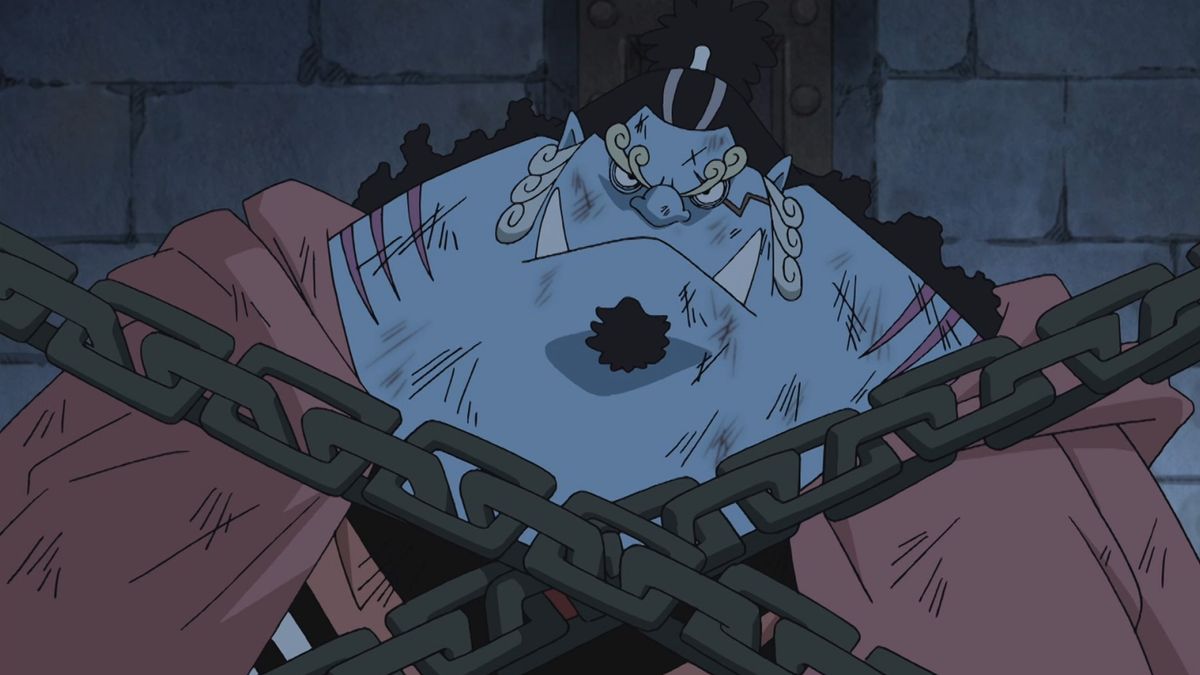
Level Six guards discuss Eternal Hell and the legendary prisoners erased from public life. Jinbe shares Ace’s cell after refusing the Government’s summons to fight Whitebeard. He tells Ace that Whitebeard claimed Fish-Man Island as his territory when pirates flooded the island during the Great Pirate Era, stopping kidnapping and slave trafficking through the force of his name. Crocodile mocks the loyalty and predicts that enemies will rush to take Whitebeard’s head.
On Level Two, Luffy, Buggy, and Galdino flee Manticores and Puzzle Scorpions. Buggy distracts the beasts with moving feet before ruining the trick by shouting. The trio reaches the Sphinx, a massive guardian that repeats noodle names. Buggy and Galdino form a secret escape alliance and use Luffy as bait. Galdino creates wax doubles, Luffy plays along, and the Sphinx pounds the floor until everyone, including the beast, falls toward Level Three.
RaeRae’s opening receipt
Episode 430 returns from a four-part movie commercial and immediately gives us Jinbe explaining how one pirate flag protected Fish-Man Island better than the world government claiming authority over the sea. That contrast is not subtle, and subtlety would be wasted here.
Above him, a giant Sphinx says noodle names while Buggy and Galdino build an escape alliance based on betraying Luffy. One Piece can place geopolitical protection, racialized trafficking, wax decoys, and a ramen vocabulary inside the same episode because tone follows character instead of pretending serious subjects require beige walls.
The return to Impel Down needs a continuity reset
Episode 430 resumes the fall from Level Two after Episodes 426 through 429 paused chronology for Strong World.
Clear directory labeling prevents the transition from looking like missing footage.
Level Six begins with institutional silence
Guards interpret quiet as normal around prisoners the world has been taught to forget.
Absence of noise does not mean absence of danger.
Eternal Hell erases people before death
Legendary criminals remain alive while public records treat them as removed from history.
Confinement becomes social disappearance.
Execution is described as release
Guards believe death may feel preferable to permanent isolation.
The statement reveals punishment designed beyond rehabilitation or ordinary security.
Jinbe sits beside Ace as a Warlord prisoner
A title meant to formalize cooperation with the Government cannot protect someone who refuses the required war.
Privilege ends at disobedience.
He rejected the order to fight Whitebeard
Neutrality was not offered as a legitimate option.
The Warlord arrangement demands violence when the state decides payment is due.
Losing the title does not change his answer
Jinbe accepts imprisonment rather than attack the man who protected Fish-Man Island.
Gratitude becomes political refusal.
Ace knows Jinbe through an old fight
Their relationship includes a battle where both men tried to kill the other.
Respect can grow from conflict without rewriting the conflict as friendship from the start.
Jinbe calls himself a pirate who hates pirates
The phrase holds experience with human crews who preyed on Fish-Men and mermaids.
Category loyalty cannot survive witnessing what the category permits.
The Great Pirate Era hit Fish-Man Island as invasion
Roger’s final words inspired adventure for some and a trafficking rush for others.
Freedom celebrated on the surface produced predators below.
Human pirates treated residents as merchandise
Fish-Men and mermaids were kidnapped for sale.
The era’s romance depends on whose ship entered whose home.
Local strength could not stop the volume
Too many crews arrived for defenders to repel continuously.
Repeated attacks turn courage into exhaustion without changing structural exposure.
Whitebeard claimed the island through his name
Declaring Fish-Man Island his territory made attacking residents equivalent to provoking an Emperor.
Reputation became a shield larger than any stationed force.
The protection used pirate hierarchy against pirates
Whitebeard did not abolish predation across the sea.
He raised the cost around one community until traffickers looked elsewhere.
That protection remains morally complicated and materially real
Territorial claim carries ownership language.
Residents still gained safety from kidnapping and sale.
Jinbe remembers outcomes rather than purity
He does not need Whitebeard to represent a perfect system.
He remembers fewer people disappearing from his home.
Debt becomes loyalty to civilians
Supporting Whitebeard also protects the stability built around his flag.
Jinbe’s refusal concerns Fish-Man Island as much as one pirate captain.
Ace tells him not to carry everything
The condemned man sees how guilt and responsibility are grinding his cellmate down.
Care moves between prisoners even when neither can open the door.
Jinbe has not abandoned hope
Chains and Level Six do not make the coming war feel decided.
Refusal survives without a visible escape plan.
Crocodile listens from another cell
Luffy’s former enemy occupies the same hidden level with his ambition intact.
Imprisonment has not softened his appetite for changing eras.
He predicts Whitebeard’s enemies will gather
An Emperor’s vulnerability attracts rivals who waited under his shadow.
The execution creates opportunity far beyond Marine justice.
Other prisoners echo the desire
Level Six contains grudges the public has forgotten but the prisoners preserve.
Erasure cannot erase resentment.
The cell block previews a wider war
Ace’s death could destabilize territory, trafficking patterns, Emperor balance, and buried rivalries.
One execution becomes a global lever.
Level Two answers politics with running
Luffy, Buggy, and Galdino have no time for strategic theory while beasts chase them.
The tonal cut keeps urgency physical.
Puzzle Scorpions multiply under attack
Striking one body produces smaller threats instead of removing danger.
Direct force makes the corridor more crowded.
Manticores chase with borrowed voices
The lion-like beasts repeat words heard from prisoners.
Human language returns without human understanding.
Random phrases make the predators worse
Loincloth and strawberry-panty fragments sound comic until teeth remain attached.
Speech does not create empathy.
Galdino knows what the words mean
The Manticores imitate sounds rather than communicate.
His prison knowledge saves the group from treating noise as negotiation.
Buggy uses his feet as a decoy
Detached steps lead the creatures away while the trio hides above.
Devil Fruit anatomy becomes tactical misdirection.
Silence would preserve the trick
Buggy announces success before safety.
Ego returns the predators faster than tracks could.
Galdino learns Luffy wants to descend
He assumed every free prisoner shared the goal of escape.
Entering deeper by choice sounds like madness because Ace has not become his responsibility.
The brother relationship changes his risk calculation
Ace is no longer an abstract high-value inmate.
Connection explains Luffy’s refusal to turn upward.
Galdino tries to leave anyway
Understanding motive does not create shared loyalty.
Self-preservation remains his first policy.
Luffy physically keeps the guide nearby
Directions matter more than Galdino’s enthusiasm.
The rescue crew continues operating without voluntary unity.
The stairs connect escape and descent
One route can take Galdino upward and Luffy downward.
Temporary cooperation survives while paths overlap.
The Sphinx controls the floor
Other beasts flee when the enormous guardian approaches.
Predator hierarchy provides the clearest warning.
Noodle names are the only vocabulary
Ramen, wonton men, and other dishes replace roars or commands.
The guardian sounds ridiculous without becoming less massive.
Buggy and Galdino create a secret alliance
Both want to use Luffy as bait while reaching the upward route.
Betrayal becomes friendship when two cowards share paperwork.
Luffy notices scheming without leaving the fight
The Sphinx remains a more immediate problem than whispers behind him.
Suspicion waits behind survival.
Gum-Gum Bazooka knocks the guardian down
Force buys time but does not end the creature.
The floor boss responds with greater agitation.
Luffy grabs the Sphinx’s mane
Clinging turns attack range into chaotic rodeo space.
Control becomes temporary proximity.
Galdino creates wax copies
Mr. 3 uses duplication to redirect the Sphinx’s attacks.
Deception finally contributes more than escape talk.
Luffy plays along with the decoys
He understands the trick quickly enough to encourage wrong targets.
Improvisation turns another man’s power into group strategy.
The Sphinx destroys the floor while missing
Every failed strike damages the structure supporting everyone.
A successful distraction creates an architectural disaster.
Buggy and Galdino attempt their getaway
Their plan depends on leaving while Luffy occupies the beast.
Success remains measured by personal distance.
The floor refuses separate outcomes
Cracks spread beneath schemers, fighter, and guardian alike.
Shared collapse overrides private plans.
Everybody falls toward Starvation Hell
Level Three receives Luffy, Buggy, Galdino, and the Sphinx together.
The rescue descends through another accident that feels inevitable in retrospect.
Go-men turns apology into the last noodle joke
The Sphinx’s falling cry sounds like sorry while preserving the food pattern.
Language accidentally becomes appropriate at the moment of maximum damage.
The episode pairs territorial protection with broken floors
Whitebeard uses a name to stabilize an island. Luffy’s group destabilizes a prison through bodies and improvisation.
Power can protect or contain depending on who controls the boundary.
This remains an episode React
This page responds to Jinbe’s imprisonment, Whitebeard protecting Fish-Man Island, Crocodile’s prediction, Manticores, Puzzle Scorpions, Buggy’s foot trick, the Sphinx, wax doubles, and the fall to Level Three. Arc-level judgment remains separate.
React classification protects the episode-versus-Review boundary.
The official local still remains canonical
The Episode 430 official story image serves as featured image, hero, static directory card, and social preview through one local attachment.
Complete metadata preserves source, accessibility, filing, and unique use.
RaeRae’s final receipt
Jinbe sits in Eternal Hell because the Government demanded that he attack the pirate whose flag stopped Fish-Men and mermaids from being sold. The Warlord title promised legitimacy only while obedience remained useful. His refusal reveals the contract.
Crocodile hears loyalty and smells an era changing. Whitebeard’s death would not end with one family grieving. Territories would lose protection, traffickers would test boundaries, rivals would chase the empty throne, and buried monsters would call that opportunity.
Above them, Luffy, Buggy, and Galdino defeat a noodle-speaking Sphinx so badly that the floor loses. The secret escape alliance falls with the rescue target, the wax strategist, and the beast they tried to use. Impel Down keeps sorting people into levels. Luffy keeps arriving by breaking the ceiling.
Jinbe’s refusal is not abstract pacifism
He opposes a specific war whose target protected his home.
Political gratitude gives the decision material stakes.
Whitebeard’s flag functioned as deterrence
Predators changed behavior because retaliation became credible.
Safety arrived through feared reputation rather than universal law.
That arrangement exposes institutional absence
The World Government claims enormous maritime authority while Fish-Man Island depends on an Emperor’s informal protection.
Legitimacy means little when residents keep disappearing.
Jinbe judges systems through vulnerable people
Titles, treaties, and pirate categories matter less than whether kidnappers can operate.
Outcome keeps his loyalty grounded.
Crocodile judges the same moment through opportunity
He sees Whitebeard’s protection as power available for seizure after death.
The cells hold competing political imaginations.
Ace becomes the hinge between those futures
Executing him invites Whitebeard into battle and exposes every territory depending on the Emperor’s survival.
The Government turns one prisoner into systemic risk.
Manticores parody communication
They repeat human phrases without carrying intention or shared meaning.
Words become another sound used by predators.
Buggy makes the inverse mistake
He has intention, language, and tactical insight, then destroys the plan by talking too loudly.
Communication becomes danger through ego.
Galdino’s wax shows intelligence under pressure
Copies redirect power rather than challenging strength directly.
The strategy works until structural damage exceeds the original problem.
Luffy treats another person’s plan as play
He encourages the Sphinx to strike false targets with immediate enthusiasm.
Improvisation lets him cooperate without formal discussion.
The broken floor defeats every private agenda
Luffy wants Ace, Buggy wants escape, Galdino wants survival, and the Sphinx wants a target.
Gravity sends all four toward the same level.
Impel Down’s vertical logic keeps backfiring
Deeper floors should increase containment.
Broken architecture turns descent into unauthorized access.
The movie detour makes the return sharper
Little East Blue offered sunlight, memory, community, and a complete crew.
Level Six returns viewers to erasure, trafficking history, and family separation.
Episode 430 restores the main urgency
Ace remains chained, Whitebeard approaches, Hancock descends, and Luffy breaks another boundary.
The prison story resumes with every clock still running.
RaeRae’s extra receipt
Jinbe’s story destroys the easy claim that legal authority equals protection. Fish-Man Island had law, borders, and people willing to fight. Whitebeard’s feared name accomplished what official structures did not: human pirates stopped treating residents as merchandise.
That safety now depends on one aging man’s survival, which explains why Jinbe accepts Level Six rather than help destroy him. Luffy does not know the full political map yet. He simply keeps moving toward Ace, collecting the people and broken floors that will force the map open.