RaeRae Reacts · One Piece Episode 429
Luffy Breaks Largo’s Net Before Boss Collects the Promised Rematch
One Piece Episode 429 movie tie-in special React follows Nami’s tunnel counterattack, Gear Third, Largo’s defeat, Yoko’s lesson, and Shiki’s animal army.
One Piece Episode 429 movie tie-in special React: Luffy breaks Largo’s full-body net with Gear Third, Nami turns an evacuation route into a counterattack, Boss catches the falling captain and demands the promised rematch, and Yoko learns why one pirate crew does not define every pirate.
What happened in Episode 429
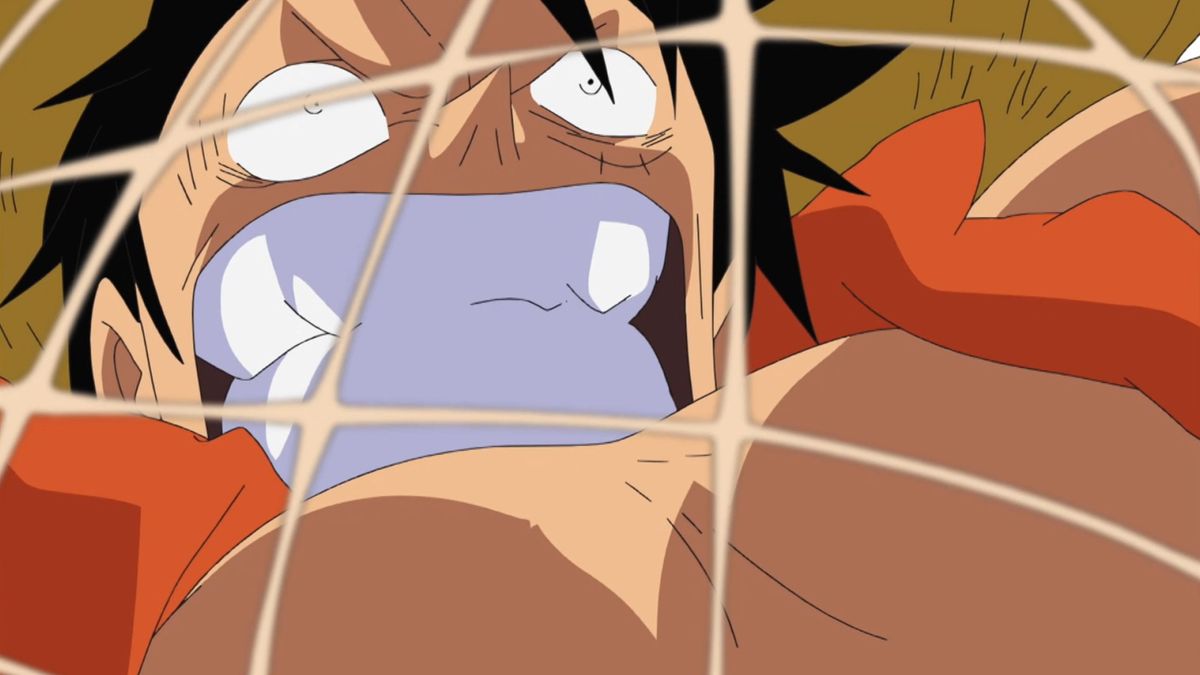
Freed by Boss’s early molt, Luffy, Zoro, and Sanji resume the fight. Luffy knocks Largo away and pursues him. Nami appears to evacuate Little East Blue’s residents through tunnels, then redirects them behind the Amigo Pirates for a surprise attack while Zoro and Sanji dismantle the crew. Largo transforms his entire body into a massive net and catches Luffy. Gear Third expands beyond the restraint, and Gigant Pistol sends Largo through his ship.
Luffy falls toward the sea after the attack. Boss saves him, then insists on their unfinished contest. The pair fight for hours. Nami tells Yoko how Luffy freed Cocoyasi Village from Arlong, giving her a specific story rather than a slogan about good pirates. The Straw Hats depart after the island is safe. The final reveal confirms that Boss escaped Shiki’s engineered-animal program and that the Golden Lion plans to use similar creatures in war against the world.
RaeRae’s opening receipt
Nami tells everyone to evacuate and quietly turns the evacuation tunnel into battlefield strategy. That move deserves respect because leadership does not always arrive shouting an attack name. Sometimes leadership smiles, moves civilians out of the firing line, and brings them back behind the men who thought fear ended resistance.
Luffy defeats a man made of nets by becoming too large for the definition of captured. Then Boss saves him from the ocean and collects the rematch promised during the crisis. Friendship in this crew’s orbit includes invoices.
Boss’s fire restores the crew’s fighters
Luffy, Zoro, and Sanji return because the beetle burned the restraints holding them.
The final battle begins with a debt, not a rescue fantasy.
Luffy targets Largo immediately
The captain who ordered capture remains the clearest route to ending the attack.
Removing subordinates cannot solve the hierarchy while Largo keeps producing nets.
The first blow creates distance
Luffy sends Largo away from Boss and the residents.
Battlefield placement becomes protection before victory.
He follows rather than celebrating
A single hit does not end an opponent connected to Shiki.
Urgency replaces performance.
Zoro and Sanji handle the Amigo crew
Freed movement lets both fighters turn anger into cleanup.
The broken Baratie sign and injured Boss remain visible reasons.
Their rivalry becomes efficient under threat
Arguments continue without preventing coordinated defense.
Competition serves the community when both men aim at invaders.
Nami announces evacuation
Moving residents away from open combat sounds like retreat.
The order protects lives while concealing a second purpose.
Tunnels preserve local knowledge
Little East Blue residents understand routes the Amigo Pirates never mapped.
Home terrain becomes tactical advantage.
Nami turns safety into surprise
The villagers emerge behind the attackers instead of disappearing from the conflict.
Withdrawal becomes repositioning.
The counterattack belongs to residents
Straw Hat strength opens space, but local people reclaim the island.
Protection does not require passive civilians waiting for celebrity heroes.
Fear stops organizing the community
Boss’s attempted sacrifice showed the cost of letting terror choose.
The tunnel maneuver gives residents a shared alternative.
Nami leads through trust in ordinary people
She does not assume only powerful pirates can contribute.
Information, timing, and numbers matter beside Devil Fruits.
Her Cocoyasi history informs the tactic
Nami knows what liberation means when residents have endured domination.
A community should participate in the moment control breaks.
Largo expands the Net-Net Fruit further
Instead of producing a separate net, he turns his whole body into one.
Capture becomes his complete physical identity.
The giant net removes ordinary escape angles
Luffy cannot simply slip between cords or outrun the spread.
Largo makes scale answer speed.
Rubber meets flexible restraint
Both powers alter shape, but only one fighter controls the surrounding space at first.
The battle becomes a contest over who defines size.
Gear Third rejects the assigned dimensions
Luffy inflates bone until the restraint cannot contain his attack.
Freedom arrives by exceeding the captor’s measurement.
Gigant Pistol carries accumulated anger
Boss was burned, shot, pressured into surrender, and caught during collapse.
The final blow answers more than Luffy’s personal confinement.
Largo crashes through his own ship
The extraction vehicle becomes part of the defeat.
Infrastructure built to remove Boss breaks under the resistance Boss enabled.
The Amigo Pirates lose organizational confidence
Their captain falls while residents attack from behind and Straw Hats control the field.
Authority collapses across several fronts at once.
Victory sends Luffy toward the sea
Gear Third and the angle of attack leave him falling without safe ground.
Defeating a Devil Fruit user does not remove Luffy’s oldest environmental weakness.
Boss catches the captain
The intended captive rescues the rescuer again.
Mutual protection becomes the arc’s final answer to Shiki’s ownership model.
The promised fight still matters
Luffy used the rematch to stop Boss from surrendering.
Boss now holds him accountable to the future he promised.
They fight for hours
The contest sounds absurd after an invasion and premature molt.
Play, rivalry, and stubbornness prove that Boss survived as a person rather than a tragic symbol.
The rematch restores ordinary relationship
During crisis, Boss became target, weapon, and sacrifice.
Fighting Luffy lets him return to friend and rival.
Yoko still needs an explanation
Watching the Straw Hats defend the island challenges her belief but does not supply history.
Nami offers a specific account from another occupied home.
Nami tells the Arlong story
She describes a pirate who enslaved Cocoyasi and the pirate who broke that rule.
The contrast refuses to treat one flag as a complete moral category.
Luffy saved Nami without buying her obedience
He destroyed the room where Arlong forced her to draw maps.
Freedom, not recruitment, made joining the crew meaningful.
The story speaks directly to Boss
Arlong treated Nami’s talent as property. Shiki treats the beetle’s power as military inventory.
Luffy opposes both forms of ownership.
Yoko receives evidence from someone harmed by pirates
Nami does not dismiss pirate violence because she experienced pirate violence intimately.
Her testimony carries credibility beyond crew loyalty.
Good pirate remains too simple a category
Luffy can protect communities and still create chaos, ignore law, and pursue selfish dreams.
Specific action remains more honest than moral branding.
Yoko can revise belief without betraying her father
Recognizing differences among pirates does not require rejecting Marine service or grief.
Discernment adds detail to inheritance.
The villagers reclaim celebration
The island survives because residents refused to let Boss pay alone.
Festive community means more after shared defense.
The Straw Hats prepare to leave
They do not convert protection into rule over Little East Blue.
Departure confirms that help did not create ownership.
Nami gathers the crew again
Navigation returns everyone to the Sunny after separate hometown routes.
The movie prologue closes its island chapter through her coordination.
Boss remains with the people he chose
Shiki’s fleet does not receive the creature, and Luffy does not demand a new crewmate.
Respect for belonging survives victory.
The final reveal changes the beetle’s history
Boss was specially created within Shiki’s program and escaped.
Little East Blue gave refuge to a living consequence of the coming war.
Escape makes Boss more than an experiment
Origin explains his abilities without defining his identity.
Community gives him a life beyond the laboratory.
Shiki wants an army of altered animals
Boss is not an isolated curiosity.
The Golden Lion plans industrial-scale biological warfare.
The world becomes the target
Little East Blue previews what one small community faces under a global ambition.
The film expands the threat from one retrieval squad to mass attack.
The Amigo defeat does not stop Shiki
Largo served as a replaceable agent within a larger structure.
Winning locally reveals rather than ends the system.
The tie-in fulfills its promotional job
Shiki, engineered creatures, and Strong World’s conflict now have a direct television bridge.
The episode closes the detour where the film can continue.
The arc remains anime-original and worth classifying honestly
Emotional meaning does not require pretending the events belong inside manga continuity.
Transparency lets viewers value the special on its own terms.
This remains a numbered television special React
This page responds to Nami’s tunnel counterattack, Zoro and Sanji’s defense, Largo’s full-body net, Gear Third, Gigant Pistol, Boss’s rescue and rematch, Yoko’s lesson, and Shiki’s engineered-animal plan. Film-level judgment remains separate.
Clear labeling protects the episode-versus-Review boundary and the continuity record.
The official local still remains canonical
The Episode 429 official story image serves as featured image, hero, static directory card, and social preview through one local attachment.
Complete metadata preserves source, accessibility, filing, and unique use.
RaeRae’s final receipt
Largo becomes a net large enough to call capture complete. Luffy becomes a fist too large for that sentence. The Gigant Pistol breaks the ship, but Boss gets the final rescue by catching Luffy before the sea can collect him.
Nami handles the quieter victories. She turns evacuation tunnels into a counterattack and gives Yoko a story grounded in lived harm. Arlong used a gifted child as property. Luffy destroyed the room where that ownership happened. Shiki’s interest in Boss belongs to the same ugly family.
Little East Blue survives because residents stop letting one friend volunteer for disappearance. Boss survives as more than an experiment because the community and the Straw Hats honor where he chose to belong. The Golden Lion still has an army plan. Strong World now has its warning label.
Nami solves the battlefield before Luffy solves Largo
Moving residents through hidden routes reduces exposure and creates a second front.
Strategy changes who can act rather than merely predicting who will win.
The islanders attack from remembered ground
Tunnels beneath replica streets turn cultural preservation into defensive infrastructure.
Home knowledge defeats outside confidence.
Largo’s final form exposes his worldview
He becomes the instrument of capture completely.
A man who treats relationships as nets eventually removes the distinction between body and cage.
Luffy expands because refusal needs space
Gear Third does not unlock a knot.
The technique makes the captor’s frame too small to remain authoritative.
Boss rescues without becoming recruited
Saving Luffy could invite another demand to join the crew.
The promised rematch preserves equality instead.
The hours-long fight is emotional recovery
Boss can spend strength on play and pride after spending strength on survival.
Exhaustion chosen freely differs from exhaustion demanded by captors.
Nami gives Yoko complexity without propaganda
Her story includes a pirate oppressor and pirate liberator.
The lesson is not trust every pirate. The lesson is judge conduct precisely.
That lesson respects the Marine father
Yoko can keep love for him while rejecting a rule too broad for reality.
Growth adds judgment rather than deleting memory.
Boss’s engineered origin does not cancel local belonging
A laboratory may explain creation. A community explains home.
Shiki has no moral claim simply because his program produced the body.
Creation is not ownership
Parents, scientists, governments, and captains can all confuse origin with permanent authority.
Boss’s escape answers that confusion through movement.
The Amigo Pirates fail because they have no relationship to protect
They fight for rank under Shiki and withdraw when the structure collapses.
Little East Blue fights for people who will remain after battle.
The Straw Hats leave the island stronger than they found the myth
Residents admired stories before meeting the crew.
Shared defense gives that admiration evidence without requiring worship.
The film setup avoids a hollow cliffhanger
The island conflict resolves before Shiki’s larger program receives focus.
Viewers get closure and invitation rather than an unfinished television ransom.
Episode 429 closes the special cleanly
Boss stays, Yoko learns, Largo loses, residents regain agency, and the Sunny departs.
The next numbered episode can return to Impel Down without leaving Little East Blue broken.
RaeRae’s extra receipt
The special ends by separating every relationship Shiki tried to collapse. Creating Boss does not mean owning Boss. Protecting Boss does not mean recruiting Boss. Saving Little East Blue does not mean ruling Little East Blue. Telling Yoko one good-pirate story does not mean denying pirate harm.
Those boundaries give the happy ending weight. Everybody leaves with the connection they chose. Largo and Shiki lose because their entire program begins by treating choice as an obstacle.
The Sunny’s departure protects the ending
The Straw Hats leave after the island regains safety instead of converting gratitude into permanent authority. Little East Blue remains responsible for its own future.
That exit distinguishes solidarity from conquest. The crew helped because capture was wrong, not because victory entitled them to the island, Boss, or Yoko’s unquestioning admiration.