RaeRae Reacts · One Piece Episode 421
Perona Finds Zoro While Harahettania Summons Brook as a Devil King
One Piece Episode 421 React follows Perona nursing Zoro on Kuraigana and Harahettania mistaking Brook for Satan during a revenge ritual.
One Piece Episode 421 React: Perona finds the wounded Zoro on Kuraigana Island, tries to recruit the one man her Negative Hollows cannot emotionally flatten, and Brook lands inside a Harahettania summoning circle where desperate villagers mistake a skeleton musician for Satan.
What happened in Episode 421
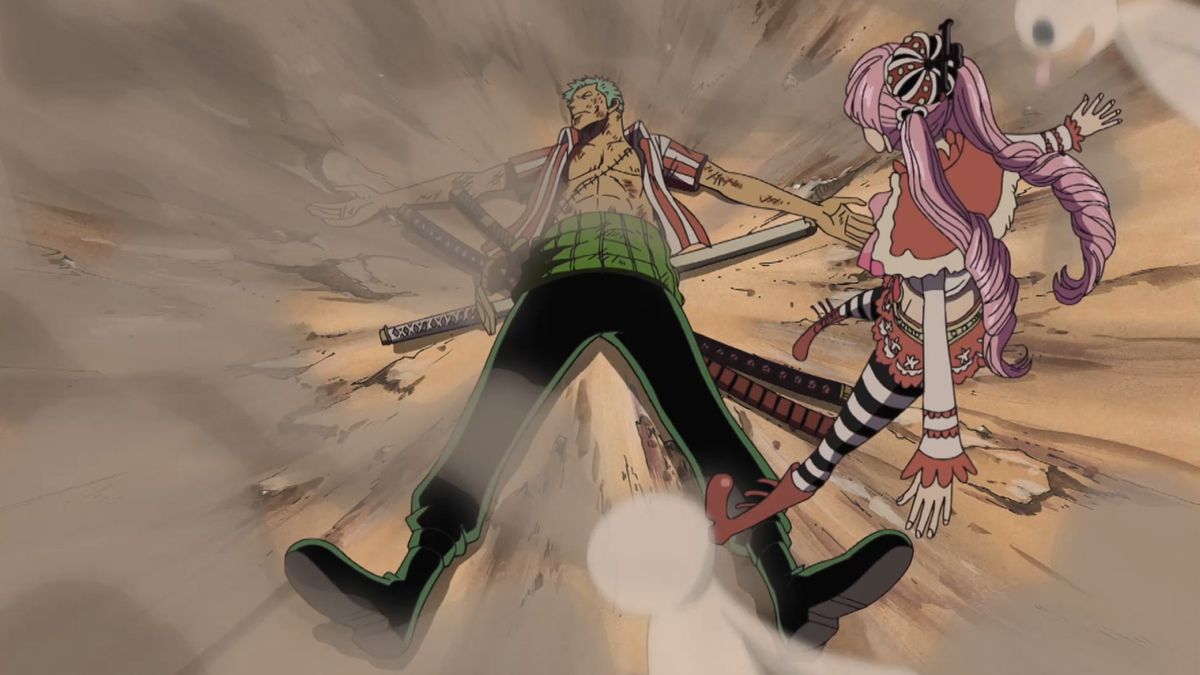
Perona remembers Kuma sending her from Thriller Bark to the ruins of the Shikkearu Kingdom, the gloomy destination she once named as her ideal vacation. Solitude stops feeling ideal almost immediately. Zoro crashes onto the same island, still carrying the damage from Thriller Bark and Sabaody. Perona drags him into the castle, treats his wounds, dresses him in a Kumashi costume, and declares that he can become her servant. Her Negative Hollows cannot keep him obedient. Zoro wants directions back to Sabaody, while Perona follows and complains through every stubborn step.
On Namakura Island, impoverished residents of Harahettania perform a ritual against the Longarm Tribe that terrorizes them. Brook falls into the circle at the perfect wrong moment. The villagers decide they successfully summoned Satan and beg their new devil king to punish their enemies. Brook responds with his usual request to see panties. Every worshipper starts complying, including the men, and Brook discovers that being mistaken for a demon does not guarantee useful interpretation.
RaeRae’s opening receipt
Kuma did not send two Straw Hats toward comfort. He sent Zoro into a ruined kingdom occupied by a former enemy and dropped Brook into a community whose suffering has made ritual feel more practical than resistance. Episode 421 makes loneliness funny without pretending loneliness feels harmless.
Perona wanted gothic peace until peace meant nobody answering. Harahettania wants a supernatural weapon because ordinary power has failed. Both locations begin with people asking another person to fill a role before learning who actually arrived.
Perona receives her requested vacation
Thriller Bark let Perona describe a dark castle full of ruins as paradise. Kuma takes the request literally.
The joke lands because fantasy loses glamour once isolation has no staff, servants, or familiar voices.
Kuraigana gives gloom consequences
Broken towers and empty halls suit Perona’s aesthetic perfectly. Daily survival does not care about aesthetic.
A dream destination becomes a test of whether she wanted darkness or wanted control over a decorated home.
Zoro arrives as another Kuma delivery
His body falls from the sky after absorbing Luffy’s pain at Thriller Bark and fighting through Sabaody.
The destination connects two former enemies before either understands Kuma’s larger plan.
Perona chooses rescue before explanation
She could leave Zoro outside. Instead, she drags him into shelter and tends injuries that have nothing to do with her.
Care appears beneath all the insults, poses, and ghost-princess theater.
The Kumashi costume is pure Perona management
Dressing Zoro like her old bear servant turns a frightening stranger into something visually familiar.
Control begins with presentation because Perona cannot make the swordsman emotionally convenient.
Zoro wakes ready to leave
Recovery barely begins before he demands a route back to Sabaody.
His first useful thought belongs to the crew, not the castle or the woman who saved him.
Negative Hollows meet the wrong target
Perona’s ghosts usually collapse pride by forcing victims into brutal self-disgust.
Zoro already carries enough severe self-criticism to make supernatural negativity look redundant.
His immunity remains one of the funniest character truths
The power fails because Zoro can produce harsher thoughts about himself without assistance.
Comedy exposes discipline twisted into a permanent internal punishment system.
Perona cannot command the patient
Medical help does not purchase obedience, even when she believes the arrangement should feel obvious.
Zoro accepts bandages without accepting ownership.
Gratitude and submission are not the same
He owes Perona recognition for saving him. He does not owe a servant contract.
Episode 421 keeps that line visible beneath the bickering.
Zoro wants one direction only
Sabaody remains the promised reunion point.
His navigation history makes the request hilarious, but the loyalty beneath the request never wavers.
A map cannot solve Zoro
Perona can point toward a route and still expect the swordsman to walk somewhere impossible.
Geography becomes a personality conflict before the journey even starts.
Perona follows because isolation already lost
She complains that Zoro should stay, then refuses to let him wander alone.
Her actions admit attachment before her language allows kindness.
Their hostility has changed shape
Thriller Bark framed Perona as an enemy and Zoro as an intruder. Kuraigana frames both as survivors displaced by Kuma.
Shared abandonment creates a reluctant partnership without erasing their history.
The castle holds missing history
Ruins suggest a kingdom emptied by violence long before either visitor arrived.
Neither character knows that the landscape will soon connect Zoro to the swordsman he most needs to confront.
Zoro’s wounds keep Kuma’s cost present
Bandages do not let the story pretend Sabaody was a clean reset.
Every movement carries the accumulated damage he chose to absorb for Luffy.
Perona sees vulnerability without easy victory
Zoro can barely travel, yet her strongest emotional weapon still cannot control him.
Physical weakness and spiritual submission remain separate conditions.
Harahettania begins with organized desperation
Villagers gather around a symbol because the Longarm Tribe has reduced ordinary defense to failure.
The ritual looks absurd, but the fear driving the ritual deserves a serious reading.
Poverty shapes the request
The residents lack weapons, political protection, and confidence that any human ally will arrive.
Calling Satan becomes a last strategy from people who believe legitimate power abandoned them.
Brook drops into a prepared narrative
A living skeleton lands exactly where worshippers expect a devil.
Timing supplies all the evidence the frightened crowd needs.
The costume problem works in Brook’s favor
Afro, bones, clothes, and impossible survival make him look supernatural before he says a word.
For once, the appearance that frightens strangers grants instant authority.
Brook accepts attention before understanding
After years alone on a ghost ship, an entire village kneeling around him feels emotionally overwhelming.
Recognition can look like belonging when isolation has lasted too long.
The villagers ask for revenge
They want the supposed devil king to punish the Longarm Tribe for repeated raids and humiliation.
Worship functions as outsourced resistance.
Brook’s first demand remains painfully Brook
He asks to see panties while the villagers expect blood, curses, or supernatural terms.
The running joke collides with a group too sincere to recognize the joke.
Everybody starts complying
Men and women treat the request as a sacred command.
Brook finally receives enthusiastic cooperation and immediately regrets the lack of specificity.
The gag exposes the danger of blind obedience
Nobody pauses to question whether a genuine savior would begin with underwear.
Desperation makes absurd authority sound reasonable.
Brook has not been given the full problem
The villagers call the Longarm Tribe evil, but Brook has not seen the raids or heard the opposing account.
Being assigned the role of weapon arrives before informed consent.
Both halves revolve around unwanted roles
Perona calls Zoro a servant. Harahettania calls Brook a devil king.
Neither label describes the person standing inside the costume.
Zoro rejects the role directly
He walks away from Perona’s command despite pain, confusion, and terrible navigation.
Freedom looks stubborn because stubbornness is the tool he has.
Brook initially plays along
Attention and comedy distract him from the political demand beneath the ritual.
His challenge will be separating compassion for the villagers from the identity they imposed.
Kuma’s destinations are not random punch lines
Kuraigana contains isolation, sword history, and a future teacher. Namakura contains performance, exploitation, and a community that needs courage.
Each island turns a Straw Hat’s familiar trait into unfinished work.
Episode 421 closes the scattered-crew survey
Nami, Franky, Chopper, Sanji, Robin, Usopp, Zoro, and Brook now have visible destinations.
The crew remains divided, but the audience no longer has to imagine eight blank fates.
Luffy still moves toward Impel Down
Hancock’s hidden passenger crosses the sea while the final crew reports unfold.
The episode keeps reunion hope alive while redirecting immediate urgency toward Ace.
The emotional timeline stays uneven
Zoro thinks about returning at once. Brook barely understands where he landed. Luffy has already changed destinations.
Separation means every crewmate operates with incomplete information.
Perona and Brook both receive audiences
Perona gains one unwilling companion. Brook gains a whole village of worshippers.
Neither audience behaves according to the fantasy imagined beforehand.
Loneliness makes strange alliances believable
A ghost princess nursing a swordsman and villagers worshipping a pirate skeleton sound ridiculous in summary.
Emotional need gives both arrangements weight beyond novelty.
This remains an episode React
This page responds to Perona’s rescue, Zoro’s Negative Hollow immunity, the Kumashi costume, Kuraigana, Harahettania’s ritual, Brook’s arrival, and the villagers’ revenge request. Arc-level judgment remains separate.
React classification protects the episode-versus-Review boundary.
The official local still remains canonical
The Episode 421 official story image serves as featured image, hero, static directory card, and social preview through one local attachment.
Complete metadata preserves source, accessibility, filing, and unique use.
RaeRae’s final receipt
Perona gets the gloomy kingdom she asked for and discovers that perfect scenery cannot answer back. Then Zoro crashes into her solitude carrying enough damage and self-criticism to defeat both good sense and Negative Hollows. She calls him a servant, but her care says companion before her pride can catch up.
Brook lands among people who need a weapon so badly that a skeleton inside a ritual circle becomes proof. Their worship is funny. Their desperation is not. Episode 421 closes the crew-location run by giving two displaced pirates communities they did not choose and roles they did not request.
Kuma’s paw prints keep looking less like disappearance and more like brutal placement. Zoro meets the landscape of his future training. Brook meets a population whose fear turns performance into authority. Neither man can return yet. Both have already entered the lesson.
Perona’s kindness refuses a clean label
She mocks, dresses, orders, and irritates Zoro while keeping him alive.
Messy care still counts as care, even when the caregiver refuses tenderness as a public identity.
Zoro’s urgency carries guilt
He does not know whether the crew survived or whether Luffy remains alone.
Rest feels irresponsible when every missing friend might be in danger.
Recovery demands dependence he hates
Zoro built his identity around endurance and self-sufficiency. Kuraigana forces him to accept shelter from someone he fought.
Dependence does not erase strength. Dependence reveals which relationships can grow past rivalry.
The Kumashi disguise cannot make him harmless
Soft fabric and a familiar silhouette do not change Zoro’s will.
Perona can edit appearance more easily than character.
Negative emotion is not Zoro’s missing ingredient
He already measures himself against promises, defeats, and the strength required to protect Luffy.
Perona’s ghosts find no open market because the swordsman supplies his own ruthless criticism wholesale.
Perona wants company under terms she controls
A servant cannot leave, challenge, or reject her version of home.
Zoro becomes valuable precisely because he refuses that safe arrangement.
Following him becomes the honest choice
Perona can remain queen of an empty ruin or argue beside a living problem.
She chooses the problem.
Harahettania shows faith born from powerlessness
The ritual does not begin with abstract theology. The ritual begins with raids, humiliation, and no successful defense.
Belief becomes a survival technology when every visible institution has failed.
Brook understands spectacle instinctively
A performer knows how posture, entrance, and timing control a room.
His accidental entrance gives him a stage before he has a song or a plan.
A stage can create responsibility
The villagers listen because they believe Brook can change their lives.
Applause feels good. Trust built from desperation carries a heavier bill.
The underwear joke breaks sacred distance
Brook’s request reveals a ridiculous pirate beneath the supposed demon king.
The villagers’ literal response proves that reverence can erase ordinary judgment.
Comedy does not cancel exploitation
The scene invites laughter while the Longarm threat remains real in the background.
One Piece regularly lets a gag open the door before harder politics walks through.
Both locations misunderstand freedom
Perona imagines company as ownership. The villagers imagine liberation as punishment delivered by an outside monster.
Zoro and Brook must resist becoming tools inside those definitions.
The crew shares one invisible promise
Every separated member intends to return to Sabaody, even when nobody knows the delay ahead.
The promise holds the crew together before distance can become abandonment.
Zoro’s route will require humility
Strength alone cannot navigate Kuraigana, heal his body, or reveal Kuma’s purpose.
The swordsman will need help from people his pride would rather classify as enemies.
Brook’s route will require discernment
Compassion for Harahettania does not mean accepting every claim or every revenge demand.
A musician who survived isolation must learn what kind of audience deserves his service.
Episode 421 earns the split focus
Neither half needs a full battle to matter. Character placement supplies the movement.
The episode finishes a map of survival before opening the prison gates.
The Amazon Lily arc ends away from Amazon Lily
Luffy’s decision has already launched the next emergency, but the story pauses to account for the people he still intends to meet.
Closure belongs to the whole crew even during the captain’s solo mission.
Kuma remains absent and powerful
He never appears in the present action, yet every location, argument, and new relationship follows his choice.
Absence becomes authorship without becoming explanation.
RaeRae’s extra receipt
Episode 421 understands that rescue rarely arrives wearing the expected face. Perona saves a man who refuses to become her servant. Brook appears as the devil Harahettania requested, then opens negotiations with a panty joke. Nobody receives the tidy relationship ordered from the universe.
That mess is the point. Zoro needs enforced recovery and a path toward greater skill. Perona needs company capable of saying no. Brook needs people after decades alone, while the villagers need courage that cannot remain outsourced to a false god. Kuma places every unfinished need in the same room and lets personality start the fight.