RaeRae Reacts · One Piece Episode 412
Hancock Turns Marguerite to Stone and Luffy Ends the Arena’s First Show
One Piece Episode 412 React follows Luffy’s immunity, Marguerite’s confession, Hancock’s judgment, and Bacura’s one-strike defeat.
One Piece Episode 412 React: Hancock discovers that neither nudity nor the Love-Love Fruit can control Luffy, Marguerite accepts punishment for saving him, and an Amazon Lily arena turns gratitude into a public death sentence.
What happened in Episode 412
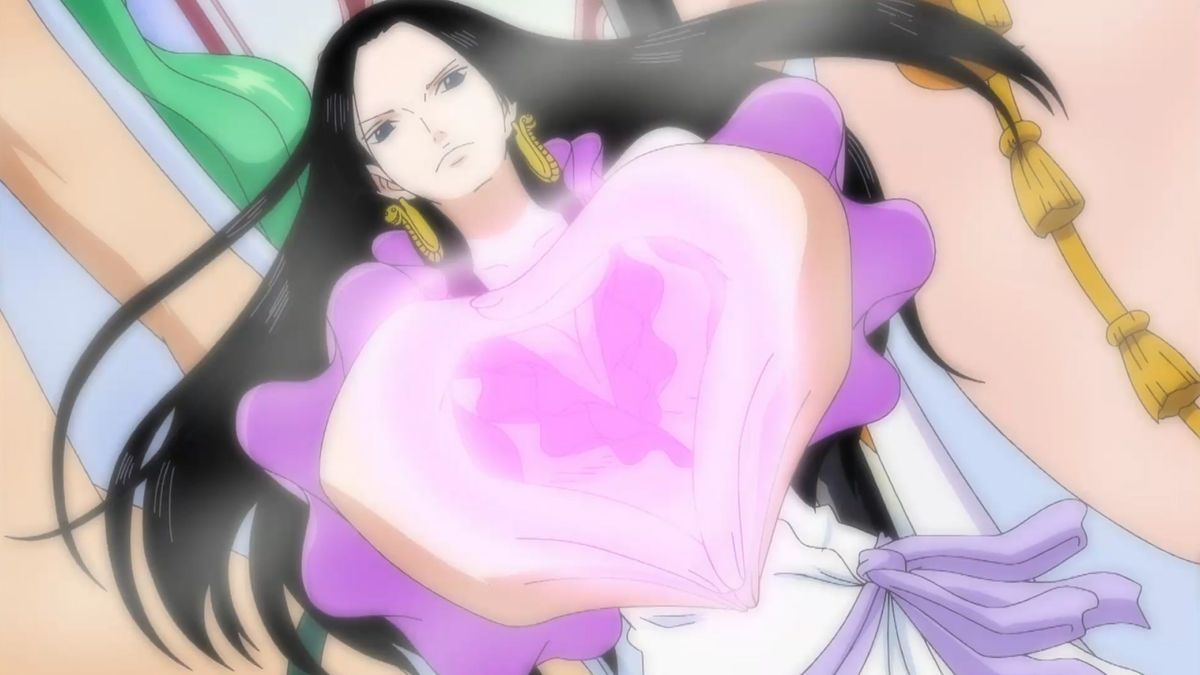
Hancock attacks the intruder in her bath, but Luffy remains unaffected by Love-Love Mellow because he feels no lust toward her. He escapes the palace only to be captured by Kuja warriors and brought before the empress in a public arena. Marguerite, Sweet Pea, and Aphelandra confess that they brought Luffy into the village and protected him. Hancock petrifies all three women despite Luffy’s plea.
The crowd cheers its ruler while Luffy’s anger replaces every concern about escape. Hancock releases Bacura, a giant black panther used for executions. Luffy defeats the animal with one strike and demands that Hancock restore the women who helped him. Sandersonia and Marigold enter the arena as the next stage of his punishment.
RaeRae’s opening receipt
Episode 412 asks what devotion looks like when everybody has been trained to applaud the person hurting them. Marguerite tells the truth. Hancock turns her to stone. The crowd celebrates because beauty has taught an entire arena to call cruelty justice.
Luffy does not care that Hancock is beautiful, does not respond to her power, and does not negotiate away the people who saved him. That combination makes him more dangerous to her system than any ordinary intruder.
Hancock begins with the response she trusts
A man saw the mark, so she reaches for petrification before explanation. Control has protected the sisters longer than disclosure ever could.
Fear makes lethal certainty feel safer than conversation.
Love-Love Mellow expects desire to provide an opening
The technique weaponizes attraction, embarrassment, and impure thought. Most people complete the attack against themselves before Hancock’s beam reaches them.
Her reputation and power use the same emotional doorway.
Luffy provides no doorway
He sees Hancock’s body without erotic interest and remains flesh. Confusion replaces the reaction she has always controlled.
Absence becomes an accidental defense.
His immunity insults the identity she performs
Hancock does not merely lose a technique. She encounters someone unmoved by the beauty that structures her authority.
A failed attack becomes a personal impossibility.
Luffy remembers the mark without solving the memory
He knows the symbol resembles something seen before, but his attention stays on escaping and returning to his crew.
Hancock hears danger inside his incomplete recognition.
The palace erupts around one forbidden witness
Guards pursue through halls and grounds while the empress protects the secret behind royal force.
A private wound mobilizes public security.
Luffy can flee the bath but not the island
Rubber speed creates distance from Hancock. The Calm Belt still surrounds every direction.
Escape from a room does not answer the larger trap.
The Kuja capture restores familiar authority
Once warriors surround Luffy, Hancock can turn an unpredictable encounter into a formal judgment.
Institutions make personal fear look procedural.
The arena transforms punishment into entertainment
Residents gather to watch the forbidden man die. Spectacle lets the crowd participate without feeling responsible.
Distance turns another person’s danger into community excitement.
Luffy enters without shame for existing
He crossed a law he never knew, accepted help, and came seeking a ship. The island treats his sex as guilt before conduct matters.
Category replaces evidence.
Hancock presides above the consequences
Elevation, guards, and adoration frame her decision as unquestionable. The architecture gives cruelty a royal silhouette.
Power looks natural when a stage has been built around power.
Marguerite refuses to let Luffy carry her choice
She admits that she saved him and brought him into the village. Sweet Pea and Aphelandra stand beside her.
Confession becomes solidarity rather than surrender.
The three women know what honesty may cost
Amazon Lily’s law is clear, and Hancock has already demonstrated indifference to pleas. They speak anyway.
Courage appears without expectation of rescue.
Luffy tries to redirect punishment toward himself
He is the outsider and wants the women left alone. Gratitude becomes immediate responsibility.
Protection begins by refusing the convenient distribution of blame.
Hancock petrifies Marguerite first
The woman who saved a poisoned stranger freezes into stone before the person she helped.
Mercy receives a public sentence.
Sweet Pea and Aphelandra share the judgment
Their loyalty to Marguerite and compassion for Luffy become statues displayed as warning.
Collective courage meets collective punishment.
The crowd continues loving Hancock
Her subjects do not withdraw affection when three neighbors become stone. They explain the violence through the empress’s beauty and authority.
Charisma separates action from accountability.
Luffy’s anger clarifies the moral center
He stops treating Hancock as the possible owner of a useful ship. She harmed people who helped him, and that fact outranks strategy.
Gratitude becomes more urgent than escape.
He demands restoration rather than revenge
Luffy wants the women returned to life. His anger points toward repair before punishment.
The request keeps victims at the center.
Hancock answers with another spectacle
Rather than acknowledge the plea, she releases Bacura to execute him for the arena.
Violence changes the subject when moral argument becomes uncomfortable.
Bacura carries institutional history
The giant panther has killed previous prisoners and knows the arena as hunting ground.
A trained animal extends state punishment without sharing state responsibility.
The crowd expects fear
Size, teeth, and reputation should make Luffy run for their entertainment. They do not understand the scale of enemies behind him.
Local terror meets a pirate shaped by the Grand Line.
Luffy does not blame Bacura for Hancock’s choice
He responds to the immediate attack, but his fury remains directed at the person who petrified Marguerite.
Power can identify the author behind the weapon.
One strike ends the executioner’s performance
Luffy drops Bacura before suspense can satisfy the audience. The arena’s guaranteed outcome disappears instantly.
Strength interrupts ritual.
The blow exposes how badly Amazon Lily measured him
Warriors knew men through inherited stories and limited contact. Nobody accounted for a captain who challenged Warlords and the World Government.
Isolation protects knowledge and preserves blind spots.
Luffy returns immediately to Marguerite
He does not celebrate the knockout or court the crowd. The three stone women remain his concern.
A victory matters only if the people behind the fight can be restored.
Hancock meets a demand beauty cannot soften
Luffy looks straight at her and refuses admiration, fear, or bargaining language. He wants her to undo the harm.
Direct moral pressure enters a court built to avoid pressure.
Sandersonia and Marigold step into the arena
Hancock’s younger sisters replace Bacura with opponents capable of understanding orders and using Devil Fruit power.
The execution shifts from animal force to family enforcement.
The sisters protect more than their ruler
Luffy has seen the mark shared across their backs. Defeating him protects a secret bound to all three women’s survival.
Personal loyalty and trauma reinforce official duty.
Marguerite remains visible during the escalation
Her stone body keeps the episode’s stakes from shrinking into a tournament.
The arena fight begins beneath an unpaid debt.
This remains an episode React
This page responds to Luffy’s immunity, Marguerite’s confession, Hancock’s petrification, Bacura’s defeat, and the Gorgon Sisters entering the arena. Arc-level judgment remains separate.
React classification protects the episode-versus-Review boundary.
The official local still remains canonical
The Episode 412 official still serves as featured image, hero, static directory card, and social preview through one local attachment.
Complete metadata preserves source, accessibility, filing, and unique use.
RaeRae’s final receipt
Hancock has never needed people to agree with her. Beauty secures forgiveness, Love-Love Mellow secures bodies, and the arena secures public approval. Luffy breaks the first two rules by feeling no desire and the third by refusing to perform fear.
Marguerite, Sweet Pea, and Aphelandra tell the truth because helping him was their decision. Hancock turns that honesty into stone while their neighbors cheer. Luffy’s response gives the episode its spine: he stops thinking about the ship and starts demanding the women back.
Bacura is supposed to make execution entertaining. One punch ends the show. Sandersonia and Marigold can bring stronger powers into the arena, but they cannot restore the authority Hancock lost when one furious outsider looked past her face and judged what she did.
Immunity changes Hancock’s understanding of men
Her experience taught her that male desire always creates vulnerability. Luffy does not fit the lesson, leaving her without a familiar category.
An exception threatens a worldview built for survival.
The arena makes community complicity visible
Hancock orders the sentence, but applause sustains the atmosphere where sentences require no defense.
Responsibility spreads through every delighted reaction.
Marguerite chooses authorship over innocence
She could describe Luffy as a burden forced upon her. Instead, she names her help as a choice and accepts the danger attached.
Agency matters even when authority punishes agency.
Sweet Pea and Aphelandra refuse isolation
Standing beside Marguerite prevents Hancock from turning one woman into the sole source of disobedience.
Solidarity changes the shape of blame.
Petrification freezes care into evidence
The statues display exactly what Hancock wants residents to avoid: compassion crossing a forbidden boundary.
A warning can preserve the values punishment tried to erase.
Luffy’s anger contains no romantic rescue fantasy
He does not protect Marguerite because he expects affection. He protects her because she acted kindly and received cruelty in return.
Gratitude remains sufficient motive.
Bacura reveals the limits of reputation
The panther’s history terrifies people whose experience stops at Amazon Lily. Luffy’s history contains giants, assassins, war machines, and impossible animals.
Threat depends on the scale used for comparison.
The single punch refuses padded spectacle
Luffy does not prolong a fight the crowd wants to consume. He removes the obstacle and returns to the actual injustice.
Efficiency becomes contempt for the arena’s premise.
Hancock escalates because acknowledgment would cost more
Restoring the women after Luffy’s demand would recognize his moral authority in front of her subjects. Sending her sisters preserves performance.
Pride makes correction feel like defeat.
The sisters enter carrying shared fear
Sandersonia and Marigold are not neutral officers. The witness in front of them has seen the secret on Hancock’s back and may expose theirs.
The coming fight grows from survival as much as obedience.
The episode separates strength from leadership
Hancock can dominate a palace and an arena. Nyon, Marguerite, and Luffy each demonstrate forms of responsibility she avoids.
Authority remains a title until action gives authority character.
Luffy’s priorities explain why he gathers allies
He needs a ship desperately, yet refuses to purchase help by abandoning three people. Others trust him because relationships do not become expendable under pressure.
Loyalty forms through witnessed choices.
The stone bodies keep the ending unresolved
Bacura falls, but Marguerite and her companions remain statues. Physical victory cannot substitute for repair.
The next battle begins with the most important result still withheld.
RaeRae’s extra receipt
Episode 412 could have treated Hancock’s failed beam as a joke about Luffy being oblivious. The stronger choice is what follows. His lack of desire prevents control, and his gratitude gives that freedom direction.
Hancock offers fear, spectacle, and increasingly powerful executioners. Luffy keeps pointing back to three women who did not deserve what happened. That stubborn moral focus makes every arena ritual around him look smaller.
The episode turns a stranger into a measure of justice
Amazon Lily calls Luffy dangerous because he is male and unknown. His conduct inside the arena offers a different record: he protects the women who helped him, asks for repair, and uses only enough force to stop Bacura.
The outlaw behaves with greater responsibility than the court sentencing him.
A public victory cannot free the statues
Defeating Bacura proves Luffy is strong, but strength alone cannot reverse Hancock’s Fruit. He must confront the person who caused the harm.
The unresolved restoration keeps moral leverage separate from combat leverage.
The final challenge keeps accountability in the room
Sandersonia and Marigold can extend the execution, but neither sister can change why Luffy fights. Hancock still holds the only power capable of restoring the women, so every new opponent also exposes her refusal to repair what she chose.
The arena reveals who receives the benefit of doubt
Amazon Lily assumes every action by Hancock must be forgivable while every action by Luffy must be dangerous. Marguerite’s compassion challenges both assumptions.
The stranger she saved behaves with restraint and loyalty. The ruler she serves uses three neighbors as punishment. Evidence enters the arena even when applause tries to drown evidence out.
That final refusal matters because Luffy never confuses popularity with goodness. An applauded sentence remains cruel when compassion becomes the crime.