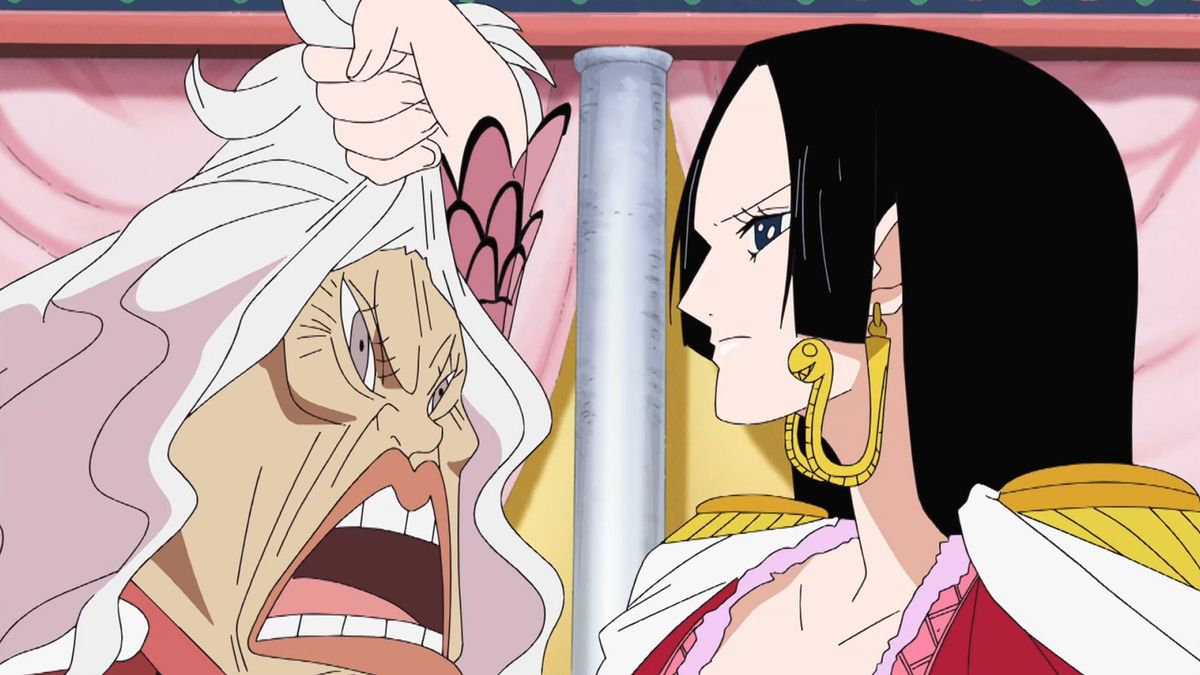
RaeRae Reacts · One Piece Episode 411
Luffy Finds Hancock’s Hidden Mark in the Worst Possible Room
One Piece Episode 411 React follows Hancock’s homecoming, Nyon’s treaty warning, the Gorgon legend, and Luffy’s bathhouse intrusion.
One Piece Episode 411 React: Boa Hancock returns to Amazon Lily, Elder Nyon warns that refusing the government’s war summons could cost the Kuja their protection, and Luffy chooses the single worst possible room for an unannounced introduction.
What happened in Episode 411
The Kuja Pirates sail home with a hold full of goods and a captain whose beauty excuses every insult in the eyes of her people. Elder Nyon confronts Hancock about Vice Admiral Momonga’s summons: the World Government expects every Warlord at Marineford for Portgas D. Ace’s execution, and Hancock’s refusal could end the agreement shielding Amazon Lily. Hancock rejects the warning and throws Nyon from a palace window.
Hancock orders the palace cleared for her bath. The island believes that the three Gorgon Sisters carry cursed eyes on their backs, marks gained after defeating a monster at sea. Anyone who sees those eyes supposedly turns to stone. Luffy, searching for the pirate empress whose ship can cross the Calm Belt, slips past the guards and crashes through the bathhouse roof. He sees Hancock’s bare back and recognizes the mark, though not from where she expects.
RaeRae’s opening receipt
Episode 411 puts an entire nation beneath Hancock’s spell before asking whether admiration and leadership are the same thing. Amazon Lily loves its empress. The government needs its Warlord. Nyon fears for its future. Hancock responds as though consequences are just more people blocking her path.
Then Luffy falls through the ceiling with the romantic instincts of a brick and the memory of someone who has seen that brand before.
Amazon Lily celebrates a successful return
The Perfume Yuda brings food, treasure, and warriors safely through the Calm Belt. Children and elders crowd the shore because a Kuja voyage supports the whole island.
The welcome belongs to a working pirate nation, not a private celebrity tour.
Hancock receives affection as tribute
Every generation wants her attention. Gifts rise toward the deck and praise follows every movement.
Love becomes part of the island’s political atmosphere.
She treats vulnerable people as scenery
Children offer handmade presents and older women reach toward their ruler. Hancock dismisses tenderness with the same cool contempt she showed the Marines.
Beauty keeps converting cruelty into something spectators call charming.
The crowd forgives before anyone asks
Her subjects explain away every slight because Hancock is beautiful. Their reaction exposes power operating without the Love-Love Fruit.
Devotion can police criticism more efficiently than force.
The Kuja Pirates understand their captain’s rhythm
They unload supplies, manage the crowd, and protect Hancock’s space. Competence around her makes the nation function even when she refuses ordinary courtesy.
A ruler’s image often rests on invisible communal labor.
Nyon arrives carrying the consequence nobody wants
The former empress interrupts the celebration because Momonga’s ultimatum cannot remain offshore forever.
Age gives her enough memory to hear danger beneath government language.
The Warlord title is a shield with a chain attached
Hancock receives legal tolerance for Kuja piracy, and Amazon Lily gains protection from direct Marine attack. In return, the government expects service when summoned.
The agreement offers safety without independence.
Ace’s execution makes refusal more dangerous
Whitebeard will not surrender a commander quietly. Marine headquarters is gathering force for a war capable of changing the age.
A distant prisoner’s sentence reaches an island that bans men.
Nyon argues for the nation rather than the government
She does not praise Marine justice or demand obedience from loyalty. She wants Hancock to preserve the legal barrier protecting Kuja lives.
Pragmatism can sound like surrender when pride owns the room.
Hancock refuses to be managed
The summons insults her authority, and Nyon’s insistence feels like another attempt to command her body and movement.
Her refusal contains sovereignty, arrogance, and older fear in proportions the episode has not revealed yet.
Throwing Nyon through a window ends debate without answering her
Hancock uses physical dismissal where leadership requires a decision. Nyon survives, but the warning remains true on the ground below.
Power can remove a messenger without removing the deadline.
Nyon’s persistence protects people who laugh at her
The court treats her as an intrusive old woman. She keeps returning because public affection does not guarantee political survival.
Unpopular memory performs necessary work.
Hancock orders privacy for her bath
The palace empties and guards establish a strict perimeter. A routine bath becomes a national security event.
Secrecy has shaped architecture, labor, and myth around three sisters.
The Gorgon story gives the island an answer
Kuja tradition says Hancock, Sandersonia, and Marigold defeated a monster whose cursed eyes remained on their backs.
A supernatural legend makes forbidden skin easier to protect.
The threat of petrification discourages curiosity
Anyone who sees the supposed eyes will become stone. Fear stops questions before guards need to explain the boundary.
A believable danger turns privacy into collective self-preservation.
The sisters built a public myth around private evidence
The episode does not yet name the mark, but Hancock’s terror tells us the story hides more than modesty.
A nation can repeat a lie lovingly when the lie keeps its rulers alive.
Bathwater cannot wash away a brand
Steam, walls, and ritual protect Hancock from being seen. None of them remove the history carried on her back.
The body remembers what public authority cannot erase.
Luffy searches for the person with the only viable ship
He has accepted that a raft cannot cross the Calm Belt. Hancock’s snake-pulled vessel is his route back toward Sabaody.
Urgency sends him toward power without etiquette or invitation.
He misunderstands a palace as a shortcut
Architecture tells him where an important person probably lives. Guards tell him where entry is forbidden. Luffy treats both facts as directions.
His navigation remains emotionally accurate and operationally disastrous.
The empty halls should warn him
A royal residence without ordinary movement signals an order in effect. Luffy notices opportunity before protocol.
Silence becomes another clue he runs past.
He slips through security built for conventional intruders
Kuja guards watch entrances and grounds. Rubber limbs and airborne momentum create a route no palace plan anticipated.
Unpredictability remains Luffy’s most reliable access credential.
The roof gives way at the exact wrong moment
His arrival becomes noise, debris, steam, and a naked empress staring at a forbidden man.
No diplomatic opening could be less prepared.
Hancock expects horror
She believes a witness to the mark should fear the Gorgon curse or expose the secret that structures her life.
Recognition feels more dangerous than attack.
Luffy does not react to nudity the way her power expects
He registers a person, a mark, and a possible memory. Attraction does not seize the scene.
Hancock’s usual control loses its first foothold.
The mark catches his attention
Luffy has seen a related symbol before and says so with characteristic directness. He cannot immediately place the connection.
A casual observation lands on Hancock’s deepest protected wound.
Recognition is worse than trespass
An intruder can be captured. A witness who understands the brand could collapse the story protecting all three sisters.
Hancock’s authority narrows into panic.
Luffy has no idea why the room changed
He wants transportation and believes identifying the mark might help explain what he sees. Hancock hears exposure, humiliation, and captivity returning through one sentence.
Two entirely different histories occupy the same bath.
This remains an episode React
This page responds to Hancock’s homecoming, Nyon’s treaty warning, the Gorgon legend, palace secrecy, and Luffy’s bathhouse collision. Arc-level judgment remains separate.
React classification protects the episode-versus-Review boundary.
The official local still remains canonical
The Episode 411 official still serves as featured image, hero, static directory card, and social preview through one local attachment.
Complete metadata preserves source, accessibility, filing, and unique use.
RaeRae’s final receipt
Amazon Lily adores Hancock so completely that contempt becomes another pose to applaud. Nyon refuses the performance. The Warlord title protects the island, Ace’s execution has activated the government’s price, and refusing Momonga could leave every Kuja exposed. Hancock throws the warning out a window because control feels safer than negotiation.
That same need for control empties a palace and turns a bath into guarded territory. The Gorgon legend gives everybody a reason not to look at the sisters’ backs. Luffy looks by accident and does something Hancock never planned for: he recognizes the mark without reacting to her beauty.
Episode 411 ends where public power and private terror collide. Hancock can petrify a ship, dismiss a nation, and make cruelty look forgivable. One confused man falling through her ceiling reaches the secret none of those powers can protect.
The homecoming shows what Hancock protects
Her bargain with the government matters because Amazon Lily is full of people, routines, and dependence. The crowd gives Nyon’s warning a face.
National risk arrives before Hancock admits any personal stake.
Admiration creates its own censorship
No subject needs an order to defend Hancock from criticism. They translate insult into beauty and distance into elegance.
A beloved image can make honest feedback socially impossible.
Nyon occupies the role applause cannot fill
She remembers earlier empresses, the danger outside the Calm Belt, and the cost of rulers making private feelings into public policy.
Wisdom sounds repetitive because consequences are repetitive.
The government’s arrangement is intentionally unstable
A Warlord receives selective freedom only while remaining useful. The threatened revocation proves protection was never unconditional.
Empire calls leverage cooperation.
Hancock’s refusal still deserves context before absolution
A state demanding her participation in an execution is not morally neutral. Her contempt for that demand does not excuse contempt for her people.
Two criticisms can remain true together.
The Gorgon myth converts trauma into folklore
Monster stories travel more safely than accounts of human cruelty. The impossible becomes easier to repeat than the unbearable.
Myth guards the sisters while isolating them.
Secrecy requires continuous community work
Guards clear rooms, residents obey warnings, and attendants maintain ritual. A personal secret becomes an institution.
Protection carries labor far beyond the protected body.
Hancock cannot choose when memory enters
The mark remains present beneath every title and every costume. Luffy’s glance activates history without permission.
Trauma does not respect rank.
Luffy’s immunity begins with absence, not virtue
He does not resist Hancock because he has mastered desire through discipline. His attention simply points elsewhere.
That difference will make him uniquely difficult for her to categorize.
Recognition connects Amazon Lily to earlier oppression
The symbol belongs to a wider system Luffy has encountered through people treated as property. His memory turns an isolated secret into evidence of a connected world.
Franchise continuity arrives through a scar.
The bathhouse reverses the expected power balance
Hancock owns the palace, commands the guards, and controls the story. Luffy possesses the one fact she cannot permit him to carry away.
Knowledge briefly outweighs territory.
His directness is both mercy and danger
Luffy does not manipulate, leer, or pretend. The same honesty prevents cruelty and removes every polite buffer from his words.
Truth without context can still wound.
The episode keeps comedy beside fear
A man crashes into a forbidden bath while looking for a ride. Beneath the absurdity, a survivor believes her past has been exposed.
One Piece lets tonal collision reveal rather than cancel emotion.
Ace remains outside Luffy’s knowledge
Nyon and Hancock discuss the execution while Luffy searches nearby. The information capable of changing his destination remains one room away.
Physical proximity intensifies dramatic distance.
RaeRae’s extra receipt
Hancock has built a life where everybody sees exactly what she permits: unmatched beauty, imperial distance, and a curse nobody dares inspect. The arrangement works until Luffy arrives without desire, permission, or enough social instinct to perform the expected fear.
Nyon worries about losing political protection. Hancock worries about losing control of her history. Luffy worries about finding a ship. Episode 411 stacks those incompatible priorities inside one palace and lets a broken roof introduce them.
The final image changes the question
Luffy came to ask whether Hancock would carry him across the Calm Belt. Hancock now needs to decide whether a man who saw her back can remain alive. Transportation gives way to survival before either person completes an introduction.
The next conversation begins under a sentence already passed in her mind.
The treaty question remains after the bathhouse shock
Luffy’s arrival interrupts Hancock before she decides how to answer Momonga, but the government deadline continues offshore. Personal exposure and national danger now demand attention at the same time.
A ruler who survives through control has lost control of both conversations, and neither problem will wait politely for the other.