RaeRae Reacts · One Piece Episode 399
Three Captains Break the Marine Blockade in Three Different Languages
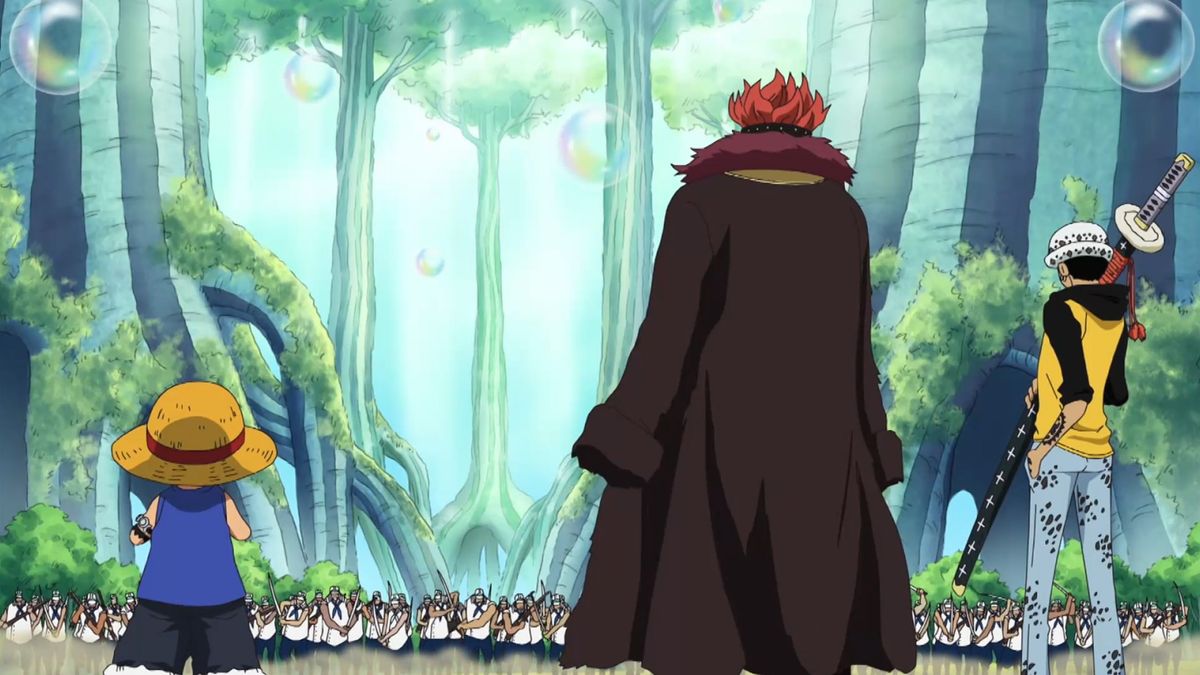
One Piece Episode 399 React follows Luffy, Kid, and Law displaying their Devil Fruits while the Supernovas face a widening government pursuit.
One Piece Episode 399 React: Luffy, Kid, and Law turn a Marine encirclement into a captain’s showcase while Kuma-shaped weapons, rival crews, and the approaching admiral reveal how little the rookies understand about Sabaody’s next level.
What happened in Episode 399
Marines surround the auction house and demand surrender. Luffy, Kid, and Law argue over who will clear the path, then display their Devil Fruit abilities against the cordon. Their crews split toward escape routes as bounty hunters and Marines target the Supernovas. Kid declares that anyone without the nerve to pursue the One Piece should leave the sea, while the government’s response grows beyond ordinary soldiers.
RaeRae’s opening receipt
Three men face a blockade and somehow make rivalry the loudest problem. That choice should be ridiculous. Episode 399 makes the ridiculous choice revealing because each captain would rather risk capture than let another future rival define him as cautious.
The swagger works for one episode. The island is already preparing a correction.
The Marines demand surrender without naming the auction
The cordon frames pirates as the only source of disorder. No announcement names Camie, slavery, Hatchan’s shooting, or the nobles who opened fire.
Official language cleans the cause away and criminalizes the response.
Luffy hears an obstacle rather than authority
Ranks and orders do not change his reading. Armed people block his crew from leaving with their rescued friend.
His moral vocabulary remains stubbornly concrete.
Kid treats the cordon as a stage
He wants Marines defeated and rivals impressed. Magnetism gathers weapons and metal into visible proof that ordinary force cannot contain him.
Ambition needs witnesses, especially witnesses carrying competing bounties.
Law controls space rather than raising his voice
His Room makes the battlefield answer to surgical boundaries. Bodies and objects shift under rules only he appears to understand.
Precision becomes intimidation because confusion reaches enemies before pain.
Three Devil Fruits become three philosophies
Luffy advances through elasticity and instinct. Kid accumulates force. Law establishes a domain and rearranges relationships inside.
The powers tell viewers how each captain imagines control.
The captains compete while solving the same problem
Every argument wastes time and still pushes the line forward. Pride becomes inefficient cooperation.
One Piece finds comedy in men who cannot admit shared purpose while visibly sharing purpose.
The crews keep leadership from becoming a solo fantasy
Killer, Bepo, Jean Bart, and the Straw Hats manage threats around their captains. Escape requires more than one spectacular attack.
A captain’s legend rests on people carrying the unglamorous edges.
Jean Bart’s freedom changes Law’s crew
A former captive leaves the auction with a captain who treated him as a person and invited him aboard.
The contrast with purchase could not be cleaner. Belonging begins through consent.
Camie’s rescue refuses ownership as the price of safety
No Straw Hat claims her because they fought for her. Friends plan to return her to the life she chooses.
Rescue that demands possession only changes the owner.
Kid reads Luffy’s ambition correctly
The punch and breakout mark somebody who will not quietly disappear before the New World. Kid recognizes a real competitor.
Respect sounds like provocation because rivalry is his preferred honesty.
Law gathers information while others announce themselves
He watches technique, temperament, and crew response. His silence preserves options.
Observation becomes a form of combat preparation.
Luffy says Pirate King without asking permission
The goal remains uncomplicated in his mouth. Admirals, nobles, rookies, and government retaliation do not revise the destination.
Certainty attracts allies and rivals because everybody understands the stake.
Kid answers with his own standard for the sea
He remembers being mocked for speaking about the One Piece. In the New World, he argues, dreamless people will not survive.
The speech connects cruelty, ambition, and vulnerability beneath his aggression.
Mockery has trained Kid to attack first
Ridicule taught him that dreams make targets. He converts that wound into contempt for anyone who approaches the sea without conviction.
Defensiveness can sound like doctrine after enough violence.
Luffy and Kid share a dream without sharing a moral code
Both pursue the same title. Their choices, crews, and relationships prevent the goal from making them interchangeable.
Competition becomes interesting because destination cannot explain character.
Law refuses to narrate his entire ambition
He does not owe rivals a manifesto in the street. Mystery protects his plan and keeps viewers reading behavior.
Silence can carry as much ambition as a shout.
The blockade breaks at the visible center
Marines fall back under powers they cannot answer. The captains create an exit through force.
Winning one line does not mean controlling the island.
Other Supernovas face their own pursuit
Sabaody contains more than three famous rookies. Separate crews move through groves while the government’s net expands.
The generation feels large because the story allows parallel danger beyond Luffy’s frame.
Bounties attract predators as well as prestige
Hunters see enormous rewards moving through confusion. Fame turns every escape route into an invitation for opportunists.
A number on a poster changes how strangers value a body.
The government’s new weapons complicate the word Kuma
A familiar silhouette appears where the real Warlord should not logically multiply. The resemblance creates confusion before explanation.
Identity becomes a weapon when institutions reproduce a feared face.
The Pacifista threat begins through mistaken recognition
Crews respond to Bartholomew Kuma’s appearance and known power. The copy benefits from terror earned by the original.
Mass production can borrow reputation before demonstrating capability.
Ordinary success becomes a dangerous measurement
The captains dominate Marines and may conclude Sabaody cannot hold them. That conclusion uses the weakest available opposition as evidence.
The next enemies exist to punish a false scale.
The episode gives the rookies their poster moment
Three captains framed together become an image of generational challenge. The scene earns celebration without promising equality.
A poster can mark arrival before the story tests survival.
Marine fear acknowledges real danger
Some soldiers recognize names, bounties, and abilities too late. Their panic confirms the rookies have outgrown ordinary containment.
Institutional numbers do not remove individual vulnerability.
The noble response endangers everybody on Sabaody
An admiral and advanced weapons do not isolate punishment to Luffy. Rival crews, residents, workers, and bystanders enter the danger zone.
Privilege externalizes consequence across an entire community.
The New World begins before the ship crosses
Sabaody functions as a gate because the power scale changes here. Ambition meets opponents that East Blue and Paradise victories could not prepare.
The threshold tests judgment as much as strength.
Rivalry gives Luffy energy without changing his values
He enjoys the contest, yet his original reason remains Camie’s rescue and his crew’s escape.
Competition adds flavor without replacing loyalty.
This remains an episode React
This page responds to the Marine cordon, the three Devil Fruit showcases, Kid’s New World declaration, and the widening Supernova pursuit. Arc-level synthesis remains elsewhere.
React classification protects the Reviews directory from episodic material.
The official local still remains canonical
The Episode 399 still serves as featured image, hero, static directory card, and social preview from one local attachment.
Complete metadata and unique use keep every route visually consistent without reusing another record’s image.
RaeRae’s final receipt
Episode 399 is a flex with an expiration date. Luffy, Kid, and Law are strong enough to make a Marine cordon look temporary and proud enough to turn escape into competition. Their powers announce three distinct kinds of captain, and their crews make the announcement possible.
Kid’s speech supplies the bruise beneath the swagger. People laughed when he said the One Piece was real, so he learned to treat ridicule as a challenge. Luffy reached the same dream through wonder. Law keeps his reason protected. One destination gathers three incompatible men.
The Marines lose the street, but the government has not shown its real hand. Kuma’s face begins appearing where one man should stand, and Kizaru is already on the island. The captains earn their poster. Sabaody is about to explain the price.
The breakout makes freedom noisy
Quiet escape stopped being available when Charlos summoned state force. The captains carve room through public refusal.
Noise becomes evidence that containment failed.
Kid’s collected weapons reverse ownership
Metal carried to control pirates answers his hand instead. Tools of authority lose loyalty to their users.
Material power can change sides without accepting official meaning.
Law turns certainty into disorientation
Marines enter with formation and orders. His Room makes position unreliable.
Control collapses when bodies no longer remain where command expects.
Luffy turns rivalry into play
Danger and delight coexist whenever a strong competitor appears. His grin does not deny risk.
Joy remains one source of resilience.
The Supernovas are not a unified class
Shared bounties and timing produce a label, not an alliance. Every crew carries distinct ethics and plans.
History can name a generation before the people inside agree on anything.
Jean Bart shows what changed inside the auction
He entered as merchandise and leaves as a crew member by choice.
That movement gives the battle a human result beyond defeated guards.
The episode protects future scale
Rookies look enormous against soldiers while ominous figures move elsewhere.
Confidence and warning share the same frame.
RaeRae’s extra receipt
The three captains are deeply annoying in exactly the way young legends should be. None can let another open a door without turning the doorway into a referendum on greatness.
That vanity clears the Marine line, frees their crews to move, and gives Sabaody one electric image. Then the copies of Kuma begin appearing. The island has heard every boast and prepares a response with no interest in playing fair.
The street fight reveals command styles
Luffy trusts improvisation and crew instinct. Kid projects dominance. Law controls information and space.
Leadership becomes visible through how each man shares risk.
Marines experience the Supernovas as a category
Wanted posters become moving bodies with abilities no briefing can fully reproduce. Recognition raises fear without supplying counters.
Paper intelligence meets lived chaos.
The rookies misunderstand one another productively
Each reads confidence as arrogance and restraint as weakness. Their need to correct those impressions drives stronger attacks.
Misreading can create momentum before creating conflict.
Kid’s dream speech rejects respectable piracy
He has no interest in adventurers who want danger without ridicule. The New World, in his telling, belongs to people willing to sound foolish before proof arrives.
His contempt protects an old wound.
Luffy needs no defense against ridicule
Mockery rarely changes his destination because approval was never part of the dream. Kid fights the people who laughed; Luffy often walks past them.
That difference may matter as much as their shared ambition.
Law keeps his dream from becoming public property
He offers rivals technique without confession. Privacy lets him gather evidence while others expose motives.
A hidden plan can survive attention better than a declared one.
The escaping crews create multiple fronts
Once captains split, Marines cannot contain one doorway and call the operation complete. Every grove may carry a different high-bounty target.
The response grows wider and less controllable.
Pacifista silhouettes undermine the captains’ victory
A broken cordon matters against ordinary soldiers. Manufactured Warlord bodies introduce durability and firepower designed for another class of threat.
The battlefield changes before anyone agrees to new terms.
A bounty can attract the weapon designed to justify the bounty
The government labels pirates dangerous, then deploys overwhelming force against the label. Survival becomes further evidence for escalation.
The cycle rewards institutions for producing the threat they announced.
Episode 399 preserves joy before the fall
The captains deserve one sequence where impossible powers feel liberating. Later defeat lands harder because viewers saw genuine potential.
Humbling works only when confidence first feels earned.
The breakout changes what every witness expects
Marines expected numbers and formation to settle the street. Buyers expected pirates to flee after challenging nobles. Residents expected fear to restore order.
Three captains overturn those expectations long enough to make another future visible.
That future remains dangerous and morally uneven. Kid, Law, and Luffy are not interchangeable liberators. They are ambitious pirates whose refusal happens to expose a rotten structure. The episode gains texture by preserving that complication.
The captains win attention before they win freedom
Luffy, Kid, and Law create an unforgettable public image, but every crew still needs a ship, route, supplies, and distance from Kizaru. Spectacle cannot perform those tasks.
The episode lets swagger remain joyful while quietly preserving the harder measurement. A captain becomes more than a poster through whether the people following him survive the consequences attached to his name.