RaeRae Reacts · One Piece Episode 387
Nami Chooses to Rescue Hatchan Without Letting Arlong Park Disappear
One Piece Episode 387 React follows Hatchan’s identity reveal, Camie and Pappag continuing alone, and Nami separating rescue from easy absolution.
One Piece Episode 387 React: the rescue reaches Duval’s base, “Hacchin” becomes Hatchan from the Arlong Pirates, and Nami receives the choice everybody else must wait for before the crew moves again.
What happened in Episode 387
The Sunny approaches the Flying Fish Riders’ hideout while Hatchan hears who is coming. His identity becomes clear, and the Straw Hats stop because Arlong Park cannot be treated as a minor misunderstanding. Camie and Pappag jump into the sea rather than abandon him. Nami decides that Hatchan’s past does not justify leaving him enslaved, so the crew resumes the rescue and crashes into Duval’s operation.
RaeRae’s opening receipt
The episode does something One Piece needs to do correctly: everybody shuts up long enough for Nami’s answer to matter. Hatchan may have changed. Camie may love him. Luffy may want to rescue him. None of those facts gives another person authority to forgive Arlong Park on Nami’s behalf.
Hatchan recognizes the Straw Hats before they recognize him
Captivity gives him time to understand the cruel shape of the rescue. The people coming to save him are people he once helped terrorize.
His discomfort does not equal accountability by itself, but awareness prevents the reunion from becoming casually cheerful.
The name change cannot hide history forever
Camie’s “Hacchin” sounds affectionate and harmless. The captive turns out to be Hatchan, former officer of the Arlong Pirates and participant in a regime built on violence against humans.
A nickname can reveal who somebody is loved as now. A former name can reveal what that person did before.
Nami’s body remembers before debate begins
Arlong Park was not a theoretical conflict. Arlong murdered Bellemere, occupied Cocoyasi Village, stole Nami’s labor, and used fear against everyone she loved. Hatchan served that crew.
No explanation about his relative kindness can erase the structure he helped maintain.
The crew stops because solidarity requires listening
Luffy already promised Camie a rescue. Once Hatchan’s identity appears, the promise intersects with Nami’s history. Moving forward without her would turn loyalty into another form of pressure.
The pause honors both commitments by refusing to pretend no conflict exists.
Camie and Pappag choose their friend without demanding agreement
When the Straw Hats stop, they jump into the sea to continue alone. They do not lecture Nami about Hatchan’s good side or insist that present affection cancels past harm.
Their action says they will risk themselves for him while leaving the crew free to decide.
Hatchan expects refusal
He understands why the Straw Hats might turn back. That expectation matters because remorse without entitlement sounds different from remorse demanding immediate acceptance.
He does not get to set the timetable for Nami’s response.
Nami distinguishes rescue from absolution
Saving Hatchan from traffickers does not declare Arlong Park resolved. Nami can oppose his captivity without rewriting his role in her childhood.
This distinction gives her decision strength. Mercy does not require historical amnesia.
Current victimhood does not erase past participation
Hatchan is now caged and treated as merchandise. He once helped a violent organization control others. Both truths remain present.
Ethical action becomes harder and more honest when the story refuses to collapse a person into only victim or only offender.
Nami’s authority comes from lived consequence
The crew can have opinions, but Nami carried Arlong’s tattoo, drew his maps, and watched her village suffer. Her proximity to harm gives her decision a weight outsiders cannot claim.
Supporting her means accepting whichever answer she chooses, not praising only the answer that advances the plot.
She refuses to become the reason traffickers win
Nami’s choice does not protect Hatchan from accountability. Her choice prevents Macro and Duval from using his past as permission to sell him.
Enemies do not gain moral legitimacy because their captive once caused harm elsewhere.
Luffy follows Nami instead of overruling her
He wants to help Camie, yet he waits through the revelation. When Nami permits the rescue, the crew moves with full commitment.
Leadership sometimes means allowing the person most affected to set the moral pace.
The rescue becomes more meaningful after the pause
Before the reveal, Hatchan was an unknown friend in danger. Afterward, helping him becomes a deliberate choice made with uncomfortable knowledge.
Solidarity gains depth when nobody needs innocence invented first.
Camie’s loyalty reveals Hatchan’s present life
She knows somebody who protects her, works beside her, and deserves risk. That relationship cannot testify about every past action, but the relationship supplies evidence that he is more than the officer Nami remembers.
Change becomes visible through the people who experience present behavior.
Pappag refuses to let fear become abandonment
He follows Camie into danger despite lacking the crew’s combat power. Friendship does not wait for favorable odds.
The leap also exposes how much the pair had hoped the Straw Hats could do what they cannot accomplish alone.
Duval’s base turns captivity into entertainment
The Flying Fish Riders cultivate spectacle through masks, machines, and dramatic entrances. Beneath the styling sits a prisoner awaiting sale.
Criminal branding cannot clean the purpose of the cage.
The Macro Gang expects scarcity to set price
Hatchan’s fish-man body becomes market value. His personhood, relationships, and fear disappear from their calculation.
The rescue attacks a business model as much as a physical prison.
The Sunny carries old enemies into new relationships
Nami and Hatchan first met inside oppression. Camie meets both through friendship and rescue. The ship becomes a place where those histories collide without receiving an instant tidy resolution.
Travel creates contact. Contact does not guarantee comfort.
Zoro and the crew prepare for total conflict
Once Nami gives the word, hesitation ends. The same crew that once destroyed Arlong Park now aims its strength at the people holding Hatchan.
The symmetry does not redeem him automatically. The symmetry shows their opposition to captivity remains consistent.
Hatchan’s freedom must precede any honest conversation
A captive cannot participate in accountability as an equal person. Macro and Duval control his body, location, and possible sale.
Rescue creates conditions where future choices and apologies can mean something beyond survival.
Nami refuses a simplistic revenge opportunity
Leaving Hatchan caged might look like consequence, but traffickers would profit and Camie would suffer. That outcome would serve people unrelated to repairing Arlong’s harm.
Revenge that strengthens another abusive system offers no justice to Cocoyasi Village.
Forgiveness remains Nami’s word to define
Translations and summaries often say she forgives Hatchan. The episode’s value does not depend on declaring every wound closed.
She chooses rescue and continued contact. Those actions can coexist with memory, anger, boundaries, and future judgment.
The episode respects emotional sequence
Recognition comes first. The crew stops. Camie and Pappag act. Nami considers. Then rescue resumes.
That order prevents action spectacle from trampling the person whose past gives the reveal meaning.
Hatchan’s shame cannot become the center
His fear of rejection makes sense, but the scene does not need Nami to comfort him for feeling bad about harm connected to her life.
Remorse becomes credible when the harmed person is not assigned emotional cleanup.
The Straw Hats enter the base as allies, not judges
They are not there to announce Hatchan morally cleared. They are there to prevent kidnapping and sale.
A rescue mission can stay focused without claiming authority over every unresolved relationship inside the group.
The episode prepares Sabaody’s central ugliness
Fish-men and mermaids fetch enormous prices. Hatchan’s cage previews an island economy where slavery operates beside tourism and commerce.
The danger is not one unusual gang. The gang feeds a respected market.
Nami does not have to explain every private calculation
The episode gives enough history to understand the stakes without demanding a complete emotional deposition. Survivors should not have to narrate each wound before friends respect a boundary or decision.
Her word moves the crew because trust has already been earned across the voyage.
Hatchan’s friendship with Camie shows change through responsibility
Camie trusts him in a world where her body attracts kidnappers. Protecting her creates present evidence about how he uses strength now.
Evidence of change matters most when change benefits people who would otherwise be vulnerable to the power he holds.
Past membership carries more than individual acts
Hatchan may have shown less cruelty than Arlong, yet his service helped the organization appear strong, patrol territory, and enforce domination. Participation in a violent structure creates responsibility beyond the worst act personally committed.
Relative kindness inside oppression cannot become a complete defense.
The crew refuses collective punishment as justice
Leaving Hatchan to traffickers would not repair Bellemere’s death, return Nami’s childhood, or compensate Cocoyasi Village. The people profiting would be Macro and Duval.
Justice should not strengthen a second abusive group merely because the captive once served the first.
Camie witnesses a form of accountability built without spectacle
Nami does not publicly humiliate Hatchan or demand that Camie choose between friends. She names enough, decides enough, and keeps moving.
Boundaries can remain firm without becoming a performance designed for outsiders.
The rescue allows Hatchan to demonstrate future conduct
Freedom gives him opportunities to protect Camie, help the crew, confront his history, and accept Nami’s limits. Captivity would freeze him inside a market category.
Accountability needs a future where better choices remain possible.
Luffy’s crew follows relational leadership
The captain usually charges first. Here the decisive authority comes from Nami because the conflict belongs most directly to her lived history.
A strong crew can shift who leads without treating leadership as a permanent throne.
The episode avoids making Nami cruel for hesitating
Stories often punish survivors who do not forgive fast enough. Episode 387 lets hesitation function as moral seriousness.
She evaluates what rescue means before offering strength to somebody linked to profound harm.
Hatchan’s fear of rejection may become useful humility
He cannot assume friendship with Camie entitles him to friendship with Nami. Different relationships carry different histories.
Accepting that difference becomes one necessary condition for any repaired connection.
Nami’s answer protects Camie from an impossible choice
If the crew abandoned Hatchan, Camie would keep trying alone and probably become another captive. Nami sees the present danger spreading beyond the man connected to her past.
Her decision protects a new friend without pretending the old relationship became painless.
Rescue becomes an act against trafficking, not a reward for virtue
The Straw Hats do not run a courtroom deciding whether Hatchan has accumulated enough good deeds to deserve freedom. Enslavement remains wrong regardless of a captive’s moral record.
That principle protects everybody because owners always invent reasons their targets deserve the cage.
The crew can carry unresolved history aboard the same ship
Nami and Hatchan do not need a final emotional settlement before occupying one mission. Clear purpose, respected boundaries, and attention to her authority create enough ground for present cooperation.
Community often moves through partial repair rather than cinematic closure.
This remains an episode React
This page responds to Hatchan’s identity reveal, Nami’s decision, Camie and Pappag’s leap, and the renewed rescue. A complete Sabaody Review belongs on the arc-level record.
React classification protects Nami’s episode-specific choice from being reduced to one sentence in a whole-arc summary.
The official local still remains canonical
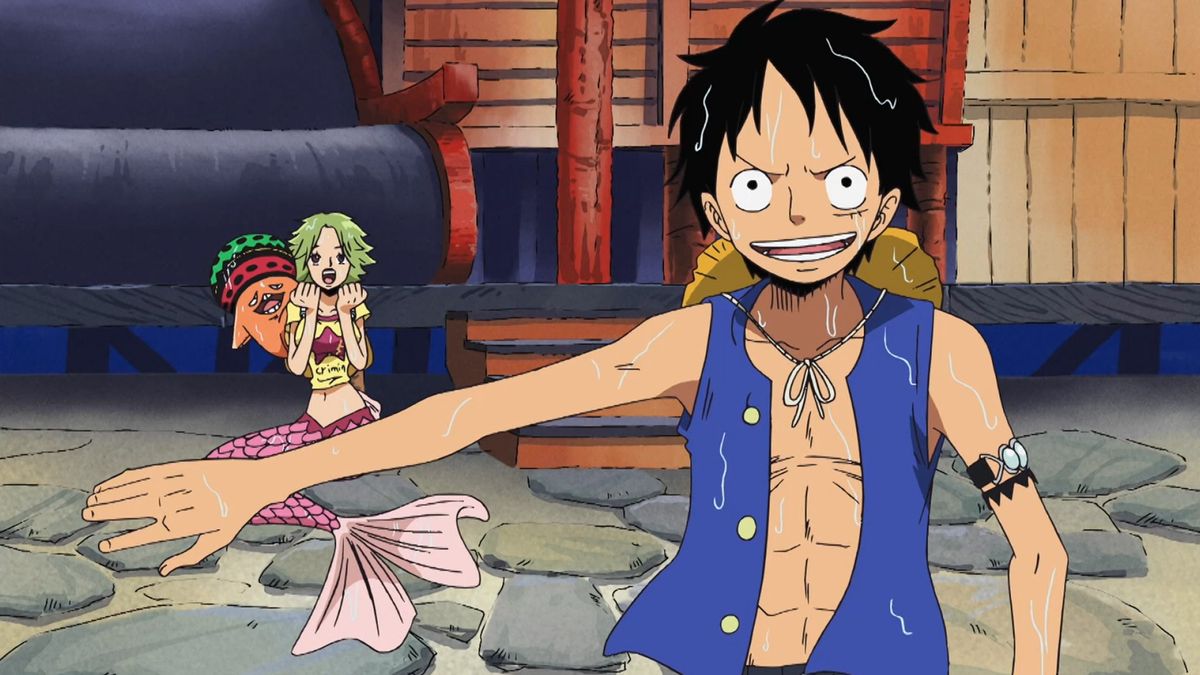
The Episode 387 still serves as featured image, hero, bounded-directory card, and social preview. One local attachment maintains recognition across every route.
Complete source, descriptive, accessibility, and filing metadata stay attached. No other record reuses the image.
RaeRae’s final receipt
Nami saves Hatchan without surrendering ownership of her history. That is the receipt. Camie’s love proves who he can be now. Arlong Park proves what he helped do then. The cage proves what traffickers are doing to him in the present. No truth gets to erase another because the plot wants everybody moving.
The crew pauses for Nami, and then the crew moves with Nami. Saving a former enemy from slavery does not bless his past. Refusing to let another abusive system consume him means Nami will not outsource justice to kidnappers. Hatchan gets freedom before he gets any hope of forgiveness, and forgiveness remains hers to define.
That decision also protects Nami from a false choice between compassion and self-respect. She can preserve both. Her boundary remains visible, her history remains true, and her strength helps stop present harm. The crew follows because friendship means trusting her judgment without asking pain to perform for everybody again.
Her answer remains fully her own.