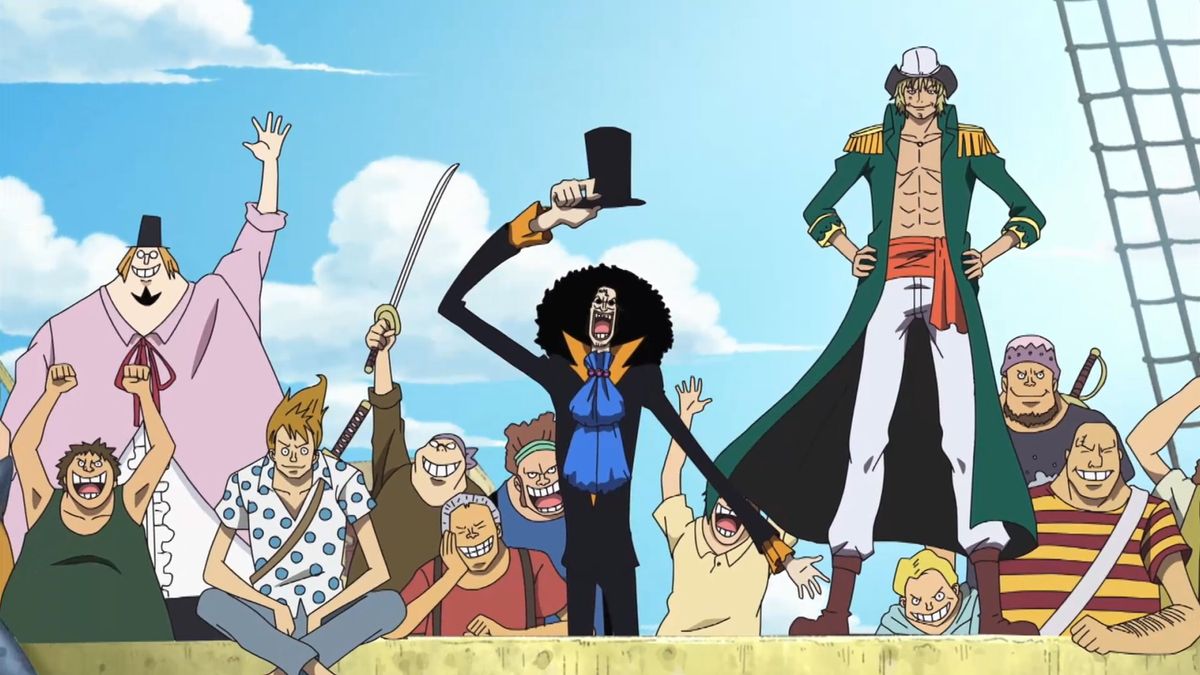
RaeRae Reacts · One Piece Episode 379
The Rumbar Pirates Leave Laboon With Crocus Before Illness Divides the Crew
One Piece Episode 379 React follows Brook’s human life, Laboon’s attachment, the Grand Line promise, and Captain Yorki’s painful departure from the Rumbar Pirates.
One Piece Episode 379 React: Brook remembers the Rumbar Pirates meeting Laboon, entering the Grand Line, leaving the whale with Crocus, and losing Captain Yorki to an unknown illness.
What happened in Episode 379
Laboon follows the musicians until the Grand Line becomes too dangerous. The crew promises to circle the world and return. Later, disease forces Yorki and infected crewmates onto another ship, leaving Brook to carry leadership and grief forward.
RaeRae’s opening receipt
A promise can remain loving and still wound the person left waiting. Brook’s memory holds both truths without reducing Laboon to a symbol.
Brook’s human face returns context to the skeleton
Episode 379 remembers Brook before death, solitude, and Thriller Bark. He had skin, companions, a uniform, and an ordinary place inside a loud musical crew.
The flashback does not make skeleton Brook more real. The flashback shows how much life the bones continued carrying.
The Rumbar Pirates treat joy as pirate work
Their music is not decoration after navigation and combat. Songs create community, comfort frightened people, and give strangers a reason to remember the crew.
They understand that leaving joy behind can be part of what a voyage accomplishes.
Laboon joins through attachment rather than recruitment
The small whale follows the sound and the people producing the sound. No contract or command makes him part of the traveling family.
Belonging begins because the crew notices his affection and responds with affection.
Size does not make Laboon’s feelings simple
He may be young and unable to speak human language, but he recognizes voices, routines, departures, and promises. His attachment has memory.
The crew’s decisions therefore affect a person, not a cute object traveling behind the ship.
The Grand Line turns inclusion into a safety question
Allowing Laboon to follow through dangerous currents could kill him. Leaving him behind will cause pain he cannot fully understand.
Care offers no painless option when every route carries risk.
Crocus becomes part of the separation plan
The crew does not leave Laboon alone at an anonymous shore. They trust the lighthouse keeper to protect him at Reverse Mountain.
Responsible separation builds care around the person who cannot continue the route.
The promise gives Laboon a future point of return
The Rumbar Pirates say they will circle the Grand Line and come back. The statement places an end around absence.
Promise becomes emotional infrastructure for a separation nobody wants.
Brook cannot know the promise will outlive almost everyone
At departure, the crew imagines a shared return. Death later concentrates the obligation into one survivor.
Promises change weight when the number of people able to keep them changes.
Entering the Grand Line requires communal courage
The Rumbar Pirates cross into a sea defined by uncertainty. Their songs do not remove danger. Music lets fear travel through the group without isolating anyone.
Joy can be a survival practice rather than denial.
Brook’s place combines musician and fighter
He carries a violin and a sword, showing that the crew never treats art as incompatible with defense. Both skills belong to the same person.
Complex roles make the Rumbar Pirates feel lived-in rather than assembled from labels.
Yorki leads through warmth before illness tests authority
Captain Yorki teases, sings, celebrates, and disciplines the crew as somebody embedded in their relationships. His authority is not maintained through distance.
That closeness makes the coming separation more painful.
A strange illness changes the voyage without asking permission
Disease enters after an island visit and spreads among crewmates. Courage cannot defeat an infection nobody understands.
The Grand Line contains threats that do not offer a duel, villain, or satisfying target.
The doctor admits the limits of available knowledge
He cannot name or cure the disease. That honesty is frightening but necessary. False certainty would endanger everyone still healthy.
Care begins by telling the truth about what medicine cannot presently do.
Contagion forces a decision between forms of loyalty
Keeping the whole crew together could spread illness and kill everyone. Dividing the ship abandons sick friends to uncertainty. No option preserves the original voyage.
Loyalty cannot always mean physical proximity.
Yorki accepts separation to protect the uninfected crew
He leaves with the sick members rather than using rank to claim the safest place. The captain’s decision recognizes that his body has become a risk to people he loves.
Protection takes the form of departure, not command.
Leaving for safety is not the same as discarding the ill
The infected crewmates travel together with support and a chance, however uncertain, to seek care. Their friends grieve because the separation matters.
Abandonment erases relationship. This departure carries relationship into loss.
Brook inherits leadership without wanting the loss that created the vacancy
Yorki’s departure leaves remaining pirates needing direction. Brook steps into responsibility while still grieving the captain.
Promotion can feel like evidence of absence rather than reward.
The crew has to continue while the ending remains unknown
Brook cannot confirm whether Yorki’s group survives. The voyage moves forward with uncertainty attached.
Ambiguous loss denies mourners both reunion and a clear place to put grief.
Laboon’s promise grows heavier after the split
Fewer Rumbar Pirates remain to finish the route. Every separation concentrates responsibility among survivors.
The whale waiting at Reverse Mountain becomes a living reason not to let the voyage simply dissolve.
Brook’s later solitude begins before the crew dies
Yorki’s departure teaches him that a familiar chorus can become smaller without warning. The final tragedy has not arrived, but loss has already entered the music.
Solitude develops through repeated subtraction.
The episode refuses to blame the sick for changing the plan
Disease is not betrayal. Yorki and the infected crewmates do not become burdens whose removal restores normality.
The remaining crew carries love and consequence forward because illness happened to people, not because people failed.
Crocus and the separated ship represent two kinds of care network
Laboon stays with a capable guardian. Yorki leaves with infected companions and a ship meant to seek another route. The Rumbar Pirates keep building support even while the group fragments.
Care can travel across several locations without losing the relationship connecting them.
The promise becomes collective memory after collective presence ends
Every person who heard the vow helped establish the obligation. Brook later carries their voices because survival leaves him as the remaining witness.
Memory can preserve plurality inside one survivor without turning him into a replacement for everyone lost.
The audience knows Laboon survived while Brook remembers uncertainty
Episode 378 gave present-day confirmation. Episode 379 returns to a Brook who cannot know the outcome.
Dramatic irony lets relief and grief occupy the same flashback.
Music marks time before time becomes unbearable
The crew sings through departures, celebrations, and difficult decisions. Repeated songs create continuity while membership changes.
Later, the same music will carry memory across death because the practice already held their life together.
Brook’s jokes do not cancel the person who endured this history
His present humor can look like avoidance, hospitality, habit, or all three. The flashback shows comedy growing beside genuine loss rather than replacing loss.
A survivor is allowed more than one emotional register.
Yorki’s departure complicates the idea of keeping a promise
He may never return to Laboon, yet leaving protects the crew members who still might. A person can fail to reach the promised destination while acting faithfully toward the relationship.
Outcome alone cannot measure the ethics of the attempt.
The episode treats care as navigation under incomplete information
No map explains the disease, no cure guarantees reunion, and no message can reach Laboon. The Rumbar Pirates choose routes based on what they know and whom they are trying to protect.
Love does not provide certainty. Love shapes decisions inside uncertainty.
Episode 379 remains an episode React
This page responds to the Rumbar Pirates meeting Laboon, leaving him with Crocus, promising to return, entering the Grand Line, and separating from Yorki after illness spreads. A complete Thriller Bark Review belongs after Brook joins and the crew departs.
React classification preserves broadcast-level close reading while keeping whole-work Reviews reserved for complete arcs, seasons, series, and films.
The official local still remains canonical
The Episode 379 still serves as featured image, hero, bounded-directory card, and social preview. One local attachment preserves recognition across every discovery route.
Complete source, descriptive, accessibility, and filing metadata remain attached. No other record reuses this image.
RaeRae’s final receipt
Episode 379 knows that leaving can be loving and still feel like abandonment to the person watching the ship disappear. The Rumbar Pirates leave Laboon with Crocus because the Grand Line could kill a young whale. They promise to return because separation needs a future. Laboon only knows that the music moved beyond the horizon.
Then illness splits the crew again. Yorki leaves because staying could spread death, and Brook inherits leadership through a loss nobody wanted. The Rumbar Pirates keep building care around each separation, but care cannot make the goodbye painless. That is why the promise matters. Not because good intentions guarantee everybody comes home, but because relationship continues placing demands on whoever survives the route.
Ambiguous loss refuses the rituals grief usually receives
Brook watches Yorki’s ship leave without knowing whether medicine, another island, or simple luck might save the infected group. He cannot welcome them back, confirm their deaths, or build a grave. The relationship remains suspended between possible outcomes.
That uncertainty follows the remaining crew because nobody knows which emotion fits the absence.
Leadership arrives as a duty to hold unresolved grief
Brook does not inherit a clean captain’s chair after a completed farewell. He has to make decisions while Yorki’s fate remains open and every crewmate carries private fear. Authority means holding the route steady without pretending uncertainty has ended.
The musician becomes a leader partly because he understands how rhythm can keep different emotions moving together.
Yorki’s choice protects life without guaranteeing his own survival
He leaves the healthier crew because remaining would make contagion more likely. The decision may reduce harm, but no moral correctness grants immunity from the disease.
Care should be measured through whose safety shaped the choice, not through whether the world rewards the person who chose well.
The infected crewmates remain Rumbar Pirates after departure
Changing ships does not revoke their place in the crew. Illness does not turn them into cargo removed from the healthy group. Their relationships, songs, and contribution remain part of the collective history.
A community reveals its values through whether absent and sick members remain inside the story.
Brook inherits the promise without owning everybody’s voice
He becomes responsible for reaching Laboon, but he cannot claim to replace Yorki or speak as though every dead companion had no distinct relationship with the whale. His role is witness and carrier.
Survival grants responsibility, not exclusive authorship over the people who died.
The original promise can be revised without being betrayed
The Rumbar Pirates expected a complete crew to circle the Grand Line. After illness and later violence, that exact return becomes impossible. Brook can still keep faith by carrying their message, song, and truthful account to Laboon.
Rigid reenactment would make the promise impossible. Honest adaptation preserves the relationship the promise was meant to serve.
Laboon deserves the truth, not a cheerful substitute
Brook may want to protect the whale from grief, but returning without explaining the losses would preserve another form of waiting. Laboon has already lived fifty years with uncertainty.
Respect means trusting him with the painful history alongside the proof that his friends remembered him.
Music becomes a portable home after the crew divides
The same songs can be played on separate ships and remembered across distance. Sound carries shared culture when physical gathering is no longer possible.
Brook’s later Tone Dial plan grows from this existing truth: music can preserve presence without pretending absence is gone.
The Straw Hats will inherit a relationship, not only a musician
Welcoming Brook means accepting Laboon, the Rumbar Pirates, the recording, and the route back to Reverse Mountain as part of his present life. New family does not require severing old family.
The healthiest beginning makes room for unfinished loyalty rather than demanding a blank slate.
Episode 379 turns backstory into active navigation
The flashback explains more than why Brook feels sad. Yorki’s departure, Laboon’s promise, and the crew’s musical identity determine what Brook must do next.
History becomes direction. The past matters because living people still need answers from the person who carries the record.