RaeRae Reacts · One Piece Episode 380
Binks’ Sake Carries the Rumbar Pirates From a Final Chorus Into Brook’s Solitude
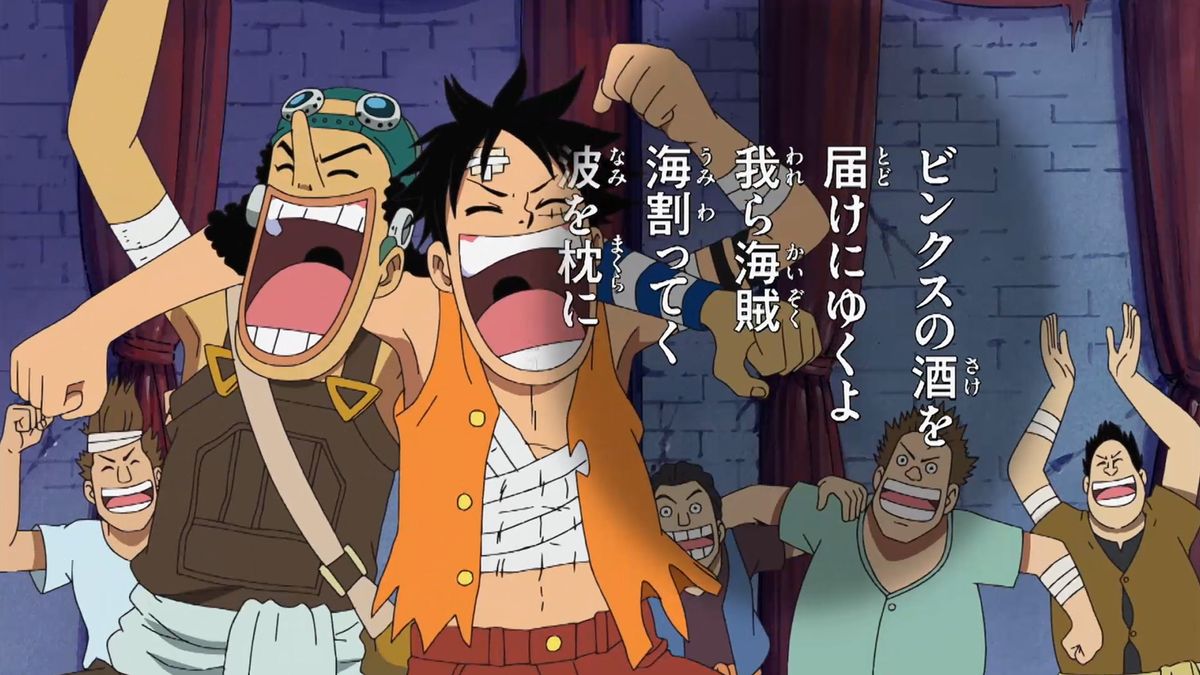
One Piece Episode 380 React follows the Rumbar Pirates recording one last song for Laboon as the chorus becomes a quartet, trio, duet, and Brook alone.
One Piece Episode 380 React: the Rumbar Pirates record “Binks’ Sake” for Laboon while poison takes the crew one musician at a time and Brook counts the chorus down to a solo.
What happened in Episode 380
Brook remembers Yorki’s departure and the final battle that doomed the remaining crew. A Tone Dial offers one route for their voices to reach Laboon. They play until every musician falls, leaving Brook to revive and wander alone.
RaeRae’s opening receipt
The song does not make death beautiful. The song lets dying people decide what part of themselves will cross the silence.
The Rumbar Pirates face an ending medicine cannot reverse
Episode 380 brings Brook’s remaining crew to a battle poisoned beyond their ability to treat. The doctor is gone, bodies are failing, and no island can be reached in time.
Death becomes certain before the musicians decide what the final hours will mean.
The Tone Dial offers preservation without rescue
A recording device cannot heal poison or return anyone to Laboon. The Dial can carry voices beyond the room where those voices stop.
Technology creates testimony, not salvation.
Brook proposes a final song because Laboon remains part of the crew
The whale is absent by distance, but the promise keeps him inside their last decision. They choose to send the sound he knew rather than leave fifty years of silence unexplained.
Relationship shapes what dying people decide to preserve.
The recording belongs to the whole chorus
Brook may eventually deliver the Dial, but every musician contributes breath, rhythm, and presence. The artifact is collective.
The survivor becomes carrier rather than author of everybody else’s final message.
Singing does not make the poison merciful
The crew laughs and plays while death approaches. Their joy is chosen resistance, not proof that dying has become easy or beautiful.
The violence that killed them remains violence even when they control the final sound.
The song lets them decide how the room will remember them
An enemy imposed the fatal condition. The Rumbar Pirates still choose arrangement, tempo, and what Laboon may someday hear.
Agency survives in the portion of the ending the poison cannot command.
Music coordinates bodies losing strength at different speeds
Some musicians can play longer than others. The shared rhythm holds them together as individual bodies begin dropping out.
The song becomes a structure flexible enough to contain unequal endings.
The chorus becomes smaller without becoming less true
Each silence changes the sound. The remaining performers continue, carrying awareness that another friend has stopped.
Continuity does not deny loss. Continuity gives loss a form the survivors can move through.
Brook counts a quartet, trio, duet, and solo
Musical language becomes grief language because ordinary sentences cannot organize the subtraction. He names the shrinking ensemble through the structure they shared.
Counting is heartbreaking because every number represents a person who was present moments earlier.
The final solo is not the performance Brook wanted
He remains at the piano because survival lasts a few breaths longer, not because the song was designed to center him. Accompaniment becomes unbearable when no other voice remains.
Solitude arrives before his first death fully arrives.
Brook smiles at the end without consenting to every loss
He remembers the Rumbar Pirates’ purpose of bringing joy and chooses a final expression consistent with that life. The smile belongs to him.
No audience should use the smile to claim grief, fear, or pain vanished.
The Revive-Revive Fruit creates a promise after death
Brook hopes his soul will return and that he can deliver the Dial to Laboon. Nobody knows whether the power will work as imagined.
Faith in resurrection becomes a route for collective testimony.
Revival does not return Brook to the moment he lost
His soul wanders through fog and finds a body already reduced to bones. The crew remains dead. The ship remains broken. The recording remains undelivered.
A second life begins inside consequences the Devil Fruit cannot undo.
The broken rudder turns survival into confinement
Brook can move, speak, and remember, but the ship cannot carry him out of the Florian Triangle. Mechanical damage translates resurrection into decades of geographic isolation.
Being alive is not identical to being free.
The mirror confirms a body he must learn again
Brook sees a skeleton and frightens himself. The reaction is funny, painful, and completely reasonable. Resurrection returned consciousness without returning familiarity.
Humor becomes one way to approach a body transformed beyond recognition.
Solitude repeats the song without restoring the chorus
Brook plays after revival because music connects him to the people who are gone and the whale still waiting. The same melody now carries absence inside every measure.
Repetition preserves relationship while reminding him that preservation is not presence.
The present-day performance changes who holds the memory
On Thriller Bark, Lola’s people and the Straw Hats hear the song. Brook no longer plays only for ghosts and an imagined listener across the sea.
Witness distributes memory beyond the sole survivor.
The crowd sings without replacing the Rumbar Pirates
New voices join the melody, but nobody becomes a substitute for the dead musicians. Participation carries the song forward while preserving the history of the original recording.
Tradition can grow without erasing source.
Lola recognizes celebration inside mourning
Her crew has just regained daylight after years of theft. Joining the music lets restored life answer Brook’s account of death.
The scene holds grief and communal joy without forcing either emotion to defeat the other.
Laboon heard the song before separation
Memory of the whale singing along proves the recording will carry a sound tied to shared life. The Dial is not an abstract message. The song belongs to an existing relationship.
Recognition can cross fifty years because the music already had a home.
The Tone Dial preserves imperfection as evidence
The recording contains voices weakening, instruments dropping away, and a performance shaped by poison. A polished replacement would lose the truth of who was present.
Imperfection makes the artifact testimony rather than tribute alone.
Brook’s responsibility is delivery, not editing
He does not need to make the final chorus easier for Laboon to hear. He needs to carry what his friends chose to send.
Respect for the dead includes preserving their voice without cleaning grief into inspiration.
The song outlives the people without making people disposable
Art survives, but survival of art cannot compensate for murdered lives. The recording matters because those lives mattered first.
Legacy should never become an excuse to romanticize the conditions that produced the artifact.
Brook’s fifty years become an act of custodianship
He protects the Dial, the promise, and the names of his crewmates through isolation. The burden keeps him connected and prevents grief from becoming anonymous.
Custodianship gives survival direction while demanding enormous emotional labor.
The present audience relieves sole-witness pressure
Once the Straw Hats hear the story and song, Brook is no longer the only person who knows how the Rumbar Pirates ended. Memory gains additional carriers.
Community cannot reverse death. Community can keep one survivor from holding every trace alone.
Binks’ Sake connects travel, death, and return without resolving them
The song belongs to voyages and gatherings, which makes the final performance ache against still bodies. The melody keeps moving where the ship cannot.
Contradiction gives the song emotional durability.
Brook chooses the future because the recording has a destination
Laboon’s survival means the Dial can still reach the listener imagined during the final chorus. Delivery is no longer a ritual for someone presumed dead.
The promise becomes actionable rather than merely memorial.
The episode trusts music to carry what exposition cannot
The shrinking ensemble communicates loss through sound, timing, and absence. No narrator needs to explain every death after the instruments stop.
Form becomes meaning because viewers hear the crew disappear.
Episode 380 remains an episode React
This page responds to the Rumbar Pirates recording their final song, dying one by one, Brook reviving alone, and the present-day crowd carrying the music forward. A complete Thriller Bark Review belongs after Brook joins and the crew leaves.
React classification preserves broadcast-level close reading while keeping whole-work Reviews reserved for complete arcs, seasons, series, and films.
The official local still remains canonical
The Episode 380 still serves as featured image, hero, bounded-directory card, and social preview. One local attachment preserves recognition across every discovery route.
Complete source, descriptive, accessibility, and filing metadata remain attached. No other record reuses this image.
RaeRae’s final receipt
Episode 380 does not make death beautiful. The Rumbar Pirates make one final choice inside a death somebody else imposed. They record the song Laboon knows, play while their bodies allow, and leave the Dial with Brook because a promise still has a listener. The chorus becomes a quartet, trio, duet, and solo. Every smaller number is a person gone.
Brook’s revival is not a happy reset. He wakes in bones, on a broken ship, surrounded by dead friends and one recording he cannot yet deliver. Music keeps the relationship alive without pretending sound replaces bodies. When new voices join him on Thriller Bark, they do not become substitutes for the Rumbar Pirates. They become witnesses. Brook no longer has to be the only living person who heard the final chorus, and memory finally has more than one pair of hands.
The Tone Dial keeps the room instead of cleaning the record
The recording preserves voices while they are strong, voices as they weaken, instruments falling silent, and Brook finishing alone. No later performance can recreate that exact passage from company into solitude.
The flaws are not defects to remove. The flaws prove who remained, who left, and how the final minutes actually sounded.
Archival truth can be painful and still be a gift
Laboon may hear friends die through the song they chose to send. Protecting him from that pain by replacing the recording with a cheerful summary would also remove their final agency.
The Dial trusts the listener with a difficult truth and gives grief a sound that uncertainty never provided.
Brook’s survival makes him custodian rather than proprietor
He holds the only copy and the only living memory of the session. That position does not make every voice his possession. His obligation is care, delivery, and accurate context.
Custodianship respects that an archive can be carried by one person while belonging to many relationships.
Fifty years of delay do not void the message
The ship could not move, Brook lacked a shadow, and daylight threatened his body. Delay grew from captivity and impossible conditions rather than indifference toward Laboon.
A late promise can remain faithful when the survivor keeps seeking a route instead of treating obstacles as permission to forget.
The present chorus changes isolation without rewriting history
Lola’s crew and the Straw Hats sing beside Brook. Their voices give him company now, but they do not appear on the old Tone Dial or claim membership in the Rumbar Pirates’ final hour.
New community can support grief without annexing the memory that came before.
The song becomes a bridge because both ends remain specific
On one end stand the Rumbar Pirates who recorded a farewell. On the other waits Laboon, the whale who knew their sound and held their promise. Brook carries the artifact between those people.
Specific relationship prevents the recording from becoming vague inspiration detached from the dead.
Music preserves plurality inside Brook’s solo survival
His body is the only body that returned, but memory still contains a captain, doctor, singers, instrumentalists, arguments, jokes, and shared purpose. The song lets those distinctions remain audible.
Brook does not survive as the whole crew. He survives as one person responsible for remembering a whole crew.
The final performance lets the Rumbar Pirates author their exit
Poison determines that they will die. Their enemies do not determine whether the last room contains terror, silence, testimony, or music. The crew chooses a form grounded in the life they built together.
Agency at the end cannot cancel murder. Agency can keep murder from owning every meaning attached to the ending.
Brook’s future needs more than endurance
He has already proven that he can survive alone for decades. Laboon’s news and the Straw Hats’ presence offer another possibility: live with witnesses, companions, and a destination shared aloud.
The next chapter should not demand more solitary strength from the man who has supplied enough.