RaeRae Reacts · One Piece Episode 363
Chopper Rejects Hogback’s Medicine After Cindry’s Body Is Ordered to Kill for Him
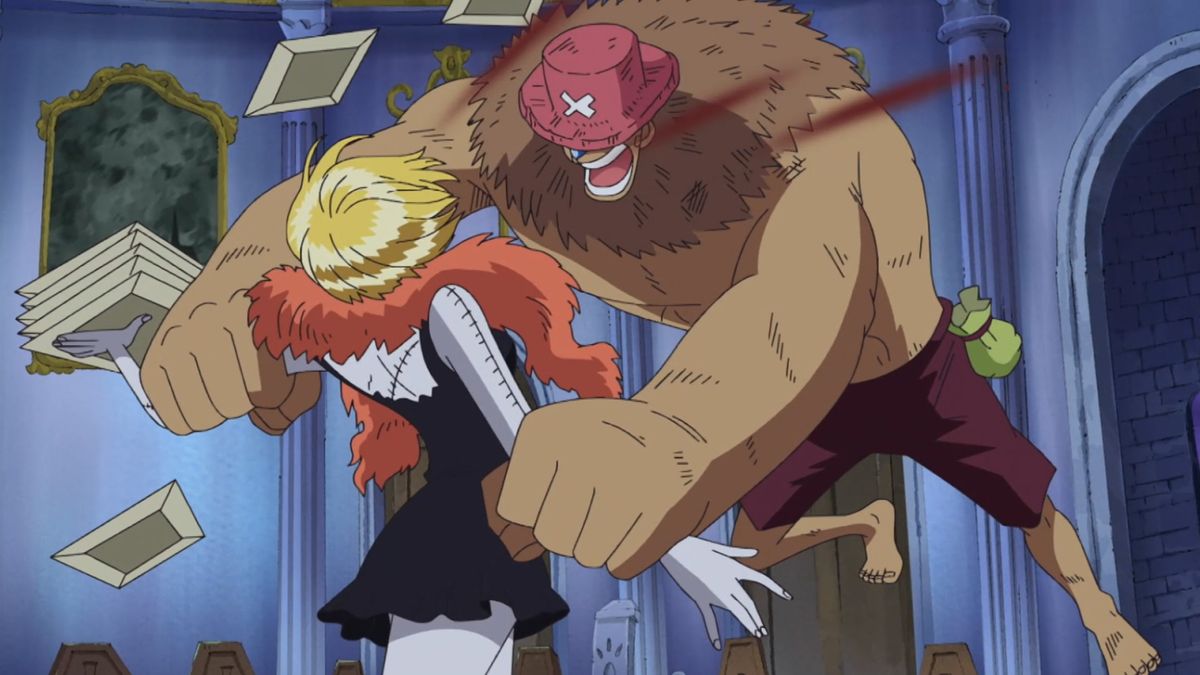
One Piece Episode 363 React follows Chopper’s anger as Hogback tells Cindry’s history and proves that technical brilliance without consent or care is exploitation.
One Piece Episode 363 React: Chopper and Robin are restrained by the dog penguin and Jigoro while Hogback explains his history with Cindry and orders her body to kill them.
What happened in Episode 363
Hogback’s story exposes a grief that never respected Cindry’s choices. Chopper rejects the celebrated doctor whose technique treats life and death as materials for private desire.
RaeRae’s opening receipt
Grief can explain longing. Grief cannot grant ownership of a woman’s corpse, rewrite her refusal, or turn obedience into care.
Hogback tells Cindry’s history as though desire grants authorship
His account begins from attachment and loss, but every detail is filtered through what he wanted from Cindry. Her rejection becomes an injury done to him rather than a decision she had the right to make.
The story exposes how easily grief can preserve entitlement instead of preserving the person who died.
Cindry’s refusal mattered before her death
She did not owe Hogback romance because he admired her or because his feelings were intense. Refusal was not a temporary obstacle awaiting enough persistence, achievement, or tragedy.
Any resurrection that erases that refusal continues the original disrespect rather than repairing loss.
A reanimated body is not consent recovered
Hogback can make Cindry’s corpse move and obey commands. Movement does not restore the person who made choices during life. Obedience produced through a stolen shadow cannot become retroactive agreement.
The body’s availability says nothing about what Cindry would have permitted.
Grief can explain conduct without authorizing conduct
Losing somebody may produce desperation, denial, anger, and impossible wishes. Those emotions deserve recognition. They do not create ownership over remains or permission to overwrite a life.
Explanation becomes dangerous when used to make the harmed person disappear from the ethical account.
Hogback values access more than Cindry’s agency
He wanted her close and accepted a version unable to refuse him. That outcome reveals what the original desire prioritized. Presence mattered more than reciprocity.
Love cannot be measured by how completely another person’s freedom must be removed to satisfy the lover.
Chopper hears a medical achievement and recognizes abuse
Earlier admiration might have focused on the technical impossibility of reanimation. Episode 363 shifts his attention toward the person whose body made the achievement visible.
Professional maturity begins when impressive results no longer hide the conditions under which those results were obtained.
Medicine without care becomes body management
Hogback repairs, stitches, modifies, and activates corpses for Moria’s army. The work manipulates biological material but abandons the healer’s responsibility to a patient.
Technical precision cannot supply an ethical purpose after the person has been reduced to inventory.
Chopper refuses fame as proof of goodness
Hogback’s reputation once stood for excellence. Direct evidence now contradicts the reputation. Chopper chooses the bodies in front of him over the authority attached to a famous name.
That decision is not childish disappointment. That decision is professional judgment grounded in harm.
An idol loses authority when evidence changes
Admiration can make a younger practitioner defend the image long after warning signs appear. Chopper allows reality to revise his belief. He does not owe lifelong loyalty to the person he once misunderstood.
Disillusionment becomes ethical when the harmed receive more weight than nostalgia.
Rejecting Hogback does not require rejecting medicine
Chopper could conclude that every celebrated doctor is fraudulent or that extraordinary treatment inevitably corrupts. Instead, he separates the vocation from the person violating the vocation.
Medicine remains worth defending precisely because Hogback’s behavior is not allowed to define the field.
Hiriluk and Kureha gave Chopper a different standard
Their methods were imperfect, chaotic, and sometimes dangerous, yet both taught that healing concerns lives rather than prestige. Chopper’s ethical inheritance gives him language for what Hogback abandoned.
A mentor’s value appears when the student can use learned principles to challenge greater fame.
Cindry’s body is not a monument to Hogback’s devotion
He may describe reanimation as proof that he could not let her go. The corpse instead becomes evidence that he would not honor the boundary she established while alive.
Possession after death does not redeem rejection during life.
Ordering Cindry to kill completes the exposure
Hogback claims attachment and immediately uses her body as a weapon against Chopper and Robin. The command reveals that her presence serves his convenience, security, and authority.
A person remembered with care would not be reduced to an obedient shield.
The command turns intimacy into labor
Cindry’s corpse must perform domestic service, emotional availability, and violence on demand. Hogback extracts several forms of labor from a body he calls beloved.
The arrangement resembles ownership more than mourning.
The dog penguin and Jigoro show the same system at scale
They restrain Chopper and Robin because shadows, bodies, and commands have been assembled into servants. Their individuality survives only in fragments useful to Hogback and Moria.
Cindry’s story is personal, but the laboratory industrializes the same violation across many dead and living people.
Robin understands histories rewritten by authority
She has watched governments decide which lives, names, and truths may remain visible. Hogback’s laboratory performs a bodily version of that erasure, preserving useful movement while suppressing original identity.
Her presence broadens Chopper’s professional outrage into a question about who controls memory.
Chopper’s anger is evidence of an ethical line
His fury is not a loss of medical objectivity. Neutrality toward abuse would serve the person with power. Anger announces that bodies and patients have been treated in a way no healer should accept.
Emotion can clarify responsibility when the facts justify the emotion.
A doctor can be technically brilliant and professionally bankrupt
Skill measures what somebody can accomplish. Ethics determines what that person is willing to do with the capacity. Hogback’s accomplishments make the violation more dangerous because he can enact entitlement at greater scale.
Competence does not cancel accountability.
The episode separates cure from control
Hogback might describe animation as overcoming death. The resulting zombies do not regain autonomous lives. They enter a command structure serving Moria.
A treatment that removes the patient’s will cannot be evaluated only by whether the body moves.
Death is not the only harm medicine must prevent
Dignity, consent, pain, identity, and the right to refuse also matter. Treating survival or motion as the sole outcome can justify terrible conditions around the body.
Chopper’s moral growth includes recognizing health as more than mechanical function.
Cindry’s surviving gestures complicate total control
Fragments associated with her preferences and resistance appear inside the zombie’s behavior. Those traces do not prove the original person has been fully restored. They do challenge Hogback’s fantasy of complete possession.
Something he tried to erase keeps making the arrangement unstable.
Refusal can persist as a disturbance in an imposed role
Even when direct speech has been taken, discomfort, hesitation, habit, or contradiction may reveal that obedience is not wholehearted agreement. Authority often interprets compliance as consent because doing so feels convenient.
Cindry’s body reminds viewers to look for the will a system is working hardest to suppress.
Hogback narrates himself as victim and hides his choices
Cindry died, he suffered, and Moria offered an impossible opportunity. That sequence can sound inevitable if every active decision disappears. Hogback still chose to accept the corpse, stolen shadow, servitude, and continued commands.
Grief did not make those choices on his behalf.
Chopper returns choice to the center of medical judgment
He does not ask only whether Hogback succeeded. He asks what happened to the person whose body became the site of success.
That question moves medicine away from spectacle and toward responsibility.
Fame insulated Hogback until a former admirer looked closely
Reputation encourages outsiders to interpret every strange result as genius. Chopper’s initial awe demonstrates that insulation. The laboratory’s evidence finally becomes impossible to reconcile with the public image.
Accountability begins when prestige stops controlling interpretation.
The confrontation belongs to Chopper without making Cindry his lesson alone
Chopper grows through what he witnesses, but Cindry cannot exist merely as material for his maturation. Her choices and dignity remain the reason the lesson matters.
Person-first analysis keeps the harmed individual from disappearing behind the hero’s development.
Robin’s support preserves Chopper’s authorship
She can assist against zombies and recognize the larger system without taking the moral confrontation away from the doctor. Chopper asked to face Hogback because the betrayal touched his vocation.
Support becomes strongest when a companion helps create room for another person’s necessary judgment.
Episode 363 remains an episode React
This page responds to Hogback’s history with Cindry, Chopper’s rejection of his medical authority, and the command ordering Cindry’s body to kill. A complete Thriller Bark Review belongs after the arc resolves those systems.
React classification preserves broadcast-level close reading and keeps whole-work Reviews distinct.
The official local still remains canonical
The Episode 363 still serves as featured image, hero, bounded-directory card, and social preview. One local attachment provides consistent recognition across every discovery route.
Complete source and accessibility metadata remain attached, and no other record reuses the image.
RaeRae’s final receipt
Episode 363 makes Chopper look past the reputation that once dazzled him and ask the question Hogback keeps avoiding: what did Cindry choose? She refused him while alive. Death did not reverse that answer. A stolen shadow making her corpse move does not create consent, and an obedient body cannot retroactively turn possession into love.
Hogback tells a grief story and hides every choice he made after grief arrived. He accepted Cindry’s body, let Moria’s system animate her, used her labor, and ordered her to kill when his authority was threatened. Chopper rejects him because medicine is not the ability to make flesh perform. Medicine begins with responsibility to the person. Fame, technique, and spectacular results mean nothing when the patient’s will has been removed from the definition of success. Cindry is not Hogback’s achievement. She is the receipt proving what his achievement cost.
Posthumous silence is not a blank permission slip
Cindry can no longer answer Hogback’s proposal, object to the use of her body, or establish new boundaries. That inability increases the responsibility of survivors; the inability does not reduce responsibility. Her known choices during life should carry more weight because she cannot defend those choices now.
Hogback treats silence as an opportunity to obtain the access refusal denied him. Ethical memory would treat silence as a reason for greater restraint.
Prestige makes exploitation easier to rename
A famous surgeon performing impossible work can call the result innovation, and admirers may repeat the label before asking whose body supplied the proof. Hogback’s status gives him control over the language surrounding his laboratory.
Chopper breaks that control by describing the human relationship rather than the technical outcome. A corpse was taken, a shadow was stolen, and obedience was manufactured. Those facts remain exploitation regardless of how advanced the procedure appears.
Cindry cannot become only the receipt in Chopper’s moral victory
Chopper needs this confrontation, but her body and history do not exist for his growth. He becomes a better doctor by recognizing that her personhood remains central even when she cannot narrate the scene herself.
The difference is subtle and essential. Hogback makes Cindry material for his desire. A person-first response must not make her material for somebody else’s inspiring lesson.
A patient is not a platform for the doctor’s greatness
Medical fame often celebrates the practitioner whose intervention looks extraordinary. The patient’s experience can disappear beneath the achievement. Hogback pushes that imbalance to horror by preserving his name while removing the patient’s choice completely.
Chopper’s standard reverses the emphasis. Skill is valuable because skill can serve somebody’s life, relief, or chosen future. When the person vanishes from the purpose, technical greatness becomes empty.
Hogback’s grief became policy for other bodies
His fixation on Cindry did not remain a private moral failure. The laboratory now assembles bodies, installs stolen shadows, and supplies Moria’s army. One man’s refusal to accept a boundary became institutional labor affecting countless victims.
That expansion explains why Chopper’s anger belongs in a public confrontation. The problem is no longer only what Hogback did to one woman he claimed to love. The problem is a professional system built from the same entitlement.
Chopper preserves wonder by demanding accountability
He does not have to become cynical about medicine because a former idol betrayed the vocation. Ethical judgment protects the possibility that extraordinary knowledge can still heal rather than control.
Rejecting Hogback clears space for a better ambition: learn boldly, care specifically, and never let admiration for what a body can do erase the person whose body is being treated.