RaeRae Reacts · One Piece Episode 356
Chopper Claims Hogback While Usopp’s Own Negativity Refuses Perona’s Power
One Piece Episode 356 React separates the crew’s targets as Chopper confronts Hogback, Luffy reaches Moria, and Usopp becomes Perona’s unlikely counter.
What happens
Luffy, Chopper, and Robin reach Moria’s dance hall, where Hogback and Cindry wait. Luffy moves to strike the doctor, but Chopper asks to take that confrontation himself. Luffy advances toward Moria while Usopp’s deeply familiar negativity makes him unexpectedly resistant to Perona’s power.
RaeRae reacts
Chopper claims professional accountability instead of outsourcing his disillusionment. Usopp turns a trait everyone mocks into protection. Thriller Bark keeps proving that strength depends on fit, knowledge, and self-recognition rather than one universal hierarchy.
Canon note
Episode 356 continues the manga-canon Thriller Bark Arc.
Chopper asks to face Hogback as a doctor
When Luffy, Robin, and Chopper reach the dance hall, Chopper does not hide behind the crew’s strongest fighter. He asks to take Hogback himself. The request comes from a wound deeper than battlefield pride.
Chopper admired Hogback’s medical reputation. Confronting him means deciding what remains of that admiration after the work reveals contempt for bodies and patients.
Professional betrayal gives the fight its weight
A stranger behaving monstrously would be easier to dismiss. Hogback once represented proof that a doctor could accomplish the impossible. Chopper now has to separate extraordinary technical ability from the ethical purpose he projected onto that ability.
Disillusionment hurts because the admired standard helped shape Chopper’s ambition. Rejecting Hogback requires rebuilding that standard rather than abandoning medicine.
Technique cannot define a healer by itself
Hogback can manipulate bodies and produce movement where death created stillness. Those feats do not automatically become healing. Medicine begins with care for the person whose body is being treated.
Without consent, dignity, or concern for suffering, technical mastery becomes another instrument of control. Chopper understands that distinction more clearly than his former idol does.
Cindry’s body makes the ethical argument visible
Cindry is not laboratory material available for Hogback’s grief or desire. Her corpse carried a life, relationships, choices, and a refusal Hogback never accepted. Reanimation does not grant him ownership.
The zombie body exposes the arrogance beneath his achievement. Hogback values access to Cindry more than the autonomy that defined her as a person.
Grief does not create consent
Hogback’s attachment cannot justify using Cindry’s remains. Pain may explain why somebody longs to reverse a loss, but explanation stops before permission. The dead are not rewards owed to the grieving.
Chopper’s challenge protects a boundary medicine must honor even when skill can cross that boundary physically.
Chopper’s anger comes from care, not wounded status
He is not fighting because Hogback failed to notice him as a peer. He is furious because patients and bodies have been reduced to useful objects. The conflict centers the harmed people rather than professional rivalry.
That focus keeps Chopper aligned with Hiriluk and Kureha, whose methods differed wildly but whose work recognized lives rather than inventory.
Luffy respects Chopper’s claim to the confrontation
Luffy could flatten the room into one captain-centered battle. Instead, he advances toward Moria and leaves Hogback to the crewmate whose history gives the confrontation meaning.
Trust allows Chopper to act as a doctor defending his profession, not merely as the crew’s small fighter receiving an assignment.
Robin becomes witness and support
Robin understands what institutions do when expertise serves power without accountability. Her presence gives Chopper practical support while preserving his authorship of the moral challenge.
Support does not need to steal the center. A companion can protect the conditions under which another person confronts the betrayal that belongs to them.
The dance hall stages bodies as entertainment
Hogback and Cindry occupy a space built for spectacle while the system around them denies the histories carried by corpses and shadows. Performance covers exploitation with movement and decoration.
Chopper’s arrival interrupts the show by asking who benefits, who consented, and whose life has been edited out.
Usopp enters a completely different battle
Elsewhere, Perona’s Negative Hollows can collapse confidence before ordinary combat begins. The ghosts bypass armor and strength by making targets surrender internally.
Usopp appears vulnerable to every imaginable fear, yet that existing vulnerability produces the episode’s most perfect defense.
Perona cannot lower somebody already beneath the floor
The joke lands because Usopp’s self-assessment is already catastrophically negative. Her ghosts search for confidence to destroy and discover a man who has rehearsed his inadequacy without supernatural help.
His immunity is funny, humiliating, and strategically invaluable. The trait he wants to hide becomes the condition that keeps him standing.
Usopp’s negativity is not the same as surrender
He speaks as though defeat is inevitable, imagines disasters in advance, and often longs to escape. Even so, he keeps participating. His language collapses while his choices continue moving toward responsibility.
Perona mistakes negative feeling for absence of resistance. Usopp proves that a person can feel terrible and still act.
Emotional power meets an emotionally unusual target
Perona’s ability works by imposing a predictable state. Most confident fighters fall because the contrast is overwhelming. Usopp offers no clean contrast for the power to create.
The matchup rewards specificity rather than raw hierarchy. A supposedly weaker crewmate becomes essential because his inner life does not fit the enemy’s model.
The joke refuses a shallow self-esteem lesson
Episode 356 does not claim that relentless self-contempt is healthy or that Usopp should remain miserable forever. The scene recognizes that survival can grow from traits formed under pain without romanticizing the pain.
Usefulness today does not eliminate the need for growth tomorrow. Both truths can occupy the same joke.
Perona’s certainty makes her careless
Her ghosts have provided reliable control over stronger opponents, so she expects emotional domination to function universally. Usopp’s response breaks the assumption before he overpowers anything else.
Systems fail when they treat human interiority as standardized. Perona has a powerful tool and an incomplete theory of people.
Usopp understands fear as familiar terrain
A fearless fighter experiences imposed despair as foreign occupation. Usopp already negotiates fear during nearly every adventure. He knows how to complain, catastrophize, and keep moving anyway.
That practice gives him a strange resilience. He does not defeat fear by never feeling fear; he survives by acting while fear keeps talking.
Chopper and Usopp both weaponize underestimated identity
Chopper is treated as a pet despite being a doctor capable of judging Hogback’s ethics. Usopp is treated as the weak coward despite being uniquely suited to resist Perona. Both confrontations expose the poverty of surface rankings.
The crew’s value lies in difference. An obstacle built to stop one kind of strength creates space for another kind.
One battle protects bodies and one protects inner agency
Hogback controls corpses and denies the consent attached to lived bodies. Perona controls emotional states and tries to make resistance collapse from within. Chopper and Usopp answer different invasions of personhood.
The episode pairs them because autonomy can be violated materially or psychologically. Both forms deserve defense.
Thriller Bark keeps turning appropriation into infrastructure
Moria takes shadows, Hogback uses corpses, Absalom scripts Nami’s future, and Perona imposes despair. Every officer gains power by replacing another person’s choice with a function useful to the organization.
The Straw Hats fight back by restoring specificity: this body had a history, this woman has a voice, this shadow has an owner, and this frightened liar still chooses his next action.
Luffy’s route toward Moria remains the central pressure
While Chopper and Usopp enter personal matchups, Luffy continues toward the source controlling the stolen shadows. The divided movement does not abandon the larger objective.
Every successful confrontation removes support from the same system. The crew can act locally because their purposes remain connected globally.
The approaching dawn follows every room
The deadline does not pause for Chopper’s reckoning or Usopp’s unexpected immunity. Luffy, Zoro, Sanji, and Brook still face erasure when sunlight reaches the island without restored shadows.
Comedy gains tension because laughter consumes minutes inside a survival clock. The episode balances both without making either false.
Usopp earns center stage without becoming somebody else
He does not need sudden fearlessness, a stronger body, or borrowed bravado to matter. The matchup calls for the exact complicated person already present.
Growth can begin from honest recognition of current traits. Heroism becomes more inclusive when contribution does not require personality replacement.
Chopper rejects the idol and preserves the vocation
Discovering Hogback’s corruption could make medicine itself feel fraudulent. Chopper chooses a harder response. He condemns the practitioner while defending the ethic Hogback violated.
That separation is maturity. A broken idol does not own the field, and rejecting him does not require surrendering the dream that made admiration possible.
Cindry remains more than evidence against Hogback
Her body should not exist only to prove another man’s corruption or another doctor’s virtue. The traces of refusal and history attached to Cindry keep pointing back toward a person whose own desires mattered.
Ethical analysis must resist repeating the reduction being criticized. Cindry is not a prop, even inside a story about people treating her as one.
Episode 356 remains an episode React
This page responds to Chopper claiming Hogback, the Cindry violation, Usopp’s immunity to Negative Hollows, and the divided crew’s continued race toward dawn. A Thriller Bark Review belongs after the arc resolves those arguments.
React classification preserves broadcast-level close reading and keeps whole-work Reviews distinct in the shared directories.
The official local still remains canonical
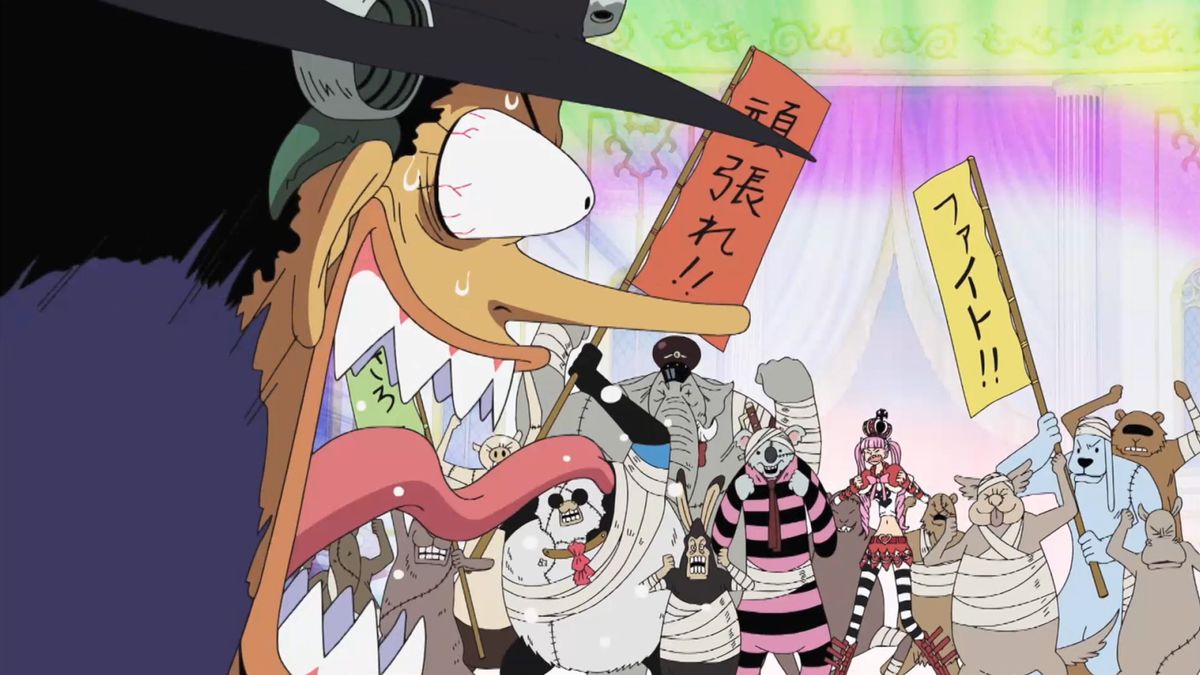
The Episode 356 image serves as featured image, hero, bounded-directory card, and social preview. One local attachment provides a consistent record identity across the One Piece hub, Reacts directory, search, and shared links.
Complete source and accessibility metadata remain attached, and no other post reuses the asset.
RaeRae’s final receipt
Episode 356 gives two underestimated Straw Hats confrontations that only they can make honest. Chopper stands in front of Hogback as a doctor who finally understands that brilliance without care is not medicine. Cindry’s body is not proof of genius. Her body is evidence that Hogback valued access over consent and wanted his grief to outrank the person he claimed to love. Chopper refuses to let the man keep professional authority after abandoning the human purpose of the profession.
Usopp receives the funniest possible vindication. Perona sends despair toward a man already capable of listing his failures without assistance, and the power finds nowhere lower to push him. Yet the joke is not that misery makes him healthy. The point is that negative feeling never stopped Usopp from choosing action. He panics, complains, predicts disaster, and remains present. Perona’s model assumes confidence is the only foundation for resistance. Usopp proves responsibility can survive without confidence. Chopper protects the meaning of care, Usopp protects the right to act from inside fear, and both men matter because the crew never required them to become somebody else first.
Fear has accidentally trained Usopp for this room
Usopp has spent the voyage entering danger without the emotional protection other fighters seem to carry naturally. He imagines pain, defeat, embarrassment, and death before the first attack lands. That habit exhausts him, yet the habit also means Perona cannot introduce despair as a shocking new condition.
His resistance comes from familiarity rather than immunity to suffering. Usopp knows the voice claiming he is useless because he has argued with that voice repeatedly and continued helping the crew anyway. The Negative Hollows can echo his worst thoughts, but they cannot make those thoughts the final authority over his choices.
Action gives Usopp’s contradiction moral value
Calling himself weak would mean little if he always left other people to absorb the danger. Episode 356 is funny because his behavior contradicts the collapse his language predicts. He stays in the confrontation after the supernatural shortcut fails.
The contradiction is the beginning of courage. Usopp does not wait to believe a heroic story about himself before doing necessary work. Every action creates evidence that his frightened self-description remains incomplete.
Chopper builds a standard Hogback can no longer define
Admiration once allowed Hogback’s reputation to stand in for medical greatness. The dance hall forces Chopper to write a better definition: knowledge must serve life, skill must respect personhood, and grief cannot authorize possession of a body.
That standard belongs to Chopper now. Hogback can retain fame and technical accomplishment while losing the moral authority Chopper once granted him. A younger doctor is allowed to judge an established one by the people harmed beneath the achievement.
Both confrontations return judgment to the underestimated
Perona assumes Usopp has too little confidence to matter. Hogback assumes Chopper’s moral outrage cannot challenge celebrated expertise. Each antagonist mistakes social ranking for truth.
Episode 356 lets the overlooked characters define the terms instead. Usopp decides whether fear prevents action, and Chopper decides whether technique deserves the name of medicine. Neither opponent gets the final word about who they are.