RaeRae Reacts · One Piece Episode 341
Hogback’s Prestige Cannot Hide Absalom’s Assault on Nami
One Piece Episode 341 React examines Hogback’s resurrection research and names Absalom’s invisible attack on Nami as sexual violence, not romance.
What happens
Hogback tells Nami, Usopp, and Chopper that he researches resurrection, inspiring Chopper’s admiration. During Nami’s shower, an invisible attacker restrains and silences her, then declares that she will become his bride.
RaeRae reacts
The episode uses professional prestige to lower the group’s guard while a sexual predator moves unseen through the same house. Absalom’s attack is not romance, flirtation, or harmless horror comedy. Nami’s body and voice are deliberately controlled without consent. The editorial receipt belongs in the center of the React, not hidden beneath plot mechanics.
Canon note
Episode 341 continues the manga-canon Thriller Bark Arc.
Hogback presents resurrection as a professional triumph
The doctor describes research capable of returning the dead, and Chopper hears a claim touching medicine’s most impossible dream. Saving life sits at the center of his vocation. A person who promises to reverse death naturally commands his attention.
The episode lets that wonder breathe because the eventual ethical break matters more when admiration was real.
Chopper’s reverence gives Hogback power before any procedure begins
Prestige controls the conversation. Chopper approaches as a student meeting a legend, which makes challenge emotionally expensive. Hogback does not need to demand obedience when reputation has already arranged the hierarchy.
Authority becomes dangerous when followers believe questions would prove disrespect rather than care.
Resurrection language hides the question of who owns the returned body
Bringing somebody back sounds merciful until the method treats bodies as materials and returned movement as service. Medicine cannot be evaluated only by whether tissue moves. Personhood, consent, memory, and freedom determine whether the result constitutes care.
Thriller Bark places those questions under every stitched seam.
A doctor’s brilliance cannot replace a doctor’s ethics
Technical ability may produce spectacular outcomes while violating the people whose bodies make those outcomes possible. Hogback’s fame tempts observers to grade skill separately from harm.
Chopper’s own medical inheritance rejects that separation. Healing exists for the patient, not for the doctor’s vanity.
The mansion divides discovery along gendered lines
While Chopper confronts the mythology of a famous male doctor, Nami encounters a hidden attacker who treats her privacy and body as available territory. Both storylines expose entitlement: one through professional prestige, the other through sexual violence.
The episode’s horror becomes institutional and intimate at the same time.
Absalom attacks Nami while invisibility protects him from identification
The shower scene is sexual assault. An unseen man restrains Nami, silences her, touches her without consent, and uses invisibility to deny her the information needed to defend herself. No romantic framing can change those actions.
Naming the conduct matters because coy language would repeat the scene’s attempt to erase her perspective.
The bathroom setting makes the violation explicitly about privacy
Nami enters a space where she should be able to close a door, wash, and control who sees her body. Absalom turns that private moment into access for himself. The threat is not accidental exposure. The threat is a person engineering secrecy so he can violate a boundary.
Horror comes from stolen control, not from Nami’s body.
Invisibility is not a joke when used to remove informed defense
The power lets Absalom observe without being observed and attack without presenting a target. That imbalance mirrors the red flare’s surveillance logic on a more intimate scale. He acquires information and access while Nami receives neither.
A supernatural ability amplifies a recognizable abuse of power.
Silencing Nami is part of the assault
Preventing her from calling for help separates her from the crew even inside an occupied mansion. The restraint communicates that her refusal is expected and will be physically overridden.
The scene must be read from the person losing agency, not from the attacker’s fantasy about what the encounter means.
Calling Nami a future bride adds coercion rather than affection
Absalom’s declaration does not express mutual courtship. He assigns Nami a role without knowing her, asking her, or respecting her resistance. “Bride” becomes possession language attached to an assault.
Marriage rhetoric cannot sanitize a choice made entirely by the person using force.
The episode exposes entitlement as a monster more familiar than zombies
Stitched creatures and resurrection experiments create gothic spectacle. Absalom’s behavior draws terror from a man deciding that desire gives him rights over a woman. The supernatural power changes logistics, not the underlying ethic.
That familiarity is precisely why editorial language cannot hide behind playful genre shorthand.
Nami remains the subject of the scene
The camera and comedy choices may complicate reception, but a responsible React keeps attention on her experience: surprise, physical danger, denied privacy, and resistance. Her body is not scenery for evaluating Absalom’s attraction.
Analysis should preserve the agency the attacker attempts to erase.
Fear does not make Nami less capable
An invisible assailant creates a tactical problem no amount of confidence can instantly solve. Nami’s distress is an appropriate response to violence under conditions designed to prevent defense.
Competence should never become a demand that women experience assault without terror.
The crew’s separation makes Absalom’s method possible
Thriller Bark has guided Nami, Usopp, and Chopper away from Sunny, then divided attention inside the mansion. Isolation is not incidental atmosphere. Isolation is infrastructure for abuse.
The arc’s earlier gates, fog, carriage, and rooms all narrow access to witnesses and support.
Hogback’s hospitality fails the most basic duty of a host
A guest is attacked inside his mansion while the environment hides the assailant. Whether Hogback witnesses the event does not erase the culture of bodies and consent surrounding his work.
A house organized around possession cannot offer meaningful safety merely because dinner and conversation look civilized.
Chopper’s dream of medical knowledge meets bodies treated as property
The promise of resurrection sounds magnificent while the mansion’s practices repeatedly convert persons into usable objects. Chopper must eventually decide whether results deserve admiration when the method violates the life medicine claims to honor.
That conflict is professional, moral, and personal.
Cindry’s presence makes service feel unnervingly controlled
Her behavior, affect, and position around Hogback invite questions about autonomy. The household does not feel like a community of equals. People appear arranged around the doctor’s desires and experiments.
The mansion keeps presenting motion without convincing evidence of freedom.
Thriller Bark links body theft to narrative theft
Brook loses a shadow and therefore control over daylight. Nami’s attacker tries to redefine assault as selection for marriage. Hogback frames manipulated bodies as proof of genius. Each offender attempts to control both a person and the story told about that control.
Editorial clarity becomes resistance to the euphemism built into the system.
The episode’s tonal comedy requires a firmer critical response
One Piece frequently places slapstick beside serious harm. Viewers can acknowledge intended jokes without accepting every joke as the final moral interpretation. Reaction writing has room to say when comic framing minimizes a violation.
Fandom love does not require pretending a beloved series handles every scene perfectly.
RaeRae’s voice can love the arc and hold the scene accountable
Thriller Bark contains gorgeous atmosphere, foundational character work, and some of the series’ most memorable emotional material. Absalom’s assault remains assault. Both statements belong in an honest fandom conversation.
Critique becomes part of engagement, not evidence that affection disappeared.
The “bride” claim previews a pattern of stolen identity
Assigning Nami a future she did not choose resembles the arc’s broader interest in bodies and shadows repurposed by powerful men. The victim’s own plans become obstacles to somebody else’s design.
Thriller Bark’s villains do not merely take objects. They attempt to author people.
Episode 341 demands content-aware classification
The broadcast remains an episode React, not a movie or series Review. The page also needs language honest enough that search and directory context do not market sexual violence as a cute romantic complication.
Accurate taxonomy and accurate prose serve the same principle: readers should know what kind of record they are opening.
The official image remains consistent without dictating page colors
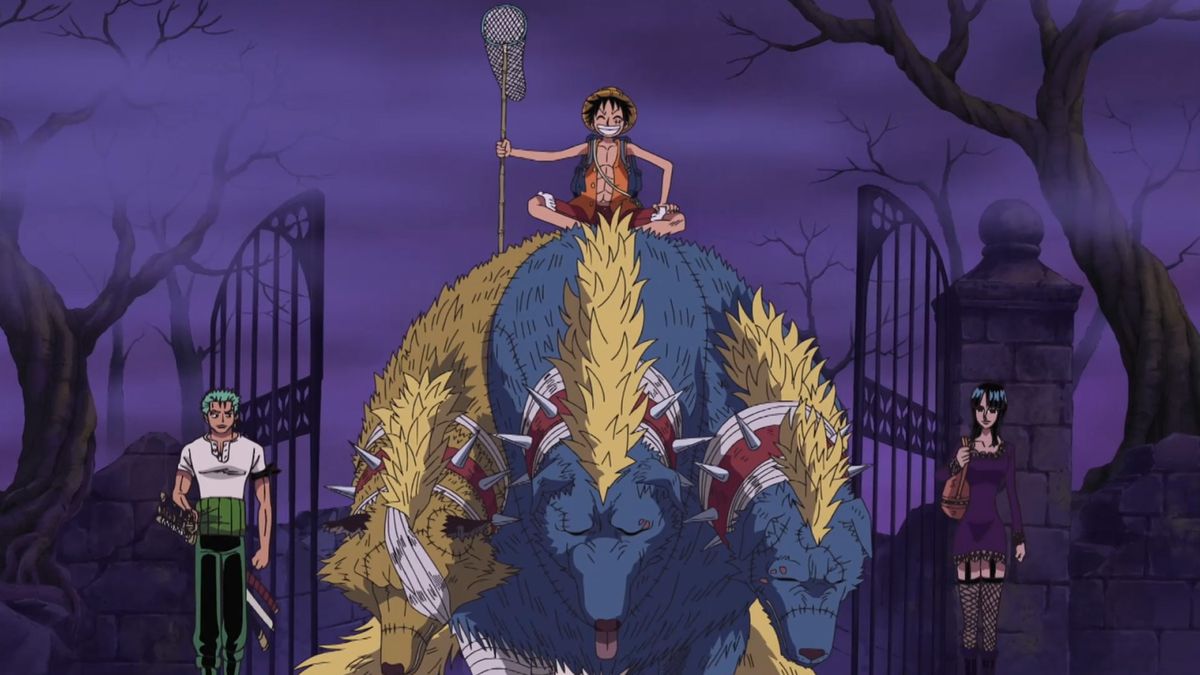
The local Episode 341 still serves as featured image, hero, directory card, and social preview. The established CVM Sekai page format remains intact rather than changing to mimic colors inside the still.
Metadata identifies the specific episode, and no neighboring post reuses the asset.
The mansion reveals danger through conflicting forms of authority
Hogback holds scientific prestige. Absalom holds invisibility and physical force. Each man assumes an ability grants permission over other bodies. One wraps entitlement in research; the other wraps entitlement in marriage language.
The episode becomes clearer when power is evaluated by consent rather than spectacle.
Chopper’s future judgment will matter because he entered in good faith
He wants to learn how impossible lives might be saved. Nothing shameful exists in that hope. Moral growth will require preserving the hope while rejecting methods that turn patients into possessions.
A worthy medical dream can survive the collapse of an unworthy hero.
RaeRae’s final receipt
Episode 341 places two kinds of body horror under the same roof. Chopper listens to Hogback describe resurrection and sees the legend he has admired, while the mansion quietly asks whether technical brilliance means anything when consent has left the building. Medicine is not holy because a famous man performs something impossible. Medicine earns trust by serving the person whose body is on the table.
Then Absalom attacks Nami in the shower. He uses invisibility to watch, restrain, silence, and touch her without consent, and he announces that she will become his bride as though marriage language can transform violence into romance. No. The word “bride” makes the coercion clearer because Nami never chose the encounter, the man, or the future he assigned her. A fandom React can love One Piece and still refuse the comic softening around this scene. Thriller Bark is already about stolen shadows and controlled bodies. Episode 341 shows the same entitlement without metaphor: powerful men deciding that another person’s body and story belong to them. Nami’s fear is valid, her resistance is the truth of the scene, and the assault must be named from her side of the locked door.
Absalom’s power depends on making Nami doubt the room around her
An invisible attacker turns empty air into a possible hiding place and ordinary movement into uncertain evidence. That destabilization is part of the violence. Nami cannot identify where the next restraint will come from, and the absence of a visible body makes witnesses harder to summon or convince.
The attack demonstrates why “nothing can be seen” never means nothing happened. Her reaction, interrupted autonomy, and physical struggle are evidence.
Consent cannot be inferred from an attacker’s preferred ending
Absalom imagines marriage and treats that imagined future as permission in the present. Consent works in the opposite direction. Nami’s choice must precede intimacy, must remain voluntary, and can be withdrawn at any time. No title, desire, joke, or fantasy supplies an answer on her behalf.
The scene becomes more disturbing because he believes his own narrative should outrank the woman resisting him.
Fandom criticism should not ask Nami to carry the show’s tonal decision
If framing reaches for comedy, responsibility belongs to the creative choice, not to the character experiencing assault. Nami does not become oversensitive because viewers feel uncomfortable. The discomfort signals a collision between a serious violation and presentation that may invite laughter.
Readers can hold the work accountable without turning the harmed character into the problem.
Chopper and Nami both encounter men who confuse capacity with permission
Hogback can manipulate bodies, so he treats the result as vindication. Absalom can disappear, so he treats access as entitlement. Neither ability answers the ethical question. Being able to cross a boundary does not grant permission for that crossing.
Episode 341 becomes a sharp statement about power when those parallel assumptions are placed beside each other.
The correct response begins by believing the boundary Nami sets
No later gag, fight, or explanation can retroactively create consent. The editorial record should preserve that fact when the plot moves onward. Nami was attacked in a private space, and her resistance defined the encounter.
Calling the scene sexual assault does not exaggerate Thriller Bark. The label refuses the exact narrative theft Absalom attempts when he calls coercion a wedding plan.
Naming the parallel does not reduce either storyline. The connection reveals an arc-wide ethic in which spectacle repeatedly tries to distract from the person whose choice was removed.