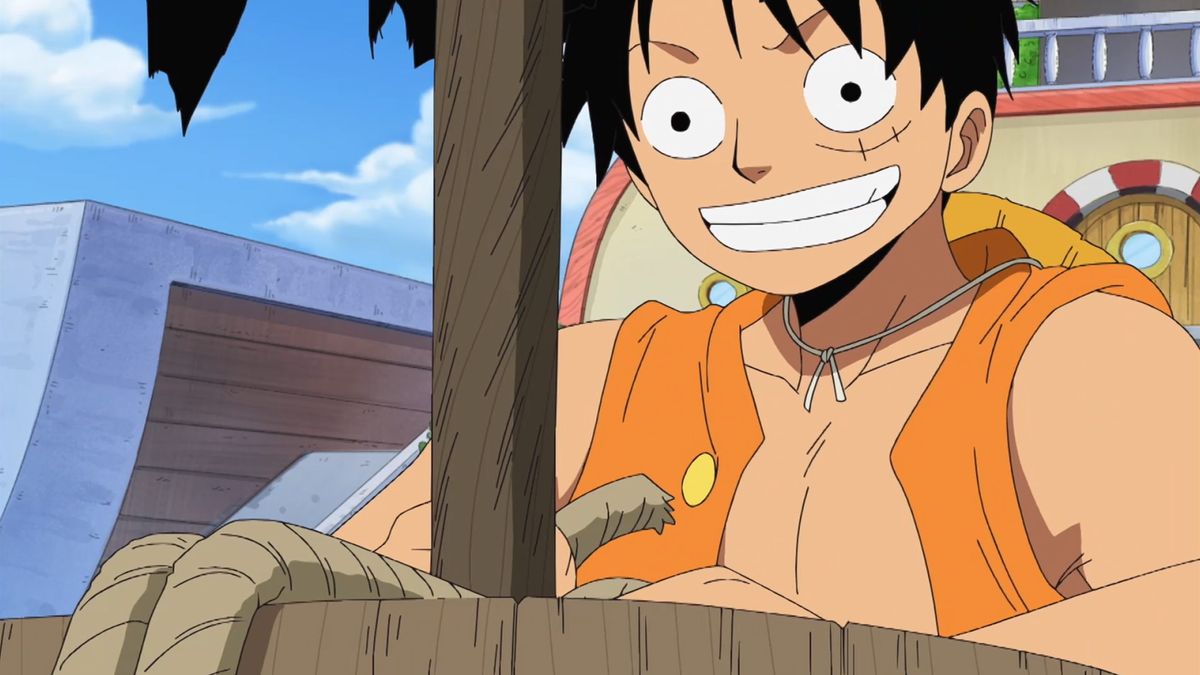
RaeRae Reacts · One Piece Episode 337
A Red Flare Guides the Thousand Sunny Into the Florian Triangle
One Piece Episode 337 React follows a drifting barrel, warning flare, sudden storm, and the living skeleton waiting inside the Florian Triangle.
What happens
The Straw Hats find a drifting barrel and open the presumed offering, only for a red flare to launch into the sky. After surviving a sudden storm, Sunny has entered the Florian Triangle, where a ghost ship and a living skeleton wait inside the fog.
RaeRae reacts
The barrel turns curiosity into a signal announcing the crew’s location. Thriller Bark begins by making visibility dangerous, then uses fog to remove the crew’s own ability to see. The transition is perfect: Sunny has a new home, but the sea immediately asks whether home can navigate a place where ordinary evidence disappears.
Canon note
Episode 337 begins the manga-canon Thriller Bark Arc.
The drifting barrel looks like a gift because the sea taught that language
Sailors can encounter offerings carried by current, and the crew initially reads the container through that familiar possibility. Opening the barrel feels curious rather than reckless because objects at sea arrive with histories nobody aboard can immediately verify.
Thriller Bark begins by exploiting interpretation. A harmless-looking tradition becomes the cover for a signal aimed at somebody watching from beyond sight.
The red flare converts curiosity into exposure
Once the barrel opens, bright light launches upward and announces Sunny’s position. The crew receives no opportunity to consent to being visible. Their action activates somebody else’s surveillance system.
The trap matters because the flare does not attack directly. The device changes who knows where they are, creating danger through information asymmetry.
Visibility becomes dangerous before the fog removes visibility
The red light tells unseen observers exactly where Sunny is. Soon afterward, the Florian Triangle surrounds the crew with conditions that prevent them from seeing what surrounds Sunny. One side gains location while the other loses context.
That imbalance defines the opening’s horror. Being watched without being able to identify the watcher turns ordinary space into threat.
The crew understands the flare quickly but cannot recall the information
Recognizing a signal after launch does not make the signal disappear. The moment demonstrates a hard limit on even excellent situational awareness: some knowledge arrives only after an irreversible action has already transmitted consequence.
Preparation helps people notice future traps. Preparation cannot guarantee every unfamiliar object will explain itself before contact.
The sudden storm overwhelms the question of who saw them
Weather demands immediate attention, forcing the crew to prioritize survival over investigating the flare. That pressure benefits whoever designed the trap. An urgent physical crisis interrupts analysis of the quieter informational threat.
Horror often works by stacking problems until characters cannot hold every danger in focus at once.
Sunny faces natural force after surviving engineered ice
Ice Hunter tested the new ship against a field controlled by bounty hunters. The storm appears less legible, reminding the crew that not every violent environment has a visible human operator. Nami must navigate before motive can matter.
Sunny’s systems provide capacity, but the sea retains authority to present conditions no machine can trivialize.
Nami’s labor keeps gothic atmosphere from replacing seamanship
Fog, storms, ghost stories, and mysterious signals can make the arc feel supernatural from every angle. Nami still reads wind, current, pressure, and route. Her expertise grounds the terror in practical survival.
The unknown becomes more frightening when competent people can name part of the danger and still cannot explain the whole.
Surviving the storm does not return the ship to familiar water
The crew clears the immediate weather and discovers Sunny has entered the Florian Triangle. Victory over one crisis becomes the transition into a larger location problem. Relief arrives without safety.
Episode 337 refuses a clean boundary between disaster and aftermath. Sometimes surviving the wave only reveals where the wave carried you.
The Florian Triangle has a reputation built from missing ships
Stories about disappearing vessels give the fog social history before the crew meets a specific threat. Fear does not begin with one monster. Fear accumulates through absences, rumors, and people who never returned to correct the account.
The location feels populated by missing evidence. Every unseen shape may belong to a story whose witness vanished.
Fog turns navigation into a problem of incomplete truth
A map can describe geography while visibility removes the landmarks needed to use the map. Sound travels without reliable distance, shapes appear without detail, and direction becomes vulnerable to drift.
Nami’s skill remains essential precisely because expertise does not become omniscience. She must make responsible choices with information the environment keeps withholding.
The new ship becomes the crew’s one stable reference
Outside Sunny, the sea loses recognizable edges. Inside, the crew knows rooms, systems, voices, and the location of one another. Home becomes navigational before becoming sentimental.
Thriller Bark threatens that stability by drawing people away from the vessel. The arc understands why separation from Sunny will feel like more than changing scenery.
Luffy meets horror with curiosity instead of genre obedience
A conventional protagonist might respect every warning, whisper inside the fog, and avoid the ghost ship. Luffy treats the unknown as a possible person, meal, adventure, or new friend. His curiosity breaks the expected rhythm of fear.
That openness creates both risk and access. He reaches relationships cautious people might never encounter, while the crew must survive everything curiosity invites aboard.
Usopp and Chopper carry fear without becoming useless
Their panic names what other characters may suppress: this place is frightening, the evidence is incomplete, and every story says ships disappear. Fear makes the audience’s response visible inside the crew.
Both characters can still observe, warn, invent, treat, and act. Courage remains meaningful because fear stays present rather than vanishing on command.
Robin’s calm gives the unknown room to reveal itself
She has spent years beside danger wearing respectable faces, so a ghost story does not automatically control her judgment. Robin can entertain macabre possibilities without losing analytical distance.
Her composure balances Luffy’s appetite for contact and Usopp’s desire for retreat. The crew needs someone capable of watching before assigning one explanation.
Franky sees Sunny tested by an atmosphere no blueprint can predict
He designed systems for pursuit, exploration, and impossible movement. Fog creates a different challenge because machinery cannot solve a threat the crew has not identified. The builder must trust people as much as people trust his ship.
A dream vessel becomes complete through collaborative use, not through possessing an answer to every sea before launch.
The ghost ship appears as evidence and contradiction
A vessel drifting inside the Triangle confirms that something survived long enough to remain visible. The condition of the ship also suggests abandonment, death, or time detached from ordinary voyage. Presence raises more questions than absence.
The crew can see a destination without knowing whether approaching provides rescue, danger, or both.
A living skeleton disrupts every available category
The figure has no flesh and still speaks, moves, laughs, and performs recognizable manners. Ordinary definitions of life and death stop providing a complete answer. The body looks like proof of one state while behavior insists on another.
Brook’s entrance makes personhood the central mystery before his history supplies explanation.
The skeleton’s politeness prevents horror from becoming simple
A monster who only threatens would let the crew respond through combat. A courteous, talkative stranger creates social obligation and confusion. The audience must consider the person beneath an appearance designed to signal death.
Thriller Bark becomes more interesting the moment fear cannot justify dehumanization without further evidence.
Laughter announces survival before the story explains survival
Brook’s voice and humor reach the crew before the Revive-Revive Fruit account arrives. He presents personality ahead of lore. Viewers meet somebody delighted by contact rather than a mechanism wearing bones.
That order protects him from becoming a puzzle box. The explanation will matter, but the person already matters first.
The episode changes tone without abandoning Water 7’s emotional lessons
Water 7 asked who gets rescued, who belongs, and whether damaged people deserve a future. Thriller Bark begins with a figure whose body seems beyond ordinary recovery and whose isolation has become nearly total.
The gothic setting changes visual language while continuing the series’ interest in people misclassified by institutions and appearances.
The flare suggests Thriller Bark has been expecting prey
A random ghost ship would create mystery. A tracking device implies organized attention. Somebody prepared the barrel, relied on curiosity, and waits for the signal to identify another vessel entering range.
The crew has not wandered into empty haunted water. They have entered a system that notices arrivals even when arrivals cannot see the system.
The horror begins through stolen information rather than supernatural force
Before zombies, shadows, or invisible bodies dominate the arc, a small device reports Sunny’s location. That opening makes the threat practical. Surveillance can be terrifying without magic because knowledge changes who controls the next encounter.
Episode 337 builds dread from agency being narrowed one quiet step at a time.
The canon transition deserves a clear boundary after Chopperman
Episode 336 used alternate superhero continuity. Episode 337 returns to the Straw Hats aboard Sunny and begins the manga-canon Thriller Bark Arc. The numbered sequence should not blur the format change.
Accurate directory labels let a viewer move through broadcast order while understanding which narrative has resumed.
Episode 337 is a React, not a series Review
This page responds to one episode’s choices: the barrel, flare, storm, fog, ghost ship, and skeleton reveal. The whole Thriller Bark Arc will require its own series or saga-level assessment elsewhere.
Keeping episode reactions out of the Reviews directory preserves the user’s explicit distinction and makes shared filters reliable.
The official story image becomes one canonical visual
The local official still serves the featured image, page hero, directory card, and social preview. That parity lets readers recognize the same destination before and after clicking.
The directory uses a different local cover, so the parent shelf and child episode never compete through duplicated imagery.
The episode earns suspense by delaying explanation responsibly
Viewers receive enough evidence to understand danger without receiving a false answer. The flare was a signal, the weather changed the route, the Triangle hides ships, and a skeleton behaves like a person. Each fact complicates the previous one.
Mystery feels fair when unanswered questions grow from visible events rather than information the story secretly withholds from everyone.
RaeRae’s final receipt
Episode 337 gives Thriller Bark a gorgeous opening because the first violation is tiny. The Straw Hats open a drifting barrel, and a red flare steals control of their location. Then a storm demands every ounce of attention while the ship crosses into fog where nobody can see who received the signal. Visibility belongs to the watcher, and uncertainty belongs to the watched. That is horror before one zombie needs to crawl out of the ground.
The living skeleton changes the question from “What monster is that?” to “Who has been surviving here?” Brook speaks, laughs, and approaches the crew as a person before his Devil Fruit can explain the body. Luffy’s curiosity is dangerous and ethically useful because he refuses to let appearance finish the judgment. Episode 337 returns us from Chopperman’s alternate special to manga-canon continuity, gives Sunny a new kind of test, and starts the arc with the right emotional promise: the fog may hide bodies, motives, and routes, but hiding a person’s history does not erase the person waiting to be known.
The opening also respects how a real crew absorbs uncertainty
Nobody aboard receives a private briefing from the genre. They compare the barrel to customs they know, respond to weather they can measure, and revise their understanding when the flare proves suspicious. That progression keeps the Straw Hats intelligent even though they walked into a trap. Intelligence is not a magic shield against deception. Good judgment means updating fast when evidence changes, and this crew does.
The sequence also refuses to make fear a single personality trait. Nami reads the route, Usopp voices dread, Robin watches, Franky trusts the ship, and Luffy moves toward contact. Those reactions are different forms of attention. Together they create a fuller survival system than one fearless captain could provide alone.
Thriller Bark opens by making welcome and warning look alike
A drifting offering, a bright flare, and a waiting ship could all belong to rescue language in another story. Here each image carries a second possibility. The barrel reports prey. The flare exposes rather than saves. The ship offers company while proving the Triangle holds histories the crew cannot yet read.
That reversal is why the premiere lingers after the skeleton joke lands. Episode 337 has already taught us not to accept the first meaning attached to an object, a place, or a body. Brook deserves the same patience. A skull is not his biography, and the fog is not the whole truth.