RaeRae Reacts · One Piece Episode 336
Chopperman Defends Television From Dr. Usodabada’s Recruitment Scheme
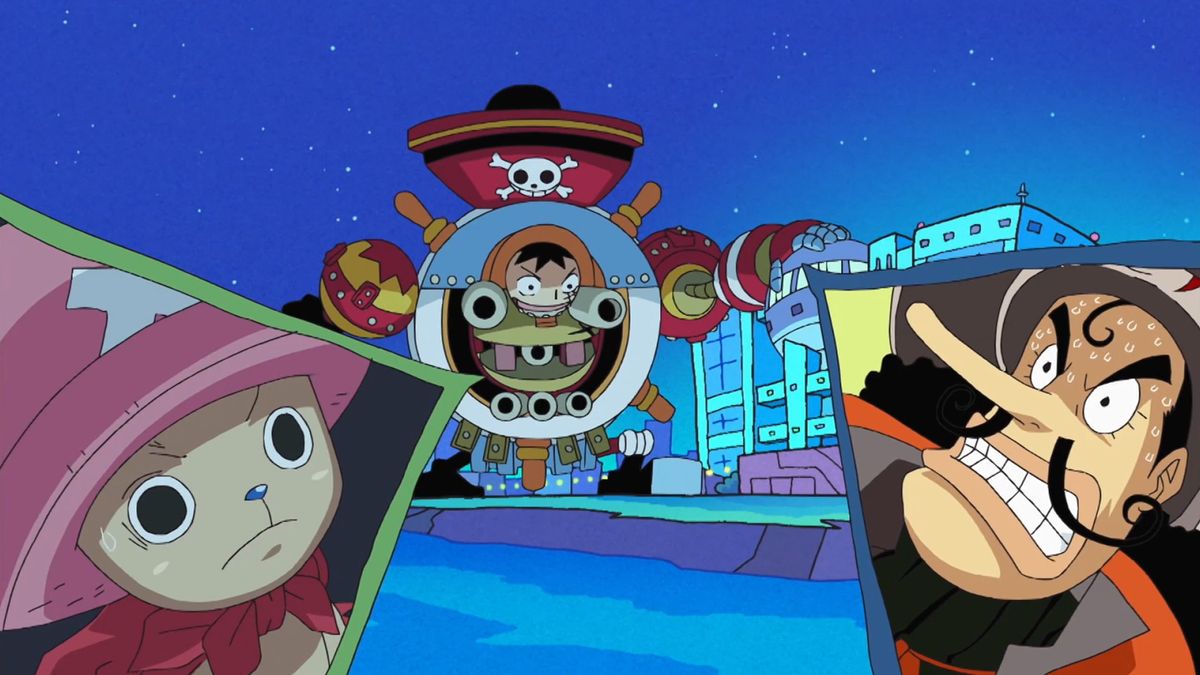
One Piece Episode 336 React covers the standalone Chopperman television special, Dr. Usodabada’s occupied station, and a hero base short on rescue calls.
What happens
Dr. Usodabada decides to recruit better help through television because Sanjirops and Zorogilla are difficult subordinates. He attacks and occupies the station, while Chopperman’s secret base faces a financial crisis because no rescue calls are arriving.
RaeRae reacts
The special turns familiar Straw Hat traits into superhero parody without asking viewers to mistake the alternate roles for main continuity. Television becomes both the villain’s recruitment tool and the public space Chopperman must defend. The household-money joke also gives heroism an ordinary pressure: costumes and courage do not pay the base’s bills.
Classification note
Episode 336 is a numbered anime television special in the Chopperman alternate continuity. This React is classified as Anime, React, Japanese Anime, and Special rather than Ice Hunter or Thriller Bark canon.
Episode 336 changes continuity before changing the channel
Chopperman is not Tony Tony Chopper quietly taking a superhero job between Ice Hunter and Thriller Bark. The special remaps familiar faces into parody roles, gives them new relationships, and treats the setting as an alternate comic world. That distinction belongs at the front of the conversation.
A complete anime hub can celebrate the broadcast without misleading viewers about where the story fits.
Television becomes the location and the weapon
Dr. Usodabada occupies a TV station because he wants the medium’s reach. Broadcasting can place his recruitment message in homes far beyond the building, turning one takeover into a mass audition for villainy.
The threat is therefore larger than physical control of a studio. Whoever controls transmission can decide which invitation, identity, and version of events reaches the public.
Usodabada treats recruitment as a branding problem
His current subordinates frustrate him, so he imagines television will deliver more useful talent. The decision resembles a manager blaming workers while refusing to examine leadership, expectations, or the culture created around them.
Better advertising cannot repair a relationship built on contempt. A larger applicant pool only gives bad leadership more people to disappoint.
Sanjirops and Zorogilla refuse the obedient-henchman fantasy
The subordinates’ oversized attitudes make Usodabada feel undermined. Their resistance drives his search for replacements, but the comedy also exposes the villain’s contradictory desire. He wants capable people whose capability never becomes independence.
Competence includes judgment, ego, and choice. Recruiting strength while demanding total submission creates conflict before the first interview begins.
The occupied station turns workers into collateral
A television facility is full of people whose jobs have nothing to do with Usodabada’s staffing crisis. Seizing the building forces employees and viewers into a private conflict they never agreed to join.
Parody keeps the danger exaggerated, but the consent receipt stays clear. Access to a platform does not create ownership of the people who maintain that platform.
Chopperman’s secret base has a cash-flow problem
The funniest setup may be the hero waiting for rescue calls while household finances collapse. A secret identity still needs food, utilities, equipment, and maintenance. Heroism does not arrive outside ordinary material pressure.
The joke makes the fantasy more human. Saving the day can be noble and still fail to pay whatever bill is sitting on the table.
No calls means no evidence that the hero is needed
Chopperman wants a crisis because responding confirms his role. Silence creates practical anxiety and emotional uncertainty. A hero without requests can begin confusing public demand with personal worth.
The special uses comedy to ask an awkward question: who are you when the identity you prepared receives no invitation to perform?
The financial crisis keeps heroism from becoming pure applause
Costumes and dramatic entrances often hide the labor supporting them. A base needs organization, resources, and somebody tracking what remains after the last adventure. Episode 336 lets domestic accounting interrupt superhero grandeur.
That interruption fits CVM Sekai’s editorial voice. Fandom fantasy becomes richer when ordinary consequences remain visible beneath the pose.
Usodabada’s attack creates the call Chopperman wanted
The hero’s economic problem appears solved by a genuine emergency, which is morally uncomfortable beneath the joke. Needing work should never become needing other people to suffer. Chopperman must answer the crisis without treating victims as fortunate customers.
Service keeps its integrity when relief for the rescuer never outranks safety for the rescued.
A hero and villain both need an audience for different reasons
Usodabada wants television to magnify his authority and attract subordinates. Chopperman needs the public to recognize danger and call for help. Both depend on communication, but one seeks control while the other should restore safety.
The medium carries no automatic morality. Purpose, consent, and consequence determine what broadcasting becomes.
Chopperman’s small body remains the center of the superhero joke
Traditional heroes are often drawn around imposing silhouettes. Chopperman’s appeal comes from the contrast between adorable scale and enormous self-importance. The cape does not erase softness; the costume frames softness as capable.
That visual joke extends Chopper’s main-series resistance to being dismissed as a pet, even though the parody belongs to another continuity.
Parody can reveal character truth without creating canon facts
Usopp’s theatrical insecurity fits a mad-scientist role, Zoro and Sanji fit combative subordinates, and Chopper fits an earnest hero desperate to help. Those correspondences make the special recognizable.
Recognition is not continuity. The alternate roles comment on familiar traits without proving that these events happened to the Straw Hats.
The special turns familiar conflict into workplace satire
Usodabada complains about employees, seeks replacements through mass media, and occupies an institution to solve a management problem. The scale is villainous, but the emotional engine resembles a terrible boss externalizing every failure.
Sanjirops and Zorogilla become more than monsters to defeat. Their attitude is evidence of a workplace nobody would describe as healthy.
Recruitment without respect produces disposable people
The doctor wants excellent talent while speaking about current subordinates as replaceable disappointments. Any new recruit can see the future inside that complaint. Usefulness will secure approval only until somebody else looks more convenient.
A team built through disposability cannot produce genuine loyalty. Fear and ambition may coordinate action, but neither creates trust.
Chopperman needs helpers without reproducing the villain’s hierarchy
A superhero story can center one name while relying on planning, communication, and support from others. The ethical difference lies in whether those contributors remain people with agency or become accessories around the lead.
Defending the station should restore everybody’s capacity to act, not simply replace Usodabada’s face with another unquestioned authority.
The television station represents public trust
People expect broadcasts to deliver information and entertainment rather than forced recruitment for a criminal scientist. Occupation corrupts that relationship by using familiar access for an undisclosed agenda.
Protecting the station means protecting the audience’s ability to receive communication not produced under threat.
The parody format gives consequences elastic scale
Characters can become monsters, scientists, heroes, and exaggerated archetypes without the main timeline carrying permanent damage afterward. That freedom supports louder jokes and faster reversals.
Elastic consequence still benefits from internal ethics. Comedy becomes sharper when viewers understand what Chopperman is protecting beyond the next gag.
The special belongs after Ice Hunter as broadcast history
Episode 336 aired after the Accino finale and before Thriller Bark began. A complete anime route should keep that placement visible so viewers encounter the same programming transition the series delivered.
Broadcast order does not make Chopperman part of the surrounding narrative. Sequence and continuity are separate metadata questions.
The special category prevents an episode number from flattening format
A numbered slot can look identical to an ordinary weekly episode inside a database. Assigning the existing Special relationship tells shared directories and readers that this broadcast changes form and continuity.
Taxonomy carries editorial meaning. Correct classification helps the right card appear in the right destination without rewriting the page manually.
The React category remains correct because this is an episode response
Episode 336 is not a review of the whole Chopperman concept or a film evaluation. The piece responds to one broadcast’s choices, jokes, structure, and implications. That makes React the correct content type alongside Special.
Format clarity keeps the shared Reviews directory free of episode-level reactions, exactly as the hub standard requires.
The Japanese Anime relationship remains necessary
Alternate continuity does not change production origin. The special belongs beneath the existing Japanese Anime child category so origin filtering and the shared Animation Library can discover the record automatically.
Origin, content type, and continuity answer different questions. Good taxonomy preserves all three instead of forcing one label to do every job.
A one-card directory is not unnecessary overhead
The bounded directory gives the special a visible image destination from the main episode spine. Readers can see that Episode 336 stands alone rather than infer the distinction from a tiny text note inside a long list.
Destination-first navigation respects the user’s request: every post reference appears as an image card, including unusual one-off broadcasts.
The hero image must carry the same promise everywhere
The official story still stored locally serves the featured image, page hero, directory card, and social preview. A reader clicking the card encounters the visual identity already presented at the destination.
Canonical image parity prevents the special from looking like four unrelated records stitched together by title.
The volume cover gives the directory its own identity
The directory uses a separate official local cover rather than recycling the episode still. That choice keeps every landing card unique and prevents a parent shelf from competing visually with its only child.
Distinct imagery supports filing order, accessibility metadata, and clear movement from directory to React.
The TV takeover satirizes attention as a resource
Usodabada wants more applicants, so he captures the infrastructure that can manufacture visibility. His plan assumes attention will translate into loyalty. The assumption mirrors every bad campaign that mistakes reach for relationship.
People seeing a message does not mean they consent to the message, trust the sender, or want the offered role.
Chopperman’s empty phone and Usodabada’s broadcast are opposites
One character has a channel nobody is using; the other seizes a channel used by everyone. Chopperman waits for consent through a request for help. Usodabada bypasses consent by forcing his demand into public space.
The communication contrast gives the episode more structure than a collection of costume jokes.
Financial anxiety does not excuse manufacturing dependency
If Chopperman’s base survives only when danger creates demand, the system contains a perverse incentive. The ethical response is not inventing emergencies or prolonging rescue. The hero must serve real need even when successful service reduces future calls.
Care remains care when another person’s independence counts as success.
The special lets Chopper occupy the central fantasy
In the main series, he often supports larger battles as doctor and crewmate. Chopperman hands him the title, costume, secret base, and final responsibility. The shift celebrates his earnestness without requiring him to become less cute or more cynical.
Centrality expands the trait viewers already love: Chopper wants his abilities to help somebody.
Comedy works because the characters commit to nonsense
Usodabada’s staffing plan, oversized subordinate egos, household budget crisis, and occupied television station become funny because nobody pauses to apologize for the premise. The alternate world treats ridiculous stakes with sincere urgency.
Commitment protects parody from becoming detached commentary. The characters live inside the joke instead of standing outside and explaining the joke.
The broadcast deserves preservation without inflated importance
A complete hub should neither omit Episode 336 nor pretend the special alters the central One Piece saga. Accurate coverage gives the card, editorial depth, source link, and classification appropriate to the actual artifact.
Completion is not exaggeration. Completion means every format receives honest context and usable navigation.
RaeRae’s final receipt
Episode 336 is delightfully unserious about costumes and completely useful as a test of whether a hub understands format. Dr. Usodabada takes over a television station because Sanjirops and Zorogilla are not the obedient talent he wants. Chopperman waits beside a silent rescue phone while his secret base runs out of money. One man forces attention; the other has to wait for somebody to request help. That contrast is the real story beneath the parody noise.
I am also keeping the classification receipt. Chopperman is alternate continuity, a numbered television special, an episode React, Japanese animation, and not an Ice Hunter or Thriller Bark canon event. Those truths can coexist in the same record. The official local image remains the hero, featured image, card, and social preview, while the directory has its own unique cover. Fandom documentation does not have to choose between fun and accuracy. We can laugh at a broke superhero base, side-eye Usodabada’s terrible management, and still make sure every directory understands exactly what kind of episode just invaded the schedule.