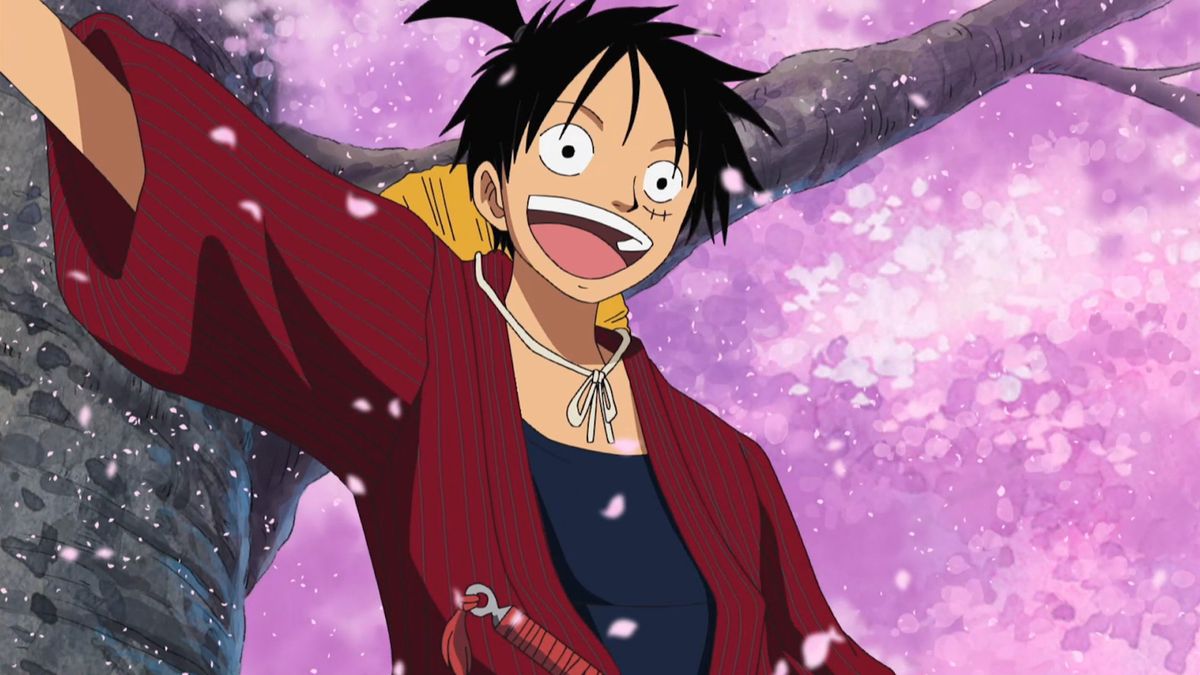
RaeRae Reacts · One Piece Episode 303
Boss Luffy Hunts a Missing Thousand-Year Cherry Tree
One Piece Episode 303 is a Grand Jipang television special about a missing cherry tree, a sick child, and bringing the spring festival to everyone.
The short version
Episode 303 pauses Enies Lobby for a Grand Jipang television special about a missing thousand-year cherry tree and a sick child who deserves to see the spring celebration. Luffy returns as Boss Luffy, but the emotional engine is familiar: community should bring wonder to the person who cannot reach the celebration alone.
This is a television special inside the numbering
The official episode guide explicitly identifies Episode 303 as a television special. The number belongs in complete episode navigation, while the Special category preserves the actual format. Calling the installment an ordinary Enies Lobby chapter would erase useful information.
Correct classification is part of respecting viewers who want to know where canon pauses.
Grand Jipang remixes familiar relationships
The alternate setting gives known faces new jobs and social roles without requiring a new emotional dictionary. Luffy remains impulsively generous. The community still gathers around food, spectacle, danger, and loyalty.
The pleasure comes from recognition with changed circumstances, not continuity confusion.
Ninjin’s illness changes the festival question
A celebration that everyone must attend sounds universal until one child physically cannot make the journey. Luffy notices the exclusion and refuses to accept that illness should make the cherry blossoms inaccessible.
That instinct is consistent across settings. He rarely begins with policy language, but he immediately recognizes when a rule or circumstance leaves somebody outside joy.
The missing tree turns wonder into a mystery
The thousand-year cherry tree is both spectacle and shared ritual. Removing the tree threatens more than scenery. The town loses the object around which people gather, remember, and renew relationships.
The search therefore carries emotional stakes even when the special keeps the comedy light.
Spring imagery lets the episode breathe
Pink blossoms, crowded streets, and festival anticipation offer a deliberate tonal reset after executions, warfare, and trauma. Rest does not cheapen the surrounding arc when the detour announces its own format honestly.
Sometimes a long weekly series needs a side road where beloved characters can be generous without an apocalypse.
Boss Luffy still leads through immediate care
He does not construct a speech about inclusion. He sees Ninjin suffering and starts searching for a way to bring the experience closer. Action arrives before prestige or reward enters the conversation.
The special understands that Luffy’s most portable trait is not piracy. The defining trait is refusal to accept another person’s lonely resignation.
A festival belongs to the whole neighborhood
The annual gathering empties every street because participation has become civic tradition. That collective energy can feel magical, but Ninjin’s absence reveals the edge of any tradition built around assumed mobility and health.
The better community adapts the ritual instead of blaming the person who cannot comply.
RaeRae’s receipt
I would never tell a first-time viewer Episode 303 advances the Enies Lobby plot. The special does not. I would also never dismiss the special as worthless filler. The episode gives the cast room to practice care in a lower-stakes register.
The key is honest labeling. Viewers can skip, save, or enjoy the spring detour without being tricked about what kind of story awaits.
Episode facts and receipts
Episode 303 aired April 1, 2007. ONE PIECE.com credits Hirohiko Uesaka for the script, Munehisa Sakai for direction, Kazuya Hisada for animation direction, and Miho Shiraishi, Michiyo Kawasaki, and Kumiko Fukuzawa for art.
Classification: numbered Grand Jipang television special and RaeRae React. Anime, Anime Series, Japanese Anime, Anime Reacts, and Special, not Anime Reviews and not a manga-canon Enies Lobby chapter.
The special format changes what viewers should expect
Episode 303 does not answer the cliffhanger around Robin, Lucci, or the Buster Call. The broadcast steps sideways into the Grand Jipang alternate world. That choice can frustrate anyone watching Enies Lobby in a binge, especially after Episode 302 ends with freedom and annihilation arriving together.
Honest labeling fixes most of the problem. A television special can be judged as a seasonal character remix rather than a failed piece of canon momentum.
The episode number remains useful for navigation, while the Special category tells viewers exactly why continuity pauses.
Grand Jipang uses casting as a fandom game
Familiar faces occupy new social positions, and viewers get to compare the alternate role with the personality they already know. The pleasure resembles seeing a repertory company perform another play. Recognition creates jokes before dialogue explains the setup.
Luffy’s generosity survives the move into a period-inspired town. The setting changes his clothes and civic role, not the instinct that makes another person’s exclusion feel intolerable.
That consistency gives the special emotional grounding beneath the costume play.
Ninjin gives the mystery a human destination
A missing landmark could produce a purely mechanical search. Ninjin’s illness makes the question personal. Luffy is not chasing the cherry tree because solving a case will flatter his reputation. He wants a child confined indoors to share the sight everybody else anticipates.
The goal turns spectacle into access. Beauty has less value when the community accepts that somebody vulnerable must miss the experience.
Boss Luffy’s answer begins with attention: he notices who is absent from the supposedly universal celebration.
The thousand-year cherry tree holds communal memory
A tree that survives generations becomes more than a large plant. Families measure springs against its blossoms. Neighbors gather beneath branches that held earlier versions of the same feast. The landmark binds private memories into a shared calendar.
Stealing or hiding that object attacks continuity. The town loses the place where people confirm that another year has arrived and that they still belong together.
The mystery works because the missing tree leaves an emotional hole larger than the physical site.
Cherry blossoms carry beauty and impermanence together
Sakura celebrations are powerful partly because blooming does not last. The brief season makes gathering urgent. People show up because waiting means missing the moment.
Ninjin’s illness sharpens that theme. A child cannot assume another spring or another chance will feel the same. Bringing the blossoms closer becomes an act of refusing unnecessary loss.
The special keeps the symbolism accessible through comedy and adventure, but the emotional logic remains serious.
A side story can reveal values without advancing plot
Canon progression is not the only measure of usefulness. Alternate stories test which qualities remain recognizable when history changes. Luffy still helps first and calculates status later. Companions still convert chaos into collective action. Community still matters more than official procedure.
Those repetitions tell us what the series considers essential about the cast.
The special does not deepen Enies Lobby continuity, but the detour can deepen recognition of the personalities driving that continuity.
The comedy needs the emotional anchor
Grand Jipang leans into exaggerated roles, misunderstandings, and familiar faces placed where viewers do not expect them. Without Ninjin, the episode could become a costume parade. The child’s situation gives every joke a destination beyond novelty.
Laughter becomes the tone of a community trying to restore celebration, not a way to mock illness or exclusion.
That balance lets the episode remain light without becoming hollow.
Boss Luffy practices care without paternalism
He does not treat Ninjin as a lesson designed to make healthy people grateful. The child has a concrete desire: seeing the cherry blossoms. Luffy responds to that desire rather than inventing a noble substitute nobody requested.
Care begins by listening to what the affected person actually wants. The special expresses that principle through direct action instead of instructional dialogue.
Ninjin’s vulnerability matters, but vulnerability does not erase preference.
The town’s empty streets reveal the force of tradition
Everyone attends the annual feast, making the celebration sound almost compulsory. Collective rituals can create belonging, yet the same assumptions can hide the people who cannot participate in the expected way.
Ninjin exposes that blind spot. A tradition becomes more generous when the community asks how to carry joy beyond the usual gathering place.
The best festivals do not merely count attendance. They expand the circle.
The spring palette offers intentional relief
Enies Lobby surrounds viewers with gray stone, government symbols, fire, and the threat of erasure. Episode 303 answers with blossoms, food, town life, and seasonal anticipation. The contrast is not subtle, and subtlety is not the purpose.
Weekly audiences in 2007 encountered the special as a broadcast event, not as an interruption selected by an autoplay queue. That original context helps explain the placement.
Modern viewers deserve both the context and permission to choose when to watch.
Skipping and enjoying can both be valid fandom choices
A viewer desperate to finish Enies Lobby may save Episode 303 for later. Another viewer may welcome twenty minutes of familiar faces acting ridiculous beneath blossoms. Neither choice requires inventing a false argument about the episode’s canon status.
My job is to give the receipt. The official guide calls the installment a television special. The story belongs to Grand Jipang. The emotional theme concerns inclusive celebration.
Clear information lets fandom preference remain preference.
Munehisa Sakai directs for ensemble warmth
The special needs a rhythm different from Lucci’s battle. Munehisa Sakai’s direction makes room for town geography, comic entrances, and the growing mystery around the tree. Kazuya Hisada’s animation direction keeps familiar personalities readable inside alternate costumes.
The art team builds a spring setting meant to feel inhabited rather than merely decorative.
Production choices support the episode’s actual assignment: a festive detour with a caring center.
The alternate world protects the main story from contradiction
Grand Jipang does not pretend the Straw Hats abandoned Robin during a Buster Call to solve a blossom mystery. The cast exists in another continuity with different roles. That separation allows playful reuse without forcing impossible chronology into Enies Lobby.
Classification therefore matters for interpretation as well as filing. Once viewers know the premise, apparent contradictions stop being errors.
The episode asks for imagination, not continuity amnesia.
RaeRae’s second look
I will always choose accurate enthusiasm over pretending every numbered episode performs the same job. Episode 303 is not essential Enies Lobby plot. The special is a sweet Grand Jipang story about refusing to let a sick child experience spring as somebody else’s party.
That premise earns affection on its own terms. Luffy’s instinct to bring joy toward the person who cannot reach the crowd feels completely true to him.
Watch now, save for later, or use the detour as recovery after Ohara. Just do not call the special an Anime Review or hide the format from readers.
The story values shared joy as real work
Fandom discussions sometimes treat saving a festival as automatically trivial beside saving a kingdom. Scale changes, but the moral instinct remains recognizable. Ninjin faces a smaller crisis that still shapes one child’s world. Boss Luffy does not demand catastrophe before care becomes worthwhile.
That generosity makes the special pleasant rather than disposable. The episode argues that bringing beauty toward somebody isolated by illness can deserve adventure, planning, and collective effort.
Alternate continuity creates room for affectionate exaggeration
Grand Jipang can amplify habits viewers already recognize because the main timeline does not need to absorb every joke. Roles become broader, entrances become louder, and coincidences become part of the game.
The cast remains emotionally legible beneath the exaggeration. Luffy still spots loneliness quickly. Friends still complain while helping. Authority still invites suspicion when ordinary people carry the cost.
The missing landmark asks who controls public memory
A thousand-year tree belongs to no single festival organizer in emotional terms. Generations have attached stories to the blossoms. Removing the landmark means interfering with a community archive written in seasons rather than documents.
The search therefore protects memory as well as entertainment. Towns need shared places where private lives overlap, and those places deserve care beyond commercial value.
Ninjin is not a prop for Luffy’s goodness
The child’s desire gives the mission direction, but the episode works best when viewers remember that Ninjin possesses a perspective rather than existing only to certify the hero. Illness limits movement, not emotional complexity or membership in the town.
Bringing the celebration within reach treats the child as part of the public, not as a charitable exception standing outside the community.
RaeRae’s final receipt
Episode 303 is a television special, full stop. That label should appear wherever the React feeds directories, because an episode number cannot overrule format. Clear taxonomy is service to readers.
Once labeled honestly, the special earns its own warmth. A missing cherry tree, a sick child, and a chaotic alternate-world Luffy create a spring story about refusing exclusion. The stakes are gentler than Enies Lobby. The care is still real.