RaeRae Reacts · One Piece Episode 299
Luffy Holds Lucci While Zoro Reads Kaku’s Impossible Geometry
One Piece Episode 299 divides rescue labor as Luffy keeps Lucci occupied, Franky runs toward Robin, and Zoro faces Kaku’s full sword barrage.
The short version
Episode 299 divides responsibility cleanly: Luffy holds Lucci, Franky continues toward Robin, and Zoro faces the full geometry of Kaku’s giraffe swordsmanship. The crew cannot concentrate force in one room because every route has a different job.
Luffy refuses help for a strategic reason
Franky offers support against Lucci. Luffy sends him forward. The decision is not pride alone. Robin needs someone who can physically reach her while the strongest CP9 agent remains occupied.
Delegation becomes captaincy
Luffy identifies which person must stay and which person must move. Trust allows him to accept that Robin’s immediate rescue will happen outside his sight.
Franky carries the route, not the headline fight
Continuing toward Robin may look less spectacular than joining Luffy. The mission values arrival over applause. Franky accepts the job the rescue needs.
Kaku turns body geometry into sword pressure
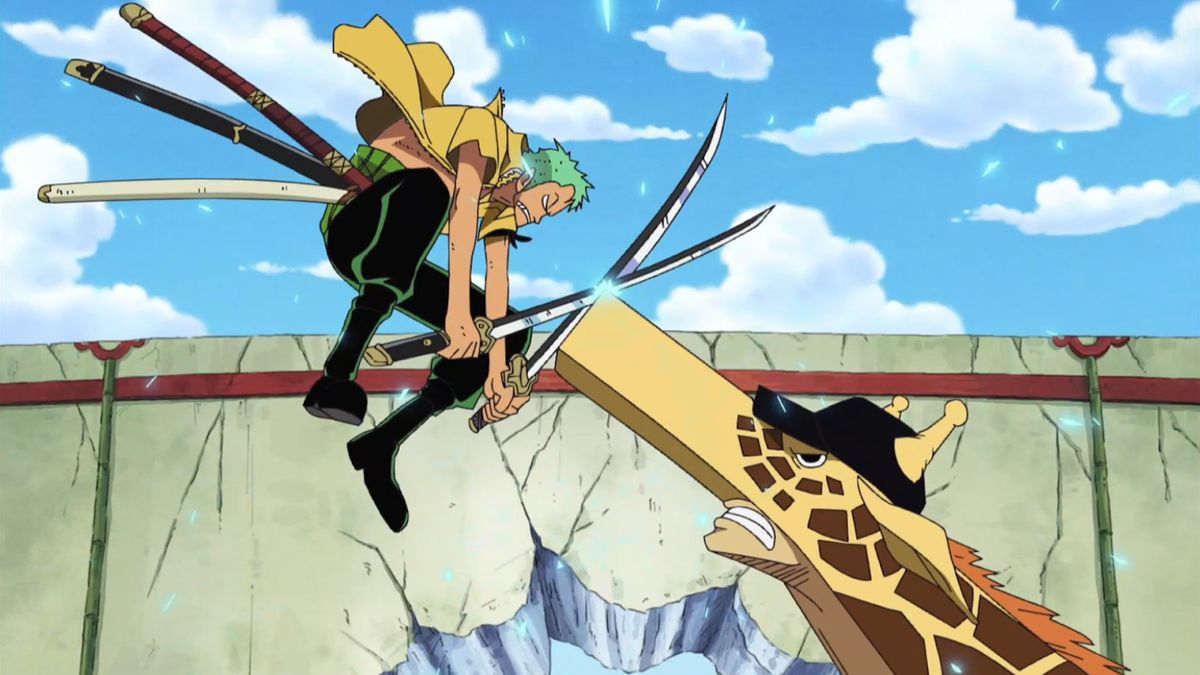
Hands, legs, neck, nose, and Rankyaku create more attack lines than conventional sword logic anticipates. Zoro must read a moving structure rather than three blades.
The giraffe joke has become a serious system
Kaku adapted embarrassment into technique. The transformation remains funny and lethal. Mastery does not require visual dignity.
Zoro’s fight is about cutting through interpretation
Multiple attack lines create uncertainty about which threat matters first. He needs concentration capable of reducing visual chaos to one opening.
Robin and the Gates of Justice remain the clock
Spandam has reached the underground exit. Zoro’s duel, Luffy’s refusal, and Franky’s movement all answer the same shrinking distance.
Adaptation and performance
Ryo Suga’s script and Hiroaki Miyamoto’s direction cross-cut individual battles through shared purpose. Kenji Yokoyama’s animation direction keeps Kaku’s complex attack pattern readable.
RaeRae’s final reaction
Episode 299 understands that teamwork is not everybody hitting the strongest opponent. Luffy stays, Franky runs, and Zoro reads the impossible giraffe geometry. Separate labor becomes one rescue.
Episode facts and receipts
Episode 299 aired March 4, 2007. ONE PIECE.com credits Ryo Suga, Hiroaki Miyamoto, Kenji Yokoyama, Miyuki Sato, and Kumiko Fukuzawa.
Classification: numbered manga-canon Enies Lobby television episode and RaeRae React. Anime, Anime Series, Japanese Anime, and Anime Reacts, not Anime Reviews.
Luffy’s refusal is a division of labor, not isolation
He tells Franky to continue because Lucci will follow the person moving toward Robin. Somebody must become the barrier. Luffy accepts the fight so Franky can preserve forward motion.
The decision depends on trust in both directions. Luffy trusts Franky with Robin. Franky trusts Luffy to survive the strongest CP9 agent without help.
Captaincy means choosing where strength should not go
Adding Franky to the Lucci fight might improve immediate odds and destroy the rescue route. Leadership requires resisting the most visible use of force when another task matters more.
Luffy’s strategic language is simple. The underlying allocation is precise.
Franky becomes Robin’s approaching ally
He burned the Pluton plans and chose her future before formally joining the crew. Running toward the Gates of Justice extends that choice. The shipwright becomes the person trusted to reach an archaeologist the government treats as a weapon.
Their shared history with institutional violence gives the assignment emotional weight beyond combat convenience.
Lucci understands how to weaponize pursuit
If nobody contains him, he can attack Franky, Robin, or the route between them. Luffy recognizes that Lucci’s mobility makes separation dangerous.
Holding one opponent in one place becomes a form of protection across the entire bridge.
Kaku’s body has become a many-bladed machine
His swords occupy both hands. Rankyaku gives the legs cutting force. Nose Gun turns the long neck into another line of attack. The giraffe form creates weapon vectors across nearly every limb.
Zoro faces quantity, range, and irregular timing. The challenge is spatial before the finishing clash becomes spiritual.
Four-Sword Style mocks stable categories
Kaku calls the technique swordsmanship even when legs and nose supply cutting attacks. The name expands around function instead of anatomy.
Zoro cannot win by policing the label. He must answer what the attacks do, not what conventional form says a sword should be.
The giraffe adaptation rewards curiosity
Kaku experimented from the first transformation. Embarrassment did not stop him from testing reach, compression, and leverage. Episode 299 shows the dangerous payoff of that openness.
Adaptability remains admirable as a skill and condemnable in service. Kaku learns quickly so CP9 can keep Robin captive.
Zoro’s discipline confronts an undisciplined silhouette
His style rests on repetition, strength, balance, and controlled intent. Kaku’s body seems visually chaotic while producing increasingly deliberate attacks.
The duel refuses a simple opposition between serious swordsman and comic amateur. Both fighters build systems. Their systems begin from different bodies.
Robin’s distance organizes every room
Spandam has reached the Gates of Justice. Franky runs toward her. Luffy stays behind. Zoro needs Kaku’s key and a cleared path. Separate fights become coordinates on one map.
The episode gains urgency by making movement meaningful. Every person is either blocking, approaching, or being carried away.
The key hunt turns duels into infrastructure
Kaku’s defeat must release more than pride. The object in his possession may unlock cuffs elsewhere. Zoro’s swords create access for bodies he cannot currently see.
That connection prevents the duel from becoming private masculine competition.
Franky refuses the glamour of the strongest matchup
Joining Luffy against Lucci would offer a larger spectacle. Running toward Spandam means accepting a less celebrated but necessary assignment.
Teamwork depends on people choosing mission value over personal visibility. Franky keeps moving.
Luffy protects Franky’s speed through confidence
Hesitation would invite negotiation and give Lucci another opening. Luffy’s certainty allows Franky to leave without spending emotional time debating the captain’s safety.
Confidence becomes logistics. A clear decision shortens the handoff.
Kaku’s attacks make perception the first defense
Zoro cannot block every cutting line equally. He needs to identify timing, intent, and the attack capable of changing the exchange. Reading comes before strength.
The episode prepares Asura by overwhelming ordinary perception. The answer will need to change what Kaku perceives in return.
The production balances two definitions of forward
Franky moves physically toward Robin. Luffy moves the rescue forward by staying. Zoro moves the key hunt forward through a stationary duel.
Hiroaki Miyamoto’s direction keeps those forms of progress legible through cross-cutting rather than treating only running as momentum.
RaeRae’s second look
Episode 299 gives me the kind of leadership I trust: Luffy does not need every heroic task to belong to him. He takes the opponent only he can hold and sends Franky toward the person who cannot wait.
Zoro’s fight carries the same principle. Kaku may be his opponent, but Robin is the reason the swords matter.
Luffy knows Lucci will target movement
Lucci’s mission is not a fair duel. He can abandon Luffy and pursue whoever threatens the transfer. Keeping his attention requires becoming the obstacle Lucci cannot ignore.
Luffy accepts personal danger to stabilize Franky’s route. The fight becomes a moving wall built from commitment.
Franky receives trust before membership
He is not yet formally a Straw Hat. Luffy still assigns him the task closest to Robin’s body. Trust grows from what Franky already chose: burning Pluton, opposing Spandam, and entering the rescue.
Found family often begins through responsibility before anyone names the relationship.
Robin’s rescue requires somebody who understands Spandam
Franky knows the man who framed Tom, exploited shipbuilding, and hid cowardice inside office power. Reaching Spandam is personal without becoming private revenge.
That history gives Franky a reason to protect Robin from the same pattern. The government treats knowledge as a weapon and people as containers.
Luffy refuses to divide attention at the wrong moment
Lucci punishes hesitation. Negotiating a two-person strategy would give the agent room to redirect. Luffy simplifies the objective: Franky runs, Luffy stays.
Clarity can be a form of tactical speed. The command removes uncertainty from the ally whose movement matters.
Kaku’s Rankyaku turns the room into a cutting field
Blade pressure no longer travels only from held swords. Legs generate arcs across distance. Zoro must protect multiple angles while seeking a path toward the body directing them.
The environment becomes part of the attack as walls and floor receive cutting force. Positioning cannot be separated from defense.
Nose Gun converts ridicule into reach
Kaku’s long nose and neck were immediate comedy. He converts both into a linear weapon. Mocked anatomy becomes an advantage through experimentation.
The move fits One Piece’s refusal to let appearance determine capability. Ridiculous does not mean powerless.
Zoro cannot rely on familiar sword etiquette
Kaku’s technique violates expectations about stance, limbs, and attack origin. Treating the duel as conventional kenjutsu would leave Zoro reading the wrong cues.
Respecting the threat means accepting the opponent’s definition of weapon long enough to build a counter.
The key hunt keeps masculine rivalry accountable
Zoro and Kaku could become a self-contained contest over sword pride. Robin’s cuffs prevent that closure. The duel matters because Kaku controls access.
The rescue gives every boast a deadline. Winning without retrieving the key would be incomplete.
Franky’s route carries collective work
His movement depends on Luffy holding Lucci, Nami and Sanji obtaining keys, Sogeking surviving, and Chopper being removed from Monster Point. He runs on accumulated crew labor.
No hero reaches Robin alone, even when one body appears alone in the corridor.
Kaku and Lucci represent different forms of CP9 danger
Lucci offers overwhelming disciplined violence and ideological devotion to killing. Kaku offers adaptability, professional skill, and a personality capable of pleasure that remains subordinated to orders.
The crew must answer both. Institutions survive through zealots and talented people willing to compartmentalize harm.
Zoro’s coming Asura begins with cognitive pressure
Kaku fills perception with too many weapons. Zoro’s response will make one body appear like several. The exchange becomes a contest over whose presence defines reality.
Episode 299 builds that need carefully. The apparition will answer an already established sensory problem.
The production lets delegation carry drama
No explosion accompanies Luffy telling Franky to go. The decision still changes the rescue more than many attacks. Direction gives the handoff space because trust is action.
Ensemble storytelling depends on recognizing such quiet pivots as major events.
RaeRae’s third look
I love that Luffy’s captain moment involves staying behind. Leadership is not always being first through the door. Sometimes leadership means holding the most dangerous person in place so somebody else reaches the friend.
Zoro’s duel operates on the same ethic. The key is more important than the ego. Every blade points beyond Kaku toward Robin.
Delegation proves Luffy understands the mission
Luffy cannot personally solve every crisis inside the Tower of Justice. Holding Lucci in place while sending Franky toward Robin is leadership through trust. He identifies the obstacle only he can occupy and releases a crewmate to handle the next essential task.
The choice answers the old misconception that leadership requires controlling every move. Luffy’s authority grows from knowing what his people can do without him.
Kaku turns architecture into pressure
Kaku’s square body and long reach let attacks arrive from angles that feel absurd until they become dangerous. Walls, floors, and distance stop behaving like neutral background. The room becomes part of his offense, forcing Zoro to read geometry while already managing multiple blades.
Comedy never erases the threat. Kaku’s improvisation makes unpredictability a weapon.
The key keeps the duel accountable
Zoro is not fighting for reputation alone. Every exchange must eventually produce access to Robin’s handcuffs. That practical obligation keeps the spectacle connected to the rescue plot and gives each delay a cost beyond wounded pride.
Episode 299 therefore builds anticipation with purpose. Zoro needs an answer impressive enough to defeat Kaku and useful enough to move the crew forward.
Patience is part of Zoro’s reading
Kaku keeps changing the problem, but Zoro does not mistake novelty for superiority. He watches how the giraffe body redistributes reach, where the swords create openings, and when confidence becomes carelessness. The episode makes observation feel active rather than passive.
That patience also separates Zoro from a fighter chasing applause. Robin remains the destination. Understanding Kaku is valuable because understanding creates the shortest path toward ending the delay.
The coming answer feels earned because Episode 299 allows pressure to accumulate before revelation arrives. Anticipation becomes story work, not empty stalling.
Kaku makes every strange possibility feel immediate, which forces Zoro to solve a moving puzzle under pressure. That restless invention gives the eventual breakthrough scale. Zoro is not simply overpowering one technique. He is mastering a fight that refuses to hold one dependable shape.