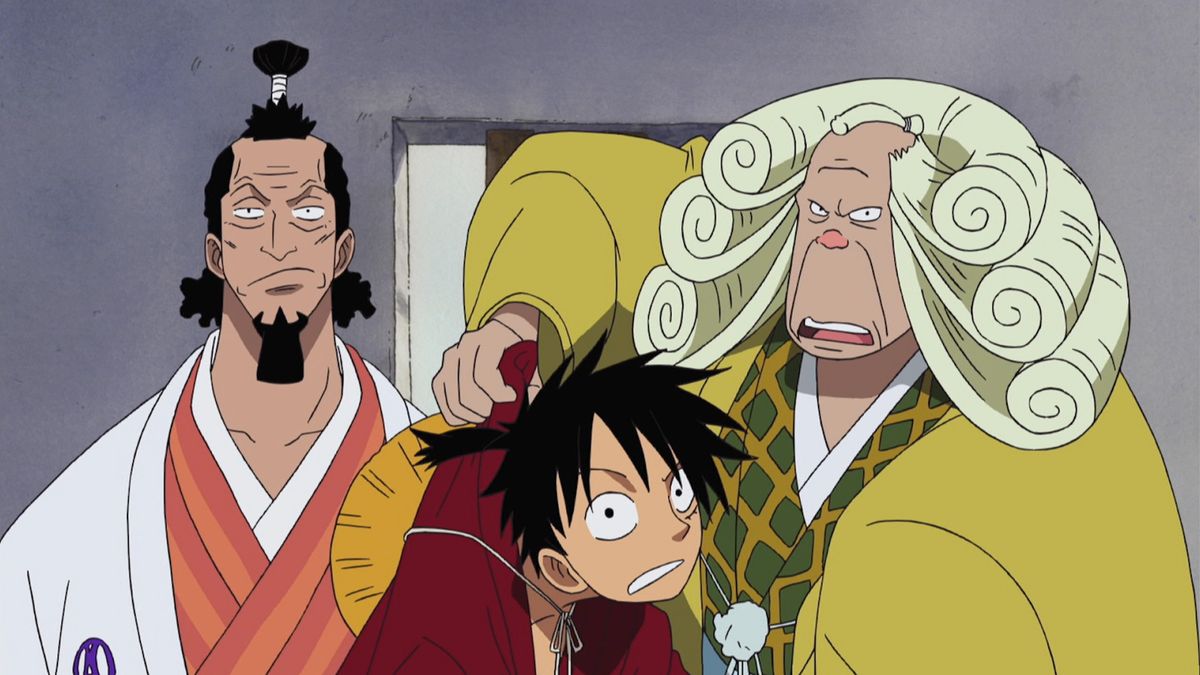
RaeRae Reacts · One Piece Episode 292
A New Year Mochi Race Gives Grand Jipang Another Red-Nosed Scheme
One Piece Episode 292 returns to Grand Jipang for a mochi race, a castle celebration, and a conspiracy targeting the town’s holiday labor.
The short version
One Piece Episode 292 returns to Grand Jipang for a New Year mochi race, a castle celebration, and a red-nosed conspiracy that treats public festivity as another opportunity for theft. Sanji, Nami, and Chopper push a loaded cart through suspiciously empty streets while an ambush waits. Boss Luffy’s world expands from lottery trouble into a community-scale holiday competition.
The special remains anime-original and outside main continuity. The classification does not make the episode disposable. The story shows how One Piece characters function inside ritual, commerce, neighborhood loyalty, and farce.
A New Year special arrives after a broadcast pause
Episode 292 aired on January 7, 2007, two weeks after the Christmas special. The real-world calendar controls the fictional detour. Weekly viewers received seasonal programming before returning to Enies Lobby.
Streaming collapses that context. Two Grand Jipang episodes can feel like a wall placed between Chopper’s dosage crisis and its consequence. Viewing conditions change reception.
The empty street is a warning before the ambush
Celebrations usually fill public space. An empty route turns absence into information. Nami, Sanji, and Chopper move supplies through a town whose normal rhythm has been interrupted.
The image works because logistical labor becomes vulnerable. The cart holds the material needed for community celebration. Attacking the workers attacks the festival before guests ever see the loss.
Mochi connects celebration to labor
Rice cakes appear as festive abundance, but abundance requires preparation, transport, coordination, and people pushing a heavy cart. Episode 292 lets food occupy the center of action rather than the edge of a feast.
Sanji’s role makes that labor visible. A cook understands that public joy has a kitchen behind the image.
Nami reads danger through missing information
Nami notices patterns that fail to appear. A silent street, a suspicious route, or a prize system with unexplained rules becomes evidence. Her intelligence remains environmental.
Grand Jipang uses that skill without ships or weather maps. Navigation is still the art of reading conditions before conditions become catastrophe.
Chopper belongs on the cart and in the town
The blue-nosed doctor participates in everyday work rather than appearing only when somebody is injured. That inclusion matters. Community is built through ordinary shared tasks, not emergency gratitude alone.
After Episode 290, seeing Chopper small, verbal, and trusted carries emotional relief. The special accidentally offers the body safety the main story is about to remove.
The red-nosed conspiracy uses familiarity as comedy
A recognizable troublemaker entering an Edo-period scheme lets the audience anticipate vanity, spectacle, and shortcuts. Alternate casting compresses exposition because the performer arrives with a library of associations.
The joke remains accessible even when continuity changes. Viewers know the type of chaos before the plan fully unfolds.
Public festivals can reproduce inequality
A race and castle celebration promise shared joy, yet prizes and access create competition. Whoever controls the rules can redirect collective energy toward private gain.
The special keeps politics light, but the structure echoes the previous lottery story. Hope becomes easiest to exploit when authority wraps the scheme in celebration.
Boss Luffy protects participation
Luffy’s alternate role does not preserve pirate ambition. The role preserves instinctive opposition to bullies who turn other people’s joy into leverage. He protects the right to join the feast.
That motivation fits the main character across settings. Freedom often begins with food, friends, and a public space nobody has monopolized.
The special format allows theatrical excess
Holiday episodes can crowd the frame with familiar faces, costumes, races, food, traps, and seasonal ritual. Plot efficiency is not the only measure. Recognition and atmosphere become part of the event.
The risk is that spectacle can become a checklist. Episode 292 works best when ensemble appearances serve the town’s social texture rather than pausing the story for applause.
Non-canon continuity still needs internal rules
Grand Jipang becomes satisfying when roles and relationships remain consistent across specials. Viewers need to know who runs the Pinwheel, who practices medicine, and why Boss Luffy intervenes.
Continuity at a smaller scale creates investment. Alternate worlds lose meaning if every return discards the previous episode’s social map.
Adaptation and performance
Writer Naoki Koga and director Yoko Ikeda construct the special around movement through town and a public event. Naoki Tate’s animation direction keeps a large comic ensemble legible. Miyuki Sato and Kumiko Fukuzawa shape the seasonal setting.
The cast plays archetypes without flattening familiar chemistry. Nami, Sanji, and Chopper remain recognizable while serving a different household and social order.
RaeRae’s final reaction
Episode 292 gives Grand Jipang more room to feel like a place instead of a one-night costume gag. I like the food labor, the neighborhood rhythm, and Chopper’s uncomplicated belonging. I remain aware that Robin is frozen behind the scheduling decision.
The special deserves its own reaction, not resentment disguised as analysis. The placement also deserves an honest receipt. Seasonal fun and serialized frustration arrived in the same broadcast package.
Episode facts and receipts
One Piece Episode 292 aired in Japan on January 7, 2007. ONE PIECE.com labels the broadcast a television special and credits Naoki Koga for the script, Yoko Ikeda for direction, Naoki Tate as animation director, and Miyuki Sato with Kumiko Fukuzawa on art.
Classification: numbered television episode, anime-original Grand Jipang alternate-setting special, RaeRae React. This record belongs in Anime, Anime Series, Japanese Anime, Anime Reacts, and Special. This record does not belong in Anime Reviews.
The second Grand Jipang visit proves the setting can recur
A one-off alternate universe can survive through novelty. A return episode needs continuity. The Pinwheel, town roles, Boss Luffy’s reputation, and familiar social relationships give Episode 292 a foundation instead of forcing another full introduction.
That repetition changes the project from costume special to parallel world. Viewers can begin asking what life between crises looks like and how the neighborhood remembers previous trouble.
Seasonal ritual creates a shared public clock
New Year celebrations synchronize a community. Food, games, races, decorations, and castle events tell everyone that ordinary time has paused for a collective beginning. Disrupting the ritual affects more than one victim.
The villains exploit that concentration of attention. Crowds, prizes, and expectation create cover. Celebration becomes both the target and the camouflage.
The mochi cart makes abundance visibly heavy
A finished feast can make labor disappear. The cart restores weight. Somebody carried ingredients, prepared food, loaded supplies, chose a route, and pushed through snow while everyone else anticipated fun.
Sanji, Nami, and Chopper become the workers behind the holiday image. The ambush threatens bodies already performing care for the town.
Sanji’s cooking offers a healthier form of service
After Episode 287 framed his gender rule as chivalry, Grand Jipang reminds viewers that Sanji’s strongest care often comes through food. Cooking answers hunger without deciding that the recipient is incapable.
Service becomes mutual when skill meets an expressed need. Pushing the cart may look less heroic than a kick, yet the labor builds the celebration everyone wants.
Nami’s suspicion protects collective resources
Nami understands that a strange route and empty street can signal an attempt to isolate valuable cargo. Her caution is not pessimism. The town’s supplies are finite, and recovery may be impossible before the event.
Protecting shared resources requires attention before loss becomes spectacular. Her intelligence catches pressure in the quiet phase.
Chopper’s ordinary usefulness matters after Monster Point foreshadowing
The main story is approaching a transformation that will make Chopper enormous and frightening. Episode 292 presents the opposite image: a small doctor helping move food through a community that recognizes him.
Neither body defines his worth. The contrast reminds viewers that the person inside the coming monster already has a profession, relationships, humor, and a place at the cart.
A castle festival can reproduce distance from power
Grand public events often present rulers as generous while workers provide the material generosity. The castle receives symbolic credit for celebration. Town labor fills the streets and tables.
The special keeps the critique playful, but following the cart reveals where abundance actually begins. Authority hosts. Ordinary people build.
The race turns cooperation into competition
A community can celebrate together while prizes encourage individuals to outrun one another. That tension gives schemers an opening. Participants focus on winning while somebody else manipulates the route or reward.
Boss Luffy’s intervention restores the larger purpose. The festival should produce shared joy, not a system where cheating becomes rational because only one outcome matters.
Buggy’s alternate role preserves theatrical insecurity
A red nose, loud ambition, and a complicated scheme remain recognizable across continuities. The character needs attention as much as material gain. Public celebration offers an audience he cannot resist.
That personality continuity makes the alternate casting efficient. The job changes. The hunger to control how everyone sees him remains.
Holiday villains threaten mood as well as property
Stealing food or prizes harms material preparation. Creating fear during a festival also teaches people that public joy is unsafe. The emotional damage can outlast the recovered cart.
Community defense therefore protects the right to gather without exploitation. Boss Luffy fights for atmosphere, memory, and participation alongside physical goods.
The production gets a larger ensemble playground
Grand Jipang allows characters separated by death, allegiance, geography, or continuity to share one street. Such abundance delights fans and risks overcrowding the frame.
Episode 292 succeeds when cameos contribute to the festival’s density. Recognition should make the town feel full rather than make the plot stop for a roll call.
The January date completes the programming pair
Episode 291 served Christmas Eve. Episode 292 served the first Sunday broadcast after New Year. Together they form a seasonal television package rather than two random deviations.
That context makes the hiatus understandable while leaving serialized frustration intact. Production history and viewer emotion can coexist without one invalidating the other.
RaeRae’s second look
I like Episode 292 more when I watch the cart. Food, medicine, navigation, and labor travel together while a celebration waits. The route turns care into action before any villain receives a dramatic entrance.
Grand Jipang earns its return by feeling inhabited. The special still delays Robin’s rescue. The delay carries more value when the alternate world offers community rather than only novelty.
Grand Jipang treats food as public infrastructure
The mochi cart links kitchen work to civic celebration. Food becomes infrastructure because the event cannot function without preparation, transport, and distribution. Sabotaging the cart resembles cutting a bridge between labor and the people labor was meant to serve.
That framing gives Sanji’s craft social weight. Cooking is not a decorative personality trait waiting between fights. The town gathers because cooks and helpers make gathering materially possible.
Celebration requires trust in rules
A race can feel joyful only when participants believe the route, prizes, and officials operate honestly. A conspiracy turns play into extraction. People continue running under assumptions the schemers have already violated.
Restoring the festival therefore requires more than defeating attackers. Somebody must restore confidence that shared activity is not a trap. Boss Luffy’s public intervention matters because everyone can see whose side he chose.
The alternate world redistributes status
Characters feared as pirates or pursued by Marines in main continuity can hold ordinary jobs and social roles here. The rearrangement reveals how much identity depends on institutions naming people criminal, official, useful, or dangerous.
Grand Jipang does not erase personality. The setting changes which traits receive legitimacy. Chopper’s difference becomes medical reputation. Luffy’s refusal of hierarchy becomes neighborhood trust. Nami’s calculation becomes business competence.
The special pair creates a seasonal bridge
Episode 291 opens the holiday detour with lottery trouble. Episode 292 closes the programming break through New Year spectacle. Viewed together, the pair has a beginning, return, and broader town map.
The bridge still spans an awkward place in the main story. Naming the pair as a bounded special directory helps viewers understand the interruption before clicking, which is exactly why image-card organization matters.
RaeRae’s placement verdict
Episode 292 belongs in the numbered sequence because that is how the series broadcast the installment. The Special category belongs beside the React category because continuity and format answer different questions. One tells viewers where the episode sits. The other tells them what kind of story they are opening.
I want both receipts visible. Fans should not have to discover halfway through that Robin’s rescue has paused for mochi, and the special should not be dismissed before anyone sees the community labor giving the comedy weight.