RaeRae Reacts · One Piece Episode 288
Franky’s Cola Crisis Turns Maintenance Into a Battle Strategy
One Piece Episode 288 restores Franky’s cola power against Fukurou while Nami climbs toward Kalifa and Luffy finds Robin’s route.
The short version
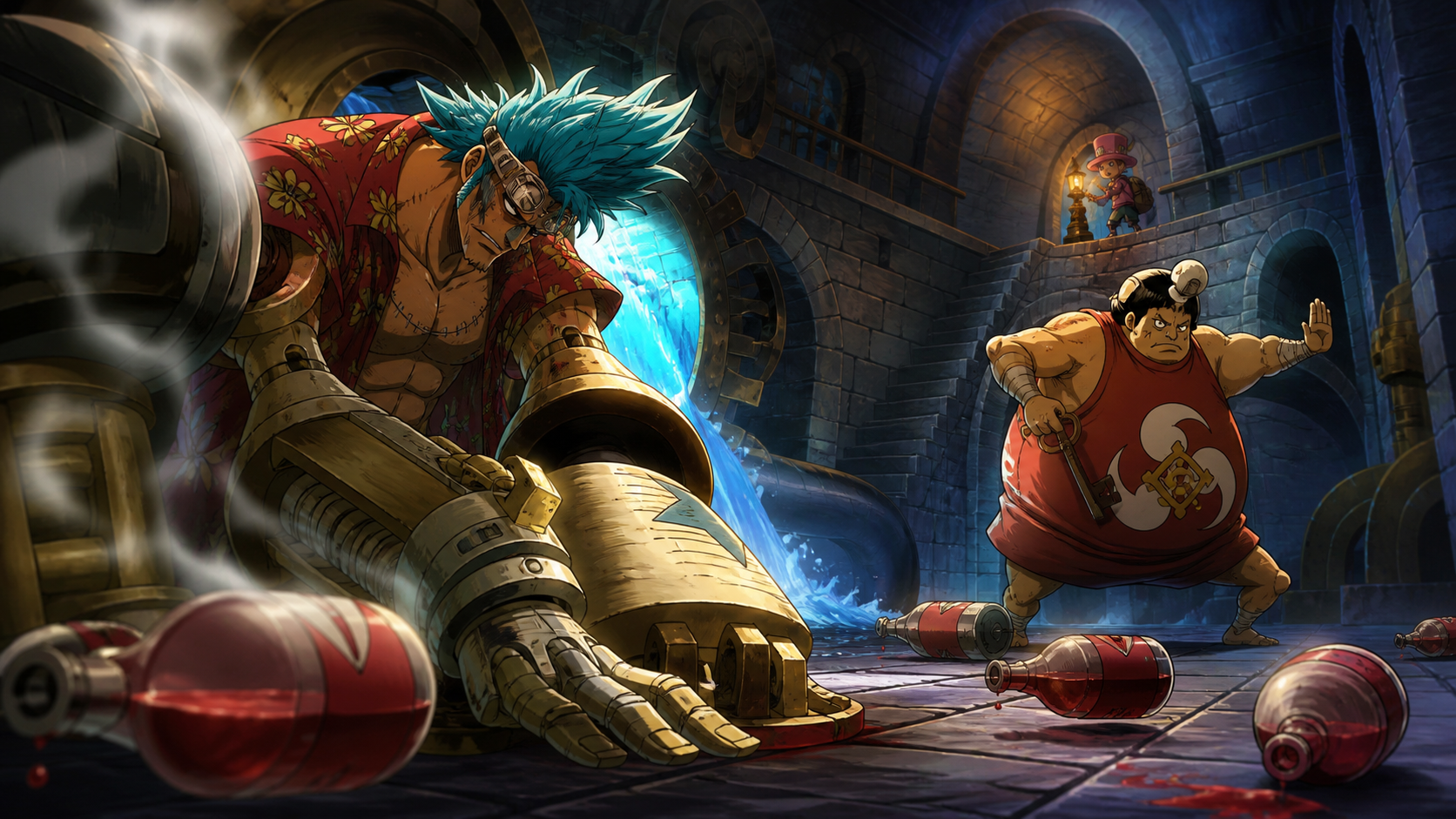
One Piece Episode 288 gives Franky a cola crisis in the middle of a death match and turns fuel into character logic. Fukurou believes the cyborg has run out of power. Franky finds the right drink, restores his fighting style, and proves that knowing somebody’s machinery is not the same as understanding the person operating that machinery.
Above him, Nami climbs toward Kalifa after finding Sanji defeated. Luffy follows Chimney’s route toward the underground passage and the Gates of Justice. Every floor now carries a separate rescue problem, and all of them run on time Robin does not have.
Cola is funny because the engineering remains consistent
Franky’s fuel source sounds like a gag, looks like a gag, and produces some of the episode’s loudest comedy. The rule also remains mechanically clear. Correct fuel restores his familiar power and temperament. Incorrect drinks alter output and behavior. Empty reserves limit techniques.
That consistency lets comedy support the fight instead of interrupting the fight. Viewers understand the stakes of every bottle immediately. A refrigerator becomes as tactically important as a weapon rack.
Fukurou mistakes observation for complete knowledge
Fukurou notices Franky’s weakening attacks and correctly identifies an energy problem. The mistake arrives when he treats that diagnosis as victory. Information produces advantage only when interpretation remains open to change.
CP9 agents often act as though measured power explains every outcome. Doriki ranks bodies. Rokushiki categorizes technique. Intelligence files categorize targets. Franky’s homemade body refuses a stable category because he designed modifications around imagination rather than institutional standards.
A self-built body carries self-authored rules
Franky rebuilt himself after the sea train nearly killed him. The cyborg body records trauma, survival, craft, and absurd personal taste. Government agents see hardware. Franky experiences autobiography.
Cola therefore means more than fuel. The choice is loud, childish, commercially recognizable, and completely his. A state that wants Pluton blueprints and treats bodies as tools confronts a body whose operating system includes pleasure.
Power can depend on care work and supplies
Battle anime often hides logistics until a dramatic shortage appears. Episode 288 makes supply visible. Franky needs somebody to understand the request, reach the refrigerator, choose correctly, and deliver under fire.
No fighter is independent. Food, medicine, maps, repairs, information, and emotional support make heroic action possible. The cola gag points toward a serious truth: combat power rests on networks of maintenance that rankings rarely count.
Nami inherits a fight and the labor around the fight
Nami reaches Sanji, assesses the damage, understands why he failed, and continues toward Kalifa. She must carry concern for her friend without letting concern consume Robin’s remaining time.
Sanji’s code created this transfer. Nami did not choose the matchup from a neutral position. She receives an active CP9 agent, an unresolved key, and evidence that one crewmate is already injured. Calling that simple teamwork would hide how unevenly the burden arrived.
Kalifa’s room turns cleanliness into threat
Soap, bubbles, polished surfaces, and bureaucratic composure give Kalifa a visual language built around purification. The World Government constantly labels inconvenient people dirty, criminal, dangerous, or demonic. A cleaning power inside that institution cannot feel politically neutral.
Nami understands presentation as a survival tool, but she does not confuse polished appearance with innocence. Her weather techniques come from studying unstable systems. Kalifa’s controlled room will have to face a woman who reads pressure changes for a living.
Luffy finds a route because Chimney refuses adult helplessness
Chimney sees passages adults miss and treats the impossible building as a place to explore. Her contribution is not decorative child courage. She provides navigation at the moment brute force needs direction.
Luffy can break walls, but a broken wall is useful only when the route leads toward Robin. Chimney converts curiosity into rescue infrastructure. Enies Lobby survives by controlling official paths. A child who ignores official use becomes dangerous to the institution.
The Gates of Justice remain the episode’s clock
Every comedic beat occurs beneath a moving deadline. Robin is not waiting safely in one room. Spandam continues toward a threshold designed to erase access. Once the gate closes around her route, rescue becomes vastly harder.
The episode keeps that pressure through cross-cutting. Franky’s cola problem may dominate one floor, but the camera returns to upward stairs and underground passages. Separate battles remain parts of one emergency.
Fukurou and Franky make spectacle out of incompatible bodies
Fukurou’s rounded form, speed, and Rokushiki discipline contrast with Franky’s angular machinery and improvised weapons. Both fighters can absorb punishment. Their visual difference turns every collision into an argument about training versus construction.
Neither side is simply natural. CP9 trained bodies into government technology. Franky rebuilt flesh into personal technology. The meaningful difference is ownership. One body was optimized for orders. The other was authored by the person living inside.
Masculinity gets to be ridiculous here
Franky cries, poses, drinks soda, shouts about being super, and fights without needing emotional restraint to prove strength. That freedom distinguishes him from CP9’s colder performance of masculine competence.
The episode lets a powerful man depend on a beverage, helpers, and visibly expressed feeling. None of those dependencies reduce him. Strength becomes collaborative and theatrical instead of silent and isolated.
Adaptation rhythm keeps three routes legible
Naoki Koga’s script and Yoko Ikeda’s direction move among Luffy, Nami, and Franky without losing the shared objective. Each route answers a different question: where is Robin going, who can recover the key, and can the fighters below keep CP9 occupied?
Takeo Ide’s animation direction gives the Franky and Fukurou impacts enough mass for the restored cola power to register instantly. Miyuki Sato and Michiyo Kawasaki’s art supports a tower whose rooms feel distinct while remaining part of the same hostile machine.
RaeRae’s final reaction
Episode 288 knows cola-powered cyborg combat is ridiculous and refuses to apologize. Good. One Piece becomes special when absurdity carries exact emotional and mechanical stakes. Franky needs fuel because survival requires maintenance, and he chose a fuel source that sounds like him.
The episode also refuses to let Sanji’s defeat vanish. Nami climbs into the consequence while Robin moves closer to the gate. I am cheering for Franky’s restored punch and keeping the receipt on who had to repair the plan.
Episode facts and receipts
One Piece Episode 288 aired in Japan on December 3, 2006. ONE PIECE.com credits Naoki Koga for the script, Yoko Ikeda for direction, Takeo Ide as animation director, and Miyuki Sato with Michiyo Kawasaki on art. The official synopsis follows Luffy finding the underground route with Chimney, Nami climbing toward Kalifa, and Franky battling Fukurou.
Classification: numbered television episode, manga-canon Enies Lobby material, RaeRae React. This record belongs in Anime, Anime Series, Japanese Anime, and Anime Reacts. This record does not belong in Anime Reviews.
Franky’s body rejects government standardization
CP9 depends on repeatable techniques. Rokushiki turns human movement into a named institutional curriculum. Franky’s body comes from one survivor working with scavenged materials, private grief, and spectacular taste. No academy designed the result.
That difference makes prediction difficult. Fukurou can measure force after contact, but he cannot consult a standard manual for cola reserves, hidden compartments, or personality changes caused by the wrong beverage. Franky’s irregularity becomes defense.
The wrong drinks reveal how fuel shapes behavior
When Franky receives something other than cola, the joke imagines identity as partly metabolic. Bodies do not merely convert fuel into neutral energy. Food, sleep, medicine, hormones, pain, and stress change how people think and move.
Anime fighters often behave as though willpower can erase material need. Episode 288 makes material need loud. Franky cannot speech his way around an empty tank. Somebody has to find the correct bottle.
Maintenance is heroic even when maintenance looks domestic
Opening a refrigerator and delivering a drink lacks the visual prestige of a named attack. Without that work, the attack never happens. The sequence gives supply labor immediate dramatic value.
This logic applies across the crew. Sanji’s meals, Chopper’s medicine, Nami’s navigation, Usopp’s repairs, and Robin’s research sustain victories credited to fists and swords. One Piece understands community best when background labor becomes visible.
Fukurou’s mistake mirrors Spandam’s larger mistake
Fukurou sees low fuel and assumes the person has become manageable. Spandam sees handcuffs and assumes Robin has become manageable. Both confuse temporary restriction with ownership.
People remain capable of relationships, decisions, and unexpected help while institutions control their immediate movement. Franky receives cola. Robin receives a crew willing to invade the court. The variable CP9 consistently undervalues is solidarity.
Nami enters Kalifa’s space with better information
Sanji’s loss is not meaningless if the crew learns. Nami knows Kalifa can exploit hesitation, holds a possible key, and operates inside a controlled room. She also knows the matchup carries emotional debris.
Information does not make the fight easy. The knowledge allows Nami to begin from reality rather than performance. That difference separates adaptation from repetition.
Weather and soap will fight over the room
Kalifa’s emerging bubble power changes surfaces and bodies. Nami’s Clima-Tact changes air, heat, moisture, and perception. Both women manipulate conditions rather than relying only on direct impact.
The coming conflict therefore promises more than a gender-matched substitution. Two systems of environmental control will compete. Nami’s advantage may come from understanding that a room is never as stable as authority wants the room to appear.
Chimney represents knowledge without credentials
No government official would recognize Chimney as a navigator of Enies Lobby. She has no badge, map, rank, or formal assignment. She notices openings because curiosity has not been trained out of her.
Institutions often mistake credentials for exclusive knowledge. Episode 288 lets a child find the route while elite agents guard the official architecture. Luffy trusts the useful person rather than the impressive title.
Comedy controls tension without erasing urgency
A nonstop serious tone can numb viewers. Cola bottles, mistaken fuel, and Franky’s transformations release pressure long enough for the next danger to register. The laugh resets attention.
The deadline remains in the edit. Robin continues moving. Nami continues climbing. Luffy continues searching. Comedy provides breath, not amnesia.
Franky fights like a shipwright
Shipwrights understand stress, joints, balance, propulsion, and repair. Franky’s attacks translate those concerns into a body. He reinforces weak points, redirects force, manages fuel, and treats damage as a technical problem.
That makes his battle intelligence different from CP9 training. Fukurou perfects a standardized martial language. Franky modifies the machine mid-conversation.
What Episode 288 adds to the larger arc
The episode moves three rescue systems forward at once. Luffy gains a route. Nami accepts the key fight. Franky restores enough power to keep Fukurou occupied. None frees Robin immediately, yet all reduce the institution’s control.
Progress in an ensemble rescue arrives through accumulated partial victories. A passage found, a matchup corrected, and a fuel problem solved can matter as much as one spectacular finish.
RaeRae’s notebook after the cola arrives
I love that Franky’s most ridiculous detail becomes proof of coherent characterization. He built a body that runs on a drink associated with pleasure, noise, and childhood delight. CP9 wants bodies to become weapons for authority. Franky made a weapon that still knows how to enjoy being alive.
That distinction belongs at the center of Enies Lobby. Robin is fighting for the right to want life. Franky’s cola-powered comeback says life includes silly preferences, maintenance, chosen design, and people willing to bring the right bottle when the tank runs dry.
The punchline carries a politics of pleasure
Authoritarian spaces prefer people who can be reduced to function. Enies Lobby labels Robin a key, Franky a blueprint container, and CP9 agents weapons with ranks. Cola frustrates that reduction because Franky’s chosen fuel carries taste. He did not build the most austere possible machine. He built a body around something he enjoys.
Pleasure does not weaken the political argument. The right to live includes more than continued breathing. Robin’s declaration reaches toward friends, laughter, food, scholarship, travel, and every odd preference the government says she should never experience. Franky’s bottle makes that larger freedom visible in a ridiculous form.
Fukurou expects exhaustion to reveal Franky’s true limit. The refill reveals another truth: people become powerful again when a community meets a material need. Heroism can look like a bottle passed at the correct moment.