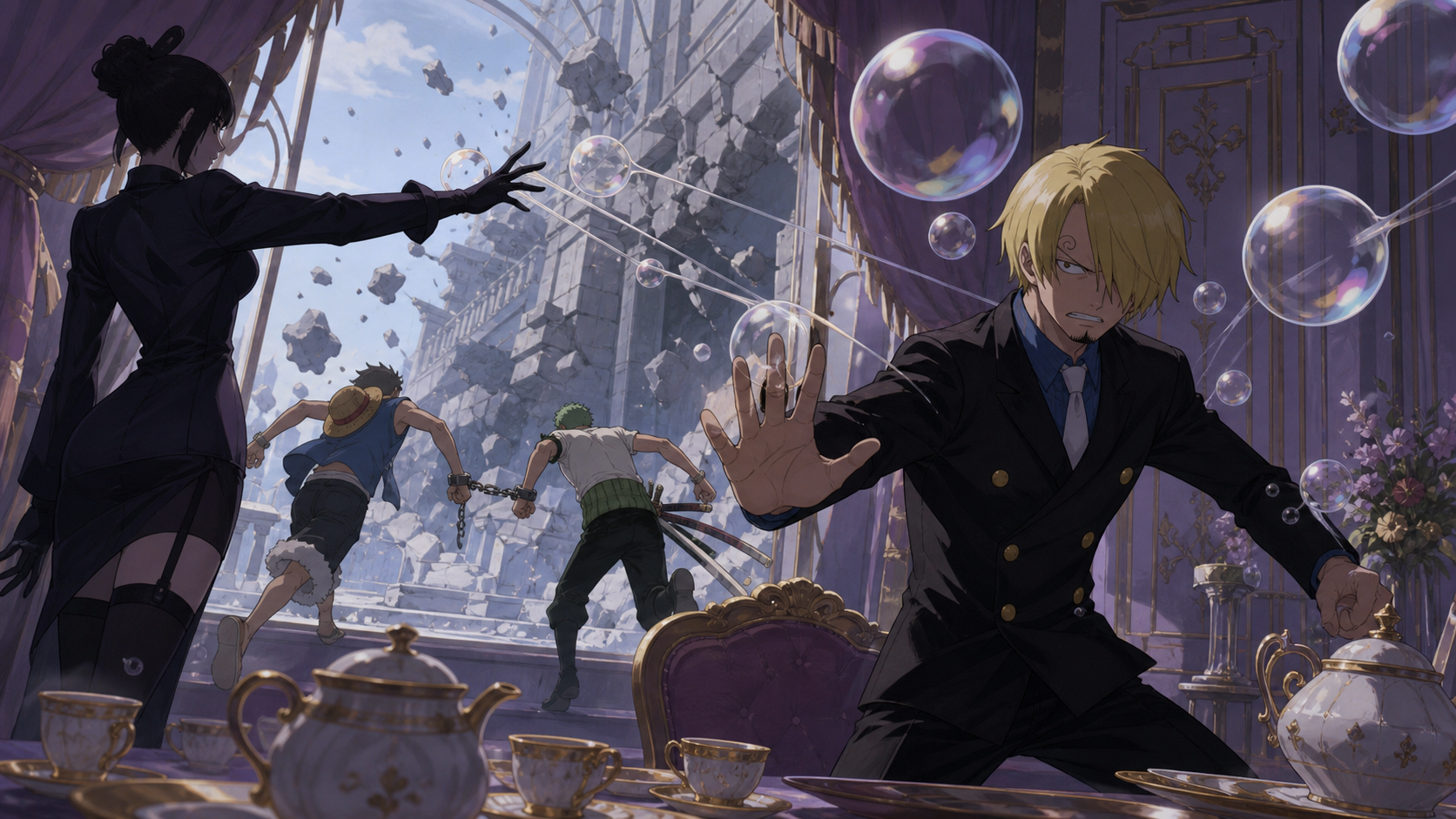
RaeRae Reacts · One Piece Episode 287
Sanji’s Chivalry Leaves Nami Holding the Consequences
One Piece Episode 287 makes Sanji’s refusal to strike Kalifa a mission failure that costs Robin time and transfers the fight to Nami.
The short version
One Piece Episode 287 turns Sanji’s refusal to strike women into a visible mission failure. Kalifa defeats him, the key remains out of reach, and Nami has to take over a fight Sanji entered but would not finish. Meanwhile Zoro and Usopp remain chained together against Kaku and Jabra. The rescue keeps moving, but only because other people absorb the consequences of Sanji’s rule.
I am not calling that romantic. I am not calling Kalifa protected. She made choices, holds power, and participates in Robin’s captivity. Sanji denies her equal accountability, then leaves a woman he loves to solve the danger.
Sanji loses before Kalifa wins
The decisive obstacle is not Kalifa’s physical superiority. Sanji enters the room unable to imagine a form of victory compatible with his rule. He can dodge, posture, flirt, and endure damage, but every path stops before meaningful resistance.
That is why the defeat feels different from losing to a stronger opponent. Sanji chooses the boundary knowing Robin is being dragged toward the Gates of Justice. The choice may be sincere. Sincerity does not remove impact.
A code is not automatically ethical because sacrifice follows
Sanji is willing to suffer for his belief. Many viewers read that willingness as proof of honor. Sacrifice can prove commitment without proving that the commitment is just. People endure pain for harmful ideas every day.
The ethical question is not whether Sanji means what he says. The question is who pays. Sanji takes the beating. Robin loses time. Nami inherits the fight. The crew carries another injured member. Kalifa keeps the key until someone else intervenes.
Kalifa’s agency disappears inside Sanji’s fantasy
Kalifa chose CP9. She uses violence professionally. She helped infiltrate Water 7, participated in Iceburg’s attempted assassination, and stands between Robin and freedom. Sanji’s rule reduces all of that history to one category: woman.
That reduction is not respect. Respect would mean believing Kalifa capable of moral responsibility, tactical danger, and defeat. Sanji instead treats gender as a permanent exemption from the consequences he would impose on any male agent performing the same work.
Nami reads the wreckage immediately
Nami does not need a lecture to understand what happened. She sees Sanji injured, identifies the matchup failure, and redirects the plan. Her response combines anger, care, and efficiency. Robin still needs the key, so Nami cannot spend the episode comforting Sanji’s intentions.
This is the invisible labor women often perform around a man’s celebrated principle. Nami translates the failure into action. She manages the emotional reality, the tactical problem, and the physical danger while the narrative still gives Sanji language associated with nobility.
Trust does not mean pretending every choice was good
The Straw Hats love one another fiercely. That bond allows criticism rather than forbidding criticism. Nami can understand Sanji’s history and still call the present result unacceptable. Compassion does not require falsifying the receipt.
Fandom should offer characters the same complexity. Loving Sanji does not require calling this moment a win. A flaw becomes meaningful when the audience can name harm without exiling the person from affection.
The title frames failure as knightly virtue
The episode title celebrates Sanji’s chivalry before viewers see the operational cost. That framing matters. Language can romanticize a decision by moving attention from the endangered people toward the purity of the decision-maker.
RaeRae’s editorial voice has no obligation to repeat the title’s verdict. The scene belongs to the text; interpretation belongs to the critic. My reading centers Robin’s deadline, Nami’s added labor, and Kalifa’s denied agency.
Zoro and Usopp expose a healthier kind of dependence
Zoro and Usopp hate their handcuffed condition, but neither can solve the physical problem alone. Their forced partnership is humiliating and useful. They argue while searching for a route that preserves both lives.
Unlike Sanji’s rule, their constraint was imposed from outside. The pair responds by adapting together. That contrast sharpens the episode: one problem forces cooperation, while one personal code forces redistribution without consent.
Jabra weaponizes lies because trust already hurts
Jabra understands that the Straw Hats arrive with emotional fractures from Water 7. Deception works best when a lie attaches to an existing fear. He does not need a believable moral identity. He needs one second of hesitation.
Usopp’s presence matters here. His separation from the crew, Sogeking performance, and uncertain place make manipulation especially cruel. CP9 uses information as another martial technique, striking relationships where bodies are harder to reach.
Kaku keeps inventing inside an absurd body
Kaku’s giraffe form refuses to settle into one predictable technique. That improvisation mirrors the Straw Hats at their best. The difference lies in purpose. Kaku adapts to enforce captivity. The crew adapts to restore Robin’s choice.
Zoro cannot dismiss a ridiculous opponent. The long neck, shifting center of gravity, and unexpected reach turn comedy into geometry. Every joke creates another angle a swordsman must read.
Enies Lobby measures values through consequences
The arc keeps converting beliefs into material outcomes. Luffy declares war and creates a rescue path. Robin says she wants to live and gives the coalition a shared destination. Franky burns the blueprints and removes government access. Sanji refuses to kick Kalifa and leaves the key behind.
Intent matters, but consequence completes the meaning. Episode 287 becomes stronger when viewers resist the invitation to evaluate Sanji only by how beautifully he suffers.
The performance makes pain real without settling the argument
Hiroaki Hirata gives Sanji’s refusal emotional conviction. That performance explains why the character believes the rule. Explanation is not absolution. A compelling delivery can make a bad decision understandable while the decision remains bad.
Akemi Okamura gives Nami the clarity the scene needs. Her concern does not erase irritation. Her irritation does not erase love. The emotional mix feels like family dealing with a predictable failure during the worst possible emergency.
Adaptation structure gives the failure room
Writer Ryo Suga and director Munehisa Sakai allow the Kalifa sequence to land before shifting the board. The episode does not need a finishing move. The changed matchup is the consequence.
Masayuki Takagi’s animation direction keeps physical damage visible enough that Sanji’s choice cannot float away as abstract gallantry. Nami finds a body on the floor, not a slogan.
RaeRae’s final reaction
Episode 287 is not Sanji at his most romantic. This is Sanji choosing a gender rule over the rescue plan and trusting the women around him to clean up the result. I love the character. I reject the framing.
Nami’s response saves the episode from becoming worshipful. She recognizes his limit, refuses to waste more time, and steps into danger with clear eyes. Robin needs a key, not a performance of purity. That is the standard I am carrying into the next fight.
Episode facts and receipts
One Piece Episode 287 aired in Japan on November 26, 2006. ONE PIECE.com credits Ryo Suga for the script, Munehisa Sakai for direction, Masayuki Takagi as animation director, and Miyuki Sato with Kumiko Chida on art. The episode belongs to the Enies Lobby CP9 battle sequence.
Classification: numbered television episode, manga-canon Enies Lobby material, RaeRae React. This record belongs in Anime, Anime Series, Japanese Anime, and Anime Reacts. This record does not belong in Anime Reviews.
Protection without consent becomes control
Sanji’s rule assumes every woman benefits when he refuses to fight her. Kalifa never asks for that protection. Nami never asks to inherit the consequences. Robin never asks for her rescue to slow so one man’s code can remain untouched. The rule claims to center women while excluding every woman from the decision.
Consent changes the ethical frame. Protecting a person from danger they reject can become paternalism. Exempting a perpetrator from accountability because of gender can become condescension. Episode 287 shows both problems while still using the language of chivalry.
Sanji has nonviolent skills and still fails to build a plan
Refusing a kick does not automatically require standing in place until defeat. Sanji is fast, perceptive, physically strong, and gifted at infiltration. He could attempt restraint, environmental disruption, escape with information, or an immediate call for a different matchup. None promises success, but each would treat Robin’s deadline as part of the moral calculation.
The failure is therefore larger than one prohibited action. Sanji enters without a contingency because he assumes his familiar performance will control the encounter. Kalifa refuses the script. Once flirting fails, he has no ethical backup plan.
Kalifa understands the advantage and uses that advantage
Kalifa does not become less capable because she exploits Sanji’s hesitation. Combatants identify constraints. CP9 built an entire operation around Robin’s fear of endangering others. Using a predictable boundary is consistent with their work.
The troubling part belongs to the story’s gender frame, not Kalifa’s tactical intelligence. She recognizes that Sanji will not answer force with force and proceeds. Treating her exploitation as unfair would repeat the same denial of agency. She is responsible for the violence she chooses and effective because she reads him correctly.
Nami’s anger is a form of care
Nami does not abandon Sanji because he failed. She also does not soften the truth until the emergency feels comfortable. Anger communicates that his life matters, Robin’s life matters, and his predictable limit endangered both.
Found family needs this kind of honesty. Endless reassurance would leave the same danger waiting for the next crisis. Nami’s response says that love can include a demand for better judgment.
Robin’s absence should sharpen the critique
Robin cannot enter the room and debate Sanji’s rule. She is handcuffed and moving toward disappearance. That absence creates a responsibility for the rescue team to evaluate choices from her position.
Centering Robin changes the question from “Did Sanji remain true to himself?” to “Did Sanji’s action improve Robin’s chance to live?” The first question produces a heroic answer. The second produces a failure. Both can be emotionally true, but only one centers the person being rescued.
The crew survives because Nami can specialize differently
Nami is not a replacement Sanji. Her strengths do not imitate his. She reads atmosphere, manipulates distance, studies opponents, and turns environmental information into force. A good crew does not keep backup copies of the same fighter.
That difference means transferring the matchup also changes the fight’s language. Kalifa will face analysis and weather rather than a cook’s kicks. The correction works because Nami brings another system of knowledge, not because any woman can mechanically substitute for any man.
Gender politics do not disappear inside a beloved gag
One Piece frequently uses Sanji’s behavior for comedy. Repetition can make a pattern feel exempt from analysis. Familiarity is not innocence. The same joke can land differently when the plot attaches a woman’s execution deadline.
RaeRae editorial work should preserve affection without surrendering judgment. I can laugh at Sanji’s theatrical panic elsewhere and still refuse romance around this result. Tone changes with stakes.
What accountability could look like after Enies Lobby
Accountability would begin with naming the transferred cost. Sanji does not need to become cruel toward women. He needs strategies that do not leave friends carrying danger he could predict.
That may mean retreating sooner, communicating the limitation before assignments, developing restraint methods, or trusting women enough to follow their lead without casting himself as protector. Growth can preserve care while discarding the part that turns care into hierarchy.
RaeRae’s notebook after Nami takes over
The most generous reading says Sanji cannot violate a lesson tied to Zeff, hunger, survival, and identity. I understand that reading. The honest reading must add that Robin and Nami receive the consequences. History explains why a person freezes. History does not make the frozen moment harmless.
Nami walking up those stairs is the episode’s answer. She does not have time to wait for a perfect man or a corrected ideology. She sees the hole in the rescue plan and fills the hole. My applause belongs to her clarity.