RaeRae Reacts · One Piece Episode 286
Kaku and Jabra Turn Zoan Power Into a CP9 Ego Contest
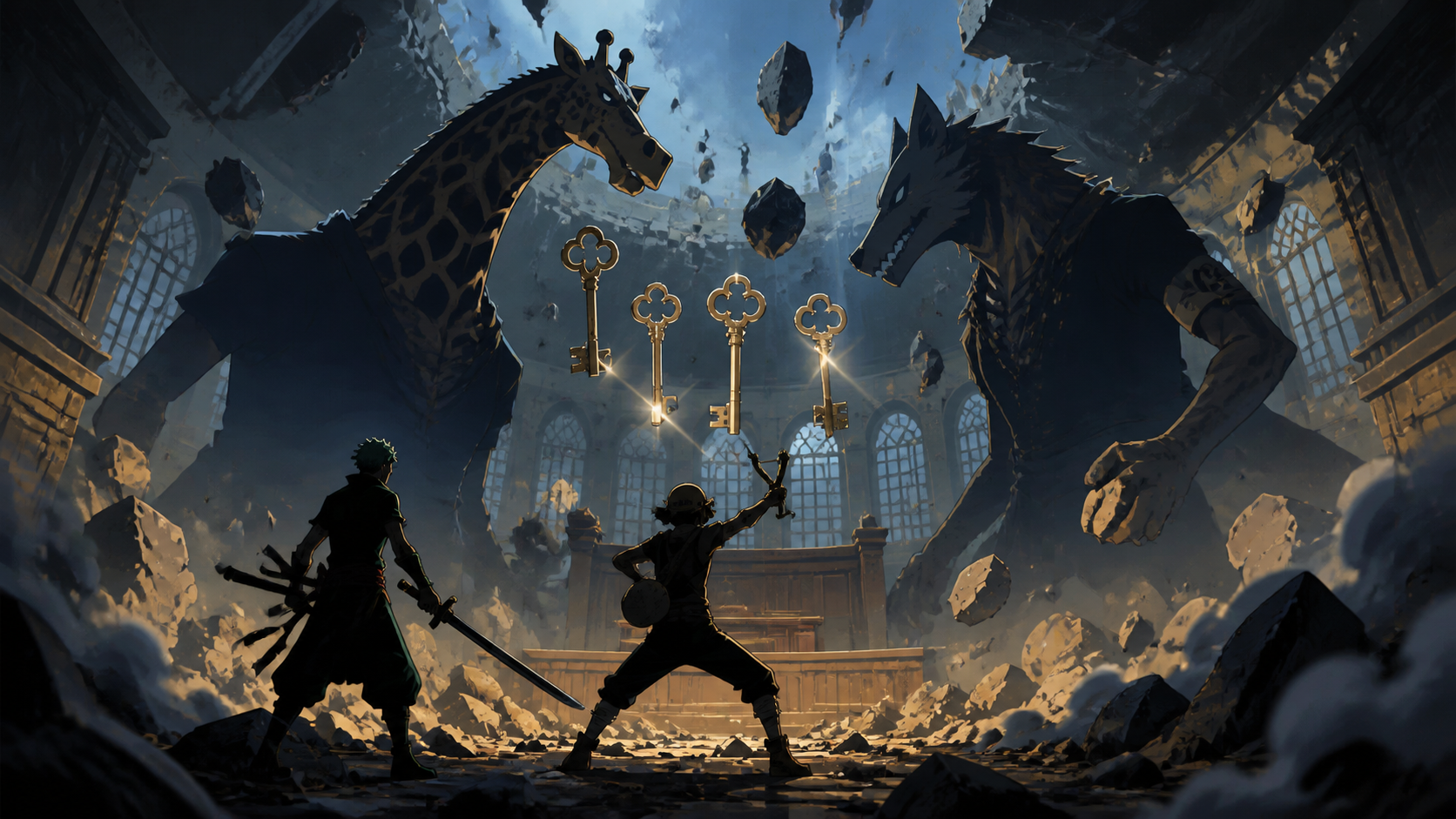
One Piece Episode 286 reveals Kaku’s giraffe and Jabra’s wolf forms while Zoro, Usopp, and Sanji enter matchups designed around their limits.
The short version
One Piece Episode 286 lets Kaku and Jabra unveil their Zoan forms, and the result is equal parts dangerous, ridiculous, and revealing. Kaku becomes a giraffe, Jabra becomes a wolf, and CP9 immediately turns transformation into another internal ranking contest. Zoro and Usopp are still handcuffed together while Sanji reaches Kalifa. Nobody receives a clean matchup because Enies Lobby has no interest in making rescue work convenient.
The comedy lands because Kaku cannot control the room’s reaction to his new body. The danger remains because awkwardness does not cancel skill. That combination is pure One Piece: a visual gag can make me laugh and still carry a blade.
Kaku wanted majesty and received a giraffe
Kaku approaches his new Devil Fruit with the confidence of a man expecting an impressive predator. The long neck arrives like a personal insult. Zoro does not allow one second of dignity to survive, and Jabra happily joins the mockery even though a rescue battle is underway.
That reaction exposes how much CP9 invests in image. Their black suits, code names, rankings, and secret techniques produce an aura of controlled menace. A giraffe body punctures the brand. Kaku can still be lethal, but he cannot dictate how everyone reads him. Power does not guarantee coolness.
The joke never makes Kaku harmless
Some anime comedy pauses danger until the punchline ends. Episode 286 refuses that separation. Kaku experiments while attacking, using reach, mass, and strange geometry as weapons. His embarrassment becomes irritation, and irritation feeds invention.
Zoro recognizes the threat beneath the absurd shape. That response matters. Laughing at an enemy is not the same as underestimating him. Zoro can mock Kaku’s neck and still watch every angle. The episode lets humor belong inside competence instead of forcing viewers to choose one.
Jabra performs certainty because insecurity is louder
Jabra receives the wolf form he believes a killer deserves. He looks at Kaku’s transformation and instantly uses that contrast to reinforce his own status. The need to announce superiority tells the truth before any Doriki number can. Secure people rarely spend this much energy narrating their rank.
CP9 encourages this behavior. Agents compare power, techniques, prey, and proximity to leadership. Cooperation exists because orders demand cooperation, not because trust binds the group. Their competition makes them formidable individuals and a brittle collective.
Zoan forms make personality visible
A Devil Fruit does not replace character. The transformation amplifies what a fighter already brings. Kaku treats the unfamiliar body as an engineering problem. Jabra treats the wolf as proof that his preferred self-image was correct. One adapts through experimentation. The other performs dominance.
That distinction gives two animal transformations different dramatic jobs. Kaku’s giraffe opens possibility. Jabra’s wolf confirms expectation. Both can hurt people, but only one forces the user to revise his understanding of himself in real time.
Zoro and Usopp remain the worst possible two-person puzzle
The handcuffs reduce two independent fighters to one badly coordinated unit. Zoro needs space, balance, and control of his swords. Usopp needs distance, sightlines, and freedom to improvise. The chain punishes both specialties while forcing physical cooperation between men whose Water 7 conflict still has emotional residue.
The gag works because neither man becomes stupid. Their abilities genuinely clash under the constraint. Every attempt to solve one problem creates another. Enies Lobby keeps asking whether the crew can translate loyalty into practical coordination, and the answer cannot arrive through declarations alone.
Usopp is not dead weight attached to Zoro
Power-scaling language can flatten this sequence into a strong fighter burdened by a weak one. That reading ignores what Usopp contributes across the rescue: information, range, deception, courage under terror, and the ability to reach people a sword cannot reach. The handcuff problem limits his tools; the problem does not define his value.
Zoro’s frustration is funny, but the story has already proved that brute force cannot solve Robin’s crisis by itself. One Piece crews survive through uneven skills. A hierarchy based only on direct combat would reproduce CP9’s worldview with friendlier faces.
Sanji reaches a matchup built around his blind spot
Sanji enters Kalifa’s room with confidence shaped by a rule he treats as sacred: he will not strike a woman. The rule sounds noble in isolation. Enies Lobby refuses isolation. Robin is moving toward the Gates of Justice. Nami and the others are fighting for keys. Every minute has a body attached.
Kalifa is not a civilian trapped in crossfire. She is an armed CP9 agent participating in kidnapping, torture, and an illegal state execution. Refusing to recognize her as a responsible combatant does not honor her agency. The choice protects Sanji’s self-concept while transferring risk to women he claims to protect.
Chivalry becomes a luxury paid for by the crew
A personal boundary is personal only when the consequences remain personal. Sanji’s rule changes the labor assigned to everyone around him. Somebody else must defeat Kalifa. Somebody else must retrieve the key. Somebody else must spend time recovering from whatever happens after he refuses effective resistance.
The series can love Sanji and still let viewers criticize this failure. Fandom does not require defense counsel behavior. Character flaws matter because beloved people can carry values that sound beautiful and function badly under pressure.
The episode builds battles through incompatibility
Great ensemble fights are not random name draws. Each matchup should expose a skill, fear, prejudice, or relationship. Kaku’s geometry challenges Zoro’s spatial control. The handcuffs challenge Zoro and Usopp’s ability to cooperate. Kalifa challenges Sanji’s gender rule before her new powers even define the fight.
Episode 286 therefore works as more than a transformation showcase. The episode arranges conflicts around what each Straw Hat cannot comfortably do. Victory will require changed tactics, rescued partners, or an admission that a cherished rule has failed the mission.
Adaptation choices keep the animal reveal alive
Scriptwriter Hirohiko Uesaka and director Yoshihiro Ueda balance exposition, comedy, and threat. The audience needs to understand two new Devil Fruits without turning the episode into a catalog. Reaction timing does much of that work. Faces and pauses explain the emotional meaning before combat explains the mechanics.
Kenji Yokoyama’s animation direction gives Kaku’s shape enough weight to preserve danger. A giraffe rendered only as a joke would drain the coming fight. A giraffe rendered only as menace would betray the scene’s comic intelligence. The visual work holds both.
RaeRae’s final reaction
Episode 286 makes me laugh at Kaku and worry about everybody facing him. That balance is harder than the episode makes the work look. The giraffe reveal attacks CP9’s cultivated cool while showing why adaptable fighters remain frightening.
The Sanji setup lands differently. I know the series wants romance around his rule. I see a crew paying the bill. Kalifa’s gender does not erase her choices, and Robin’s life cannot wait for Sanji’s self-image to remain spotless. Episode 287 needs to face that consequence honestly.
Episode facts and receipts
One Piece Episode 286 aired in Japan on November 19, 2006. ONE PIECE.com credits Hirohiko Uesaka for the script, Yoshihiro Ueda for direction, Kenji Yokoyama as animation director, and Miyuki Sato with Michiyo Kawasaki on art. The episode belongs to the Enies Lobby CP9 battle sequence.
Classification: numbered television episode, manga-canon Enies Lobby material, RaeRae React. This record belongs in Anime, Anime Series, Japanese Anime, and Anime Reacts. This record does not belong in Anime Reviews.
Why CP9’s rankings cannot predict this room
Doriki offers a clean number for physical force, and clean numbers are comforting to organizations that want authority to look scientific. The measurement does not account for a swordsman’s ability to read unfamiliar geometry, a sniper’s capacity to improvise under panic, or a new Zoan user’s learning curve. Episode 286 places all three omissions in one room.
Kaku ranks highly and gains more physical power, yet transformation also introduces variables he has never trained. Zoro faces a stronger body with unstable technique. Usopp appears weakest by CP9’s metric while carrying the creative thinking most suited to a problem no manual anticipated. The number remains factual within narrow boundaries and misleading beyond them.
Kaku’s experimentation resembles shipwright thinking
Kaku spent years working around ships, structures, measurements, and movement. His first response to the giraffe body is not surrender. He tests leverage. He changes angles. He learns what the neck, legs, and mass can do while Zoro is trying to cut him.
That practical curiosity connects Kaku to the Water 7 identity he used as a disguise. A cover maintained for years can still shape habits. CP9 asks agents to become other people, then assumes no part of the performance becomes real. Kaku’s delight in ships and his engineering response to transformation make that assumption harder to defend.
Animal symbolism refuses a simple moral code
Wolves carry familiar associations with predation. Giraffes arrive with gentler cultural assumptions. Episode 286 refuses to let the animal decide the ethics of the user. Jabra looks like the expected killer, while Kaku remains fully capable of state violence inside an animal shape viewers may consider harmless.
The same refusal appears across One Piece. Bodies do not reveal moral worth. A frightening appearance can hold tenderness. A polished uniform can hide cruelty. A ridiculous transformation can serve oppression. Judgment has to return to action.
Sogeking gives Usopp room without removing Usopp
The mask lets Usopp enter Enies Lobby after declaring that he left the crew. Everybody understands the fiction at a different level, yet the fiction creates enough emotional distance for him to act. Being chained to Zoro threatens that fragile construction because escape and performance both become impossible.
Zoro does not need to expose him verbally. The battle exposes dependence physically. Sogeking cannot operate as an untouchable hero from a distant tower. Usopp’s body remains inside the mask, afraid and necessary. The episode keeps that contradiction alive rather than rushing toward reconciliation.
Sanji confuses a lesson with a universal law
Zeff’s influence explains Sanji’s rule. Explanation gives the belief history, affection, and emotional force. A childhood lesson can save a boy in one context and fail adults in another. Growth requires deciding whether inherited rules still protect the people they claim to protect.
Kalifa’s room is the test. She is not asking Sanji to surrender his tenderness toward women. She is using lethal authority to stop Robin’s rescue. Effective defense does not require hatred, humiliation, or misogyny. Sanji treats all force as equivalent because his code offers no vocabulary for accountable resistance.
The crew’s diversity should challenge inherited rules
Living with Nami and Robin should complicate any belief built around women as a protected category. Both women make strategic decisions, survive violence, commit violence, and carry responsibility for others. Neither fits a decorative ideal.
A found family matters partly because new relationships can revise old lessons. If the crew only confirms everything each member believed before joining, companionship becomes applause instead of transformation. Episode 286 opens a painful opportunity for Sanji to learn from women he actually knows.
What this episode contributes to Robin’s rescue
Robin barely controls the screen, yet every matchup derives urgency from her movement. That narrative structure matters. The story does not need to cut back to her suffering every minute to justify attention. The crew carries her declared wish into separate rooms.
Episode 286 contributes knowledge: the enemy’s new forms, the crew’s bad pairings, Sanji’s limit, and the tactical cost of the handcuffs. Progress is not only distance toward a gate. Understanding the shape of failure is part of building the next workable plan.
RaeRae’s notebook after the reveal
I keep returning to the laugh Kaku cannot control. CP9 stole years from Water 7 while performing competence, loyalty, and ordinary community. One giraffe neck breaks the performance’s cool surface. The man underneath still has talent, vanity, curiosity, and a job built around hurting people for the state.
That mixture is more interesting than a sleek villain reveal. I do not need Kaku to look majestic. I need the fight to show what he does when control disappears. Episode 286 gives him an absurd body and asks whether adaptability can preserve authority. Zoro’s answer is going to arrive through steel.