RaeRae Reacts · One Piece Episode 285
CP9 Hides Robin’s Freedom Inside a Five-Key Hunt
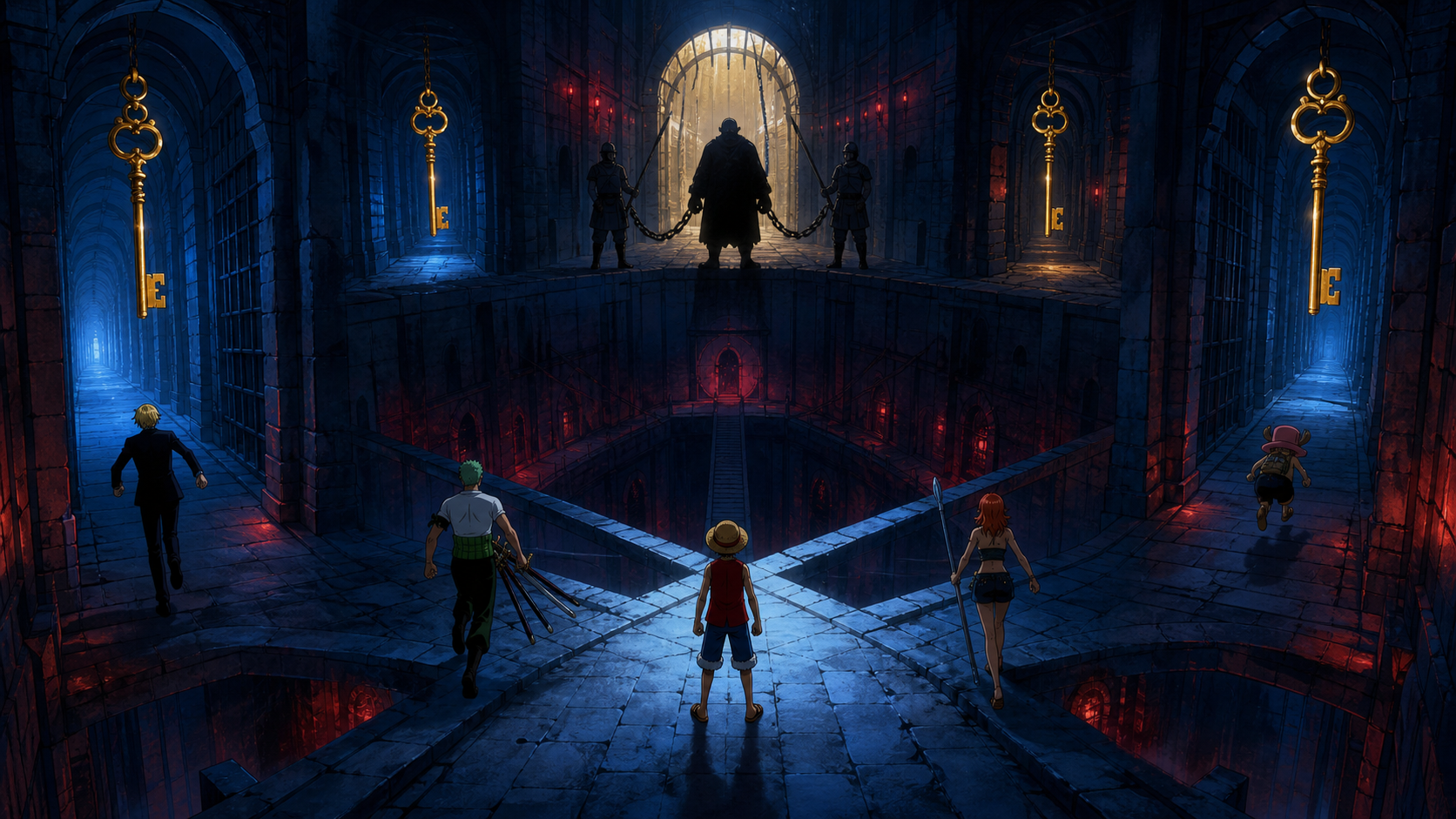
One Piece Episode 285 splits the Straw Hats across the judicial tower after CP9 makes every agent a possible holder of Robin’s handcuff key.
The short version
Episode 285 turns Robin’s rescue into a five-key hunt, and CP9 converts uncertainty into a weapon before the first proper matchup even settles. Spandam leads Robin toward the Gates of Justice. Fukurou announces that one of five agents holds the correct handcuff key. The Straw Hats split because defeating everyone is suddenly the only reliable search method.
This setup is smart, cruel, and extremely government. The keys create a procedural problem around a human emergency. CP9 does not merely guard Robin. The agents force rescuers to spend time, bodies, and attention inside a system designed by the captor.
Five keys turn uncertainty into control
If the crew knew who held Robin’s key, they could concentrate force. CP9 removes that knowledge. Each opponent becomes mandatory because any opponent may carry the answer. The tactic distributes risk and prevents the Straw Hats from choosing the most efficient route.
Uncertainty becomes more powerful than a simple locked door. A door has one location. The correct key may move, fight, lie, or fall somewhere unreachable. Fukurou enjoys explaining the trap because explanation does not reduce the advantage. Knowing the rules only confirms how thoroughly CP9 controls the board.
Robin’s handcuffs are more than metal
Sea-Prism Stone suppresses Devil Fruit abilities, but the handcuffs also perform institutional ownership. Robin can walk, speak, remember, and resist emotionally while the state controls what her body can do. Spandam treats that limitation as proof of authority.
The key hunt exposes the difference between legal custody and justice. Enies Lobby contains courts, agents, gates, and official chains. None of those structures produced a fair process for Robin. Procedure becomes theater arranged after the verdict. The handcuffs make a predetermined outcome look orderly.
The crew splits because time has a destination
Spandam is moving Robin toward the Gates of Justice. The threat therefore has direction and a deadline. The crew cannot clear rooms leisurely or recover between every fight. Losing wastes time Robin does not possess. Episode 285 makes victory operational rather than decorative.
That urgency changes how matchups feel. Each Straw Hat brings different skills, injuries, and emotional pressure. Splitting multiplies vulnerability, yet staying together guarantees delay. The decision shows trust through separation. Crew members accept that friends will fight beyond immediate help because every route serves the same rescue.
CP9 turns people into job functions
The agents present themselves through Doriki rankings, Rokushiki techniques, animal forms, and assigned authority. Their organization encourages comparison through measurable combat power. Such measurement looks objective and hides everything excluded from the number: judgment, loyalty, imagination, medical knowledge, navigation, and the capacity to disobey an immoral order.
Spandam sits above stronger agents despite laughable personal combat ability. That fact destroys any claim that CP9 operates as a pure meritocracy. Power ranking governs subordinates while political connection governs leadership. The strongest bodies enforce decisions made by one of the weakest men.
Fukurou tells the truth for cruel reasons
Fukurou’s zipper-mouth joke turns secrecy into character design. He reveals information compulsively, yet the five-key announcement remains strategically useful. Truth can harm when delivered inside a controlled trap. Transparency alone does not create fairness.
The scene is funny because Fukurou treats lethal procedure like gossip. The humor also reveals CP9 culture. Violence becomes workplace routine. Robin’s life becomes a game condition. Agents discuss keys and matchups while the person inside the handcuffs disappears beneath logistics.
Luffy’s role narrows as everyone else’s expands
Luffy cannot solve every CP9 fight and still reach Robin in time. The captain’s job becomes forward pressure. Other crew members must claim opponents, keys, routes, and consequences. Enies Lobby is strongest when the narrative makes that distribution visible.
A weak hero story would let supporting characters delay enemies until Luffy arrives. Episode 285 establishes separate responsibilities. Zoro’s sword work, Nami’s analysis, Sanji’s infiltration instincts, Chopper’s body knowledge, and Usopp’s range are not decorations around the captain. They are the rescue architecture.
Nami asks the question underneath the fight
Nami’s practical thinking matters whenever the crew receives incomplete information. She does not need the most powerful attack to influence the plan. She tracks constraints: five agents, five keys, one deadline, multiple routes. Her mind converts panic into tasks.
That labor often receives less celebration than a finishing blow because planning does not always produce one screenshot. The hub should resist that bias. Episode Reacts need to name who interprets the situation, who carries information, who notices costs, and who keeps the crew’s emotional declaration attached to a usable route.
The key hunt repeats Robin’s lifelong problem
Robin has spent years treated as the key to forbidden history. Episode 285 literalizes the metaphor around her body. Five physical keys circulate among agents while the government drags the archaeologist toward a gate. Everyone wants access. Almost nobody in authority asks what Robin wants opened.
The Straw Hats distinguish themselves by treating the key as a tool for restoring choice. They do not want her knowledge extracted, controlled, or destroyed. They want the cuffs removed so Robin can decide what happens next. Same object, different politics.
Sanji’s matchup already carries a warning
Episode 285 begins distributing opponents, and Sanji’s path toward Kalifa exposes a rule he refuses to question. His prohibition against striking women will soon collide with Robin’s deadline and Nami’s safety. The rule is framed as honor. The consequences fall on other people.
Respect cannot mean denying a woman’s agency as an opponent while allowing her to hurt friends without effective resistance. Kalifa chose CP9, uses lethal force, and participates in Robin’s captivity. Treating her as untouchable does not liberate her from sexism. The rule places Sanji’s self-image above the mission.
Keys, locks, and manufactured scarcity
CP9 possesses the means to remove Robin’s cuffs and fragments access across five bodies. That arrangement creates scarcity by design. Nothing natural requires the rescue to work this way. The captor builds the obstacle, then lets the rescuers appear desperate and chaotic while responding.
Institutions use similar tactics whenever basic access depends on opaque procedures, multiple approvals, missing documents, or officials who each control one piece. The suffering person becomes responsible for navigating complexity created by power. Episode 285 turns that bureaucratic violence into an action-story mechanism.
Adaptation structure and battle anticipation
Scriptwriter Naoki Koga and director Takahiro Imamura handle a transition episode. The installment must explain the key system, move Robin, split the crew, establish matchups, and preserve urgency without resolving major fights. Such episodes can feel like furniture moving. Episode 285 avoids the worst version because every setup detail changes the rescue plan.
Kazuya Hisada’s animation direction keeps character movement and spatial clarity important. Viewers need to understand who enters which corridor and why separation matters. Enies Lobby’s tower can become visual soup quickly. Clear staging protects the tactical argument.
Japanese performances sell CP9’s workplace cruelty
Kumiko Watanabe gives Fukurou comic rhythm without making the information harmless. The agent sounds delighted by a system that forces desperate people into fights. That delight belongs beside Spandam’s smug authority and Robin’s controlled fear.
The Straw Hat performances carry another register: urgency expressed through familiar personalities. Nobody becomes a generic soldier because the plot enters battle mode. Their differences remain audible, which keeps the split from reducing the crew to interchangeable combat units.
RaeRae’s final reaction
Episode 285 is setup, but setup does real work. The five keys give every fight a shared purpose while preserving individual character stakes. Robin keeps moving toward the gate. The crew cannot afford ornamental battles. Every opponent may hold freedom in a pocket.
I also see the trap beneath the fun matchup board. CP9 controls information, procedure, architecture, and time. The Straw Hats respond with trust distributed across people the government would never rank correctly. One side has a bureaucracy. The other has a crew. The coming fights will test which structure adapts when the plan starts breaking.
Episode facts and receipts
One Piece Episode 285 aired in Japan on November 12, 2006. ONE PIECE.com lists Naoki Koga as scriptwriter, Takahiro Imamura as episode director, Kazuya Hisada as animation director, and Miyuki Satō with Kumiko Fukuzawa on art. The episode draws from manga chapters 400 through 409 and begins the official CP9 battle grouping within the larger Enies Lobby story.
Classification: numbered television episode, manga-canon Enies Lobby material, RaeRae React. The record belongs in Anime, Anime Series, Japanese Anime, and Anime Reacts. The record does not belong in Anime Reviews.
The key game punishes cooperation by consuming time
CP9 cannot stop the Straw Hats from caring about Robin, so the agents make care expensive. Every teammate must accept a separate fight. Every wrong key consumes energy and minutes. Every injury reduces the strength available for escape. The system weaponizes the crew’s refusal to abandon her.
That tactic resembles collective punishment. Robin’s friends become targets because they contest the state’s claim. The government can then point to the resulting destruction as evidence that pirates create chaos. Episode 285 keeps the causal chain visible: CP9 builds the trap, moves the prisoner, scatters access, and forces the rescue into violent corridors. The crew responds to manufactured conditions.
Five opponents do not create five equal fights
Doriki encourages viewers to arrange CP9 into a simple strength ladder. The Straw Hats cannot choose matchups through numbers alone. Location, Devil Fruit abilities, weapons, injuries, temperament, and moral rules reshape every encounter. Sanji may physically outclass an opponent and still lose because his own prohibition controls his actions. Nami may rank lower in direct force and win through analysis of a power system.
The episode therefore sets up an argument against single-number evaluation. Institutions love metrics because metrics make people easier to deploy. Real conflict breaks the model. Adaptation, imagination, and willingness to change matter after the first collision reveals what the metric ignored.
Robin’s deadline is designed to prevent reflection
Spandam keeps moving because reflection threatens obedience. If Robin receives time with the crew, the coercive bargain may collapse. If agents question the mission, Ohara’s official story may crack. If Oimo and Kashii compare the government’s claim with the truth, their loyalty changes. Speed serves the institution by keeping everyone inside assigned information.
The Straw Hats need speed for the opposite reason. They race to create a pause in which Robin can choose. Same urgency, different purpose. Spandam wants the Gates of Justice to make her disappearance irreversible. The crew wants the cuffs removed so no institution speaks through her body.
Procedure can hide personal cowardice
Spandam rarely performs the difficult work himself. He points to rules, agents, chains, and superior orders. Procedure gives his private cruelty a public costume. If challenged, he can claim that the organization required the outcome. Episode 285 shows how cowardice scales when bureaucracy distributes each harmful action across separate workers.
One agent carries a key. Another escorts Robin. Another guards a corridor. Another reports orders. Each task looks smaller than the final violence. Together the tasks produce disappearance. The key hunt forces viewers to reconstruct the whole system, just as the Straw Hats must fight through every compartment.
The crew’s split is a trust exercise with actual consequences
Found family sounds easy when everyone stands in one heroic line. Episode 285 asks whether trust survives closed doors. Crew members cannot monitor every fight or approve every decision. They believe the others will keep moving, obtain keys, and ask for help when possible.
That trust is not blind certainty that nobody will fail. Sanji fails against Kalifa. Zoro and Usopp become handcuffed together. Chopper will push his body past safe control. Trust means the group can adapt around failure without converting failure into disposability. CP9 ranks agents. The Straw Hats redistribute work.
Nami’s planning deserves the same dramatic weight as combat
When Nami parses the key problem, she performs intellectual triage. Which facts are certain? Which statements come from an enemy? Which risks can the crew accept? Which route reaches Robin before the gate? Her analysis shapes every later victory even when another character lands the loudest hit.
A directory built to CVM Sekai standards should name that labor because fandom summaries often erase women between signature attacks. Nami is not simply present at Enies Lobby. She translates a coercive puzzle into actionable choices, then enters her own dangerous matchup. Strategy and courage occupy the same body.
Why the official key might still be another lie
Fukurou announces that one of the five keys opens Robin’s cuffs, but CP9 has already demonstrated comfort with deception. The crew cannot verify the claim without fighting and testing. The possibility of another lie increases pressure even if the statement proves true.
This is how captured institutions damage information itself. A truthful statement from CP9 remains difficult to trust because the organization uses truth selectively. Credibility is a relationship built through accountable behavior, not a reward automatically granted by uniforms or access to facts.
The coming matchups reveal each character’s limits
Episode 285 promises action, but thels also forces each Straw Hat into a moral and practical boundary. Zoro must fight while trapped beside Usopp. Sanji must confront the cost of a gender rule he treats as as identity. Nami must decode a power designed to humiliate and immobilize. Chopper must decide how far medicine can justify self-harm. Franky must fuel a mechanical body during a rescue.
Those limits matter more than clean victory. ICONIC-style Reacts should ask what a fight exposes about a character, not only who won. CP9’s key system becomes a sequence of personality tests because freedom sits behind every opponent.
The Gates of Justice turn distance into dread
The gate functions before Robin reaches that structure. Every mention creates a countdown. Enies Lobby already pretends that justice occurred. Crossing the gate would move Robin beyond even the thin visibility of the island. The government converts architecture into inevitability.
Luffy’s crew attacks that feeling as much as the physical route. Their presence says no corridor, office, bridge, or gate becomes destiny merely because authority designed the building. Episode 285 makes that refusal practical. Five keys, five agents, one moving prisoner, and no spare time remain.