RaeRae Reacts · One Piece Episode 284
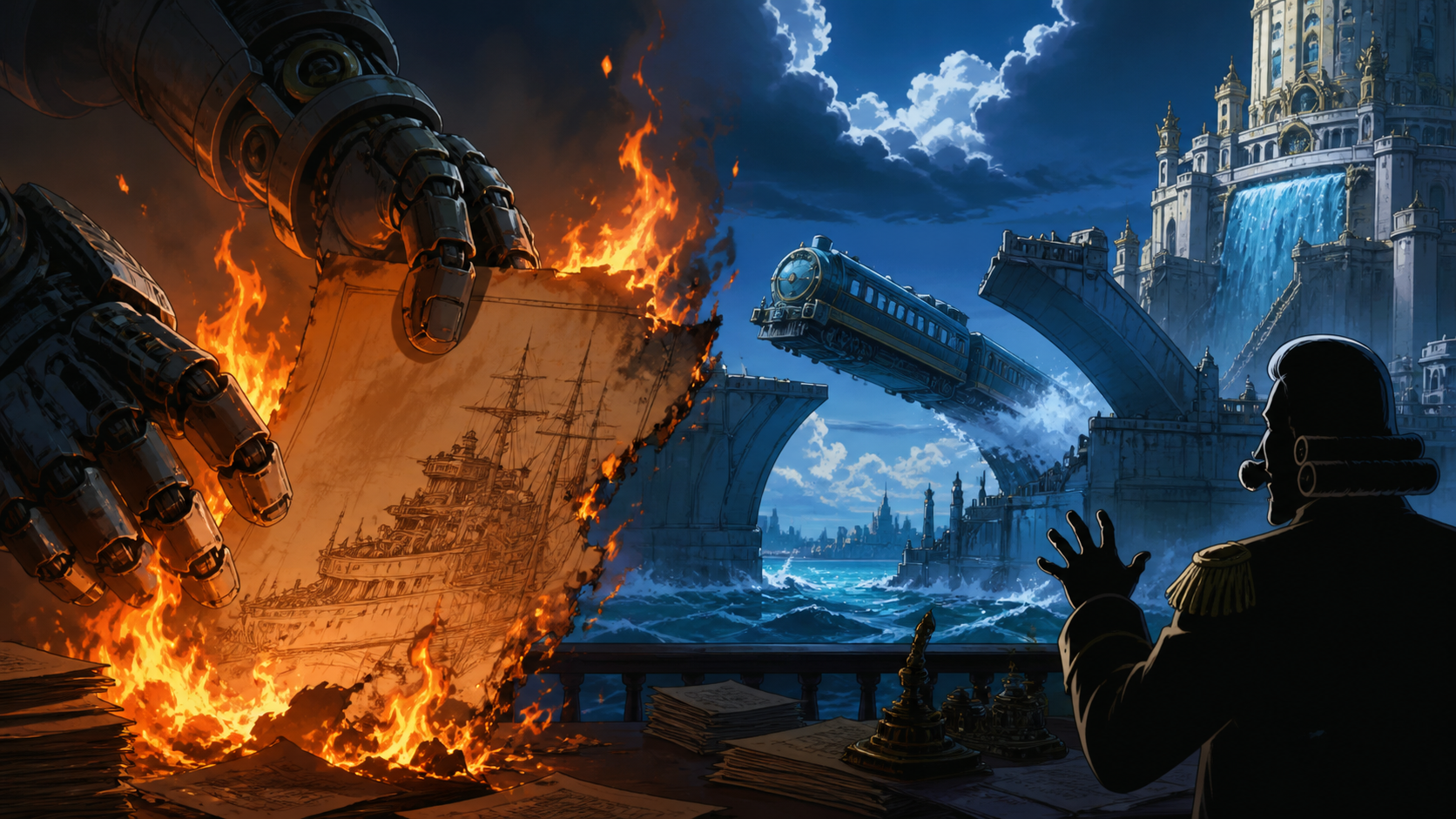
Franky Burns the Future Spandam Wanted to Steal
One Piece Episode 284 puts Pluton’s blueprints in Franky’s hands, then lets him deny Spandam the weapon and choose Robin’s rescue.
The short version
Episode 284 finally releases the pressure built across five recap broadcasts, and Franky answers government power with the most responsible act of destruction in the room. He burns Pluton’s blueprints in front of Spandam, not because knowledge has no value, but because the government has proved what kind of value those plans would hold in its hands. Then Rocketman flies through a broken drawbridge because this rescue has never respected normal transportation.
I needed movement after Episodes 279 through 283. The anime owed the audience movement. Episode 284 delivers fire, machinery, commitment, and one enormous entrance. More importantly, the episode turns Franky from a reluctant ally guarding inherited responsibility into a person actively choosing Robin and the Straw Hats over the safety logic that controlled his life.
Franky does not burn history
The distinction matters. Tom gave Franky the Pluton plans so another weapon could be built if the ancient Pluton ever returned. The blueprints function as a countermeasure, a technical archive, and a burden passed through shipwright generations. Burning them is not equivalent to the World Government burning Ohara’s library. Ohara was destroyed so authority could monopolize the past. Franky destroys a weapons design so authority cannot manufacture catastrophic force in the present.
Both acts involve fire and forbidden knowledge. Their politics point in opposite directions. The government removes public capacity to question power. Franky removes government access to a weapon. Any analysis that celebrates all destroyed documents equally misses who controls the information, who faces the threat, and what the information enables.
A blueprint is not morally neutral once Spandam enters the room
Technical knowledge can serve construction, deterrence, coercion, defense, profit, or mass death. The page does not decide the purpose alone. People, institutions, incentives, and material conditions decide. Spandam wants Pluton because possession would magnify his authority. He has already shown casual cruelty, cowardice, contempt for subordinates, and a talent for turning institutional language into personal permission.
Franky does not trust a better supervisor to arrive later. He judges the institution through the people and methods currently carrying its flag. That choice is radical because the plans once protected the world through potential balance. Burning them ends one line of deterrence. Franky accepts that cost because the immediate path to government weaponization has become too dangerous.
Tom’s inheritance was always about responsibility
Tom teaches Franky that a shipwright must love whatever ship he builds, even when other people use that ship badly. The lesson never means consequences disappear. Franky’s Battle Frankys helped Spandam frame Tom, and that wound drives years of guilt. Creation cannot control every future use, yet creators still live with what their work makes possible.
The Pluton decision brings that argument back without offering an easy answer. Keeping the plans preserves a counterweapon and creates a theft target. Destroying the plans prevents theft and removes a contingency. Franky chooses under pressure, with incomplete information, while Robin’s life hangs beside the calculation. Responsible action often looks less like certainty and more like accepting which risk one refuses to transfer to everyone else.
Spandam loses the object and misunderstands the person
Spandam treats Franky as a container. First he wants the blueprints hidden inside the cyborg body. Then he treats Robin as a key capable of activating ancient history. Both people become delivery systems for state ambition. Their consent never enters his equation. That reduction explains why Franky’s theatrical burn hurts him beyond the lost paper. A person he classified as inventory makes a choice he cannot reverse.
The scene also exposes Spandam’s dependence on institutional power. He does not win loyalty, build technology, read the poneglyphs, or defeat strong opponents. He acquires authority by standing inside a bureaucracy and directing people with greater skill. Franky’s fire strips away one asset and leaves the hollowness visible.
Franky chooses Robin before joining the crew
Found-family stories become cheap when every bond arrives after a formal membership ceremony. Franky acts before Luffy offers him a place. He understands Robin’s persecution because the same government destroyed Tom, criminalized Water 7’s shipwright work, and turned technical creation into evidence for a predetermined verdict.
Shared enemies alone do not create trust. Franky has fought Luffy, stolen money from Usopp, and helped escalate Water 7’s internal disaster. The relationship changes through action. He protects Robin’s future and destroys the leverage CP9 wanted from him. The crew, in turn, treats his body and knowledge as his own rather than government property.
Rocketman refuses respectable entry
The sea train launch gives the episode the physical release missing from the recap block. The drawbridge stops halfway. A normal vehicle would stop. Rocketman interprets the broken route as a ramp. Kokoro, Iceburg’s workers, the Franky Family, and the Straw Hats turn damaged infrastructure into collective momentum.
That image fits the arc. Enies Lobby presents itself as permanent order: gates, towers, courts, uniforms, ranks, official routes. The rescue coalition keeps converting those structures into unintended tools. Roofs become roads. bridges become launch points. giants become allies after receiving the truth. Institutional design cannot guarantee obedience once people understand the lie holding the design together.
The entrance belongs to more than the Straw Hats
Luffy’s crew receives the heroic framing, but Episode 284 keeps the wider coalition visible. Galley-La workers carry loyalty to Iceburg and Water 7. The Franky Family follows a boss the city calls criminal. Oimo and Kashii change sides after learning the government deceived them. Kokoro drives a prototype sea train into a war zone with grandchildren and companions aboard because One Piece has never met a safety guideline that could survive friendship.
That coalition prevents the rescue from becoming one captain’s private spectacle. Government violence crossed multiple communities. Resistance therefore arrives through multiple grievances, skills, and relationships. Some allies want Robin saved. Some want Franky returned. Some want answers for giants. Some refuse to let CP9 define justice. Their routes converge without erasing their reasons.
Robin watches somebody destroy the government’s preferred future
Robin has spent twenty years believing her knowledge makes everyone around her vulnerable. Franky carries knowledge that could make the entire world vulnerable. His response is not self-erasure. He chooses what to do with the knowledge, destroys the physical plans, and remains present to face the consequence.
The comparison offers Robin another model. Dangerous knowledge does not automatically make the knower guilty. Institutions seeking control create much of the danger. Franky can reject the government’s use without accepting the government’s story about his right to exist. Robin can do the same, though decades of persecution make that emotional move much harder than one burning page.
Ancient weapons, deterrence, and the question the episode cannot settle
The blueprint burn feels righteous because Spandam is obviously unfit to hold power. The longer political question remains uncomfortable. If ancient Pluton exists and hostile actors awaken that weapon, the countermeasure is gone. Franky makes a local decision with global consequences because every available option contains catastrophe.
One Piece works best when freedom carries such costs. A simpler series would label the plans evil and finish the discussion. Episode 284 preserves ambiguity. Knowledge can protect by existing. Knowledge can endanger by becoming stealable. Destruction can resist tyranny. Destruction can reduce future defense. RaeRae does not need a tidy answer to recognize why Franky chooses fire in that room.
Adaptation and pacing after the recap wall
Director Hiroyuki Kakudō and animation director Eisaku Inoue handle an episode carrying both ideological decision and large mechanical payoff. The visual rhythm must sell paper burning as irreversible, then expand the frame for Rocketman’s launch. The contrast works because the first act concentrates power in Franky’s hand while the second act distributes movement across the rescue coalition.
The return to present action also exposes how long the five-week recap interruption lasted. Episode 284 feels faster partly because the preceding broadcasts stood still. That relative speed should not receive unearned praise. The episode succeeds through decisive staging, clear objectives, and consequences that change the available future.
Kazuki Yao gives Franky weight beneath the volume
Franky’s performance lives at maximum volume so often that quieter conviction can surprise viewers. Kazuki Yao lets bravado remain part of the character without making bravado the whole character. The blueprint scene needs confidence, grief, and finality. Franky knows what Tom entrusted to him. He also knows Spandam helped turn Tom’s creations into a death sentence.
The delivery refuses Spandam’s framing. Franky is not a thug destroying something beyond his understanding. He is a shipwright making an informed technical and moral decision. The body Spandam treats as a hiding place becomes the body controlling the archive’s fate.
RaeRae’s final reaction
Episode 284 gives me the thing I wanted after five recaps: a choice that cannot be undone. Franky burns the plans. Rocketman flies. The coalition breaches the tower. Every beat moves Robin’s rescue forward while deepening the argument about knowledge and control.
I love the scene because destruction serves responsibility rather than tantrum. I also refuse the easy claim that destroying knowledge is always brave. Context makes the act. Franky denies a violent institution access to a weapon, accepts the lost countermeasure, and stays to help the person that institution turned into another key. That is commitment with a receipt.
Episode facts and receipts
One Piece Episode 284 aired in Japan on November 5, 2006. ONE PIECE.com lists Hirohiko Uesaka as scriptwriter, Hiroyuki Kakudō as episode director, Eisaku Inoue as animation director, and Miyuki Satō with Fumihiro Uchikawa on art. The episode adapts material within manga chapters 389 through 399 and closes the official Episode 264 through 284 Enies Lobby grouping before the CP9 battle grouping begins.
Classification: numbered television episode, manga-canon Enies Lobby material, RaeRae React. The record belongs in Anime, Anime Series, Japanese Anime, and Anime Reacts. The record does not belong in Anime Reviews.
Franky refuses the fantasy of a harmless creator
Creators often defend themselves by separating intention from use. A shipwright builds a vessel; a captain decides whether that vessel carries food or cannons. An engineer designs a system; an institution decides whether the system serves people or monitors them. Tom’s lesson asks Franky to love the created object without pretending the creator can govern every future action. Episode 284 pushes one step further. Sometimes a creator or custodian still controls access, and access becomes the last meaningful ethical decision.
Franky cannot undo the Battle Frankys that Spandam used against Tom. He can decide whether Spandam receives Pluton. Burning the plans does not cleanse guilt or restore Tom. The act converts memory into a boundary. Franky refuses to repeat passive faith that a powerful tool will somehow avoid powerful abusers. That refusal feels earned because Water 7 has shown the cost of leaving consequences outside the design conversation.
The body holding the plans also belongs to Franky
Franky hides the blueprints inside his modified body, which makes custody physically personal. Government agents search, capture, beat, and transport him because they assume his body contains something the state may claim. The same arc treats Robin’s mind as state property because she can read the poneglyphs. CP9’s logic turns bodies into locked cabinets.
Both characters answer through bodily autonomy. Franky opens the hiding place only to destroy the state’s desired object. Robin names her wish while handcuffed and physically controlled. Neither choice requires permission from the institution claiming jurisdiction. Episode 284 therefore connects weapon politics with personhood. A government willing to treat people as storage will never become a trustworthy guardian of what those people know.
What the flames cost the future
RaeRae criticism should stay present even during a satisfying rebellion. The blueprint burn removes a government target and also removes options from people not present in the room. Future generations cannot study, secure, or reproduce the countermeasure Tom’s predecessors preserved. Franky makes that decision alone because the capture leaves no time for consensus.
The scene works because the cost remains real. Heroism without loss would turn the fire into a visual flourish. Franky chooses one danger over another: the uncertain future danger of an awakened Pluton without a matching design, versus the immediate danger of Spandam and CP9 acquiring construction knowledge. Viewers can support his judgment without pretending the choice solves ancient-weapons politics forever.
Rocketman carries Water 7 into Enies Lobby
The rescue coalition does not arrive in a generic vehicle. Rocketman carries Tom’s engineering history, Kokoro’s experience, Iceburg’s city, Galley-La labor, and Franky’s extended family into the government stronghold. The train becomes a moving archive of people Spandam tried to divide and classify.
That history makes the launch more than spectacle. Water 7 was nearly destroyed by lies around Iceburg, Robin, and Franky. Now workers and outlaws occupy the same train because the deception has been exposed. Truth does not automatically repair relationships, but truth makes cooperation possible. Rocketman’s broken entry turns repaired trust into physical force.
A shipwright chooses what deserves to survive
Franky burns one design while fighting to save one archaeologist. The contrast rejects any rule that preservation is always moral or destruction is always immoral. Pluton’s plans enable a weapon. Robin’s knowledge enables historical understanding. The World Government tries to preserve weapon access and destroy the reader. Franky reverses the priority.
That reversal contains the episode’s sharpest political statement. Human life and agency outrank state appetite for technical domination. Knowledge deserves context, and preservation deserves a purpose. Franky does not hate blueprints. He loves building enough to understand that some construction paths should close when every available custodian seeks mass power.