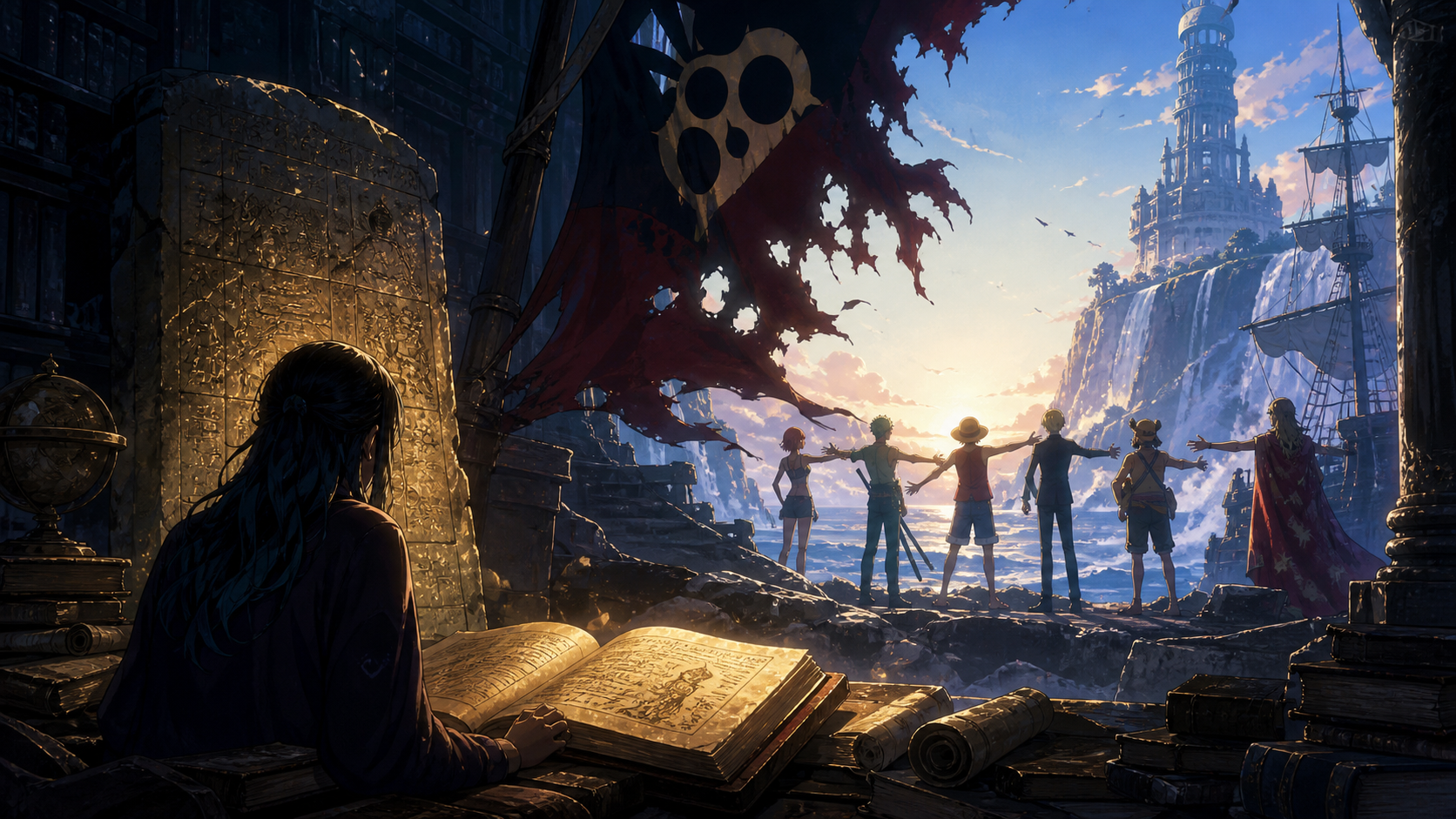
RaeRae Reacts · One Piece Episode 283
Robin’s Past Is the Government’s Crime Scene
One Piece Episode 283 returns to Robin’s life in hiding and exposes how the World Government manufactured the isolation that uses against her.
The short version
Episode 283 makes Robin’s recap the final file because her past is not background decoration,that is the prosecution’s entire excuse and the reason her choice to trust the crew costs so much.
By the fifth recap, patience is not a renewable resource. I wanted the bridge, the keys, CP9, and consequences. Instead, the anime returns to Robin’s twenty years of flight. This one at least sits directly on the nerve of the current conflict. The World Government built a child into a global warning label, then used the isolation that caused as proof that she could never belong anywhere.
What this recap is actually doing
Ohara, Saul, the scholars, the bounty, and the betrayals explain why Robin treats attachment as a countdown. Every community can become a target. Every ally can decide the reward is safer than loyalty. Her intelligence does not protect her from that lesson; that helps her document every repetition. The recap asks the audience to feel how radical “I want to live” is after survival taught her not to want anything aloud.
Robin’s history is not simply sad. that is political. A government destroys knowledge, kills witnesses, criminalizes a child, controls the public story, and lets the bounty poster perform decades of propaganda. Calling her a demon is cheaper than admitting Ohara frightened the state because researchers could read what power buried.
The choice that matters now
The Straw Hats do not rescue Robin by proving her useful. They already know she is brilliant, dangerous, funny, private, and essential. They rescue her because she is Robin and because she finally names the future she wants. That distinction protects the found-family argument from becoming another employment contract with better snacks.
Spandam calls state violence justice because the building says court and the flag says government. Robin’s memories expose the fraud. Ohara received punishment before any honest hearing, and Robin’s life became a sentence without end. The crew’s declaration of war is theatrical, but the state declared war on her childhood first. The flag only makes the existing conflict visible.
Adaptation, pacing, and the awkward truth
Of the five recap episodes, this one has the strongest present-tense justification and the least excuse for treating reused footage lazily. The material is devastating because the original flashback was specific, not because recap automatically equals depth. Editing that keeps returning us to Robin’s face at Enies Lobby strengthens the argument. Long uninterrupted replay weakens that.
The bonus comedy sits strangely beside genocide, persecution, and suicidal resignation. That discomfort is real. that also reflects the series’ refusal to let trauma own every register forever. I can respect the instinct while questioning the placement.
RaeRae’s final reaction
Episode 283 does not move Robin closer to the ship in physical distance. that makes clear how far she had to travel internally to ask for the ship at all. I remain annoyed that five weeks of climax became recap programming. I am not confused about why Robin closes the set: her history is the receipt showing that this rescue challenges an entire political system, not one bad boss with a stupid haircut.
Episode facts and receipts
One Piece Episode 283 aired in Japan on October 29, 2006. The official ONE PIECE.com episode record classifies that inside the Enies Lobby story and identifies that as a recap installment. That distinction matters: this React judges how the anime reframes established material at this exact rescue-story pressure point rather than pretending the flashbacks are new plot.
Classification: numbered television episode, recap-heavy anime-original presentation, RaeRae React. that belongs in Anime and Japanese Anime, and that does not belong in Anime Reviews.
Ohara was an information-control operation
The Buster Call kills people, destroys buildings, burns books, and turns an island into a warning. Physical destruction is only half the operation. The World Government also controls the explanation. Scholars become demons. Research becomes a threat to ordinary safety. A child survivor becomes criminal evidence rather than evidence of state violence.
Robin’s bounty poster keeps that explanation circulating long after the smoke clears. Every person who sees her receives a number and a label before receiving her story. The state outsources surveillance to civilians, pirates, bounty hunters, and frightened communities. Persecution becomes self-maintaining because the reward system makes betrayal look practical.
A child learns to become useful before becoming visible
Robin survives by reading rooms, organizations, power structures, and exit routes. Intelligence becomes armor. She joins groups without expecting permanence and offers skills valuable enough to delay betrayal. Such survival is not coldness by nature. Such survival is adaptation under repeated threat.
The Straw Hats disrupt the pattern because they want more than her labor. They enjoy her strange humor. They trust her knowledge. They make space for privacy while still noticing absence. The crew can be intrusive and chaotic, but their attachment is not based solely on what archaeology produces for Luffy’s route.
That distinction makes Enies Lobby dangerous for Robin in a new way. Losing transactional allies confirms an old rule. Losing people who know her and still choose her would destroy the fragile exception she has started to believe. Surrender becomes an attempt to control the timing of loss and preserve the exception through disappearance.
Saul’s promise was not sentimental decoration
Jaguar D. Saul tells Robin that nobody is born to be alone and that friends will appear somewhere on the sea. The promise can sound painfully optimistic beside a world willing to hunt an eight-year-old. Robin’s adulthood does not prove Saul wrong. Her adulthood shows how much organized violence can delay a humane prediction.
The Straw Hats become evidence after years of counterevidence. That timing matters. Robin does not distrust love because she failed to appreciate kindness. She distrusts love because experience repeatedly punished attachment. Episode 283 should never frame her hesitation as a personal flaw that Luffy’s enthusiasm cures in one afternoon.
The government creates the danger used to isolate Robin
Spandam argues that Robin’s existence endangers everyone nearby. The claim contains a twisted factual surface: government forces really will attack her associates. The missing clause is responsibility. Robin does not generate the violence. The government chooses violence, then points to the threatened consequences as proof that she must surrender.
This logic appears whenever abusive power says compliance is the only way to keep loved ones safe. The threat becomes natural weather rather than a deliberate decision by people with names, budgets, weapons, and authority. Enies Lobby rejects that framing. The crew identifies the aggressor and returns responsibility to the institution making the threat.
Burning the flag makes an existing war visible
Luffy’s order to Sogeking does not begin conflict with the World Government. Ohara already proves the government’s willingness to wage war on knowledge and children. Robin’s lifelong pursuit proves the conflict never ended. The burning flag refuses the polite fiction that only one side has escalated.
Symbols matter because institutions use symbols to turn local violence into universal authority. The flag tells citizens, agents, judges, and soldiers that every government action represents legitimate order. Burning that symbol cannot dismantle the institution, but the act publicly rejects the legitimacy claim around Robin’s destruction.
The scene also depends on Usopp. The crew member most anxious about personal power performs the long-distance shot that announces war. Luffy names the decision, but collective capability makes the declaration real. One Piece loves captain mythology while repeatedly showing that captains cannot execute their myths alone.
Robin’s wish must remain hers
Rescue narratives can become another form of control when heroes decide what a suffering person should want. Enies Lobby avoids that trap at the critical moment by requiring Robin’s voice. The crew confronts the lies around her, demonstrates commitment, and asks for the desire hidden beneath coerced surrender.
“I want to live” does not create an obligation to become cheerful, grateful, or permanently available. Survival can contain fear, anger, privacy, relapse, and ambivalence. The wish only establishes that Robin wants a future. The crew’s job is to help protect access to that future, not author every page.
Why a fifth recap still frustrates me
Robin’s history carries the strongest connection to the present conflict, but emotional relevance does not erase broadcast rhythm. Viewers waited through four previous recap installments. The climax remains suspended. A production decision can contain thoughtful thematic arrangement and still damage momentum.
The best recap editing makes old footage answer a new question. Episode 283 approaches that goal because every betrayal, bounty, and flight explains the difficulty of Robin’s public wish. The weakest editing simply replays tragedy and expects pain to deepen through repetition. Trauma is not seasoning. More screen time does not automatically create more respect.
Yuriko Yamaguchi keeps Robin from becoming a symbol only
Robin carries enormous themes: forbidden history, genocide, state propaganda, archaeology, loneliness, and chosen family. A performance can drown beneath that symbolic weight. Yuriko Yamaguchi protects the person through restraint, dry humor, measured speech, and the fractures that appear when control stops working.
The recap reminds viewers that Robin’s calm has never meant absence of feeling. Calm is a practiced surface. At Enies Lobby, the voice moves from defensive certainty toward a wish that sounds almost physically torn from years of suppression. That performance keeps the scene from becoming a slogan detached from the woman saying the words.
RaeRae’s placement verdict
Episode 283 belongs in the numbered archive as a recap-heavy React with explicit context. Robin’s history cannot be omitted from the Enies Lobby argument. The five-episode scheduling block also cannot be praised as clean pacing. Honest fandom holds both conclusions.
The episode’s central receipt remains devastating: Robin was never dangerous in the way the government claimed. She was dangerous to a political story because she could read another story buried underneath. The state created a lonely fugitive, called that loneliness proof of guilt, and expected everyone else to accept the file. The Straw Hats reject the file and choose the person.
Archaeology threatens convenient innocence
Historical power depends on selective memory. Governments celebrate victories, rename violence, classify documents, and teach later generations a story that makes current authority look inevitable. Robin’s ability threatens that process because the poneglyphs preserve testimony outside the approved archive. The stones cannot be easily revised by a press office or frightened witness.
That does not mean every forbidden fact automatically produces justice. Knowledge requires interpretation, distribution, and people willing to act. Robin’s work matters because she combines language skill with a stubborn desire to know what happened. The World Government responds by criminalizing the question. Ohara shows that censorship escalates when ordinary secrecy can no longer contain evidence.
Living after the declaration
“I want to live” is a beginning, not a cure. Robin still carries habits built across two decades. She will withhold information, calculate exits, and expect danger to follow attachment. The crew cannot erase that history through one rescue. They can repeatedly prove that conflict, fear, and usefulness do not determine whether she belongs. Episode 283 matters when the recap makes the scale of that ongoing work visible. The declaration opens a future where trust can become practice instead of miracle.
Watch notes for Episode 283
Episode 283 needs the clearest content warning in the five-part set because Robin’s memory file returns to genocide, childhood persecution, repeated betrayal, and a state campaign designed to erase history. Those events are not generic sadness. Every scene should be read alongside the World Government’s present claim that Robin creates danger. The government created the danger, distributed the bounty, taught the public the demon label, and punished anyone who interrupted the story. Robin’s survival techniques make sense inside that machinery. Her wish to live therefore does more than complete a character arc. The wish rejects the identity written for her by an institution with global reach. The recap block remains a pacing wound, but Robin’s installment supplies the political receipt the rescue cannot do without.
The archive owes Robin precision
A complete hub must distinguish canon event, recap construction, production choice, political reading, and RaeRae’s judgment. Blending those categories would repeat the same problem Robin faces: somebody with authority writes a convenient file and expects the label to replace the person. Precision is not coldness here. Precision is respect.