RaeRae Reacts · One Piece Episode 278
Robin Finally Gets People Strong Enough to Hear That She Wants to Live
One Piece Episode 278 connects Saul’s promise, Kuzan’s compromised mercy, Robin’s child bounty, the burning flag, and her demand to return to sea.
Bottom line: Robin does not discover a desire to live; she finally gets people strong enough to hear the truth
One Piece Episode 278 earns one of anime’s most quoted lines by showing every force that trained Nico Robin to deny the line. Ohara burns. Jaguar D. Saul dies buying her a path. Kuzan lets her escape without offering a home. The government places a bounty on an eight-year-old and teaches every future companion to calculate her value against the danger of keeping her.
Twenty years later, Luffy does not hand Robin hope like a gift. The Straw Hats destroy the government’s claim to speak for them, accept the consequences of loving her, and demand the desire beneath her surrender. “I want to live” becomes possible because Robin is finally speaking to people who will not turn the answer into another weapon.
Episode facts and production credits
Episode 278 aired in Japan on September 24, 2006, as part of the same broadcast production block as Episode 277. Hirohiko Kamisaka wrote the screenplay. Takahiro Imamura and Yoshihiro Ueda directed, Takeo Ide and Naoki Tate served as animation directors, and Miyuki Sato, Kumiko Fukuzawa, and Kunihiro Chida handled the art direction.
The episode finishes Robin’s Ohara memory and returns to the two rooftops at Enies Lobby. That structure lets childhood evidence answer the present confrontation directly. Robin’s refusal stops looking mysterious once viewers have watched the government build the refusal year by year.
Saul understands that escape requires emotional instructions, not only a boat
Saul helps Robin move away from the destruction, but distance alone will not keep her alive. She needs a reason to continue after losing everyone and everything familiar. He tells her that nobody is born to be alone and that friends who will protect her exist somewhere in the world.
That promise is not a guarantee of immediate kindness. Robin will meet exploitation, betrayal, and fear for years. Saul gives her a direction rather than a timetable. Keep moving long enough for the claim to become testable.
Saul’s laugh becomes survival equipment
Saul asks Robin to laugh even while she cries. The request can sound impossible, but he is not demanding cheerful denial. Their shared laugh gives Robin a recognizable piece of him to carry after his body is gone.
Dereshishishi is awkward, loud, and impossible to polish into solemn heroism. That ugliness helps. Robin can reproduce the sound when grief makes ordinary language unavailable. Memory enters the body through breath and rhythm.
Kuzan freezes Saul while calling the decision justice
Kuzan confronts a former friend who rejected the operation on moral grounds. Freezing Saul completes the institution’s answer to dissent. A vice admiral who refuses extermination becomes another target inside the extermination zone.
Kuzan is not ignorant. He knows Saul, sees Robin, understands the civilian stakes, and participates anyway. Any later mercy must remain beside that responsibility. One compassionate exception does not erase the larger obedience.
Saul spends his final strength making Robin face the future
Saul cannot defeat the fleet or preserve Ohara. He can create minutes, direction, and a belief Robin may need later. His final action stays focused on the child rather than on proving himself heroic.
That focus protects the scene from becoming a grand male sacrifice that sidelines Robin. Saul’s death matters because of what his care enables in her life, not because suffering automatically makes him noble.
The evacuation ship destroys the government’s claim of a controlled operation
Vice Admiral Sakazuki orders the civilian evacuation ship destroyed because a scholar might be hiding aboard. The attack exposes the category “innocent civilian” as temporary. Suspicion removes protection instantly.
Sakazuki calls the massacre necessary to prevent the mission from failing. That reasoning makes certainty irrelevant. A possible scholar becomes enough justification to kill everyone. The government’s objective is not careful justice. The objective is zero surviving risk.
Absolute Justice converts uncertainty into permission for maximum violence
Sakazuki treats any chance of forbidden knowledge escaping as worse than confirmed civilian death. The doctrine places institutional security above human life and rewards the person willing to act without hesitation.
“Absolute” sounds principled until viewers ask who defines justice and who absorbs mistakes. The people ordering the strike do not risk their own families when suspicion proves wrong.
Kuzan lets Robin escape because Sakazuki reveals where obedience ends
The evacuation ship’s destruction and Saul’s stand force Kuzan to confront the operation’s meaning. He creates an ice route and allows Robin to leave. Mercy enters the story through a man who helped enforce the catastrophe.
I do not need to call Kuzan secretly good to recognize the choice. He saves one child after failing many other people. The action matters, the failure remains, and the tension follows him through the series.
Kuzan gives Robin a chance, not safety
Robin leaves Ohara alone with directions and no stable protector. Kuzan does not expose the government, clear her name, provide a trusted adult, or guarantee food and shelter. His mercy is narrow.
That narrowness explains why survival stays brutal. Letting someone live creates responsibility only partially fulfilled when every surrounding system continues hunting the person.
The government turns an eight-year-old survivor into the criminal story
Officials assign Robin a bounty of seventy-nine million berries and accuse her of destroying Marine ships. The lie transforms a child who escaped state violence into the cause of violence. Public fear can then perform the pursuit without needing the full military everywhere.
The amount signals danger, value, and official certainty to people who will never see the evidence. A number becomes propaganda. Strangers learn to interpret Robin’s face through the bounty before meeting her.
The wanted poster makes shelter economically and politically expensive
Anyone who recognizes Robin can collect money, avoid government suspicion, or protect themselves by reporting her. Keeping her creates risk without an obvious reward. The bounty restructures every future relationship before trust begins.
Robin learns to expect hospitality to expire when another person notices the cost. That is why the Straw Hats’ refusal matters. They know the price has grown beyond money and stay anyway.
Years of betrayal teach Robin to leave before affection becomes evidence
Robin moves through organizations that value her skills until pressure arrives. Some people use her. Some fear her. Some may care and still choose self-preservation. Repetition turns Saul’s promise into something that feels increasingly childish.
Her survival strategy becomes departure. She reads the room, predicts betrayal, and leaves enough emotional distance to keep the next loss manageable. The strategy works until a crew refuses to follow the script.
Adult Robin mistakes repeated harm for a law of human nature
After enough betrayals, Robin concludes that nobody will keep choosing her against the World Government. The conclusion is evidence-based but incomplete. Her sample contains people placed under deliberate institutional pressure.
The government wants her to interpret engineered outcomes as natural truth. If every relationship collapses after officials threaten punishment, Robin may decide attachment itself is the problem rather than the punishment.
Luffy asks Robin to separate her desire from the government’s predicted outcome
Robin keeps explaining what will happen if the crew saves her. Luffy asks what she wants. The question interrupts a lifetime spent predicting other people’s fear before naming her own need.
Desire does not guarantee victory. Robin may want to live and still face death. The question matters because the government has been treating its threat as the only legitimate voice in her decision.
The crew accepts risk aloud so Robin no longer has to consent for them
Robin’s surrender rests on the belief that saving the crew requires choosing captivity. The Straw Hats reject that bargain publicly. They decide that fighting the government belongs to them too.
Shared risk changes the ethics of rescue. Robin is not ordering uninformed friends into danger. Informed friends are demanding the right to stand beside her, and they refuse to let Spandam represent their interests.
Luffy tells Sogeking to burn the flag because the symbol is doing real work
The World Government flag tells Robin that the enemy is larger than any person, crew, or island. Luffy understands that her fear attaches to the institution as a whole. He orders Sogeking to shoot the flag.
Destroying cloth does not destroy the government. The action destroys ambiguity. Nobody can describe the rescue as a local disagreement with CP9 after the flag burns over Enies Lobby.
Sogeking’s fire turns Usopp’s distance into exact usefulness
Usopp may be hiding behind a mask, but his skill is fully present. The shot requires range, accuracy, nerve, and trust in Luffy’s decision. Nobody else on the roof can make the same declaration in the same way.
The crew does not need Usopp to resolve every private wound before contributing. Belonging can remain damaged and still produce responsibility. His shot makes that contradiction visible.
Burning the flag answers twenty years of forced neutrality
Robin survived by joining temporary groups without trusting them and by leaving before their conflicts with the government reached open war. The Straw Hats remove the possibility of staying politely outside the issue.
They choose Robin over institutional approval. That choice does not romanticize war. The government had already made her existence a conflict. The flag shot admits the conflict instead of pretending compliance will create peace.
Spandam cannot understand loyalty that does not calculate institutional odds
Spandam believes the government’s size should settle every human relationship. He expects rational people to abandon Robin once the threat becomes explicit. The crew’s declaration looks insane because his worldview cannot measure love, anger, memory, or moral disgust.
His confusion exposes a weakness in authoritarian power. Fear controls people efficiently until someone values another person more than the punishment attached to solidarity.
Robin’s cry contains grief, terror, relief, and an unfamiliar demand
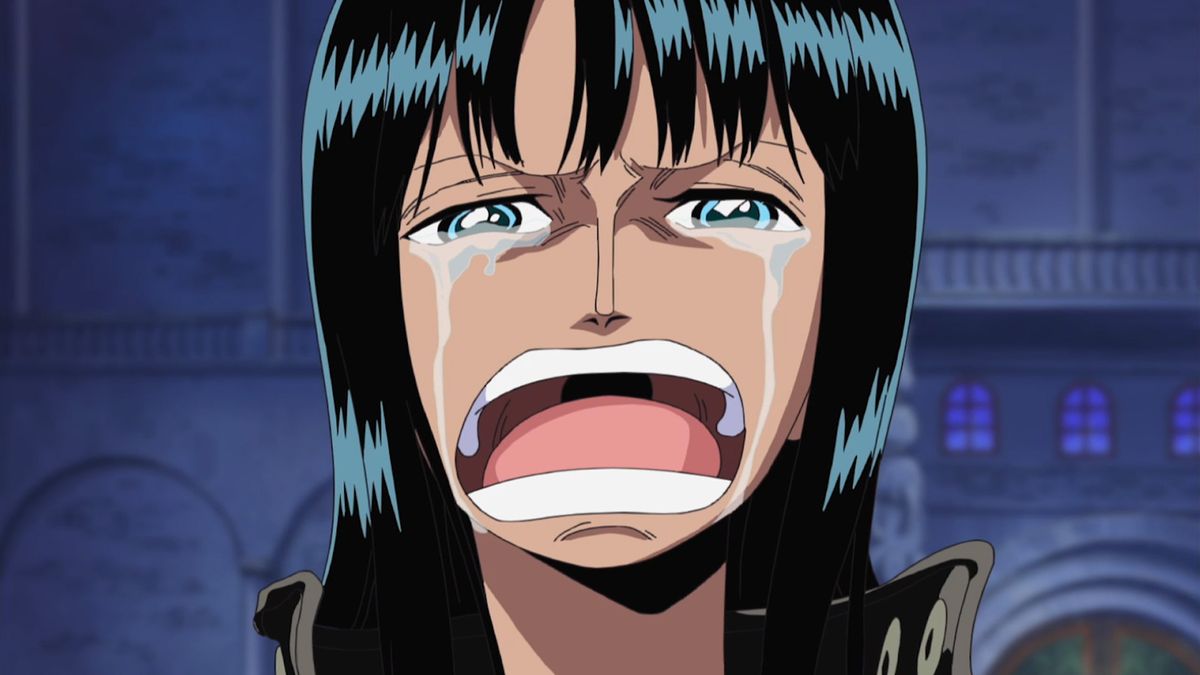
“I want to live” is not a clean victory speech. Robin cries because wanting creates vulnerability. The statement admits that surrender was not desire, that Saul’s promise still matters, and that the crew now has something she is terrified to lose.
She also asks them to take her to sea. Survival needs a destination. Robin does not merely reject death. She names continued life with these specific people.
The line works because Robin says “want,” not “deserve”
Robin does not present a legal defense or prove moral purity. She names desire before settling whether the world considers her worthy. That distinction matters after years of accusations that treated existence as a crime.
A person can want life while carrying guilt, uncertainty, harmful choices, and unfinished relationships. Survival should not require winning an argument about perfection first.
Saul’s promise reaches Enies Lobby through six ridiculous people
Saul told Robin that friends who would protect her existed somewhere. The promise took twenty years, many betrayals, and a pirate crew terrible at ordinary risk management. The delay does not make Saul wrong.
The Straw Hats are not abstract friendship. Each person crossed specific danger, used a distinct skill, and arrived with unresolved problems. The promise becomes credible through labor.
The episode does not cure Robin’s trauma with one declaration
Saying she wants to live changes the immediate choice. The statement cannot remove nightmares, survivor guilt, distrust, grief, or habits built across two decades. Healing will require repeated evidence after the rescue.
That limitation does not weaken the scene. A first honest desire can be decisive without becoming a magical cure. Robin has opened a future where further care becomes possible.
The Japanese performances make the famous line sound physically difficult
Yuriko Yamaguchi lets Robin’s control fracture before the words arrive. Breath, pitch, and crying make the statement feel pulled through resistance rather than delivered for a highlight reel. Mayumi Tanaka’s Luffy stays direct enough to hold the space open.
Kappei Yamaguchi gives Sogeking’s declaration energy without stealing Robin’s scene. Kazuki Yao’s Spandam supplies the contempt that clarifies what the crew rejects. The ensemble builds pressure around one voice.
The direction connects fire across Ohara and Enies Lobby
Fire destroys the Tree of Knowledge in Robin’s past and consumes the government flag in her present. The images are not morally equivalent. One fire erases people and evidence. The other marks refusal against the institution responsible.
Takahiro Imamura and Yoshihiro Ueda use that visual relationship to turn memory into action. Robin cannot undo Ohara, but the crew can answer the meaning the government assigned to the destruction.
The animation keeps Robin’s face more important than the spectacle
Warships, ice, cannon fire, a burning library, opposing rooftops, and a flaming flag could overwhelm the episode. Takeo Ide and Naoki Tate keep returning to Robin’s changing expression.
The scale matters because the pressure is enormous. Her face matters because policy only becomes morally legible when viewers see the person forced to carry the pressure.
“I want to live” is a political statement because the government criminalized her existence
Robin’s desire would be personal under ordinary conditions. The World Government made survival defiant by labeling her existence dangerous. Wanting a future rejects the state’s verdict.
The line does not claim Robin alone can defeat the system. Political meaning grows from collective support. She speaks because others have made room, accepted risk, and aimed fire at the symbol demanding her silence.
RaeRae verdict: the scene is iconic because every earlier wound remains inside the answer
Episode 278 does not earn tears by yelling louder than other episodes. The scene works because Robin’s words contain Ohara, Olvia, Saul, Kuzan, the evacuation ship, the bounty, every betrayal, and every time she left before somebody could sell her. The crew cannot erase those facts. They can stop the facts from deciding alone.
Robin wants to live and go to sea with them. That request is specific, frightened, and unfinished. Perfect hope would feel fake after what she survived. This hope cries, asks for help, and still expects a fight. Good. That sounds like a future a real person might actually enter.