RaeRae Reacts · One Piece Episode 277
Ohara Burns Because the Government Cannot Defeat Its Evidence
One Piece Episode 277 joins Clover’s historical argument, Robin and Olvia’s reunion, archival labor, and the opening Buster Call against Ohara.
Bottom line: Ohara is destroyed because the government cannot win an argument with evidence
One Piece Episode 277 finally shows the Buster Call as more than Robin’s private nightmare. Warships surround Ohara, government agents seize Nico Olvia, Professor Clover explains what the scholars discovered, and cannons begin erasing the people who could prove him right. The violence is enormous, but the motive is embarrassingly small: powerful men are afraid of a historical record they cannot fully control.
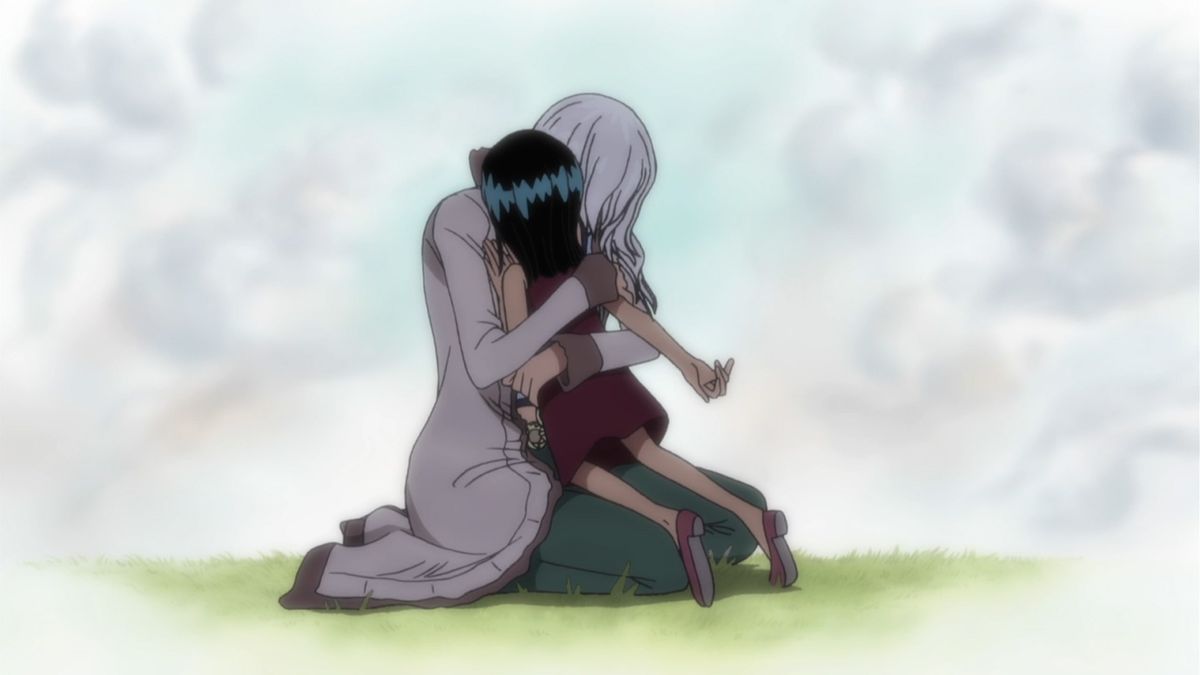
Robin and Olvia recognize each other just as the government removes any time for an ordinary reunion. Their embrace does not pause the operation. Cannon fire separates mother and daughter because the World Government treats family, scholarship, and memory as acceptable collateral when authority feels questioned.
Episode facts and production credits
Episode 277 aired in Japan on September 24, 2006. Hirohiko Kamisaka wrote the screenplay. Takahiro Imamura and Yoshihiro Ueda directed, Takeo Ide and Naoki Tate served as animation directors, and Miyuki Sato, Kumiko Fukuzawa, and Kunihiro Chida handled the art direction. The episode follows the scholars’ confrontation with the government and the opening bombardment of Ohara.
The production team has to balance historical explanation, family reunion, military scale, and immediate terror. The episode refuses to separate those jobs. Clover’s argument explains why ships arrived, while Robin’s face shows what official policy means when applied to one child.
Clover asks for the right to finish because evidence deserves a hearing
Professor Clover knows the government may kill him. He still asks to state the scholars’ conclusion. The request is not naïve faith in a fair court. He wants the record spoken where officials cannot later claim the researchers found nothing.
Speech becomes preservation. Even if the government destroys the notes, someone may remember the shape of the argument. Clover uses his remaining time to place responsibility where responsibility belongs.
The scholars reconstruct a civilization from fragments the government failed to erase
Ohara’s researchers compare Poneglyphs, archaeology, language, chronology, and material evidence. They do not receive one convenient document explaining the Void Century. Their conclusion comes from years of collective interpretation across damaged records.
That method matters because the government calls the work reckless while responding without a counterargument. Officials do not challenge a translation, date, artifact, or chain of reasoning. They challenge the scholars’ right to ask.
The ancient kingdom terrifies the government before Clover can say its name
Clover describes a powerful civilization whose ideas may threaten the current world order. The Five Elders order his death before he can finish naming the kingdom. Their timing becomes evidence inside the scene.
If Clover’s theory were nonsense, officials could let him speak and expose the weaknesses. Silencing the final word tells viewers that the name carries political force. The government confirms the importance of the scholarship through panic.
The Five Elders use distance to keep policy clean on their side of the call
The decision makers do not stand beneath falling shells. They communicate through Den Den Mushi and convert an island into a problem to be resolved. Administrative distance removes faces, smells, screams, books, homes, and children from the decision.
Distance does not reduce responsibility. The order travels through technology, ranks, and ships, but the choice remains attached to the people who authorize extermination after hearing the evidence.
Spandine turns cowardice into inherited government privilege
Spandine leads the operation with the same combination of fear, vanity, and institutional protection later seen in Spandam. Neither man needs exceptional courage or intelligence because the government lends them overwhelming force.
The family resemblance is political, not only comic. Authority passes through systems that reward obedience upward and cruelty downward. A weak official becomes dangerous when consequences always land on someone with less protection.
Olvia is arrested as proof before the government pretends the case was settled
Agents bring Olvia before the scholars because her capture connects the expedition to Ohara. The government uses her body as evidence of guilt while refusing any forum where motive, method, or findings could be examined honestly.
That is prosecution theater. The verdict existed before the arrest. Olvia’s presence gives officials an image they can use to justify the operation already moving into place.
Robin claims her mother when denial can no longer protect either of them
Robin recognizes Olvia and begs to stay with her. Olvia’s earlier attempt to hide the relationship collapses because separation no longer offers safety. The government has already targeted the island and the scholars.
The embrace is painful precisely because both people stop performing distance. Robin gets the truth she wanted, but receives almost no time to live inside the relationship. Recognition arrives beside imminent loss.
Olvia finally touches the child she tried to protect through absence
Olvia’s embrace cannot replace years away. The episode does not ask one emotional moment to settle every question about motherhood, work, secrecy, and abandonment. The touch confirms love while leaving the lost childhood visible.
That incompleteness feels honest. People can love each other deeply and still be harmed by choices made under political pressure. Reunion gives them truth, not enough time.
The bombardment separates Robin and Olvia because violence controls time
Cannon fire interrupts the reunion before mother and daughter can explain, apologize, remember, or plan. State violence steals more than bodies and buildings. Violence controls which conversations get to finish.
Robin carries that interruption for twenty years. At Enies Lobby, her resistance to hope comes from knowing how quickly a government operation can turn a possible future into smoke.
Civilian evacuation becomes part of the government’s performance of mercy
Officials separate scholars from other residents and present evacuation as evidence that the operation targets criminals carefully. The distinction helps the government protect its public image. Ordinary people may believe compliance will place them outside the punishment.
The promise is fragile because the same authority defining innocence can change the definition whenever convenient. Later violence against the evacuation ship exposes how little civilian status means once officials fear a scholar may have escaped.
Collective punishment makes neighbors police one another
Residents frightened by the Buster Call have reasons to distance themselves from the scholars. Government messaging encourages the belief that forbidden research brought destruction onto everyone else. Blame moves horizontally toward the targeted group instead of upward toward the people firing cannons.
That mechanism keeps institutions safe from public anger. If civilians blame researchers for provoking violence, officials never have to defend why questions about history deserved mass death.
The scholars choose books because books contain lives beyond their own
Researchers rush to save texts from the burning Tree of Knowledge. A viewer may want them to abandon everything and run. The scholars understand that the library holds work created across centuries, including voices already dead.
Their choice does not mean paper matters more than people. The books are one way people continue speaking. Saving them protects future access to language, evidence, memory, and the possibility that destruction will not achieve total silence.
Throwing books into the lake is desperate archival work
The scholars use the tools and time available. They cannot build a perfect fireproof repository during bombardment. They move volumes away from flames and trust water may preserve enough material for someone else to recover.
That labor rejects the government’s timeline. Officials expect destruction to finish the argument today. The scholars work for an unknown reader who may arrive years later and ask why a lake holds a library.
The Tree of Knowledge burns as a workplace, not a decorative symbol
Flames consume shelves, research stations, catalogs, architecture, and the physical order scholars used to locate information. The destruction targets infrastructure as much as individual books.
An archive without organization becomes harder to use even when fragments survive. The government attacks context because context lets facts connect into conclusions. One surviving page may matter, but a preserved collection can challenge an entire official story.
Saul returns to protect Robin after refusing the operation
Saul could flee while the island becomes chaos. He moves toward Robin because dissent without protection would leave the child carrying the cost of his moral awakening.
His choice gives practical meaning to conscience. Leaving the Marines was the beginning. Helping Robin escape requires him to oppose former colleagues with his body, rank knowledge, and remaining time.
Vice Admiral Saul proves the institution contains disagreement and suppresses the disagreement
Saul’s refusal prevents the Marines from being treated as one mind. Individuals inside the system can recognize criminal orders. The presence of dissent also removes the excuse that no alternative was imaginable.
The government answers his objection by treating him as a traitor. Institutions committed to violence often redefine conscience as disloyalty because moral debate threatens operational speed.
Kuzan’s presence complicates obedience before his final choice
Kuzan arrives as a Marine vice admiral connected to Saul and the Buster Call. Personal knowledge and institutional duty occupy the same battlefield. The episode begins setting up a decision that cannot remain theoretical.
Kuzan knows Saul is not a cartoon criminal. He knows the government authorized the operation. Any continued obedience must pass through facts visible in front of him, not ignorance.
The Buster Call distributes guilt across ten warships and thousands of tasks
Some people load shells, some aim, some relay orders, some guard prisoners, and some authorize targets. The scale makes personal responsibility feel smaller to each participant. Ohara still burns through the combined result.
“Following orders” describes a mechanism. The phrase does not erase choice. Every role deserves analysis according to power, knowledge, coercion, and action, but the institution depends on enough people deciding their fragment is not the whole crime.
Robin watches adults make her knowledge punishable before she can use the knowledge
At eight, Robin can read Poneglyphs. She has not led an army, overthrown a government, or exposed the ancient kingdom to the world. Officials punish potential before conduct.
That preemptive logic lets power call a child dangerous based on what she may someday understand. The government treats literacy as intent and survival as future rebellion.
The episode refuses the lie that neutrality could save Ohara
The scholars could not preserve the forbidden history while remaining neutral about its suppression. Civilians could not live on the island without entering the radius of government punishment. Saul could not obey the operation while remaining personally opposed.
Power closes the neutral space, then blames people for choosing sides. The useful question becomes who created conditions where research, residence, and compassion attract military violence.
The direction keeps Clover’s theory attached to immediate consequences
Takahiro Imamura and Yoshihiro Ueda do not present the Void Century explanation as a pause outside the drama. Officials react in real time, agents move, Robin searches for Olvia, and warships wait. Information changes the danger as the words are spoken.
That structure shows why history matters. Clover’s conclusion is not trivia for fans collecting lore. The conclusion explains the government’s behavior and the world Robin must survive.
The animation makes scale frightening without losing faces
Takeo Ide and Naoki Tate balance fleets, cannon fire, the Tree of Knowledge, crowds, agents, and intimate expressions. Scale could easily swallow Robin and Olvia. Their faces remain the emotional measure of every military image.
The art direction gives fire, smoke, stone, books, water, and ships distinct physical weight. Ohara feels occupied before destruction, which prevents the island from becoming an empty set built only to burn.
The Japanese performances make the reunion unfinished on purpose
Anzu Nagai’s young Robin reaches for Olvia with years of need compressed into a few words. Yuriko Yamaguchi gives Olvia love, urgency, guilt, and restraint without turning the mother into a speech about sacrifice.
Masane Tsukayama gives Clover authority grounded in scholarship rather than theatrical defiance. His voice remains focused on the historical argument even while officials prepare to kill him, which makes their panic look smaller.
Ohara survives first as a question the government cannot stop people from asking
The government can destroy the island and declare the scholars criminals. The extreme response creates another question: what information required this much force to suppress? Violence may hide evidence while making the absence suspicious.
Robin becomes the living route back to that question. Her survival means the operation cannot achieve the clean ending officials want, even when she spends years unable to share what she knows.
RaeRae verdict: the cannons expose who feared whom
Episode 277 shows scholars holding books while the World Government arrives with warships. Officials call Ohara dangerous, but the imbalance reveals the truth. The government fears an argument assembled from stones, languages, and patient human labor.
Robin and Olvia receive one embrace before cannon fire takes control of their time. Clover gets enough words to make the Five Elders interrupt him. The scholars get enough minutes to throw books toward a future reader. None of those acts defeats the Buster Call today. Every act keeps the government from owning the meaning of what happened, and that is why power tries so hard to erase them.