RaeRae Reacts · One Piece Episode 273
Gear Second Turns Luffy’s Body into a Rescue Decision
One Piece Episode 273 debuts Gear Second as Luffy accelerates his circulation, surpasses Soru, and accepts bodily risk to reach Robin in time.
Bottom line: Gear Second is brilliant because Luffy redesigns his rubber body, and frightening because his body pays for the redesign
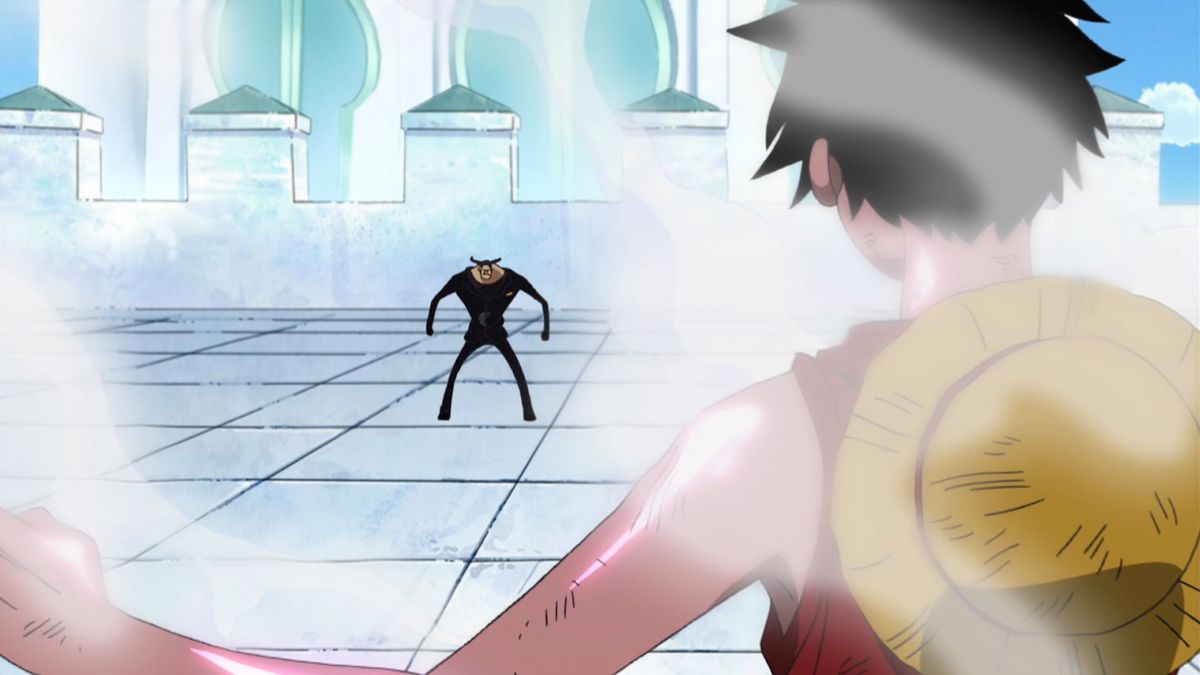
One Piece Episode 273 gives Luffy the speed and force needed to overwhelm Blueno. Steam rises from his body, his circulation accelerates, and attacks gain the “Jet” name because ordinary movement no longer describes what viewers are seeing. Blueno’s Soru cannot preserve the gap.
The transformation works because rubber physiology makes a dangerous process survivable. Survival does not mean harmlessness. Luffy converts his heart, blood vessels, and organs into part of a combat engine because protecting his friends feels worth the strain.
Water 7’s defeat created the problem Gear Second solves
CP9 moved faster than Luffy could reliably track and used Iron Body to absorb attacks that normally ended fights. Anger could not close that technical gap. He needed more speed, faster delivery, and enough force to break a trained defense.
Gear Second grows from admitting the old method was insufficient. Luffy rarely explains defeat in formal language, but his body shows that he studied what happened and refused to repeat the same limitation while Robin remained at risk.
Luffy treats rubber as physiology instead of a bag of stretchy tricks
Earlier techniques focused on extending limbs, storing tension, changing size, or using recoil. Gear Second asks what elasticity means for circulation. His legs act like pumps, driving blood faster through vessels that can expand without rupturing as quickly as an ordinary human body would.
The idea makes the Devil Fruit feel integrated into the whole person. Rubber is not a costume worn over normal anatomy. Every system inside him has adapted to the same impossible material property.
Steam gives viewers a visible sign of internal work
The body’s accelerated activity produces heat and a vapor-like effect across Luffy’s skin. The visual makes hidden physiology readable without stopping the fight for a medical lecture.
Good transformation design tells the audience what changed before dialogue supplies every detail. Steam suggests pressure, heat, speed, and a machine pushed beyond ordinary operation.
The stance matters because activation requires deliberate preparation
Luffy enters Gear Second through a specific low position and pumping action. The form does not arrive because emotion randomly unlocks a reserve. He chooses a process.
That deliberate activation gives him responsibility for the risk. He understands enough to initiate the method and has decided the current emergency justifies the strain.
Blueno’s Soru becomes readable once Luffy exceeds the speed
Six Powers looked supernatural when agents vanished from the crew’s vision in Water 7. Gear Second lets Luffy move fast enough to follow, intercept, and surpass the technique.
Speed changes perception as well as offense. The new form gives him time inside moments that previously belonged entirely to CP9. Blueno loses the informational advantage that made every exchange feel controlled.
Jet attacks are not merely old names with brighter animation
The acceleration changes how quickly force reaches the target and how little time Blueno has to brace. Luffy’s familiar attack language connects the new form to skills he already understands while marking a different output.
Continuity matters. Gear Second does not replace years of fighting with a separate personality. The technique amplifies a combat vocabulary built through earlier journeys.
Iron Body fails because defense has limits
Blueno’s strongest Iron Body variation represents confidence in trained durability. Jet Bazooka breaks through because Luffy has changed the force and speed reaching that defense.
No technique deserves permanent victory merely because an institution standardized the technique. A defense remains a physical choice with thresholds an adaptive opponent can test.
The fight reverses CP9’s emotional position from Water 7
Blueno once belonged to the group that overwhelmed the Straw Hats and made resistance look childish. On the courthouse roof, he has to process an opponent who returned with a solution beyond his expectations.
The reversal feels earned because the earlier humiliation remains visible inside Luffy’s method. Victory does not erase the loss. The loss became research.
Protecting friends supplies purpose, not immunity
The episode title connects Gear Second to Luffy’s desire to protect the crew. That motive explains why he accepts danger. Love cannot prevent heat, fatigue, organ strain, or the consequences of forcing circulation.
Stories become dishonest when noble intent cancels bodily cost. Luffy’s body does not know Robin deserves rescue and then suspend biology out of respect. His unusual biology gives him more room to take the risk.
Chopper would have questions about this technique
The crew’s doctor is fighting toward the courthouse while Luffy experiments alone. Chopper has no chance to assess the method before activation. That absence reflects the cost of Luffy’s head start.
A captain can own his body and still owe his crew information about a technique that may collapse him during a rescue. Autonomy and responsibility remain connected when other people depend on his survival.
Luffy’s self-sacrifice can become another form of unilateral protection
Robin tried to decide alone that surrendering herself would keep everyone safe. Luffy now decides alone that bodily strain is the price he will pay to protect the crew. Their motives mirror each other more than either person may recognize.
The difference is not that his sacrifice is automatically healthier. He has more physical leverage and a better chance to survive. Both friends need a version of care where risk becomes shared knowledge instead of a secret individual debt.
Gear Second turns urgency into measurable output
Luffy has spent the arc running because every delay moves Robin closer to irreversible custody. The new form makes that urgency physical. His circulation, temperature, movement, and attack speed all accelerate.
The transformation therefore fits the story rather than interrupting the story for a new toy. Enies Lobby compressed time, and Luffy changed his body to operate inside that compression.
Blueno becomes the test case rather than the final purpose
Defeating him matters because the courthouse route is blocked. Luffy did not invent Gear Second to settle a personal rivalry. Blueno is the first CP9 agent standing between him and Robin after the method becomes available.
That focus keeps the battle emotionally clean. The victory means movement, not status. Luffy needs the door open.
The technique exposes the gap between standardized training and personal invention
CP9’s Six Powers represent years of disciplined instruction across agents. Gear Second emerges from Luffy’s specific body, experiences, losses, and willingness to experiment. Another fighter cannot simply copy the pump and expect the same result.
Standard systems create consistency. Personal invention can exploit conditions the standard never anticipated. Enies Lobby built confidence around known categories of strength. Luffy arrives with a category still being created.
The power-up remains connected to labor performed by everyone else
Luffy has the rooftop and the visual transformation. The coalition crossed Aqua Laguna, opened gates, carried injured allies, broke through thousands of guards, and kept the courthouse reachable.
Gear Second solves one critical fight. The rescue remains collective. Celebrating the captain should not erase the people whose work gave him time and position to innovate.
The Jet Bazooka carries emotional memory without needing a speech
Bazooka is one of Luffy’s familiar finishing ideas. Adding Gear Second speed turns an old movement into the answer to a new level of defense. The attack remembers who he was while proving he changed.
That continuity gives the impact more weight than a completely unrelated technique would have. Growth expands identity instead of discarding identity.
Physical cost creates future tactical questions
If Gear Second drains stamina or strains the body, Luffy cannot maintain the form without limit. He will need to choose when activation matters, how quickly to finish a fight, and what condition remains afterward.
Those questions protect tension. A stronger form should open possibilities and create constraints. Otherwise every later obstacle becomes a simple request for permanent activation.
Munehisa Sakai’s direction makes the transformation feel like a threshold
Hirohiko Kamisaka’s screenplay has to explain enough physical change for the new form to make sense while preserving the speed of the Blueno fight. Munehisa Sakai’s direction uses stance, steam, disappearance, reaction, and impact to make the difference immediate.
Katsumi Ishizuka’s animation direction carries the velocity and force needed for Gear Second to feel beyond ordinary Luffy movement. Miyuki Sato and Michiyo Kawasaki’s art keeps the courthouse roof stable while the fighter crossing that space changes completely.
Episode 273 aired on July 30, 2006
The official One Piece record places Episode 273 one week after Luffy announced that his techniques would evolve. The episode belongs to the Enies Lobby arc and connects to manga Volume 40.
The official summary identifies steam rising from Luffy, Gear Second’s activation, speed beyond Soru, Jet Bazooka, and Blueno’s strongest Iron Body defense being shattered.
Where to watch One Piece Episode 273
Use the current licensed One Piece route available in your region, including Crunchyroll where Episode 273 is offered. Confirm the episode number and title because catalog coverage, subtitles, and dubs differ by country.
The official Japanese episode page provides the original title, broadcast date, summary, production credits, manga volume connection, and arc classification.
Faster circulation changes thought, reaction, and pain at once
Gear Second is usually discussed through movement speed, but faster blood flow supports the whole combat process. Luffy must see Blueno’s shift, decide on an angle, move, strike, and recover before the agent completes the next Six Powers technique. The form compresses that chain.
Greater output can also make warning signs harder to notice during adrenaline. Heat, strain, and fatigue may arrive after the form ends, when the immediate opponent is gone and the body no longer has an emergency to organize around.
The transformation asks how much future health belongs to the present emergency
Robin needs help now. Luffy’s body must continue carrying him through future seas, future fights, and the ordinary days his crew expects to share. Gear Second places those timelines in tension.
No clean calculation exists because refusing the technique may lose Robin, while careless repetition may shorten his ability to protect anyone later. Leadership includes choosing under that uncertainty and accepting that friends may challenge the choice afterward.
Blueno cannot adapt quickly because institutional confidence delayed curiosity
He sees Luffy activate an unfamiliar state and initially evaluates the change through the categories CP9 already knows. The delay is small, but Gear Second operates inside small delays. By the time Blueno understands the new speed, Luffy has changed the rhythm of the fight.
Elite training can encourage curiosity or suppress curiosity. CP9’s confidence in standardized superiority makes an improvised rubber-body technique easier to underestimate during the first crucial exchange.
The victory changes what CP9 must believe about the crew
Water 7 allowed the agents to treat the Straw Hats as emotional amateurs who could be overwhelmed and left behind. Blueno’s defeat removes that comfortable assessment. The crew did not merely arrive with more determination. At least one fighter arrived technically transformed.
That information will travel through the remaining battles. Every CP9 agent now has reason to consider that the opponents below may also carry new tools, refined techniques, and lessons learned from the first loss.
Luffy’s body keeps a record even when he refuses to discuss the record
He often moves past injury with food, sleep, laughter, and another adventure. Scars, exhaustion, shortened recovery, and the need for Chopper’s care still accumulate. The body remembers choices the captain may not want to narrate.
Gear Second adds a repeatable form of strain to that history. A technique can remain worth using and still require honest tracking. Treating consequences as weakness would make the crew less prepared, not more heroic.
RaeRae verdict: Gear Second earns the hype because innovation, love, and danger arrive in the same body
Episode 273 gives Luffy a transformation that answers the exact failure CP9 exposed. He studies speed, defense, and his own rubber physiology, then builds a method Blueno’s training cannot immediately contain. Jet Bazooka feels like payoff rather than a gift.
I will cheer the steam and still worry about the organs underneath. Luffy protects his friends by making his body do more than his body did yesterday. That choice is brave, intelligent, and dangerously familiar in a crew where people keep trying to carry everyone alone.