RaeRae Reacts · One Piece Episode 268
Nami’s Lightning Proves the Crew Gets Stronger by Becoming More Specific
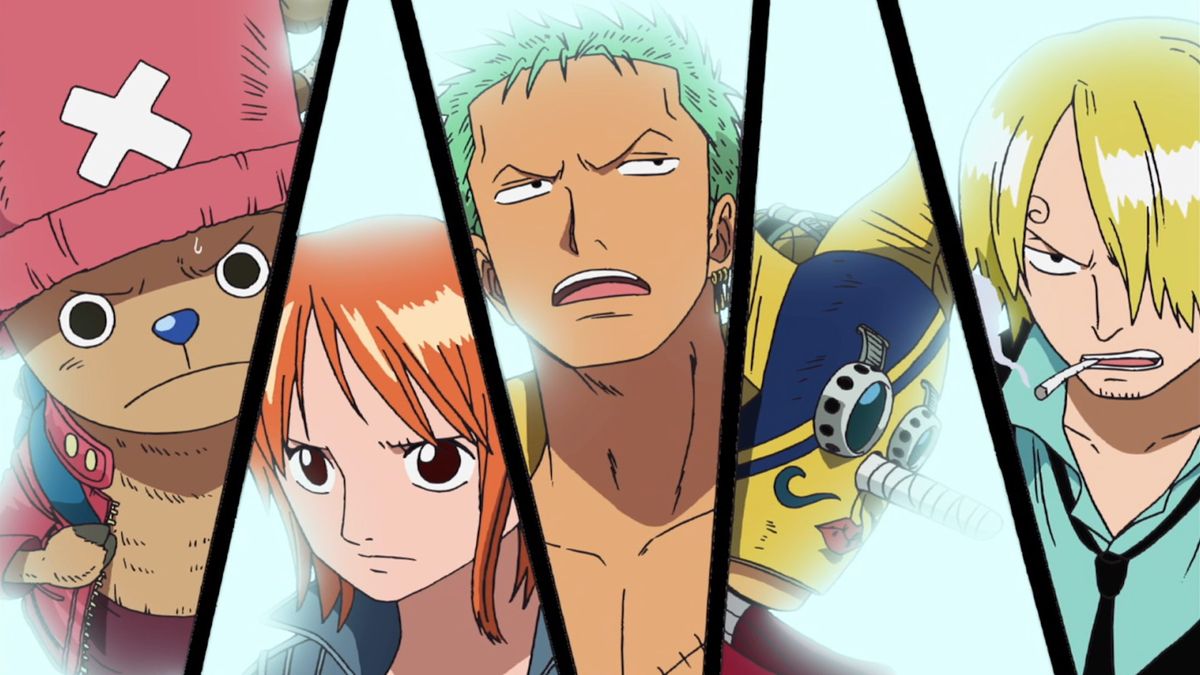
One Piece Episode 268 lets Zoro, Sanji, Nami, Chopper, and Sogeking combine distinct skills after Rocketman’s crash and chase Luffy deeper into Enies Lobby.
Bottom line: Episode 268 works because the Straw Hats do not become five versions of Luffy
One Piece Episode 268 puts Zoro, Sanji, Nami, Chopper, and Sogeking on Enies Lobby after Rocketman’s crash and sends them chasing a captain who already ran ahead. Guards surround the landing area. Each crew member answers through a different body, profession, weapon, and emotional rhythm.
Nami’s completed Clima-Tact steals the episode because her Thunderbolt Tempo clears a huge section of the battlefield without asking her to imitate the crew’s strongest physical fighters. The rescue advances when difference becomes coordination, not when everyone pretends courage has one shape.
Rocketman delivers the crew in the least graceful way possible
The train’s airborne entry gets everyone past the barrier and leaves them inside a crash site full of guards, debris, confusion, and injured allies. The solution creates the next problem immediately. That consequence keeps the spectacle honest.
Arrival is not victory. The crew must regain footing, identify the route, protect the coalition, and catch Luffy before he reaches a defense he cannot handle alone. Emergency transportation bought access, not control.
Zoro clears space through disciplined force
Zoro meets the guard crowd as a swordsman who has trained his body and technique for direct confrontation. His attacks create lanes through numbers that could pin slower fighters around Rocketman. The job suits him, so the crew lets him do the job.
His strength does not make navigation or rescue planning unnecessary. Zoro can cut through a line and still get lost on a hallway. The joke remains funny because competence and incompetence coexist inside the same person.
Sanji turns movement into protection
Sanji’s kicks remove immediate threats while keeping his hands available for the craft he refuses to compromise. He reads bodies, positions, and danger quickly enough to protect weaker allies without waiting for a formal assignment.
That protective instinct can become controlling when he assumes women need decisions made for them. Robin’s rescue requires a better version of care: create room, absorb danger, and let Robin speak for herself when the crew reaches her.
Nami’s completed Clima-Tact proves invention can change who controls a battlefield
Nami does not have Luffy’s endurance, Zoro’s swords, or Sanji’s legs. Usopp built the Clima-Tact around her weather knowledge and performance skills. The completed version turns those abilities into a weapon capable of changing conditions across a wide area.
Thunderbolt Tempo is not borrowed strength. Nami understands temperature, moisture, timing, charge, and how opponents read a seemingly fragile woman. Technology extends expertise she already earned through navigation.
The lightning strike is spectacle with a tactical job
The attack chars a broad group of guards and prevents the crew from spending time on individual fights. Nami’s contribution changes the resource math. One weather-based action preserves physical energy for the deeper island.
Large attacks become meaningful when they alter choices. The crew can stop defending the crash perimeter and start chasing Luffy. The lightning does not exist only for a bright frame.
Usopp’s engineering remains present even while Sogeking holds the weapon
The Clima-Tact carries Usopp’s ability to build strange tools around another person’s habits. He did not give Nami a generic gun or ask her to fight like him. He designed a system that rewards her intelligence and theatrical confidence.
Sogeking’s mask complicates the credit because Usopp is hiding from the crew conflict while his work supports their survival. The disguise cannot erase his place in the team. Every successful weather attack quietly proves that his usefulness was never limited to physical power.
Chopper brings transformation and medical responsibility into the breach
Chopper can switch forms to meet different physical needs, which makes him unusually adaptable inside a crowd. He also has to watch the bodies around him for injuries Rocketman’s landing and the ongoing fight may hide.
That double role creates pressure. A doctor entering combat cannot spend every ounce of strength as though treatment will happen by magic later. Chopper’s decisions must preserve enough judgment and energy for the people who will need him after the adrenaline drops.
Sogeking contributes distance inside a crew built around close combat
Zoro, Sanji, and Chopper can engage guards directly. Sogeking watches farther routes, targets threats before they reach the group, and uses tools where a fist or blade cannot reach. Enies Lobby’s bridges and towers make that distance more valuable.
Usopp once interpreted physical weakness as evidence that the crew might discard him. The island keeps proving that a team designed only around close-range strength would have fewer answers.
The crew is chasing Luffy and Robin at the same time
Robin remains the mission’s reason. Luffy’s head start creates a second urgent target because the captain can turn one rescue into several emergencies. The crew must close the gap without losing sight of why he ran.
That frustration is part of loving him. They trust his judgment about Robin and distrust his ability to wait for support. Real loyalty includes knowing exactly which problem a person will create.
Luffy’s advance pulls the crew forward without organizing them
His refusal to stop gives everyone a clear direction. The crew knows he will keep moving toward Robin until an opponent physically prevents him. That predictability helps them follow even when the route is chaotic.
Direction is not management. Nami, Zoro, Sanji, Chopper, and Sogeking still have to decide who clears guards, who reads the terrain, who protects support members, and how quickly they can leave the crash site.
Teamwork does not require a group attack every time
The crew contributes through parallel actions that support one objective. Zoro and Sanji clear immediate bodies. Nami changes the whole field. Chopper adapts between strength and care. Sogeking covers distance. The sequence feels coordinated even without a rehearsed combination.
That model fits a crew built through separate dreams and professions. They are not soldiers trained into identical movement. They trust each person to notice the job suited to them.
Nami’s power-up also carries the history of the crew’s conflict
Usopp improved the Clima-Tact during a period when he felt useless and left the crew. The weapon’s success sits beside that unresolved hurt. His engineering remains essential even while he doubts his own place.
The emotional irony is sharp. Nami can clear a battlefield because Usopp understood her abilities well enough to build for them. He gave another crewmate a tool that respects her identity while fearing the crew no longer respected his.
Enies Lobby’s ordinary guards keep paying for CP9’s protected position
The five Straw Hats fight personnel stationed between the landing and the Tower of Justice. CP9 waits deeper inside with Robin and Franky. The institution places layers of lower-ranked bodies between elite agents and consequence.
Every cleared crowd exposes that hierarchy. Guards face lightning, blades, kicks, transformations, and projectiles because officials decided a coerced prisoner must remain beyond challenge. Rank determines who absorbs the first cost.
The completed Clima-Tact changes how enemies read Nami
Opponents often see a lightly built navigator carrying a decorative staff and assume she belongs behind the real fighters. Nami uses that expectation as part of her timing. By the time the field recognizes a weather system, the attack is already formed.
Her femininity does not need to disappear for competence to become believable. She can care about money, appearance, fear, navigation, and survival while controlling lightning. A rounded woman does not have to trade personality for power.
The episode lets preparation pay off publicly
Power-ups can feel cheap when a character produces a perfect answer without prior labor. The Clima-Tact has a history of experiments, jokes, failures, misunderstanding, and Nami learning how to turn weather effects into combat.
The completed version feels satisfying because improvement grew from repeated use and collaboration. Usopp changed the tool. Nami still has to understand the conditions and perform the technique under pressure.
The crew’s five-person run visually restores a damaged family
Robin has been taken, Luffy is ahead, and Usopp remains behind the Sogeking identity. The group running together is incomplete and emotionally complicated. The image still shows people choosing the same direction after Water 7 nearly split them apart.
Restoration does not mean pretending the conflict vanished. The Going Merry decision, Usopp’s apology, and Robin’s own answer remain unresolved. Shared action keeps the relationships alive long enough for honest repair later.
Hiroaki Miyamoto’s direction gives each skill a clear job
Hirohiko Kamisaka’s screenplay moves the five Straw Hats from Rocketman’s landing into a coordinated advance. Hiroaki Miyamoto’s direction gives Zoro, Sanji, Nami, Chopper, and Sogeking separate beats without letting the episode feel like five disconnected demonstrations.
Kazuya Hisada’s animation direction supports the crowd action and Nami’s wide-area lightning. Miho Shiraishi and Miyuki Sato’s art keeps the plaza and onward route readable so the visual power translates into actual progress.
Episode 268 aired on June 25, 2006
The official One Piece record places Episode 268 one week after Rocketman’s flight. The episode belongs to the Enies Lobby arc and connects to manga Volume 40.
The official summary highlights Zoro and Sanji defeating guards after leaving Rocketman, Nami using the completed Clima-Tact and upgraded Thunderbolt Tempo, and the five Straw Hats running after Luffy.
Where to watch One Piece Episode 268
Use the current licensed One Piece route available in your region, including Crunchyroll where Episode 268 is offered. Check the episode number and title because catalog coverage, subtitles, and dubs differ by country.
The official Japanese episode page provides the original title, broadcast date, summary, production credits, manga volume connection, and arc classification.
Wide-area power creates a responsibility problem Nami understands
Thunderbolt Tempo does not distinguish targets through friendship. Nami has to read where allies stand, how the charge will spread, and whether the attack will block the route she intends to open. More range means more responsibility for placement.
Her navigation background prepares her for that burden. Navigators already make decisions where wind, water, distance, and timing can injure the whole crew. The completed Clima-Tact moves the same judgment from the deck into combat.
The crew saves energy because CP9 remains the real physical test
Ordinary guards can drain the group before the elite agents appear. Nami’s lightning clears space quickly, while Zoro and Sanji avoid turning every defender into a prolonged duel. The crew must preserve strength for opponents whose abilities already overwhelmed them in Water 7.
Resource management gives the crowd battle purpose. Winning the plaza too expensively would serve Enies Lobby’s design. The government can replace guards more easily than Chopper can replace the crew’s stamina.
Sogeking’s presence keeps Usopp’s conflict visible inside a triumphant moment
The mask lets the rescue continue, but the mask also reminds viewers that Water 7 damaged the crew. Every group shot contains a friend who believes he needs a fictional identity to stand beside them. That pain does not disappear because his tools work.
Usopp’s eventual return must honor both sides of the conflict. Luffy cannot treat captaincy as meaningless, and Usopp cannot use grief to avoid accountability forever. Episode 268 lets loyalty act before pride is ready to speak.
Following Luffy requires trust without surrendering judgment
The five run because they believe he is moving toward Robin and will not abandon her. They do not assume every decision he made on the route was sensible. Nami can call him an idiot while dedicating every skill she has to reaching him.
That combination protects the crew from blind obedience. Trust names the shared moral destination. Judgment remains available for tactics, safety, and the arguments that will come after everybody survives.
RaeRae verdict: Nami’s lightning proves the crew gets stronger by becoming more specific
Episode 268 could have made the landing a generic crowd fight. Instead, the crew separates the work according to actual strengths. Zoro cuts, Sanji kicks, Chopper adapts, Sogeking covers distance, and Nami turns weather knowledge plus Usopp’s engineering into one clean battlefield shift.
The result sounds obvious, but action stories often confuse teamwork with everybody gaining the same kind of destructive power. The Straw Hats remain strange specialists carrying unresolved feelings in the same direction. Robin needs that whole difficult crew, not five copies of the captain already causing trouble ahead.