RaeRae Reacts · One Piece Episode 266
Oimo and Kashii Turn the Gate into a Labor Problem
One Piece Episode 266 pits the coalition against giant gatekeepers and reveals how Enies Lobby combines weaponized bodies, layered architecture, and elite CP9 power.
Bottom line: Oimo and Kashii turn the second gate into a labor problem the coalition cannot solve through swagger
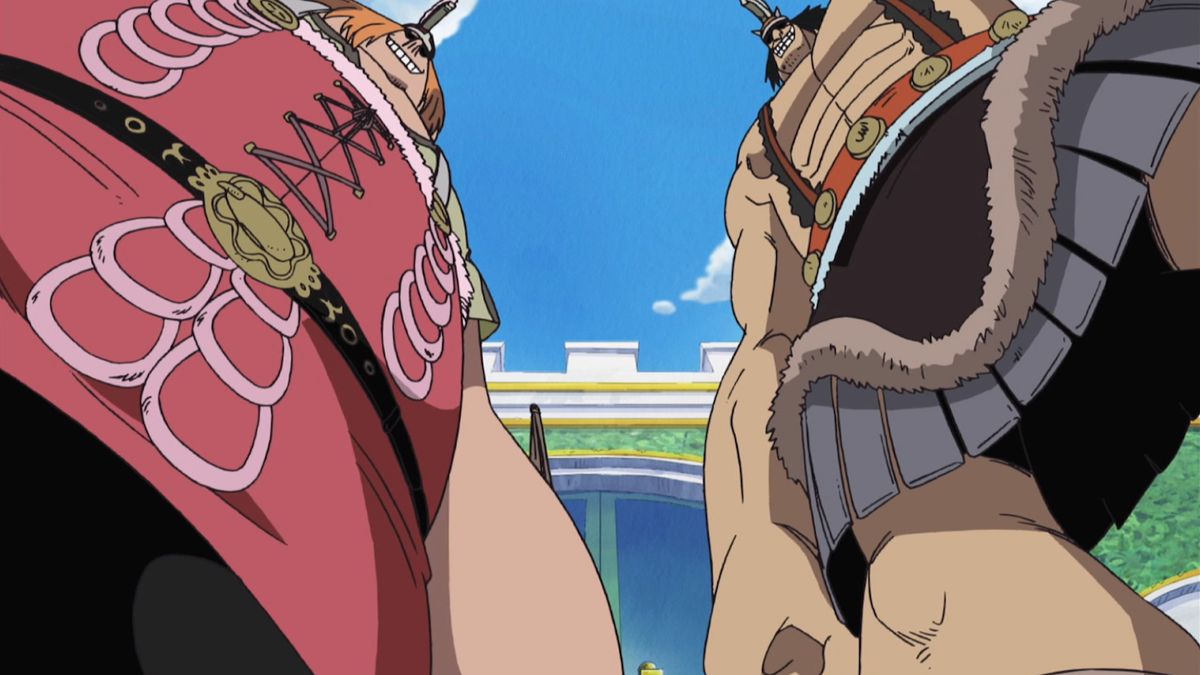
One Piece Episode 266 introduces two giant gatekeepers who flatten the Franky Family’s strongest men almost immediately. The point is not that the rescue coalition suddenly became weak. Enies Lobby assigned bodies of extraordinary size to hold one narrow route, and every person behind the gate depends on somebody finding a practical answer.
The episode also gathers all eight CP9 agents inside the Tower of Justice. One front shows ordinary allies struggling against weaponized scale. The other shows elite government power assembling around Robin and Franky. Rescue has reached the island, but reaching the island was never the same as controlling the battlefield.
The giant gatekeepers make Enies Lobby’s architecture feel staffed rather than decorative
A huge gate means little if ordinary defenders cannot hold the opening. Oimo and Kashii give the structure living force. Their bodies match the government’s monumental design, so the coalition cannot treat the entrance like another door waiting for Paulie’s ropes or a few strong shoulders.
That pairing of architecture and labor matters. Institutions do not operate through stone alone. Somebody guards the gate, follows the schedule, accepts the story told by superiors, and uses physical power to keep outsiders away.
The Mighty Destroyers learn that a useful reputation still has limits
The Franky Family brings the Mighty Destroyers forward as a major source of strength. Their confidence makes sense inside the scale of Water 7 street fights and demolition work. Oimo and Kashii change the scale in one blow.
I like that the episode lets capable people fail without turning them into frauds. Strength works within circumstances. A crew that refuses to revise after meeting a larger force becomes foolish. The coalition survives by accepting new information quickly.
King Bull becomes the answer because mobility can beat a bad strength contest
When the first heavy fighters cannot overpower the giants, King Bull arrives in land mode. The rescue shifts from matching bodies directly to using transport, momentum, positioning, and coordination. That change respects the problem instead of pretending determination adds unlimited muscle.
One Piece regularly makes vehicles part of the cast’s practical intelligence. King Bull is not glamorous beside swords and Devil Fruit attacks. The animal gives the coalition a way to move weight and people through ground designed to stall them.
Oimo and Kashii are people before they are obstacles
The camera first presents the giants through the danger they pose, but their size should not erase their personhood. They have names, a shared history, loyalty, and reasons for standing at Enies Lobby. Government service did not grow naturally from their bodies.
That distinction becomes important as the arc reveals more about how officials secured their obedience. A giant is not a siege engine born for somebody else’s gate. The institution benefits when outsiders see only the weapon and never ask who gave the order or what story made the guard stay.
The government knows how to exploit loyalty without respecting loyalty
Oimo and Kashii’s connection to Dorry and Brogy will expose one of Enies Lobby’s ugliest recruitment methods. Officials use the giants’ devotion to their captains, then turn that devotion into decades of labor. The institution understands the emotional bond well enough to manipulate the bond.
That pattern mirrors Robin’s coerced agreement. The government threatens people she loves because her loyalty is real. Exploitation works by finding something human and converting that human attachment into control.
The coalition cannot know every hidden history before the fight starts
At the second gate, most rescuers see two enormous defenders trying to stop them. They do not have time for a complete investigation while friends are being transferred deeper inside. The immediate response must protect the route.
Good intentions do not grant perfect information. The ethical test becomes whether the coalition can change course when new facts appear. Fighting a guard to survive the moment differs from refusing to recognize the guard’s coercion after the truth becomes available.
CP9’s full assembly creates a colder kind of scale
Oimo and Kashii dominate through visible size. CP9 dominates through training, secrecy, state permission, and the knowledge that eight specialists can divide the Straw Hats into separate crises. The Tower of Justice concentrates that threat around two prisoners.
The agents do not need a crowd to look dangerous because Water 7 already showed what a few members could do. Seeing the full unit confirms that the crew has not yet met the complete force assigned to Robin and Franky.
Robin is surrounded by people who call coercion procedure
Inside the tower, officials can describe the transfer as an orderly process. The guards at the gates make that order possible by preventing anyone from reaching the person whose consent was manufactured through threats.
The episode’s split geography connects those layers. A lie told in a secure room depends on bodies outside taking hits to protect the room. Administrative violence and physical violence belong to the same operation.
Franky understands what government interest does to inherited knowledge
Franky carries Pluton’s blueprints because Tom’s workers accepted responsibility for keeping a countermeasure available if an ancient weapon returned. CP9 reduces that history to possession. Their mission treats him as a container they can open through force.
His capture stands beside Robin’s because both characters inherited dangerous knowledge through communities the government punished. Neither person created the old history. Both are expected to surrender control of what the history means.
Luffy remains ahead while everybody else pays attention to the route
Luffy’s solo charge keeps pulling ordinary guards toward the main island. The coalition cannot copy his path because Rocketman, support members, and fighters with different bodies still need the gate. His advance and their delay are two pieces of the same rescue.
The contrast makes his leadership look both inspiring and difficult. He gives the mission moral speed. His allies give the mission enough structure to survive his speed.
Paulie’s ropes turn size into a question of balance
A giant may be too heavy to defeat through direct impact, but height creates leverage and balance problems. Paulie’s working knowledge lets him look for lines, anchors, and angles. The episode keeps building fights from professions rather than assigning everyone the same kind of power.
That variety makes the coalition feel earned. Galley-La did not travel to Enies Lobby to imitate pirates. The shipwrights brought the skills they already used to control weight, rigging, and dangerous structures.
The Franky Family’s loyalty survives public humiliation
The Mighty Destroyers go down hard, and the moment could fracture a group built around loud confidence. Instead, the family keeps moving because rescuing Franky matters more than protecting a reputation.
That shift is emotional growth without a speech about growth. People who once performed toughness for status accept being outmatched and continue contributing. Loyalty becomes stronger when pride stops controlling every decision.
King Bull’s land form makes absurdity practical
A giant sea creature switching into land travel sounds like a gag, and One Piece enjoys the visual. The transformation also solves a real transportation problem. Comedy and utility occupy the same moment.
RaeRae humor works best this way. The funny detail belongs to the world, the character, and the job. The story does not interrupt Robin’s danger for a joke that leaves everyone less believable.
The Tower of Justice name does not prove justice happens inside
Government language tries to settle moral questions before anyone enters the room. Calling the building a Tower of Justice tells workers and citizens how to interpret the actions happening there. Robin’s experience gives viewers reason to reject the label.
A fair institution would provide evidence, defense, independent judgment, and protection from coercion. CP9 used infiltration, assassination plans, threats, and secret power to deliver Robin. The building’s title cannot repair the route.
Eight CP9 agents show how specialized violence becomes an organization
Each agent brings different abilities, habits, and levels of discipline. Together they form a unit capable of surveillance, infiltration, capture, assassination, and battlefield response. Specialization makes the group more effective than eight interchangeable fighters.
The Straw Hats understand that principle too. Their difference is purpose and consent. Crew members chose a relationship and argue inside that relationship. CP9 specializes under a chain of command that treats people as assignments.
The episode refuses to let the invasion become one straight victory march
Luffy’s early progress could have made Enies Lobby look too easy. Oimo, Kashii, and the full CP9 lineup restore the scale of opposition without erasing what the coalition already accomplished.
Progress meets a new problem because that rhythm resembles real work. Opening one gate reveals the next gate. Reaching one institution reveals the people and procedures maintaining the institution.
Yoko Ikeda’s direction balances two forms of threat
Hirohiko Kamisaka’s screenplay moves between the loud gate struggle and the controlled gathering inside the Tower of Justice. Yoko Ikeda’s direction lets Oimo and Kashii feel physically overwhelming while allowing CP9’s stillness to feel equally dangerous.
Noboru Koizumi’s animation direction supports the size contrast and King Bull’s movement. Miyuki Sato and Kunihiro Chida’s art makes the second gate, main island, and tower feel like connected layers of one defended system.
Episode 266 aired on June 11, 2006
The official One Piece record places Episode 266 one week after Luffy’s rapid advance. The episode adapts material connected to manga Volume 40 and belongs to the Enies Lobby anime arc.
The official summary emphasizes the Mighty Destroyers falling to Oimo and Kashii, King Bull arriving in land mode, and all eight CP9 members assembling inside the Tower of Justice. Those details define the episode’s two-front pressure.
Where to watch One Piece Episode 266
Use the current licensed One Piece route available in your region, including Crunchyroll where Episode 266 is offered. Verify the episode number and title because catalogs and language options differ by country.
The official Japanese episode page provides the original title, broadcast date, summary, credits, manga volume connection, and arc classification.
Size changes the rescue’s resource math
Every plan at the gate depends on weight, distance, available rope, stable anchors, and how much force King Bull can produce without injuring riders. Oimo and Kashii make those limits visible. The coalition cannot pull an infinite supply of strength from enthusiasm.
That resource math grounds the fantasy. Large bodies require space and leverage. Transport can fail. Workers tire. A plan becomes convincing when the story respects those constraints and lets characters combine tools rather than discover convenient power because the scene needs an exit.
The giants show how long service can normalize a false story
Oimo and Kashii have guarded Enies Lobby for years under an arrangement connected to their missing captains. Repetition can make the assignment feel permanent even when the original reason was manipulated. Daily labor builds habits around a lie.
The government benefits from that passage of time. New officials can inherit the arrangement without personally inventing the deception, then call the result tradition or duty. Institutional wrongdoing survives when each person treats the existing setup as somebody else’s moral responsibility.
The coalition’s ability to learn will matter more than its first impression
The rescuers initially understand Oimo and Kashii as defenders who must be moved. Later information can change that relationship if people remain willing to listen. A group committed only to winning would ignore the giants once the gate opened.
Robin’s rescue asks for a deeper habit: notice when authority has coerced or deceived somebody, even when that person stood on the opposing side. The same moral attention that recognizes Robin’s false consent must remain available for workers trapped inside Enies Lobby’s lies.
RaeRae verdict: the second gate proves that rescue needs workers who can rethink the problem
Episode 266 interrupts the easy fantasy that enough courage turns every barrier into the same fight. The Mighty Destroyers meet bodies they cannot overpower. Paulie, King Bull, and the coalition have to use balance, transport, and coordination instead.
Oimo and Kashii also deserve to become more than giant-shaped obstacles. Their loyalty has been turned into government labor through manipulation, just as Robin’s love for the crew was turned into compliance. Enies Lobby keeps calling that control justice. The rescue keeps exposing the people buried under the label.